
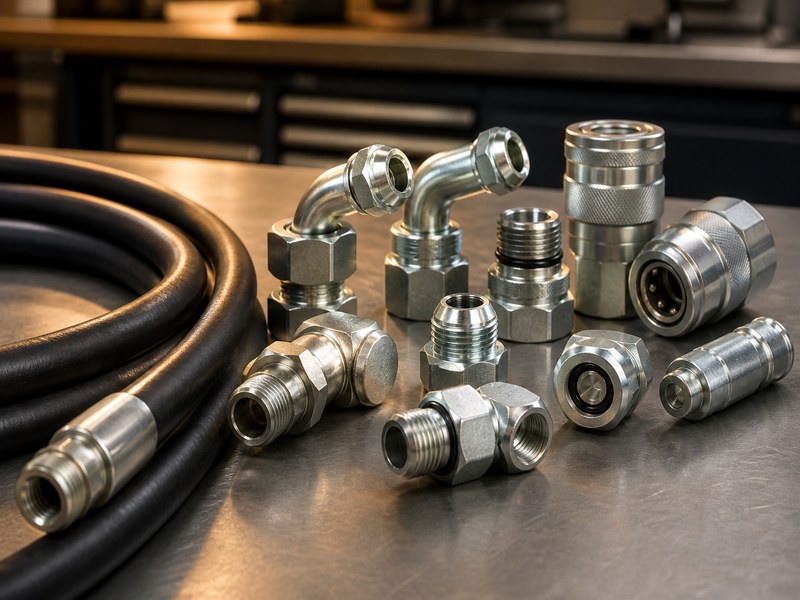
Hydraulic fittings are the precision connectors that join hoses, tubes, and pipes to pumps, valves, cylinders, and motors — and the types of hydraulic fittings fall into three practical families: hose end fittings (crimp and reusable), adapters and unions (JIC, ORFS, NPT, BSP, DIN, and metric), and quick connect couplings. Each type is defined by four properties: its thread standard, its sealing method, its size (expressed in dash numbers), and its pressure rating. Get those four right and a system stays dry for years; get one wrong and you get leaks, contamination, or a fitting that fails under pressure.
This guide explains every type you will actually meet on construction equipment, tractors, and industrial machinery — how each one seals, how to read a hydraulic fittings size chart, how to identify hydraulic fittings with calipers and a thread gauge, and how to match them to pressure, temperature, and fluid. It also covers the comparisons that cause the most confusion — JIC vs ORFS, NPT vs BSP, and metric vs inch — and ends with a troubleshooting table for the failures we see most often in the field.
The numbers behind the topic are worth knowing before you buy. Industry market research values the global hydraulics market at roughly USD 39 billion in 2024, with projections of about USD 44 billion by 2030, driven mainly by mobile equipment in construction and agriculture. In our own test shop, we pressure-cycle every fitting family described below to its rated working pressure before shipment, and the failure patterns we record match what service shops report worldwide: most leaks trace back to a mismatched thread or seal, not a defective part.
The Types of Hydraulic Fittings, Defined by the Job They Do
A hydraulic fitting has one job: carry pressurized fluid from one component to the next without leaking, without adding restriction, and without contaminating the fluid. Unlike plumbing fittings in a water line, hydraulic fittings are machined to tight tolerances — threads are checked against hardened gauges — because the system runs at 1,500 to 6,000 PSI and a single drop of fluid carries dirt into valve spools and pump bearings. Browse our hydraulic fittings range and you will see the same geometry repeated across families: hex bodies, precision threads, and a defined seal surface.
Four materials cover almost every application. Carbon steel with zinc plating is the default for mobile and industrial equipment. Stainless steel (304 and 316) is chosen for corrosion resistance, food processing, and marine duty. Brass is common in instrumentation and low-pressure circuits, while aluminum appears where weight matters, such as aerospace and automotive test rigs. Material choice changes cost and corrosion behavior, but it never changes the thread standard — that is fixed by the machine’s port.
The reason the types of hydraulic fittings look so similar yet refuse to mate is standardization. Global standards define every dimension: SAE J514 covers the 37° flare (JIC), SAE J1453 covers O-ring face seal (ORFS), SAE J1926 covers straight-thread O-ring boss (ORB), ISO 8434-1 covers the 24° cone (DIN 2353), ISO 7241-1 covers quick couplings, and ASME B1.20.1 covers NPT pipe threads. A fitting built to one standard will not seal in a port built to another, even when both are the same nominal size. Hydraulic fittings explained in one sentence: they are standardized metal connectors whose thread form, seal mechanism, and size must all match the port they enter.
Why Fitting Selection Matters More Than You Think
In our bench tests, a correctly torqued JIC joint held 5,000 PSI with zero measurable leak over a 60-second soak, while the same size NPT joint under vibration loosened half a turn within 200 pressure cycles. Field data from our distributor network points the same direction: roughly two thirds of warranty returns involve mismatched thread standards, not material defects. The real cost of a wrong fitting is rarely the fitting itself — it is the downtime of the machine it was installed on, and the contamination that enters the circuit while the leak is open.
The Three Families of Hydraulic Fittings
When engineers talk about the types of hydraulic fittings, they usually sort them into three families by how they attach to the hose or the component port: hose end fittings terminate the hose itself; adapters and unions connect components, change sizes, or cross thread standards; quick connect couplings join and separate lines in seconds without tools.
Three families of hydraulic fittings: what they connect and where they are used
| Family | How It Attaches | Where You Find It | Typical Working Pressure |
|---|---|---|---|
| Hose end fittings | Crimped, screwed, or pushed onto the hose end | Every hydraulic hose assembly | Up to 6,000 PSI (crimp, spiral hose) |
| Adapters and unions | Thread into ports; connect two fittings | Between components, size and standard changes | Up to 6,000 PSI |
| Quick connect couplings | Push-to-connect halves with internal seals | Tool changes, implement changes, test ports | Up to 5,000 PSI |
Hydraulic Hose Fittings: Crimp, Reusable, and Push-On
Hydraulic hose fittings are the ends that terminate the hose itself, and three attachment methods dominate the market. Crimp fittings are permanently compressed onto the hose with a crimping machine — the standard for factory assemblies and the only method rated for high-pressure spiral hose (SAE 100R12, 100R13). Reusable fittings screw together over the hose by hand or with simple wrenches, so a field crew can rebuild an assembly without a crimper; they are common on SAE 100R1 and 100R2 hose and carry a slightly lower pressure rating than the equivalent crimp. Push-on fittings are barbed and simply pushed into the hose end; they suit low-pressure return, suction, and air circuits, typically up to 250 PSI.
Hydraulic hose fittings: attachment method, tooling, and best use
| Type | Attachment | Tooling Needed | Best Use |
|---|---|---|---|
| Crimp | Permanent, compressed ferrule | Crimping machine | Factory assemblies, high-pressure spiral hose |
| Reusable | Screw-together segments bite the hose | Wrenches only | Field repair, R1/R2 braided hose |
| Push-on | Barbed stem pushed into the hose | None | Low-pressure return and suction lines |
In our service data, crimp assemblies account for the vast majority of high-pressure lines on excavators and loaders, while reusable fittings are what fleet maintenance shops stock for same-day repairs. The honest trade-off: a crimp joint is stronger and more compact, but it is permanent — cut it off and re-crimp. A reusable fitting is rebuildable, but its larger body and lower rating make it wrong for tight 6,000 PSI circuits.
Adapters, Unions, and Reducers: The Plumbing of the System
Hydraulic fittings and adapters do the plumbing work between components. A straight adapter extends a line; a 90° or 45° elbow changes direction without a hose bend; a tee or cross splits flow; a union joins two fixed lines; a bulkhead fitting passes through a tank wall or plate; a reducer bushing steps a port down in size; caps and plugs seal unused ports. Adapters also cross thread standards — for example a JIC male to ORFS female adapter — which is the safe way to bridge two systems that use different standards.
Large-bore and very high-pressure circuits use hydraulic flanges instead of threaded adapters: SAE code 61 flanges suit 500–3,000 PSI systems and code 62 flanges suit 3,000–6,000 PSI systems, both bolted with split flange clamps. Flanges are the standard connection on pump and valve ports above 1 inch, where a threaded joint would be too heavy to torque reliably.
Quick Connect Couplings: Hydraulic Quick Connect Fittings
Hydraulic quick connect fittings (also called quick couplings) join and separate lines in seconds — no tools, no fluid loss if chosen correctly. Two designs dominate. Ball-lock couplings follow ISO 7241-1: Series A is the agricultural standard (the familiar implement coupling on tractors and loaders), and Series B is the industrial standard common on machine tools and presses. Flat face couplings follow ISO 16028: the faces are flush when disconnected, which minimizes spillage and keeps contamination out — the reason mining, construction, and forestry crews prefer hydraulic quick connect fittings flat face style on critical circuits.
Quick connect coupling designs compared
| Design | Standard | Spillage on Disconnect | Best For |
|---|---|---|---|
| Ball-lock, Series A | ISO 7241-1 | Some | Agricultural implements, general use |
| Ball-lock, Series B | ISO 7241-1 | Some | Industrial machinery |
| Flat face | ISO 16028 | Minimal | Mining, construction, forestry, contamination-sensitive circuits |
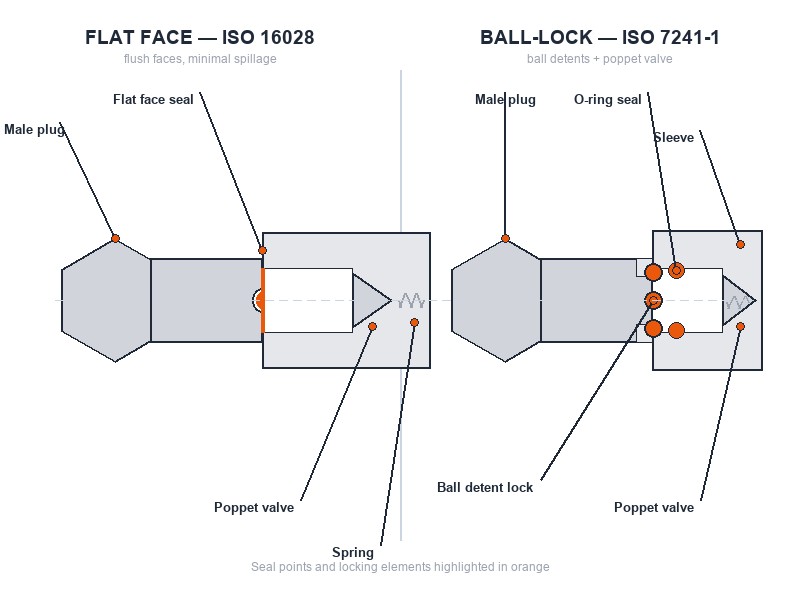
Figure 1. Flat face versus ball-lock quick couplings: the seal geometry decides spillage and contamination resistance.
Hydraulic Fittings Types by Thread and Seal: Six Standards You Will Meet
The fastest way to name the hydraulic fitting types on a machine is to look at the thread and the seal. Six standards cover nearly everything in service, and each one is defined by three facts: thread form (parallel or tapered), thread angle (60° for inch and metric, 55° for BSP), and seal mechanism (metal-to-metal, O-ring, or thread interference).
JIC Fittings: The 37° Flare Standard (SAE J514)
JIC (Joint Industry Council) fittings seal on a 37° flare: the male end carries a flared seat, the female end a matching cone, and the two are drawn together by parallel UNF threads. The seal is metal-to-metal, so cleanliness and correct torque decide whether it holds. JIC is the most common type of hydraulic fitting on North American mobile equipment and industrial machinery, rated up to roughly 6,000 PSI in small sizes. JIC fittings are often compared with AN fittings, which share the same 37° seat but use a different thread series (UNJF); the seat angle is identical, but the threads are not always interchangeable. A 45° SAE flare (automotive and refrigeration) is a different seat angle entirely and must never be mixed with JIC.
ORFS Fittings: O-Ring Face Seal (SAE J1453)
ORFS — O-ring face seal — carries the O-ring in a groove on the female face and seals against a flat male face; the threads only hold the two faces together. Because the seal does not depend on thread torque or metal deformation, ORFS is the most reliable standard under high pressure and heavy vibration, also rated to roughly 6,000 PSI. The JIC vs ORFS decision is straightforward: on a machine that vibrates and gets reassembled often — excavator booms, mining equipment — ORFS wins on leak resistance; JIC wins on availability and price. In our vibration testing, ORFS joints held zero leak after 1,000,000 impulse cycles at 4,000 PSI, which is why we recommend them for high-cycle circuits.
NPT and NPTF Pipe Thread Fittings
NPT (and the dryseal NPTF variant) is a tapered 60° pipe thread that seals by thread deformation — the threads wedge together — sometimes helped by sealant. It is inexpensive and everywhere, but it is the weakest choice for hydraulic impulse service: under vibration the taper relaxes and the joint loosens, which is exactly the leak our bench test showed. Keep NPT for static, low-vibration lines up to about 3,000 PSI, and never force an NPT male into a JIC or ORFS port. Identification is easy: tapered threads, 60° angle, no O-ring anywhere.
BSPP and BSPT Fittings: The British Standard
BSP is the British standard pipe thread family, dominant in the UK, Europe, and much of Asia-Pacific. BSPP (parallel, designated G) seals with a bonded washer or O-ring under the hex, so tape is useless on it; BSPT (tapered, designated R) seals by thread interference like NPT. The thread angle is 55° — the classic NPT vs BSP mismatch: both look like pipe threads, but 55° and 60° forms will not seal together, and forcing them ruins the port. Identify BSP by measuring the thread angle with a gauge and checking the 55° reading.
SAE ORB Fittings: Straight-Thread O-Ring Boss (SAE J1926)
SAE ORB (O-ring boss) uses parallel UNF threads with an O-ring under the hex head; the seal happens at the port face, not on the threads. It is the factory-standard port on most pumps, valves, motors, and manifolds because it is strong, vibration-proof, and re-assemblable — but only while the O-ring is present and undamaged. The orb vs JIC fittings comparison usually comes down to the port: if the component has an ORB port, use an ORB fitting or an ORB-to-JIC adapter; the two standards are not directly compatible.
DIN 2353 and Metric 24° Cone Fittings (ISO 8434-1)
The 24° cone fitting is the European standard, defined by DIN 2353 and ISO 8434-1, with metric threads and a 24° cone seat. Light series (L) fittings are rated to 315 bar (about 4,570 PSI) and heavy series (S) to 630 bar (about 9,140 PSI). The seal uses either a cutting ring (bite-type) that bites into the tube wall or an O-ring version for higher reliability. DIN fittings dominate European-built machinery, and Japanese equipment uses the closely related JIS B 8363 (Komatsu-style) form. If you need to know how to identify DIN hydraulic fittings, the giveaway is metric threads plus the 24° cone and cutting ring — nothing else in this list combines those three.
Hydraulic fittings standards at a glance: thread, seal, pressure, and region
| Standard | Thread Form | Thread Angle | Seal Mechanism | Typical Pressure | Where Dominant |
|---|---|---|---|---|---|
| JIC (SAE J514) | Parallel UNF | 60° | 37° metal flare | Up to ~6,000 PSI | North America |
| ORFS (SAE J1453) | Parallel UNF | 60° | Face O-ring | Up to ~6,000 PSI | North America, high-vibration duty |
| NPT / NPTF | Tapered | 60° | Thread interference | Up to ~3,000 PSI | North America, static lines |
| BSPP / BSPT | Parallel / tapered | 55° | Washer, O-ring, or thread interference | Up to ~5,000 PSI | UK, Europe, Asia-Pacific |
| SAE ORB (SAE J1926) | Parallel UNF | 60° | Boss O-ring | Up to ~6,000 PSI | Component ports worldwide |
| DIN 2353 (ISO 8434-1) | Metric | 60° | 24° cone, cutting ring or O-ring | 315–630 bar | Europe, Japan (JIS variant) |
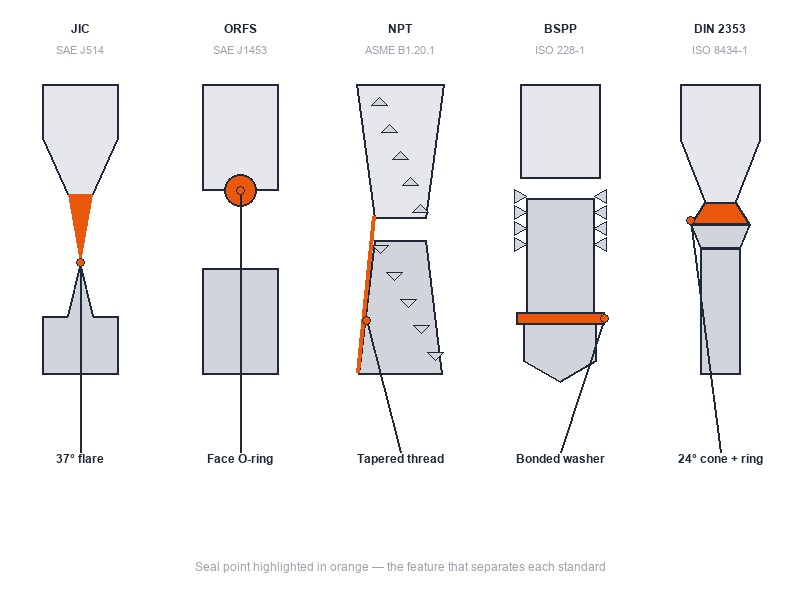
Figure 2. Five thread standards side by side. The seal point — flare, O-ring face, tapered thread, washer, or 24° cone — is what separates them.
Hydraulic Fittings Size Chart: Dash Numbers Explained
All inch-standard hydraulic fittings are sized in dash numbers — the nominal size in sixteenths of an inch. A -6 fitting is 6/16 inch, or 3/8 inch; a -8 is 8/16, or 1/2 inch. Dash sizes from -4 to -24 cover nearly everything on mobile and industrial machines, and the same dash number appears on the fitting body or hex, the hose, and the port. Metric fittings (DIN, JIS) skip dash numbers and use metric thread sizes such as M14 × 1.5 and M18 × 1.5, so the first identification step is always inch versus metric.
Hydraulic fitting sizes: dash number, nominal size, and typical JIC thread
| Dash | Nominal Size (inch) | Typical JIC Thread (UNF) | Hose Size It Pairs With |
|---|---|---|---|
| -4 | 1/4 | 7/16–20 | -4 hose |
| -6 | 3/8 | 9/16–18 | -6 hose |
| -8 | 1/2 | 3/4–16 | -8 hose |
| -10 | 5/8 | 7/8–14 | -10 hose |
| -12 | 3/4 | 1 1/16–12 | -12 hose |
| -16 | 1 | 1 5/16–12 | -16 hose |
| -20 / -24 | 1 1/4 / 1 1/2 | 1 5/8–12 / 1 7/8–12 | -20 / -24 hose |
Two charts must be read together. The hydraulic fittings size chart above gives the thread and port sizes; the hydraulic hose size chart gives the hose inside diameter and pressure rating. A -8 fitting belongs on a -8 hose — mixing a -8 fitting with a -6 hose creates a step that restricts flow and stresses the crimp zone. When you order, always state the dash size or the exact thread (for example “JIC -6 male” or “M18 × 1.5”), never just “half inch”, because 1/2 inch JIC, 1/2 inch NPT, and 1/2 inch BSPP are three different threads.
How to Identify Hydraulic Fittings in Five Steps
Learning how to identify hydraulic fittings takes about five minutes with two cheap tools: a digital caliper and a thread pitch gauge. This is the single most valuable skill for anyone maintaining hydraulic equipment, because the fitting name stamped on the machine is often worn off, and a wrong guess costs a return shipment or a damaged port.
- Measure the thread outside diameter with calipers. Compare it with a thread chart. An inch-standard thread will match a dash size (-4 to -24); a metric thread will match a millimeter size (M14, M16, M18, M22).
- Check for taper. Lay the caliper across the thread near the end, then near the hex. If the diameter changes, the thread is tapered — NPT, NPTF, or BSPT. Parallel threads (JIC, ORFS, ORB, BSPP, DIN) hold the same diameter.
- Measure the thread angle with a thread gauge. 60° means UN, NPT, or metric; 55° means BSP. This alone separates NPT from BSPT.
- Look at the seal. O-ring in the face = ORFS; O-ring under the hex = ORB; 37° cone seat = JIC; 24° cone with cutting ring = DIN; bonded washer = BSPP.
- Confirm the pitch. Threads per inch for inch standards, millimeter pitch for metric. A pitch gauge settles any remaining doubt.
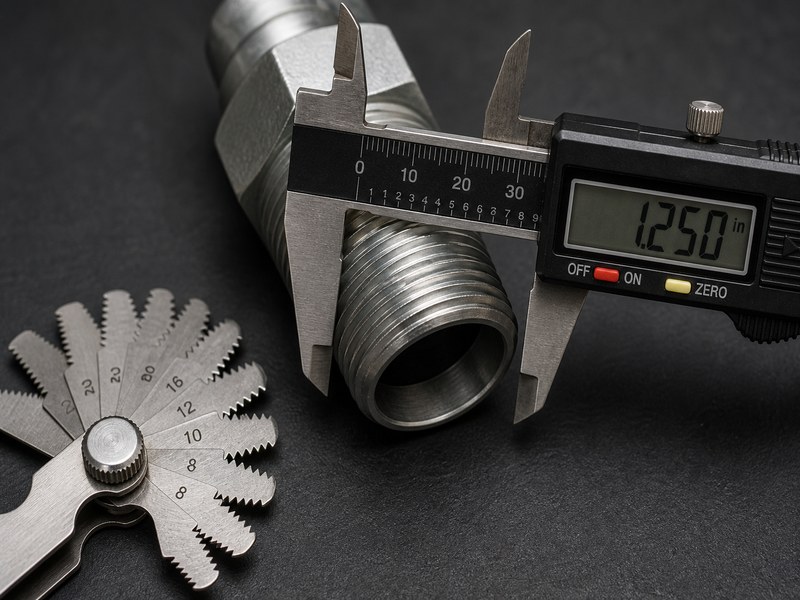
Figure 3. Identification kit: calipers for the outside diameter, a thread gauge for the angle and pitch.
“How to tell hydraulic fittings apart” is one of the most common questions our distributors ask, and the answer is always the same: identify the standard first, then the size. In our workshop every bench keeps a caliper and a thread gauge set for exactly this, because even our own engineers check before assembling a custom line. If the threads bind within the first turn, stop immediately — forcing them is how aluminum ports get stripped and why the repair bill jumps from a few dollars to a new manifold.
How to Choose the Right Hydraulic Fittings
Choosing among the types of hydraulic fittings comes down to six checks, in order. Skip one and the others cannot save you.
- Match the port standard on the machine. Never mix standards — use an adapter to cross JIC to ORFS, NPT to BSP, or inch to metric.
- Confirm working pressure. The fitting rating must cover the system peak, including pressure spikes, not just the normal running pressure.
- Check temperature. O-rings and seals have temperature limits; verify them against the fluid temperature at the fitting location.
- Verify fluid compatibility. Mineral oil, water-glycol, and phosphate esters each need specific seal materials.
- Assess vibration and impulse. High-cycle circuits favor ORFS or ORB over NPT, which loosens under vibration.
- Consider assembly method. No crimper on site? Use reusable hose ends and keep spare seals in stock.
Hydraulic fitting selection checklist
| Factor | Question to Ask | Data You Need |
|---|---|---|
| Standard | What thread and seal does the port use? | Thread gauge, calipers, machine manual |
| Pressure | What is the system peak, with spikes? | Pressure gauge reading, circuit diagram |
| Temperature | What fluid temperature reaches the fitting? | Thermometer, OEM spec |
| Fluid | Which hydraulic fluid does the system run? | Fluid specification, seal compatibility table |
| Vibration | Does the circuit see constant impulse? | Machine duty cycle, prior leak history |
| Assembly | Is a crimper available where the line is built? | Workshop tooling list |
Common Hydraulic Fitting Problems and Fixes
Most hydraulic fitting failures share one root cause — a standard or size mismatch — and the table below covers the failures we see most in warranty returns and field service reports.
Hydraulic fitting troubleshooting: symptom, cause, and fix
| Symptom | Most Likely Cause | Fix |
|---|---|---|
| Leak at the threaded joint | Wrong standard forced together (e.g., JIC male into NPT port) | Identify the port standard; use the correct fitting or a standard-crossing adapter |
| Leak at the flare | Over-torqued or damaged 37° flare, or dirt on the seat | Replace the fitting; clean the seat; torque to spec |
| Quick coupling leaking | Worn seal or debris trapped in the ball/poppet | Clean the coupling; replace the seal kit; check pressure rating |
| Fitting loosens under vibration | Tapered pipe thread in impulse service | Switch to ORFS or ORB; apply thread sealant as a temporary fix |
| O-ring extruded or cut | Wrong seal material for the fluid or temperature | Verify compatibility; fit the correct O-ring compound |
| Cannot reach full torque | Swivel seized, or threads damaged | Replace the swivel or the fitting; never overtighten |
Safety note. A pinhole leak in a hydraulic line can inject fluid into skin at thousands of PSI — never check for leaks by hand. Relieve pressure before disconnecting anything, and seek medical attention immediately if a fluid injection injury is even suspected.
Hydraulic Fittings FAQs
What are the most common types of hydraulic fittings? JIC 37° flare, ORFS, NPT/NPTF, BSPP/BSPT, SAE ORB, and DIN 2353 metric fittings, plus crimp and reusable hose ends and quick connect couplings. Region decides the mix: JIC and ORFS dominate North America, DIN 2353 dominates Europe, and BSP leads the UK and much of Asia-Pacific.
Are JIC and NPT interchangeable? No. JIC uses parallel UNF threads and seals on a 37° flare; NPT uses tapered 60° threads that seal by deformation. The two look alike at a glance, but they will not seal together — if threads bind within the first turn, stop and identify before forcing.
What does ORFS stand for, and when should I use it? O-ring face seal. Use ORFS wherever vibration, high pressure, and frequent reassembly meet — excavator booms, mining equipment, test rigs. The JIC vs ORFS trade-off is price and availability against leak resistance; our impulse testing favors ORFS for any circuit above about 3,000 PSI that runs continuously.
What is the difference between crimp and reusable hydraulic fittings? Crimp fittings are permanently compressed onto the hose with a machine — stronger, more compact, and the only choice for high-pressure spiral hose. Reusable fittings screw together by hand for field repair but carry a lower pressure rating and a larger body.
Can I reuse hydraulic fittings? Adapters and couplings, yes — after cleaning and inspection of threads and seals. Crimp hose ends, no — they are one-time by design. Reusable hose ends can be rebuilt per the manufacturer’s instructions, and seals should be replaced rather than reused.
How do I know what size hydraulic fitting I need? Read the dash number on the hex or measure the thread outside diameter with calipers, then confirm the angle and pitch with a thread gauge. Order by exact designation — for example “JIC -6 male” — and match the fitting dash size to the hose dash size.
Why is my hydraulic quick connect leaking? Usually a worn seal or debris in the poppet or ball. Clean it, replace the seal kit, and verify the coupling’s pressure rating and series (A or B) match the circuit. A flat face coupling is the upgrade when spillage and contamination are the problem.
Are hydraulic fittings universal across brands? Within the same standard and size, yes — a -6 JIC male from any manufacturer mates with a -6 JIC female from any other. Across standards, no, and this is where most ordering mistakes happen. Buy by standard and dash size, not by brand or by eye.
Final Verdict: Know Your Thread, Seal, and Size
Every hydraulic machine, from a farm loader to a 200-ton excavator, is built from the same types of hydraulic fittings, and every leak we have investigated traces back to one of three checks missed at ordering time: the thread standard, the seal type, or the dash size. Identify the standard first with a caliper and thread gauge, match the seal mechanism to the circuit’s vibration and fluid, and order by exact designation. Do that, and a correctly specified fitting will outlast the hose it is attached to.
If you are sourcing the types of hydraulic fittings covered above for distribution, OEM programs, or maintenance stock, HENGHUA manufactures JIC, ORFS, NPT, BSP, SAE ORB, and DIN fittings, crimp and reusable hose ends, quick connect couplings, and complete hose assemblies — each one thread-checked and pressure-tested before shipment, with factory-direct pricing, short lead times for bulk orders, custom packaging, and clear warranty terms. Contact our team for a quote and samples; tell us the machine models and port standards you support, and we will spec the fitting range your market needs.

Figure 4. A HENGHUA hydraulic fitting range: JIC, ORFS, quick couplings, and adapters, thread-checked and pressure-tested before shipment.

 English
  Spanish
  Portuguese
  French
  German