
How Do You Clean a Hydraulic Hose Assembly Before Installation?
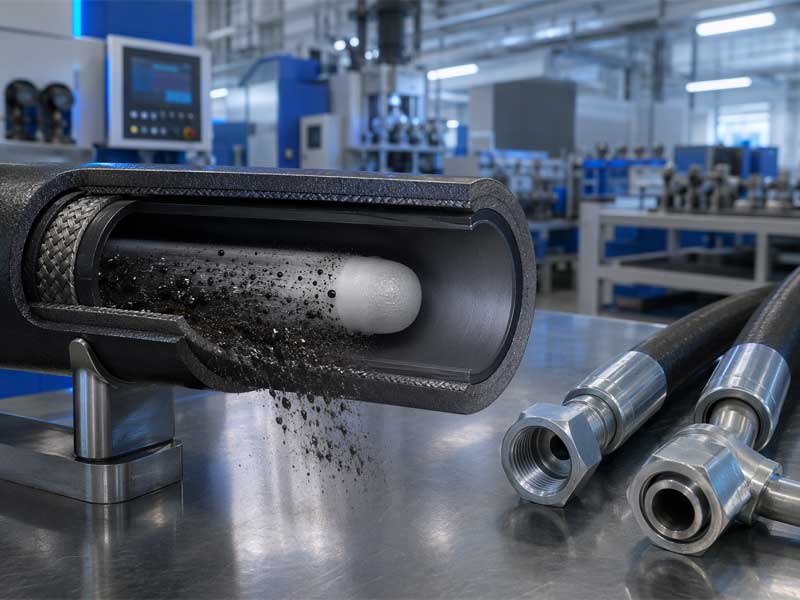
A hydraulic hose assembly is cleaned by removing internal contaminants using foam projectile cleaning, fluid flushing, or filtered compressed air. The most effective method is foam projectile cleaning, performed before fitting installation, because it physically wipes the tube wall to remove rubber particles, cutting debris, and manufacturing residue. This process is critical for achieving ISO 4406 cleanliness requirements and preventing premature system failure.
Hydraulic Hose Cleaning Quick Facts
| Item | Details |
|---|---|
| Best Cleaning Method | Foam projectile cleaning |
| Recommended Cleaning Time | Before and after crimping |
| Main Contaminants Removed | Rubber particles, metal debris, dust, manufacturing residue |
| Primary Cleanliness Standard | ISO 4406 |
| Standard Verification Method | Laser particle counting |
| Main Purpose | Prevent hydraulic component failure and extend system life |
What Is Hydraulic Hose Assembly Cleaning?
Hydraulic hose assembly cleaning is the process of removing internal contaminants—including rubber particles, metal debris, dust, and manufacturing residue—from a hose before it is connected to a hydraulic system. The purpose is to achieve the required cleanliness level and prevent damage to pumps, valves, cylinders, and other precision components. This is a mandatory quality control step, not an optional maintenance task.
1. Why Hydraulic Hose Cleaning Is Non-Negotiable
Contamination is the leading cause of hydraulic component failure, accounting for nearly 70% of all hydraulic system breakdowns. While many operators focus on filtering hydraulic fluid, they often overlook a primary contamination source: new hose assemblies. Even microscopic particles can cause abrasive wear on pumps, stick spools in valves, and block precision orifices. Proper cleaning before installation is not a recommendation—it is a requirement for system reliability and longevity.
2. Are New Hydraulic Hoses Actually Clean?
No. This is a common and costly misconception. Brand-new hoses are not “clean-room” products. They contain contaminants from multiple stages of their manufacturing and handling lifecycle. Unless a hose is specifically ordered as a “pre-cleaned” assembly with verifiable test data, it should be considered contaminated and in need of cleaning.
3. Sources of Hydraulic Hose Contamination
Understanding where contamination comes from is the first step to controlling it. The primary sources are:
- Manufacturing Residue: Leftover mandrel lubrication, rubber dust, and polymer particles from the extrusion process adhere to the inner tube.
- Cutting and Crimping Debris: The cutting process generates rubber and metal particles. The heat from the blade can melt these particles, causing them to stick firmly to the tube wall, making them difficult to remove later.
- Storage and Handling: Unless hoses are properly capped, they can accumulate dust, dirt, and moisture during storage and transport. Even a small opening can allow particles to enter.
- Connector Contamination: Fittings and couplings can also be contaminated with dust, metal shavings, or rust from storage.
Hydraulic Hose Contamination Sources Diagram:
| Stage | Contaminant Source | Contaminant Type |
|---|---|---|
| Manufacturing | Extrusion process | Rubber particles, lubricants, polymer dust |
| Cutting | Sawing the hose | Metal chips, rubber debris, heat-fused particles |
| Assembly | Fitting insertion and crimping | Metal shavings, swarf, surface oxides |
| Storage | Open ends & environment | Dust, moisture, microbial growth |
4. Hydraulic Hose Cleaning Methods Comparison Table
Choosing the right method depends on your application, hose length, and required cleanliness level. Each method has distinct advantages and limitations.
| Method | Best Application | Advantages | Limitations | Typical Cleanliness Achieved |
|---|---|---|---|---|
| Foam Projectile Cleaning | New hose assemblies (before crimping) | Highest cleanliness level; removes adhered particles; effective cleaning of the entire inner wall. | Requires specialized launcher and correct projectile size; risk of projectile debris with poorly sized projectiles. | ISO 4406 13/10 |
| Fluid Flushing | Finished assemblies & long, complex systems | Can monitor cleanliness in real-time; effective for system-wide cleaning. | Requires fluid management; potential chemical incompatibility; higher cost and time. | Varies with filtration |
| High-Pressure Air | Short hoses & initial debris removal | Fast, low cost, and easy to perform. | Cannot remove adhered particles; risks pushing debris to the middle of the hose; air must be clean and dry. | Low, unreliable |
5. Hydraulic Hose Cleaning Equipment
Professional hydraulic hose cleaning requires specialized equipment to achieve and verify the required ISO 4406 cleanliness levels. The key equipment includes:
- Projectile Launcher: Used to push foam projectiles through the hose assembly at high speed, physically wiping the inner wall to remove debris.
- Foam Cleaning Projectiles: Available in a range of sizes to match different hose inner diameters (IDs). The projectile should be 20–30% larger than the hose ID for an effective seal.
- Flushing Equipment: For finished assemblies, flushing rigs circulate filtered fluid through the hose. These systems often include heating elements to lower fluid viscosity and improve flushing efficiency.
- Laser Particle Counter: The standard tool for verifying cleanliness. It provides real-time data on particle counts at specific micron sizes, confirming whether the assembly meets the required ISO 4406 code.
6. Hydraulic Hose Cleaning Process Step by Step
To achieve consistent, verifiable results, follow this industry-standard procedure:
Hydraulic Hose Cleaning Process Flow:
- Cut Hose to Length →
- Remove Cutting Debris (Initial Projectile Cleaning) →
- Install Fittings & Crimp →
- Final Cleaning (Projectile or Flush) →
- Clean External Surfaces →
- Cleanliness Verification →
- Cap, Seal, and Package
Detailed Steps
- Step 1: Cut the Hose. Use a proper hose-cutting saw to minimize particle generation. Avoid abrasive wheels.
- Step 2: Initial Cleaning (Crucial). Immediately after cutting, while the tube is still warm, fire foam projectiles from both ends of the hose. This removes the most stubborn, heat-adhered debris.
- Step 3: Attach Fittings and Crimp. Insert fittings and perform the crimping process.
- Step 4: Final Cleaning. Perform a second cleaning (projectile or flushing) to remove debris generated during crimping and fitting insertion.
- Step 5: Clean External Surfaces. Clean all fittings and connectors to prevent external dirt from entering during installation.
- Step 6: Cleanliness Verification. Verify cleanliness using a particle counter or visual inspection of projectiles.
- Step 7: Cap and Protect. Immediately apply clean end caps to the assembly. Seal in clean packaging if not used immediately.
7. ISO 4406 Cleanliness Standards: The Industry Benchmark
Verifying cleanliness against an international standard is essential for quality assurance. ISO 4406 is the global standard for reporting particle contamination levels in hydraulic fluids and components.
7.1 What Does ISO 4406 Mean?
ISO 4406 uses three numbers to classify hydraulic fluid cleanliness. Each number represents the particle count at a specific micron size.
Example: A code of 18/16/13 means:
| Code | Particle Size | Meaning |
|---|---|---|
| 18 | Particles larger than 4 µm | Indicates the number of particles in the fluid sample |
| 16 | Particles larger than 6 µm | Indicates the number of particles in the fluid sample |
| 13 | Particles larger than 14 µm | Indicates the number of particles in the fluid sample |
The lower the numbers, the cleaner the fluid. A target code is chosen based on the sensitivity of the most critical component in the system (e.g., a servo valve will require a lower, cleaner code than a simple gear pump).
7.2 Required Cleanliness Levels by System Sensitivity
| Sensitivity Level | System Type | Pressure Range | ISO 4406 Code |
|---|---|---|---|
| Low | Low-pressure gear pump systems | < 180 bar | 20/18/15 |
| Medium | High-pressure piston pump, load sensing | < 280 bar | 18/16/13 |
| High | Ultra-high pressure, servo-valve systems | > 280 bar | 17/15/12 |
8. How to Verify Hydraulic Hose Cleanliness
Cleanliness verification ensures that the cleaning process has been effective and that the assembly meets the specified requirements.
- Particle Counting: Using an automatic particle counter during fluid flushing provides a continuous readout, allowing the operator to stop flushing once the target cleanliness level is reached.
- Projectile Inspection: After a projectile cleaning, the condition of the projectile is a direct indicator of internal hose contamination. A dirty projectile signals a need for additional cleaning.
- Visual Inspection: Using a borescope can help inspect the internal surface of the hose, though this is less practical for long or narrow hoses.
9. When Should Hydraulic Hose Assemblies Be Cleaned?
To maintain system integrity, cleaning is mandatory at several critical junctures:
- Before Initial Installation: This is the most critical time to remove manufacturing and storage contaminants.
- After Cutting: To remove particles generated by the cutting process while they are still loose.
- After Crimping: To remove debris introduced during fitting attachment.
- After Prolonged Storage: Even capped hoses can accumulate moisture or dust over time.
- After a Contamination Event: If a pump fails or a filter is bypassed, the entire system, including hose assemblies, must be flushed.
10. Common Hydraulic Hose Cleaning Mistakes to Avoid
Even with a procedure in place, mistakes can compromise cleanliness:
- Assuming “New” Means “Clean”: This is the most common and costly error. Always clean new hoses.
- Using Unfiltered Air: Blowing unfiltered compressed air introduces moisture and particles.
- Skipping the “Before Crimping” Clean: This is the best opportunity to remove particles that become stuck during cutting.
- Delaying Capping: Leaving a hose uncapped for even a short time invites contamination.
- Using Incompatible Fluids for Flushing: This can degrade the hose tube material.
- Incorrect Projectile Size: Using a projectile that is too small will not clean effectively; one that is too large may become lodged.
11. Applications Requiring Clean Hydraulic Hoses
Hydraulic hose cleanliness is not a niche concern; it is critical across nearly every sector of industry. Contamination control is especially vital in:
- Construction Equipment: Excavators, loaders, and bulldozers operate in dirty environments, making clean assemblies crucial.
- Mining Machinery: High pressures and extreme conditions demand reliable, contamination-free hydraulics.
- Agricultural Equipment: Tractors and harvesters rely on hydraulic systems for steering and implements.
- Injection Molding Machines: Precision and repeatability in plastic production require clean, well-maintained hydraulic systems.
- Offshore and Marine Hydraulics: System reliability is critical for safety and operations.
- Aerospace Hydraulics: Stringent cleanliness standards must be met for flight control systems.
- Industrial Automation: Robotic arms and manufacturing equipment require consistent, contamination-free operation.
12. Frequently Asked Questions About Hydraulic Hose Cleaning
To comprehensively cover user search intent, we have expanded our FAQ section to address the most common queries.
Q1: Can you install a hydraulic hose without cleaning it?
A: No. Even new hoses contain manufacturing debris that will damage pumps and valves. Cleaning is mandatory for reliable operation.
Q2: What is the best way to clean a hydraulic hose assembly?
A: Foam projectile cleaning is considered the most effective method for achieving the highest level of cleanliness (ISO 4406 13/10).
Q3: Do I need to clean the hose before or after crimping?
A: Ideally, both. Perform a first cleaning immediately after cutting, and a second cleaning after crimping to remove all debris.
Q4: What is the recommended pressure for air cleaning?
A: Air pressure should be between 90 psi and 120 psi, and the air must be filtered to ≤5 µm to avoid adding contamination.
Q5: How do I know if my hose is clean enough?
A: The required cleanliness is determined by your system’s most sensitive component (e.g., servo valves need higher cleanliness than gear pumps). Verify using a laser particle counter.
Q6: What are the ISO cleanliness standards for hydraulic hoses?
A: The standard is ISO 4406, which provides a three-number code (e.g., 18/16/13) representing particle counts at >4µm, >6µm, and >14µm.
Q7: Can flushing damage a hydraulic hose?
A: Yes, if the flushing fluid is chemically incompatible with the hose tube material. Always verify compatibility to prevent the hose from softening or degrading.
Q8: How should cleaned hoses be stored?
A: They must be capped immediately and stored in a clean, dry environment to prevent recontamination.
Q9: Why do hydraulic hoses need to be cleaned before installation?
A: Hydraulic hoses need cleaning because manufacturing residue, rubber particles, and cutting debris can enter the hydraulic system and damage precision components like pumps and servo valves.
Q10: What happens if hydraulic hoses are not cleaned?
A: Unclean hoses can introduce contamination that causes valve sticking, pump wear, reduced efficiency, and premature hydraulic system failure.
Q11: How often should hydraulic hoses be flushed?
A: Hydraulic hoses should be flushed during initial installation, after major repairs, after component failure, or whenever contamination is suspected.
Q12: What equipment is used to clean hydraulic hoses?
A: Common equipment includes projectile launchers, foam projectiles, flushing rigs, filtration systems, and laser particle counters.
Q13: What is the difference between hose cleaning and hose flushing?
A: Cleaning typically refers to removing contaminants inside individual hose assemblies, while flushing is the process of removing contamination from the entire hydraulic circuit.
Q14: Is hydraulic hose cleaning a specialist job?
A: Yes. Proper cleaning requires specialist knowledge and the correct equipment. Attempting to clean hoses without proper knowledge can cause damage or be ineffective.
Q15: What contaminants are found in new hydraulic hoses?
A: New hoses commonly contain rubber dust, metal particles from cutting, mandrel lubricants, and other manufacturing residues.
13. Professional Manufacturing Example: How HENGHUA Controls Hydraulic Hose Contamination
Understanding how a professional manufacturer applies these principles provides a benchmark for quality. A robust contamination control process is integrated into every stage of manufacturing.
The HENGHUA Contamination Control Process
- Controlled Cutting: Using precision cutting saws that minimize heat and debris generation.
- Systematic Cleaning: Every assembly is cleaned using the foam projectile method both before and after crimping to ensure internal cleanliness.
- ISO 4406 Verification: We employ verified procedures and quality checks to help achieve ISO 4406 cleanliness levels suitable for medium to high-sensitivity systems.
- Clean Assembly and Packaging: All assemblies are capped and sealed immediately after cleaning and testing. They are handled with clean gloves and packaged in protective materials.
- Pulse Test Validation: Our assemblies are validated on advanced pulse test stands. They have demonstrated durability exceeding 1,000,000 impulse cycles at rated working pressures, proving the long-term integrity of our manufacturing and cleanliness processes.
By following this rigorous process, HENGHUA delivers assemblies that meet the performance and cleanliness standards required by demanding industrial applications, from construction and mining to injection molding and offshore hydraulics.
14. Custom Hydraulic Hose Assembly Solutions
HENGHUA provides comprehensive, custom-engineered hydraulic solutions for original equipment manufacturers (OEMs) and industrial end-users. Our product portfolio is designed to meet the rigorous demands of modern hydraulic systems.
Our Core Solutions Include:
- Custom Hydraulic Hose Assemblies: Tailored to your exact specifications, ensuring optimal fit, performance, and longevity.
- High-Pressure Hydraulic Hose Solutions: Engineered to withstand extreme pressures and harsh operating environments.
- OEM Hose Assembly Manufacturing: Seamless integration with your supply chain, delivering consistent, high-quality components that meet your design requirements.
- Industrial Hydraulic Hose Supply: A reliable source for standard and custom assemblies to support maintenance, repair, and operations (MRO) and production.
Why Partner with HENGHUA?
HENGHUA is committed to providing high-quality, reliable hydraulic solutions backed by rigorous testing and contamination control. Our pulse test stands validate the durability of our assemblies, ensuring they perform at the highest level in critical applications across construction, agriculture, mining, and manufacturing.
[Contact the HENGHUA engineering team today] to discuss your specific requirements and learn how our expertise can help you solve your most challenging hydraulic applications.
Cleaning hydraulic hose assemblies is a critical, non-negotiable step in ensuring the longevity and reliability of any hydraulic system. By understanding the sources of contamination, selecting the right cleaning method, and adhering to a strict procedure, you can prevent up to 70% of premature system failures.
Following a standardized hydraulic hose cleaning procedure helps manufacturers, technicians, and engineers achieve reliable hydraulic system performance while significantly reducing contamination-related failures. Whether you are a maintenance technician on the shop floor or an engineer specifying components, prioritizing proper hydraulic hose cleaning is one of the most effective investments you can make in your equipment’s performance and uptime.
Industry References & Standards
- ISO 4406: Hydraulic fluid power — Fluid cleanliness classification
- BFPA P111: Recommendations for Hydraulic Hose Assembly Cleanliness (British Fluid Power Association)
- SAE J1273: Recommended Practice for Hydraulic Hose Assemblies

 English
  Spanish
  Portuguese
  French
  German