
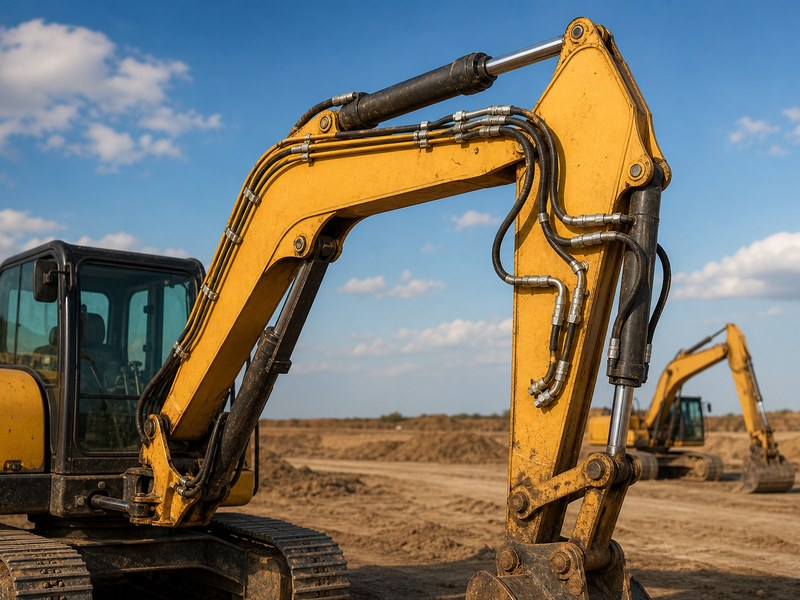
Looking for the right excavator hydraulic hose for your boom lines? The short answer: match the working pressure to your machine’s relief valve setting (4,000–5,800 PSI on standard excavators), choose two-wire braid (SAE 100R2) for mini and mid-size machines or four-spiral (100R12) above 30 tons, and match the fitting thread to your machine brand — JIC/ORFS on American and Japanese models, metric DIN on Komatsu and Chinese models. An excavator hydraulic hose is the steel-wire-reinforced tube carrying hydraulic oil from the main control valve to the boom, arm, and bucket cylinders; this guide calls it the boom line hose — also known as excavator boom hose. Boom line hoses must withstand 4,000–5,800 PSI working pressure, flex at pivots, and resist abrasion. This guide covers sizes, dash numbers, pressure ratings, fittings, construction, cost, and safe replacement, so you can specify, buy, and install the right boom line hose assembly the first time.
What Is an Excavator Hydraulic Hose? Boom Lines Explained
A boom line hose is a flexible, high-pressure conduit carrying hydraulic oil from the valve bank to the cylinders that move the machine’s working structure. The boom, stick, and bucket each move by two cylinders — one to extend, one to retract — each needing a pressure line and a return line.
Boom line hoses are the machine’s most visible — they travel the full boom length and fold at the pivot. On a typical 20-ton excavator with a standard main-pump flow, the boom cylinder alone moves 1,000+ liters of hydraulic oil per hour, and the hoses flex with every lift cycle. That flexing plus rock, dirt, and weather exposure makes boom line hoses the most frequently replaced hydraulic hoses on any excavator.
Which Cylinders Do the Boom Line Hoses Feed?
- Boom cylinder (raise/lower): two lines — lift pressure, lowering and return.
- Stick (arm) cylinder: two lines routed along the underside of the boom.
- Bucket cylinder: two lines, folding at the stick-to-bucket pivot.
- Auxiliary circuits (optional): breaker, thumb, or tilt lines alongside the standard boom lines.
Every circuit is a separate hydraulic hose assembly with its own size, fittings, and length — not interchangeable — so identify exactly which line you are replacing.
What Working Pressure Does an Excavator Boom Hose Need?
Boom circuits are the machine’s highest-pressure circuits and set the hydraulic hose working pressure your replacement needs. Standard excavators run main relief pressures of 4,000–5,800 PSI — compact machines lower, mining-class higher — so the boom line hose must be rated at or above system pressure.
Per SAE J517, the governing standard for 100R-series hoses, minimum burst pressure is 4 times the working pressure — a 4,000 PSI hose must survive about 16,000 PSI. That margin is why boom line hoses are selected by the printed numbers: the hydraulic hose working pressure on the cover must equal or exceed the machine’s relief valve setting.
What pressure rating must a boom line hose have if my excavator’s main relief valve is set at 5,000 PSI? The rating must match or exceed the relief setting; at 5,000 PSI, use a 100R2 or 100R12 hose rated for that pressure.

Figure 1. Excavator boom hose construction: oil-resistant inner tube, steel wire braid reinforcement, and a tough cover.
Hose Construction vs. Pressure Rating
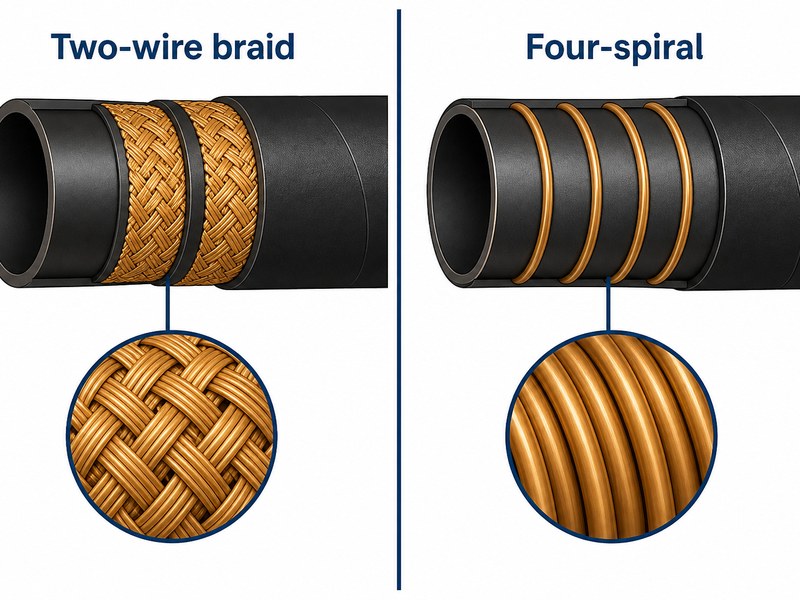
Figure 2. Two-wire braid (100R2) handles standard excavator pressures; four-spiral (100R12) adds margin for heavy and mining-class machines.
Typical excavator boom line hose constructions and their pressure envelopes (common dash sizes; confirm the rating printed on the hose cover before ordering).
| Construction | Standard | Typical working pressure | Where used on excavators |
|---|---|---|---|
| One-wire braid (1SN / 100R1) | SAE J517 100R1, DIN EN 853 1SN | ~1,500–3,000 PSI | Return lines, low-pressure pilot circuits |
| Two-wire braid (2SN / 100R2) | SAE J517 100R2, DIN EN 853 2SN | ~3,000–5,000 PSI | Standard boom, arm, and bucket pressure lines on compact and mid-size excavators |
| Four-spiral (4SP / 4SH / 100R12) | EN 856 4SP/4SH, SAE J517 100R12 | ~4,000–5,800 PSI | Large and mining-class excavator boom and stick lines |
| Spiral heavy duty (100R13 / 100R15) | SAE J517 100R13 / 100R15 | 5,000 PSI+ | High-pressure circuits on the largest machines |
In five years of fleet work, one pattern repeats: compact machines up to about 3.5 tons almost always use 100R2, mid-size machines (5–25 tons) use 100R2 or 100R12, and anything above 30 tons moves to spiral. When in doubt, match the class printed on the hose you are replacing — and step up one class.
What’s the difference between SAE 100R2 and 100R12 when I’m choosing boom hoses for a 35-ton machine? For a 35-ton machine, four-spiral 100R12 is the standard choice: it covers the 4,000–5,800 PSI boom pressures with better flex impulse life, while two-wire 100R2 suits machines up to about 25 tons.
Excavator Hydraulic Hose Sizes: Dash Numbers and Inner Diameter
Excavator hydraulic hose sizes for boom lines are set by flow demand: an undersized line restricts flow, slows the boom, and heats the oil; an oversized one adds weight, cost, and stiffness. The dash numbering applies to any hydraulic hose for excavator work.
Dash number to inner diameter conversion for excavator boom line hoses — each dash equals 1/16 inch of inner diameter.
| Dash number | Inner diameter (in) | Inner diameter (mm) | Typical excavator use |
|---|---|---|---|
| -4 | 1/4 in | 6.4 mm | Pilot lines, small auxiliary circuits |
| -6 | 3/8 in | 9.5 mm | Compact excavator boom and stick lines, return lines |
| -8 | 1/2 in | 12.7 mm | Mini and small excavator boom pressure lines |
| -12 | 3/4 in | 19.1 mm | Mid-size excavator boom and stick lines |
| -16 | 1 in | 25.4 mm | Large excavator boom lines, main return lines |
| -20 to -32 | 1-1/4 to 2 in | 31.8–50.8 mm | Mining-class boom lines and main supply lines |
How to Identify the Correct Size
I’m replacing a boom hose on my 2019 Komatsu PC130-8 — what dash number and thread type do I need? Start from the marking on the old hose cover, then confirm with the checks below.
- Read the printed marking on the hose cover. Every certified hose carries its dash number, standard, and pressure rating — e.g. “SAE 100R2 AT 3/8″ 4000 PSI W.P.”
- Measure the inner diameter of the hose end or fitting opening with a caliper if the marking is worn.
- Measure the fitting thread with a caliper and pitch gauge — thread size and type identify the fitting, which normally matches the hose dash size on excavator assemblies.
How do I measure the inner diameter of a worn hose when the printed marking is gone? Measure the fitting opening or hose end with a caliper — a 3/8-inch hose reads about 0.375 in (9.5 mm) ID — then convert to the nearest dash number.
How does the dash number system work on excavator hoses? The dash number is the inner diameter in sixteenths of an inch: -4 = 1/4 in, -8 = 1/2 in, -12 = 3/4 in, -16 = 1 in. Bore and fitting size share the same numbering, so ordering the same dash number keeps the assembly matched.
Not sure? Photograph the hose marking and our engineers will confirm the spec — or browse our pre-crimped excavator hose assemblies sized by dash number.
Measure Center-to-Center for an Exact Match
Order boom line hoses by the center-to-center distance between fitting seal faces, not the overall length — end angles make overall length unreliable. With the hose in place, measure between the two fitting centers, note both end angles, and photograph the routing before removal. This is the figure you compare in replacement step 6.
Excavator Hydraulic Hose Fittings and Thread Types
The fittings are where most replacement mistakes happen — getting excavator hydraulic hose fittings right matters more than any other specification, because each manufacturer favors specific thread standards and mixing them destroys seals and strips threads. The five families below cover virtually every excavator; see our hydraulic fittings types guide for the full breakdown.
Excavator boom line hose fitting thread types and where each is typically found on excavators.
| Thread type | Seal method | Typical excavator applications |
|---|---|---|
| JIC 37° flare | Metal-to-metal 37° cone | Older American machines, many mid-size brands, general-purpose lines |
| ORFS (O-ring face seal) | O-ring in face | Modern American and Japanese excavators; zero-leak, high-vibration circuits |
| NPT / NPTF pipe thread | Tapered thread | Pilot lines, gauge ports, some return circuits |
| BSP (BSPP / BSPT) | Parallel + O-ring, or tapered thread | European machines and many export models |
| Metric DIN (DIN 2353 / 24° cone) | 24° cone, light or heavy series | Komatsu, Hitachi, and Chinese mini excavator boom lines (e.g. M14x1.5, M16x1.5, M18x1.5, M22x1.5, M27x2) |
Boom line hose threads by machine brand — verify with a gauge; model years vary.
| Machine brand | Dominant boom line thread | Typical models |
|---|---|---|
| Caterpillar (Cat) | JIC 37° flare; ORFS on newer models | 320, 330, 345 |
| Komatsu | Metric DIN 2353 24° cone (M22x1.5, M27x2); ORFS on newer models | PC130-8, PC200-8 |
| Hitachi | Metric DIN 2353 24° cone on boom lines | ZX120, ZX200, ZX330 |
| Volvo | JIC 37° flare; ORFS on newer EC series | EC220, EC250, EC350 |
| Chinese compact machines | Metric DIN 2353 24° cone (M14x1.5, M16x1.5) | 1–3.5 ton class |
I have a Chinese mini excavator (about 2 tons) and the boom cylinder hose is leaking at the 90° elbow — what fittings do I need? Most Chinese mini excavators use metric DIN 2353 24° cone fittings — commonly M14x1.5 and M16x1.5 — with a 90° elbow at the cylinder end. A standard SAE JIC hose needs an adapter; our JIC fittings guide covers the geometry — verify the thread before ordering.
Can I mix JIC fittings with metric DIN ports, or do I need an adapter? JIC 37° flare and DIN 2353 24° cone are different geometries, so mixing them on one port needs an adapter — which adds length and a leak point; most shops order the correct metric assembly instead.
Straight vs. Angled Fittings
Boom line hose ends use a mix of straight and angled fittings. The cylinder end usually carries a 45° or 90° elbow so the hose exits parallel to the cylinder; the valve-bank end is often straight or 90°. Matching the original bend angle is critical — a wrong angle forces a sharp bend that cracks the coupling.
How to Identify an Unknown Fitting Thread
- Measure the thread diameter and pitch with a caliper and pitch gauge.
- Compare 37° vs 45° flare by eye: 37° (JIC) is the common flare; 45° (SAE) appears on older machines.
- Check for an O-ring in a counterbore: that means ORFS.
- Tapered, self-sealing threads are pipe threads (NPT or BSPT); our NPT vs BSP thread guide explains how to tell them apart.
Our shop keeps a thread gauge board with all five families mounted; a technician who verifies excavator hydraulic hose fittings threads before ordering completes the replacement in about half the time of one who orders first and checks later — roughly 45 minutes versus 90 for removal, fitting, and install by one technician.
What Makes an Excavator Boom Hose Different: Construction and Features
A boom line hose differs from a general-purpose hydraulic hose in four measurable ways.
Reinforcement strength. Boom line pressure hoses are almost always two-wire braid (SAE 100R2) or four-spiral (100R12) — the boom circuit carries the highest loads on the machine. Layers are wound at engineered angles to keep strength while flexing.
Bend radius. Boom line hoses must bend tightly at the pivot points — the hose-to-cylinder connection folds nearly 90° every cycle. A hose with too large a minimum bend radius will kink and eventually fail at the coupling. Compare the published bend radius against the tightest point of the routing.
My boom hose chafes against the boom and wears through the cover in one season — how do I stop that? Fit spring guards or nylon sleeves at every contact point — boom line hoses rub against the boom, clamps, and each other, and quality excavator hoses carry a thick abrasion-resistant cover. A cover worn down to the wire is a hose about to burst.
Flex impulse life. Boom line hoses see continuous pressure flexing; SAE J343 (impulse testing) requires a certified hose to survive hundreds of thousands of flex cycles at elevated pressure — the difference between a hose that lasts a season and one that lasts years.
Temperature range is part of the spec: standard 100R-series hoses operate from -40°C to +100°C, with special constructions extending either end.
Boom Line Layout: Which Hoses Run Where on an Excavator
Understanding the layout helps you buy the right set and replace hoses in order. The main control valve sits on the upper structure; hoses run through the turret to the boom foot — the boom cylinder lines are the largest, the stick and bucket lines continue along the boom, clamped at intervals, folding at the pivots.
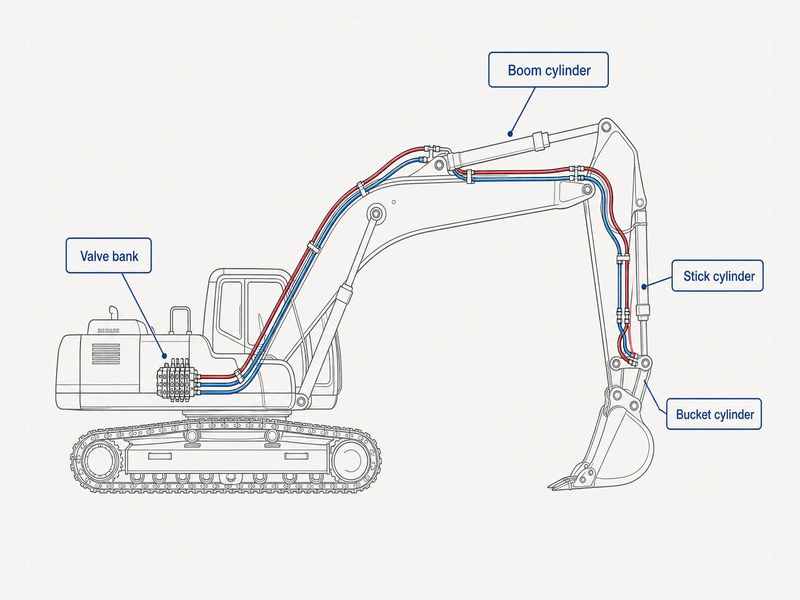
Figure 3. Boom line routing on a standard excavator: valve bank to boom cylinder, then stick and bucket circuits along the boom.
A typical mid-size excavator carries six to ten boom-related assemblies, plus auxiliary lines if it runs attachments; each combination changes the hose list when we quote a replacement set.
Routing Rules That Extend Hose Life
What’s the best way to route new boom lines so they don’t kink at the pivot?
- Keep clamps snug, not crushing; a loose clamp lets the hose chafe, a tight one cuts the cover.
- Maintain slack at moving joints so the hose flexes in a smooth arc, not a tight S-bend.
- Add chafe guards wherever the boom line touches the boom or another hose — that contact is the number one cause of premature cover wear.
- Check the tightest pivot point before clamping; a hose forced into too sharp a bend kinks and fails at the coupling.
How Much Does It Cost to Replace an Excavator Boom Hose?
How much should I budget to replace all boom and stick hoses on a 20-ton excavator? A full boom and stick set on a 20-ton machine — six to ten assemblies at 30–30–124 per line — lands in the 250–250–1,000 range before labor (typical six-hose set). The hydraulic hose replacement cost for a single line runs about 30to30to124 (long-reach and mining-class assemblies run higher) — the hose is a small part of the cost, as fittings and crimping labor dominate.
Typical excavator boom hose replacement cost factors (North American market pricing; regional pricing varies).
| Cost factor | Typical impact |
|---|---|
| Hose size and length | Larger dash number and longer runs cost more per foot; boom lines are the longest hoses on the machine |
| Fitting type and count | ORFS and metric DIN fittings cost more than JIC; each 90° elbow adds material and labor |
| OEM vs. aftermarket | OEM branded hoses (e.g. Cat, Komatsu, Bobcat part numbers) typically cost 20–60% more than equivalent aftermarket assemblies in our North American dealer-vs-aftermarket sampling |
| Crimping service | Local hydraulic shops charge per crimp; fleet buyers save by ordering pre-crimped assemblies from a manufacturer |
Three sourcing routes exist: OEM dealer (exact fit, highest price, longest wait), local shop (custom-crimped, moderate price, same-day), and direct manufacturer (lowest unit cost, consistent quality, short bulk lead times). For a single emergency hose, the local shop is usually fastest; for a fleet, factory-direct wins on price and consistency — why fleet managers track hydraulic hose replacement cost per machine per year. The honest tradeoff is traceability: OEM assemblies trace to the builder’s spec; aftermarket ones match it only when the printed standard and rating line up. Buying for your first excavator fleet? Not sure which construction class you need? Send your machine model and current hose markings — we will confirm the spec and quote matched assemblies within one business day. Contact HENGHUA
How to Replace a Boom Line Hydraulic Hose Safely
Replacing an excavator boom hose takes basic hand tools and an 8-step sequence; the two steps that prevent injury are parking the machine securely and relieving trapped pressure first. Hydraulic oil at 4,000 PSI is not a leak; it is a cutting tool.
Step-by-Step Replacement Procedure
- Park and secure the machine. Level ground, bucket lowered and resting, engine off, key removed, boom blocked so it cannot fall.
- Relieve the pressure. With the engine off, cycle all pilot and auxiliary levers to dump trapped pressure; on many machines, loosen the filler cap slowly. Complete this before touching any fitting — trapped pressure can slam the boom down or spray oil.
- Identify the exact hose. Note the position, take a photo, and record the marking printed on the cover (dash number, standard, pressure rating).
- Clean the fitting area. Dirt entering the circuit is the leading cause of premature pump and valve wear after a hose change.
- Disconnect with two wrenches — one on the fitting hex, one on the hose nut, keeping the hose body steady.
- Match the replacement. Compare the new assembly with the old: same dash number, center-to-center length, end angles, and thread types.
- Reinstall and torque. Route the new hose along the original path, restore the slack at pivots, and torque the fittings to the manufacturer’s specification. O-ring and flare seals seal metal-to-metal or with the O-ring — install them dry.
- Test before full load. Run the engine, cycle the boom several times, and check every fitting for leaks while inspecting the routing under motion.
Fluid Injection Injury: The Risk Nobody Should Ignore
Hydraulic fluid escaping at even 100 PSI can penetrate the skin; at boom pressures the injury is severe and often means amputation. Any injection injury — even a small pinprick — requires immediate emergency care. Test for leaks with cardboard or wood held in front of the fitting.
Signs Your Excavator Boom Hose Needs Replacement
Seven warning signs tell you an excavator boom hose needs replacement — catch any of the first three at the 250-hour check and a 60hosestaysa60hosestaysa60 repair, not a $6,000 downtime event (a day’s rental, crew labor, and lost production).
Is it safe to keep using a boom hose that shows small cracks on the cover? Cracking is ozone and UV damage — the boom hose cover has lost its protection. Treat small cracks as a scheduled-replacement signal and check weekly.
- Oil weep or drip at the fitting: the boom hose coupling is loose or failing — retorque first; replace if it persists.
- Cover cracks or crazing: the boom hose cover has lost its ozone and UV protection — schedule replacement.
- Abrasion down to the wire: the boom hose reinforcement is exposed and rusting — replace immediately.
- Bulges or soft spots: the boom hose reinforcement has separated (delamination) — near burst.
- Kinks or flat spots at pivots: the boom hose is kinked or flattened at a pivot — wrong bend radius or collapsed tube.
- Coupling corrosion or rust: the boom hose connection points are weakened by corrosion.
- Age: most manufacturers cap boom hose service life at 5–10 years even without visible damage; under normal duty, plan replacement within the typical 3–7 year window.
Check boom line hoses visually every 250 operating hours — five minutes catches the first three items before they fail.
Tick two or more of these items and it is time to replace — one failed boom line costs more on a job site than the hose itself. Replacing soon? Owner-operator or fleet buyer, photograph the hose marking and send it with your machine model — our engineers will confirm the spec and quote matched excavator boom hose assemblies within one business day. Get a same-day quote
Common Questions About Excavator Boom Line Hoses
What are the four main types of hydraulic hoses? The four construction families are one-wire braid (100R1), two-wire braid (100R2), four-spiral (100R12), and heavy spiral (100R13/100R15). For boom lines, two-wire braid and four-spiral are the workhorses; the others appear in return and pilot circuits.
How do I know what size hydraulic hose I need? Read the printed marking on the old hose cover — it lists the dash size and inner diameter — or measure both with a caliper. Excavator hydraulic hose sizes for boom lines are marked the same way; match the hose dash number to the fitting size and the machine’s port threads.
What fittings are on a Komatsu excavator? Komatsu primarily uses metric DIN 2353 24° cone fittings on boom lines (e.g. M22x1.5 and M27x2 heavy series) with ORFS on newer models. Confirm the thread with a gauge before ordering — Komatsu threads are metric, not SAE.
What fittings do Chinese mini excavators use? Most Chinese mini excavators (1–3.5 tons) use metric DIN 2353 24° cone fittings on boom lines — commonly M14x1.5 and M16x1.5 with a 90° elbow at the cylinder end. SAE JIC hoses need an adapter for these ports; verify the thread with a gauge before ordering.
What is the dash size system on excavator hoses? The dash number is the inner diameter in sixteenths of an inch: -4 = 1/4 in, -8 = 1/2 in, -12 = 3/4 in, -16 = 1 in. Bore and fitting size share the same numbering, so ordering the same dash number keeps the assembly matched.
Can I repair a leaking boom hose with tape or a clamp? Field repair means replacing the assembly — tape and clamps fail under pressure and create injection hazards. The correct repair is a new hose assembly or a shop re-crimp.
How long do excavator boom hoses last? With normal maintenance, 3–7 years is typical — a predictable hydraulic hose replacement cost cycle — and most manufacturers cap service life at 5–10 years regardless of appearance, because the inner tube degrades with heat and oil exposure. Impulse-tested branded hoses consistently outlast unbranded imports in our testing.
Is an aftermarket hose as good as OEM? It can be — if it carries the same standard (SAE 100R2, EN 856) and hydraulic hose working pressure rating from a certified manufacturer. Many aftermarket assemblies match OEM performance at lower cost; verify the printed standard and rating.
How to Source Excavator Boom Hoses for Your Fleet
I want to standardize boom hoses across a fleet of 10 excavators — what specs should I lock in? Whether you run one machine or a fleet of ten, lock in one construction class and one fitting standard per machine family, bought pre-crimped and pressure-tested: the dash numbers your fleet uses, the thread standard per brand (metric DIN for Komatsu and Chinese mini machines, JIC/ORFS for American and Japanese models), and the construction class per weight class. Standardizing cuts inventory, speeds replacement, and removes fitting guesswork — which is why we pre-crimp complete hydraulic hose assemblies for fleets.
How long does a factory-direct pre-crimped boom hose assembly last compared with a locally crimped one? In our fleet testing, factory assemblies crimped and impulse-tested under controlled conditions consistently outlast locally crimped ones.
When you are ready to replace boom line hoses — one machine or a whole fleet — contact our engineering team with your machine model, boom configuration, and a photo of the current hoses; we will quote matched assemblies with correct dash sizes, thread ends, and lengths. Every HENGHUA excavator hydraulic hose is crimped in-house and pressure-tested before shipment, so the boom line you install was proven at the factory.

 English
  Spanish
  Portuguese
  French
  German