
The Trelleborg steam hose range splits into two published pressure steps, one for cleaning and circulation and one for high-pressure steam. STEAM 6 is the lower step, published to 164 °C, and STEAM 16 is the upper step, published to 210 °C.
This article reads the maker’s published figures for both steps and maps them to ISO 6134 Type 1 and Type 2. It explains what a two-step range means when you size a line, and it shows how to build an equivalent two-step range from a general steam catalog. Every figure below is published data, a standard-defined pairing, or a labeled conversion.
About a 14-minute read at 250 words per minute; figures are quoted from the maker’s published data, and calculated values are labeled.
How the Trelleborg Steam Hose Range Is Organized
Most catalogs open with a material. This one opens with a duty. The maker sorts its steam work into four duty classes. The hose choice follows the job rather than the compound.
The STEAM 6 and STEAM 16 steps share one general architecture, so a steam transfer hose from either step differs mainly in its published duty ceiling.
Reading the Trelleborg steam hose range this way keeps sizing simple. You match the line’s saturated steam pressure and temperature to a step, then confirm bore size, cover, and coupling. Other family members, S 2096, BIOVAST, and PETROVAST, sit inside the same program. For a wider look at the category, see the steam hose category page.
A pressure-first range asks a simpler question: how hot and how hard is the steam?
Trelleborg Steam Hose Pressure Steps in Published Figures
The maker publishes the two steps as separate families, each with its own temperature window. The table below collects those published figures as the maker states them.
Table 1. Published figures for the two pressure steps in the maker’s steam family.
| Family | Published duty | Published temperature window | Published construction note |
|---|---|---|---|
| STEAM 6 | Heavy-duty industrial cleaning and circulation | -30 to +164 °C | Lower-pressure step of the industrial range |
| STEAM 16 BLACK | High-pressure steam | -30 to +210 °C | Synthetic EPDM smooth black tube, steel braid reinforcement, synthetic EPDM black cover with a fabric-impression finish, BK color code |
| STEAM 16 RED | High-pressure steam | -30 to +210 °C | Same construction as the black version, synthetic EPDM red cover, RE color code |
STEAM 6 covers the cleaning and circulation band, and STEAM 16 covers the high-pressure steam band. Both published windows start at -30 °C, so the cold-end limit is shared. The steam hose temperature ceiling is what separates them: 164 °C on the lower step and 210 °C on the upper step. That difference is the reason the range carries two steps instead of one.
Specifications quoted for the named product are those the manufacturer publishes; confirm them against the maker’s current datasheet before you order.
HENGHUA is not affiliated with, and does not distribute, the named brand.
The BLACK and RED suffixes are standard color codes, not duty grades. Both publish the same window and the same construction, so the cover color is a marking choice. On a busy site, a color difference between two otherwise identical hoses is the fastest way to keep the steps apart at the rack.
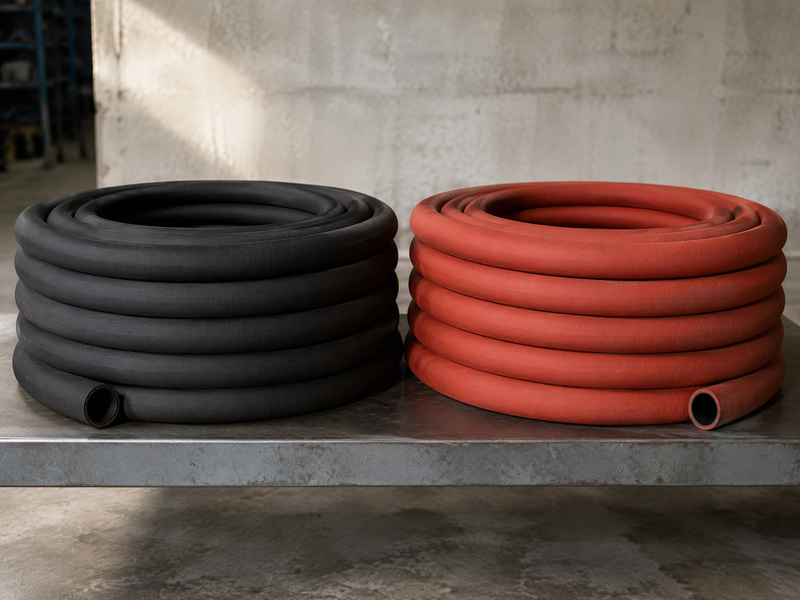
Figure 1. Two hose coils on a storage rack, one with a black cover and one with a red cover, otherwise alike in build.
Scope note: both published steps are saturated-steam windows. The maker lists superheated steam duties as a separate job class and notes the greater thermal demand it places on hose materials. For superheated service, confirm the series and its published ceiling with the maker.
How Do the Two Steps Map to ISO 6134 Type 1 and Type 2?
ISO 6134 defines two steam hose types, and the maker’s two steps line up with them. Type 1 is the low-pressure steam hose, with a maximum working pressure of 0.6 MPa, which equals 6 bar, at 164 °C. Type 2 is the high-pressure steam hose, with a maximum working pressure of 18 bar at 210 °C. The type is defined by the pressure and temperature pair.
That alignment matters because the standard and the maker describe the same two duties. On the Trelleborg steam hose side, STEAM 6 sits at the Type 1 pairing of 6 bar and 164 °C, and STEAM 16 sits at the Type 2 pairing of 18 bar and 210 °C. In imperial units, 18 bar reads as 261 psi and 210 °C reads as 410 °F, both calculated.
The maker publishes each temperature window; the pressure figures in this mapping come from the standard.
Table 2. The two steps mapped to ISO 6134 Type 1 and Type 2.
| ISO 6134 type | Maximum working pressure | Temperatura | Mapped published step |
|---|---|---|---|
| Type 1 | 0.6 MPa (6 bar) | 164 °C | STEAM 6 |
| Type 2 | 18 bar (261 psi, calculated) | 210 °C (410 °F, calculated) | STEAM 16 BLACK and STEAM 16 RED |
Read the two rows side by side and the design intent becomes clear. The lower step is sized for cleaning and circulation lines that never leave the saturated band. The upper step is sized for high-pressure steam, where pressure and temperature rise together. A planner who knows only the standard can still specify the right step.
National standards sit alongside the international one. BS 5342 is the UK steam rubber hose standard that appears beside ISO 6134 in maker catalogs. When a datasheet cites both, the published pressure and temperature pair is the item to compare, not the standard label.
The same mapping helps when a supplier quotes a hose without a type label. Ask for the published pressure and temperature pair, then match it to Type 1 or Type 2. If the pair matches neither, order against the stated pair and leave the type label to the maker’s datasheet.
Before ordering against either pairing, it helps to review how rating and failure differ on the working pressure vs burst pressure guide.
How Do You Size a Line Against Two Pressure Steps?
Sizing becomes a two-question exercise instead of a material debate. First, find the saturated steam pressure and its matching temperature for the line. Second, choose the step whose published window covers both. If the line is ever cleaned at high pressure, plan for the upper step even when normal running is gentle.
A steel braid steam hose behaves differently in each step. On the lower step, the reinforcement carries a modest pressure load while the tube carries the thermal load. On the upper step, both loads rise together, so a similar-looking hose has a harder job. The steam hose temperature margin, not the bore size, is usually the deciding figure.
A Trelleborg steam hose picked for the wrong step still looks correct on the outside. The cover and the coupling can look identical across the two steps, because the architecture is shared. The window printed on the layline is the only reliable tag. For bore selection itself, use the hose size selection guide.
Table 3. What changes and what stays the same across the two steps when you size a line.
| Sizing decision | Lower step | Upper step | Why it matters |
|---|---|---|---|
| Running pressure | 6 bar, Type 1 pairing | 18 bar, Type 2 pairing | Sets the reinforcement load |
| Temperature ceiling | 164 °C | 210 °C | Sets the tube limit |
| Superheated service | Not the published duty | Not the published duty | Superheated steam adds thermal load |
| Coupling type | Assembly rating can fall below the hose rating | Same caution applies | Band and clamp joints reduce assembly pressure |
| Drain after use | Required | Required | Residual liquid causes popcorning |
The table shows that most sizing decisions are the same on both steps. Only the pressure and temperature rows change. That is the practical value of a two-step range: the installer learns one pattern and applies it twice.
Sizing also depends on how the line is used, not only on its design point. A line that runs at a steady saturated condition looks simple on paper, but cleaning cycles, warm-up, and valve operation all add short excursions. Planning against the published ceiling gives those excursions room.
Keep a short specification note with each line. Record the duty, the published step, the pressure and temperature pair, and the cover code. When the line is replaced, the note answers the sizing questions without a second site survey.
Trelleborg Steam Hose Construction and Cover Codes
Both published steps share one construction pattern, and the maker states it in the same terms for each. A synthetic EPDM tube carries the steam. Steel braid reinforcement carries the pressure. A synthetic EPDM cover protects the braid, and the maker publishes a fabric-impression finish. The BLACK and RED names are color codes rather than performance grades.
A steel braid steam hose also needs a way out for the steam that crosses the tube wall. Steam hose practice is to vent the cover with a perforated or pin-pricked finish for exactly that reason. Without the vent path, permeating steam lifts the cover and causes blistering or delamination.
For this family, confirm the cover vent on the datasheet. A steam transfer hose specified for the upper step carries the same layers as the lower-step version, so the layer order alone cannot separate the two.
Table 4. Steam hose construction by layer, with the recognition clue for each layer.
| Layer | Material | Function | How to recognize it |
|---|---|---|---|
| Tube | Synthetic EPDM, smooth | Carries steam and resists heat and aging | Smooth bore at a cut end |
| Refuerzo | Steel braid | Carries the pressure load | Metallic braid visible at a cut end |
| Cover | Synthetic EPDM, fabric-impression finish | Protects the braid and resists abrasion | Fabric-impression surface in black or red |
| Cover venting (general practice) | Perforated or pin-pricked finish, standard practice | Vents steam that permeates the tube wall | Small pin holes across the cover |
| Marcado | Printed layline | Names type, pressure, and temperature | Print names the family and color code |
The construction table is worth keeping at the bench. When a hose arrives, the layer order tells you what it is for. The cover finish is published as fabric-impression, so the texture alone will not separate steam duty from other wrapped hoses. The printed layline then confirms the step.

Figure 2. Two cut hose ends at the same scale, so the layer stack can be compared when a hose is replaced.
Keep the layline legible, because it is the field shortcut for the published window. Avoid drag points and sharp bends at the rack, where abrasion can wear the print away. If the print fades, replace the identification rather than guess the step from the cover color alone.
Building an Equivalent Two-Step Steam Range
You can reproduce the same two-step logic from any catalog. Start from the duty, set the pressure and temperature ceiling, and then choose the construction that reaches it. Our steam line follows the same duty-first split, so the pairings in Table 5 can be ordered as written.
Table 5. Building a two-step steam range from a general catalog.
| Step | Duty to state | Pressure and temperature to specify | Construction to request |
|---|---|---|---|
| Lower | Cleaning and circulation | 6 bar at 164 °C, the Type 1 pairing | Heat-resistant tube, steel braid, vented cover |
| Upper | High-pressure steam | 18 bar at 210 °C, the Type 2 pairing | Same pattern with a higher-temperature tube |
| Both | Fittings and sizes | Match both steps to one size series | Couplings rated for the assembly |
The upper step is where a steel braid steam hose earns its place, because the braid carries the higher pressure load and the tube holds the higher temperature. For a single line that must serve both duties, specify the upper step and accept the wider published window. For a dedicated cleaning circuit, the lower step is enough. A Trelleborg steam hose buyer faces the same fork, and the logic transfers.
Two ready examples are the EPDM steam hose 170 °C and the EPDM high temperature steam hose 230 °C. Both are built on the pattern we use across the line: an EPDM or CR tube, wire reinforcement, and a pin-pricked cover.
The two-step approach also simplifies spares. If both steps share one size series, a single set of couplings and clamps covers the site. That reduces the chance of fitting a lower-step hose with an upper-step coupling, or the reverse, which is a common field error.
Write the two steps into the maintenance plan as well. The drain rule, the coupling rule, and the inspection interval do not change between steps, so one plan covers both. The only step-specific item is the printed ceiling on the layline, which should match the duty written on the line card.
Steam Transfer Hose Duties: Saturated, Superheated, Heating, Cleaning
The maker lists four duties and treats them as different jobs. Saturated steam service is the everyday case, where pressure and temperature move together along the saturation curve. Industrial heating is steady, low-shock work. Steam cleaning adds intermittent high-pressure bursts. Superheated steam duties sit apart from the other three.
The steam hose temperature requirement climbs with each duty. Saturated service stays inside the published window of the chosen step. Cleaning cycles and valve operation add short pressure spikes that the step’s ceiling must absorb. Superheated service is different in kind, because the maker notes that superheated steam puts greater thermal demands on hose materials.
That note is the reason a Trelleborg steam hose is not sold on material alone. Two hoses with the same EPDM tube and the same steel braid can still be rated for different duties, because the published ceiling sets the limit. For the saturated case in detail, see the guide to EPDM steam hose for saturated steam.
Cleaning duty deserves a closer look, because the name covers two different setups. A fixed cleaning line uses plant steam at a steady condition, while a portable steam cleaner can run hotter and harder between cycles. The maker’s published duty list separates steam cleaning from the other three duties, which is a useful reminder to check the cleaning setup separately.
Heat is not the only variable. Condensate return lines can expose a hose to warm, wet conditions for long periods, which is a different stress from a steam burst. The published windows describe the steam duty, so choose the step for the steam, then check the outside conditions separately.
Maintenance Rules That Protect the Trelleborg Steam Hose Line
One rule matters more than any other: drain the hose after every use. Residual liquid left inside a steam hose causes popcorning, a blistering failure in the tube that ends the hose early. The same instruction appears in published literature for other steam hose families, which shows how common the mistake is.
Couplings deserve the same care. A band or clamp connection can pull the assembly working pressure below the rating of the hose itself. General quick-acting couplings are not for steam service. Match the fitting to the step, and re-check the assembly rating after any field repair.

Figure 3. A band clamp drawn up over a hose shank; the joint has to be re-rated before the line goes back into service.
Two industry guides support these habits. ARPM IP-11-1 covers the use, testing, and inspection of steam hose, and the NAHAD Industrial Hose Assembly Guidelines cover the coupling side of the same problem. Neither guide replaces the maker’s datasheet, but both give inspection intervals and failure checks a written basis.
Nothing here replaces the maker’s datasheet. The published window is the starting point, and the site conditions decide the rest. Store steam hoses drained and straight, inspect the cover for blisters before each shift, and never leave a hose pressurized overnight.
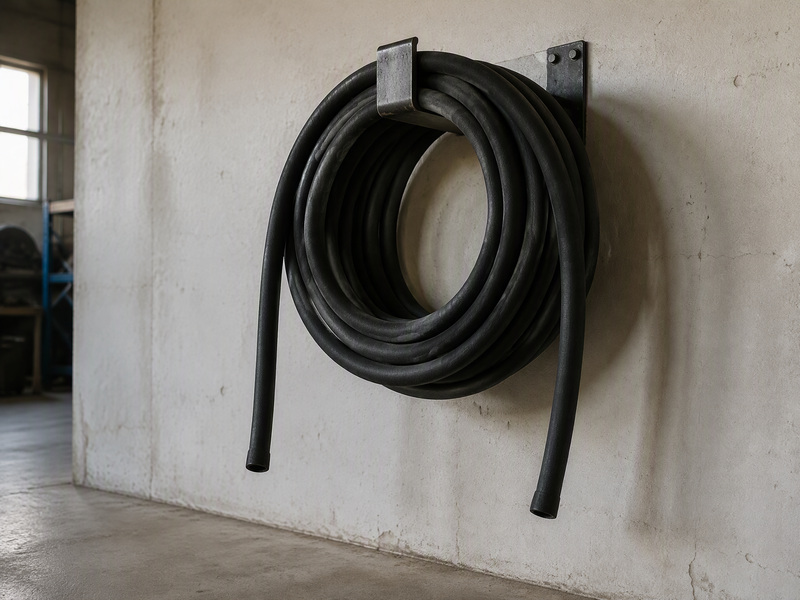
Figure 4. A hose stored on a wall bracket with both ends left open, so any condensate can run out between shifts.
Record every failure and what caused it. A tube failure near the coupling usually points to a fitting problem, while a blistered cover points to trapped steam or missed drainage. Reading the failure location shortens the next diagnosis.
Trelleborg Steam Hose FAQs
What does the industrial range include?
The Trelleborg industrial range includes two published pressure steps plus supporting family members. STEAM 6 serves heavy-duty industrial cleaning and circulation. STEAM 16 BLACK and STEAM 16 RED serve high-pressure steam. The maker also lists S 2096, BIOVAST, and PETROVAST inside the same steam program. Together they cover four stated duties, from saturated steam service to steam cleaning.
How does the range split by pressure?
The split follows duty rather than material. The lower step is published for cleaning and circulation and matches ISO 6134 Type 1 at 6 bar and 164 °C. The upper step is published for high-pressure steam and matches ISO 6134 Type 2 at 18 bar and 210 °C.
What does STEAM 16 add over STEAM 6?
STEAM 16 raises the published ceiling from 164 °C to 210 °C and matches the high-pressure Type 2 pairing at 18 bar. It keeps the synthetic EPDM smooth black tube and the steel braid reinforcement of the family. The cover is published in black or red, under the BK and RE color codes.
What is the difference between the black and red versions?
The maker publishes the same temperature window and the same construction for both. Color is the only published difference, and BK and RE are listed as the standard color codes. Pick the color your site marking plan already uses, then keep that choice consistent along the rack.
Why does this range use steel braid reinforcement?
A steel braid steam hose uses the braid to carry the pressure load. On the lower step the braid handles a modest load while the tube handles the heat. On the upper step both loads rise together, so the braid works harder. The tube still sets the thermal ceiling.
How does the range map to ISO 6134?
The two steps pair with the two types that carry the same numbers. STEAM 6 shares the Type 1 pair, 0.6 MPa at 164 °C, and STEAM 16 shares the Type 2 pair, 18 bar and 210 °C. The type labels come from the standard; the temperature windows come from the maker, so a planner can work from either one.
What is a steam transfer hose rated for?
For this range, the rating depends on the step you choose. The lower step is published from -30 to +164 °C, which covers cleaning and circulation lines. The upper step is published from -30 to +210 °C, which covers high-pressure steam. In each case the rating is the maker’s published window rather than a universal steam figure.
Why is the steam hose temperature ceiling so important?
The ceiling decides which step fits. Both published windows share a -30 °C floor, so the cold end rarely separates them. The upper limit does: 164 °C on the lower step and 210 °C on the upper step. Size against the ceiling first, then confirm pressure, because superheated steam adds thermal load.
How do I keep the hose from failing early?
Two habits cover the common failure modes. Drain after every use, because liquid left in the bore blisters the tube from the inside and shortens its life. Inspect the cover at each shift change, and treat every field repair as a reason to re-check the assembly rating rather than the hose rating alone.
Can I build the same range from another catalog?
Yes, if the two duties are kept apart from the start. Name the cleaning duty and the high-pressure duty separately, then ask for a saturated series and a higher-temperature series. Keep one size series across both, so the same fittings serve either step.
About HENGHUA
HENGHUA is a hose and coupling manufacturer serving distributors, retailers, and OEM brands worldwide. Our steam line is built with an EPDM or CR tube, one to two layers of wire braid or four to six layers of wire spiral, and a pin-pricked cover. Bore sizes run from 3/8 in to 4 in. Saturated steam service is covered to 210 °C and superheated steam to 230 °C, and a separate food-grade series serves food and beverage work.
Our quality systems are ISO 9001, IATF 16949, and ISO 14001, and the factory covers 35,000 m² with 95 production lines and exports to more than 70 countries. An in-house laboratory runs hydrostatic tests to ISO 1402 and impulse tests to ISO 6803. We offer factory-direct pricing, short batch lead times, and a warranty, along with OEM/ODM support, custom lengths to a ±1% length tolerance, cover printing, and private label.
Learn more about our manufacturing base on the about page, then Solicita un presupuesto y muestras gratuitas.
 English
 Spanish
 Portuguese
 French
 German
 Arabic
 Russian
 Indonesian
 Japanese
 Korean