
Cryogenic hose insulation decides how much product boils away, and the cryogenic overview sets the wider context between the tank and the point of use. It also decides the weight, the flexibility and the maintenance burden of the assembly. Three methods are used in practice, and each suits a different balance of transfer frequency, route and budget.
This guide compares them on heat leak, weight, handling and failure modes. It is a technical overview: the figures that matter come from the manufacturer, and this page tells you which figures to ask for.
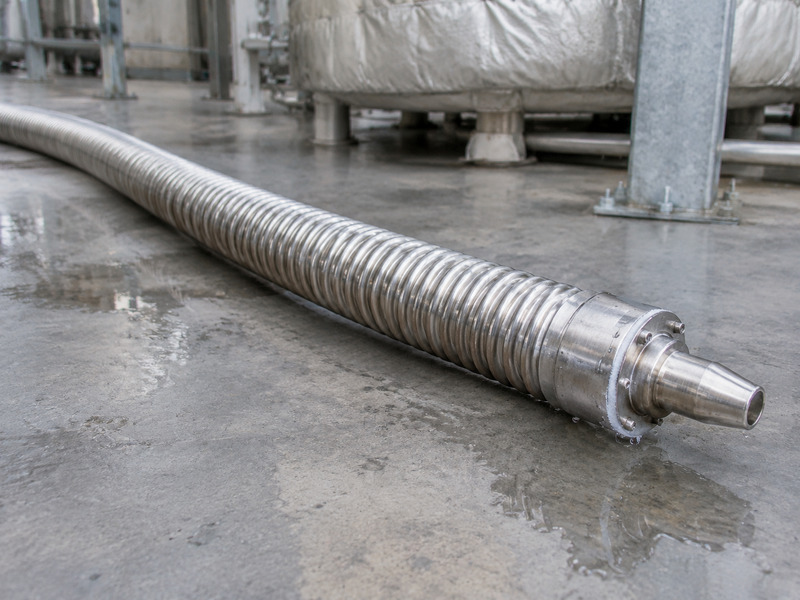
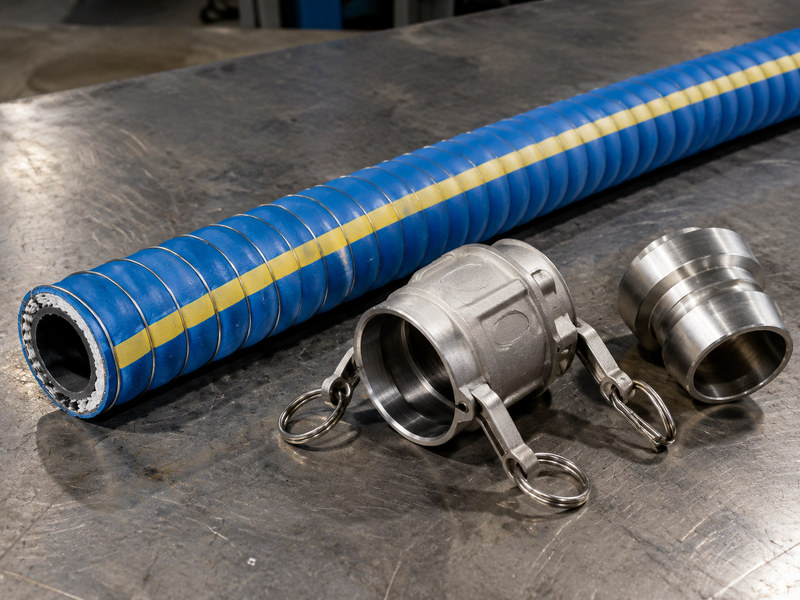
Figure 1. A vacuum jacket on a bayonet connection. The silver surface is the outer wall of a vacuum space, not a cosmetic finish.
Why Does Insulation Matter So Much?
Because the product is at its boiling point, and any heat that reaches it turns liquid into gas.
That gas is boil off gas. It changes the composition of what remains, raises pressure in a closed system and represents product that was paid for and never delivered.
The economics are simple: a poorly insulated line loses more product per transfer, and the loss is continuous while the line is cold. Over a year of frequent transfers, insulation dominates the total cost of ownership.
What Methods Are Used?
Three.
A vacuum jacketed hose surrounds the core with an evacuated space, and the LNG comparison shows where that construction sits against metal and an outer wall. With a good vacuum, heat leak is very low, and the jacket also protects the core mechanically.
An aerogel insulation hose wraps the core in a nanoporous blanket, a porous solid that insulates by trapping still air in nanometre pores, then in an outer jacket; the temperature review explains why the duty is so unforgiving. Heat leak is low and the assembly stays flexible, but performance depends on the blanket staying dry and undamaged.
Foam and wrapped elastomeric insulation are the simplest and cheapest, with the highest heat leak. They suit short, infrequent transfers where the loss is tolerable.
How Do They Compare?
| Attribute | Vacuum jacketed | Aerogel wrap | Foam or elastomer |
|---|---|---|---|
| Heat leak | Mínimo | Bajo | El más alto |
| Peso | Alto | Moderado | Bajo |
| Flexibilidad | Bajo | De moderado a alto | Alto |
| Cooldown time | Longer, mass to cool | Moderado | Short |
| Damage tolerance | Jacket breach kills vacuum | Blanket sensitive to moisture | Cuts and tears easily |
| Maintenance | Vacuum check | Visual and dryness | Visual |
| Coste relativo | El más alto | Moderado | Mínimo |
| Exception | A route that must move every shift | A site with no vacuum port to read | A duty where any boil-off at all is unacceptable |
Table 1. Cryogenic hose insulation methods compared. The rows that decide most projects are heat leak and damage tolerance.
A vacuum jacketed hose wins on performance and loses on weight and repair. An aerogel insulation hose sits in the middle and is often the practical choice for a route that has to move.
Where Does the Vacuum Fail?
A vacuum jacket depends on its vacuum, and the vacuum depends on the jacket being intact.
Three failures occur. A puncture or a scuff through the outer wall, which lets air in. A seal failure at a fitting, which does the same more slowly. And outgassing from materials inside the space, which degrades the vacuum over years even without damage.
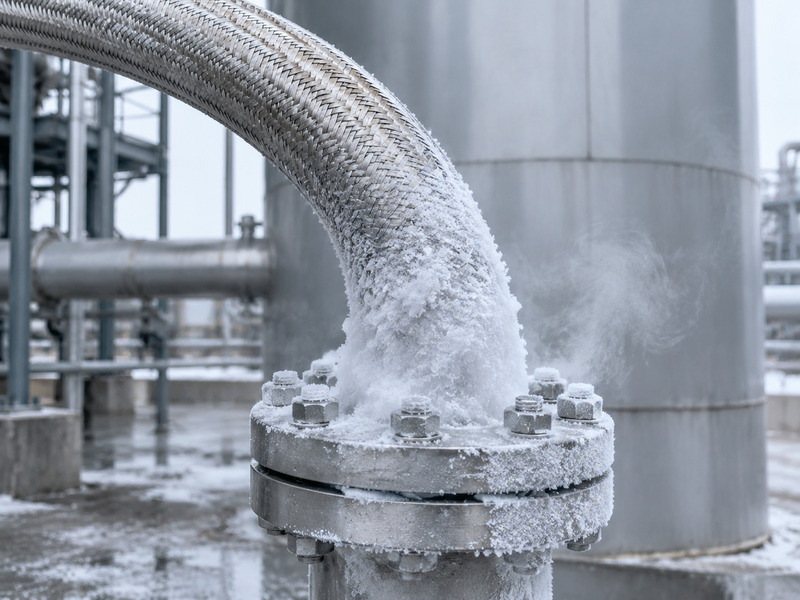
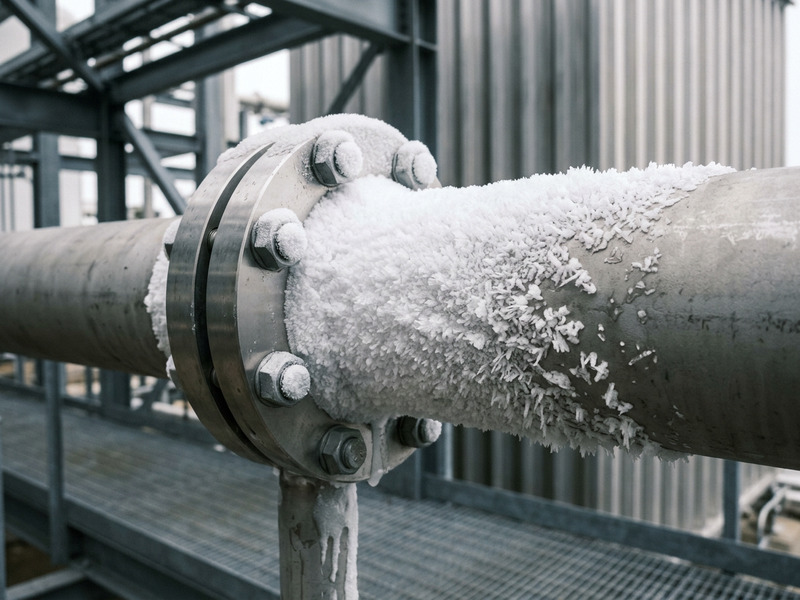
The symptom is frost where frost should not be, and the diagnostic is a vacuum reading. That is why a jacketed assembly needs a maintenance procedure that includes a vacuum check rather than a visual inspection alone.
Where Does Aerogel Fail?
Moisture, mostly.
A nanoporous blanket insulates by trapping gas in very small pores. Water filling those pores destroys the performance, and water arrives through condensation, through a jacket breach or through cleaning.
An aerogel insulation hose therefore needs a sealed outer jacket and a storage habit that keeps it dry. A hose stored on a wet floor for a season may look sound and insulate poorly.
The second failure is compression. A blanket that has been stood on or clamped tightly loses thickness and performance in that area.

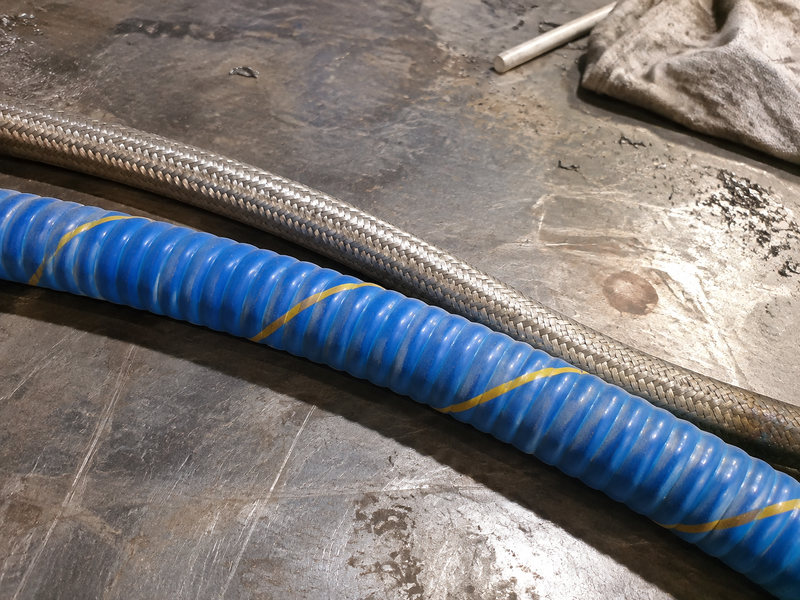
Figure 2. Two assemblies side by side: a silver jacket and a wrapped blanket. Each method fails through the layer that does the work.
How Do You Choose?
Four questions.
How often is the line used? Frequent transfers justify the lowest heat leak; occasional ones do not.
Does the route move? Movement favours flexibility, which favours aerogel or foam over a rigid jacket.
What is the consequence of a boil-off overshoot? A closed system with a tight pressure budget needs the best insulation available.
And who maintains it? A vacuum jacket needs a vacuum check; a blanket needs dryness. Choose the method the site can actually maintain.
| Duty pattern | Sensible insulation | Motivo |
|---|---|---|
| Daily transfer, fixed route | Vacuum jacketed | Lowest heat leak |
| Weekly transfer, moving route | Aerogel wrap | Flexibility and weight |
| Occasional top-up | Foam | Loss acceptable |
| Continuous cold line | Vacuum jacketed | Steady-state performance |
| Temporary or rental | Foam or aerogel | Handling risk |
| Exception: continuous cold on a moving route | Vacuum jacketed with a flexible coupling | Steady state wins over handling here |
Table 2. Cryogenic hose insulation by duty pattern. The second row is where most terminals land.
What Figures Should You Ask For?
Three figures decide an insulation choice, and each needs its conditions stated with it. Cryogenic hose insulation is not compared on a material name.
The heat leak or boil-off figure, per metre and per unit length, at the duty temperature. The cooldown time and the coolant required. And the weight per metre, because it decides handling and support.
Ask also for the maintenance procedure and the acceptance criteria. An insulation claim without a maintenance path is a purchase, not a specification.
How Does Cooldown Interact With Insulation?
Insulation slows heat coming in; it also slows the assembly cooling down, because the insulated mass has to be chilled before liquid arrives.
A vacuum jacketed hose has more mass and a longer cooldown. An aerogel wrap is faster. Foam is fastest and loses the most afterwards.
That trade matters on a route with frequent short transfers. A line that takes an hour to cool for a twenty-minute transfer spends more time cooling than working, and the coolant consumed in cooldown is a real cost.
Two habits reduce it. Keep a line cold between transfers where the system allows, rather than warming and re-cooling. And size the insulation for the transfer pattern rather than for the worst case, because over-insulation costs time on every duty.
What Does a Vacuum Jacketed Hose Need?
Three things, and all three are procedural.
A vacuum reading at commissioning, recorded, so degradation can be measured rather than guessed. Repeat that reading on a fixed interval: a drop against the commissioning figure is the only warning a jacket gives before frost appears. A route that protects the jacket from abrasion, because a scuff is a slow leak to atmosphere. And a rule that the jacket is never a lifting point and the assembly is never dragged.
The jacket is the working part, not the packaging. A site that treats it as packaging loses the insulation within a year and blames the product.
Where a jacketed assembly is stored, keep it supported and capped. A jacket that sits on a wet floor picks up moisture at the seals, and moisture at the seal is where the vacuum goes first.
How Do You Inspect Insulation in Service?
Four checks, and none requires opening the assembly.
Look for frost where frost should not be: at a fitting, along the jacket, or at a support contact point. Frost is the visible evidence of heat leak.
Check the outer surface temperature if a contact thermometer is available. A cold spot on the jacket is a local failure.
Read the vacuum where a port exists, and record it against commissioning. A trend is more useful than a single figure.
And check the physical condition: scuffs, cuts, crushed sections and damaged seals.
A boil off gas line is inspected the same way, with one addition. Because it is cold continuously, a small defect shows earlier, and a frost patch on a vapour line is often the first sign of a jacket problem.
Where Does Specification Usually Go Wrong?
Three ways.
Specifying insulation by material name rather than by performance, which makes offers incomparable. Ignoring the maintenance requirement, which produces an assembly the site cannot keep working.
And forgetting the fittings, which are the largest local heat leak on any insulated assembly and the most damaged part of it. Each is corrected by writing the requirement rather than the product, and by asking for the maintenance procedure with the offer.
What Does the Maintenance Plan Look Like?
An insulation system that is not maintained degrades quietly. The plan depends on the method, and the difference is worth writing down before purchase.
For a jacketed assembly there are four items: a commissioning vacuum reading, an annual reading, a visual check of the jacket at every transfer, and a standing rule against slinging the assembly from its jacket. A cryogenic hose insulation specification that omits the vacuum port makes all four impossible.
For an aerogel wrap there are three: a visual check for jacket damage, a dryness check at storage, and a rule that keeps the assembly off wet floors. A wrapped hose that has been stored badly insulates poorly and looks fine.
For foam, replacement on damage rather than inspection, because foam damage is obvious and repair is rarely economic.
In all three cases, record the condition at each transfer. A cryogenic hose insulation problem announces itself as frost weeks before it becomes a pressure problem, and the record is what makes that visible.
El standards map shows which documents sit behind these routines, and the datasheet guide shows where the insulation figure belongs.
How Should an Insulated Assembly Be Stored?
Storage damages more insulated assemblies than service does, and the damage is almost always preventable with three habits and a dry floor. A store that treats insulation as packaging will pay for it at the tank.
Three habits prevent most of it. Keep the assembly off the floor, on a rack or a pallet, because a wet floor attacks the outer layer and the seals at the same time. Cap the ends, because a fitting that fills with grit is a fitting that will not seat. And avoid tight coiling, because the outer layer creases where it bends and a crease is where it fails first.
A tie-down strap is the fourth problem, and it is the one most often created by the store itself. A strap pulled hard enough to hold a coil will compress the outer layer along one line, and that line is where performance drops. Use a wide soft strap and enough of them that the coil does not need to be tight.
Keep the storage area dry and out of direct sun, and keep the rack clear of the walkway so the assembly is not knocked. Ultraviolet light degrades most outer jackets, and a jacket that has chalked is a jacket that will crack at the next bend.
Record the inspection with the assembly number, so a condition found later can be traced to a delivery rather than blamed on the last shift. Inspect before installation, not after. A frost mark on a stored assembly is impossible, but a scuff, a crushed section or a displaced seal are all visible, and each is cheaper to reject at the store than to diagnose at the tank. Write the maintenance method into the purchase order: a vacuum port, an annual reading or a dryness check, whichever the site will actually do.
Preguntas frecuentes
Which insulation is best for LNG?
Vacuum jacketing gives the lowest heat leak. Aerogel is a practical compromise where flexibility and weight matter.
Is a boil off gas line insulated the same way?
It is insulated, and the requirement is different: the duty is continuous cold rather than a transfer, so steady-state performance matters more than cooldown.
Can a vacuum jacket be repaired?
Rarely in the field. A jacket breach usually means returning the assembly for repair or replacement.
Does insulation affect the hose rating?
Not the pressure rating, but it affects the temperature at the outer surface and therefore the handling and the surrounding equipment.
How is heat leak measured?
By the manufacturer, on a test rig, in defined conditions. Ask for the conditions as well as the figure.
Does a thicker blanket always insulate better?
Only while it stays dry and uncompressed. Beyond a point, thickness adds weight and stiffness with little gain.
What is the most common insulation failure?
A jacket breach, from handling, from abrasion on a support or from a fitting seal.
About HENGHUA
Ambient composite hose is what HENGHUA builds; insulated cryogenic assemblies are not in the range. We can specify the ambient lines around a cold system and will say clearly where the insulation question belongs to another supplier.
For a cryogenic project, ask for the heat leak, the cooldown and the maintenance procedure, and choose the method the site can keep working.

 English
 Spanish
 Portuguese
 French
 German
 Arabic
 Russian
 Indonesian
 Japanese
 Korean