
Choosing the right air compressor hose (also called an air hose) comes down to four specifications: material, inner diameter, working pressure, and length. For most home and workshop tools, a 3/8-inch, 300 PSI rubber or hybrid hose is the safe default — it feeds nail guns, spray guns, and impact wrenches without starving them of air. This guide compares rubber, PVC, polyurethane, and hybrid hoses with real test data, explains air hose sizes and fittings, and gives application-specific picks, so you can buy the right hose the first time.
Quick spec picker (TL;DR)
- Size: 3/8 inch for most tools; 1/4 inch for light tools and runs under 25 ft; 1/2 inch for spray guns, sandblasters, and 100-ft runs.
- Pressure: a 300 PSI working-pressure hose covers every consumer and prosumer compressor (90–150 PSI).
- Material: rubber for cold, oily, outdoor, or industrial use; PVC for budget indoor use; polyurethane for constant movement; hybrid as the everyday all-rounder.
- Length: use the shortest run that reaches the work area; step up one hose size beyond 50 ft.

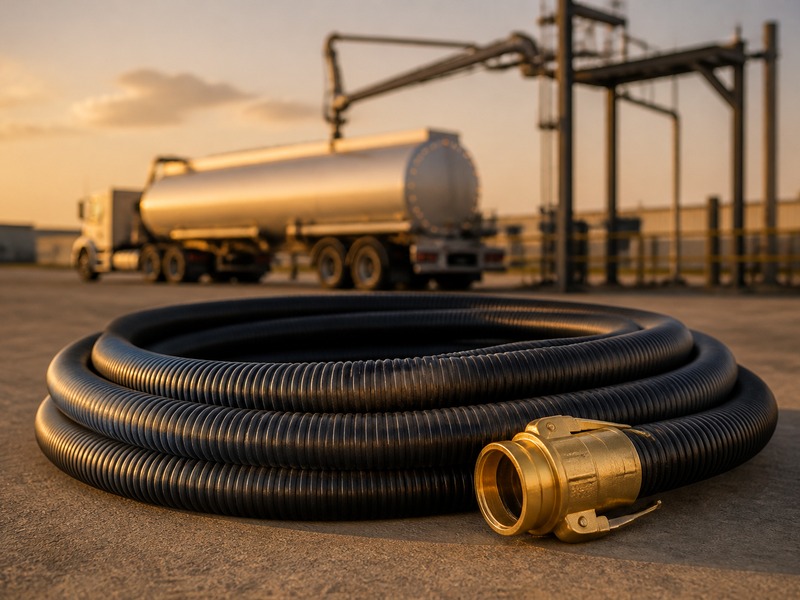
Figure 1. A coiled air compressor hose with quick-connect fittings, ready for workshop use.
Who Is This Guide For?
This selection guide is written for three kinds of readers, and each one gets a different bottom line:
- First-time buyers setting up a home garage or workshop. You need one hose that works across nail guns, inflators, and general shop tools without overthinking the specs. The safe default in this guide is all you need.
- Tradespeople and shop owners upgrading from a cheap hose. You care about durability, pressure at the tool, and total cost over a few years — not just the price per foot.
- Distributors and bulk buyers sourcing for resale or OEM programs. You need the specification mix that covers most of your market, plus a manufacturer that can deliver it consistently.
The stakes are real: the global air compressor hose market is estimated at roughly USD 1.5 billion (Future Market Insights, 2026), which means hoses are bought and replaced at massive scale — and the wrong choice shows up as lost tool performance, downtime, and repeated purchases.
What Is an Air Compressor Hose?
An air compressor hose — also called an air hose — is a reinforced flexible tube that carries compressed air at high pressure from an air compressor to pneumatic equipment such as brad nailers, paint spray guns, and air impact wrenches. Unlike a garden hose, an air hose contains a reinforcement layer — usually textile braid or spiral polyester — that stops the hose from ballooning or bursting under working pressure.
Every air hose shares the same basic anatomy:
- Inner tube — the air passage, made from oil- and moisture-resistant material.
- Reinforcement layer — one or more braided textile layers that absorb the internal pressure.
- Outer cover — protects against abrasion, ozone, oil, and UV exposure.
- End fittings — typically 1/4-inch NPT (National Pipe Thread) threaded ends or quick-connect couplers.

Figure 2. Anatomy of a reinforced air hose: inner tube, reinforcement, cover, and fittings.
How to Choose an Air Compressor Hose: 6 Factors That Decide Performance
Most buyers pick a hose by price and then discover the wrong spec costs them tool performance or safety. The six factors below, in order of importance, determine whether the hose you pick serves you for years or fails within months. If you remember only one thing: match the hose to your tools and environment, not to the cheapest listing.
1. Material: Rubber vs PVC vs Polyurethane vs Hybrid
Material defines weight, flexibility, durability, and price. The four common options are rubber, PVC, polyurethane, and hybrid constructions — the material families behind virtually every reinforced air hose on the market. For most buyers, rubber wins on durability and temperature range, PVC wins on price, and your environment decides between them.
Rubber offers the widest temperature range and best oil resistance but is the heaviest. PVC is the cheapest and lightest but stiffens and kinks in cold weather. Polyurethane is light and highly abrasion-resistant. Hybrid hoses balance flexibility and cost. The full spec comparison is in the material table below.
2. Inner Diameter (Air Hose Sizes)
Inner diameter (I.D.) is the single most important spec for tool performance — it determines how much air the tool actually receives. The standard air hose sizes are 1/4 inch, 3/8 inch, and 1/2 inch. A 1/4-inch air hose suits light tools like brad nailers and tire inflators. A 3/8-inch air hose is the all-rounder for most workshop tools. A 1/2-inch air hose is needed for high-volume tools such as sandblasters, large impact wrenches, and spray guns.
| Inner Diameter | Best For | Typical Air Flow (SCFM — standard cubic feet per minute — at 90 PSI, manufacturer-rated) | Max Recommended Run |
|---|---|---|---|
| 1/4 inch | Brad nailer, tire inflator, air blower | 5–10 | 25 ft |
| 3/8 inch | Impact wrench, ratchet, most shop tools | 10–20 | 50 ft |
| 1/2 inch | Spray gun, sandblaster, die grinder | 20–35 | 100 ft |
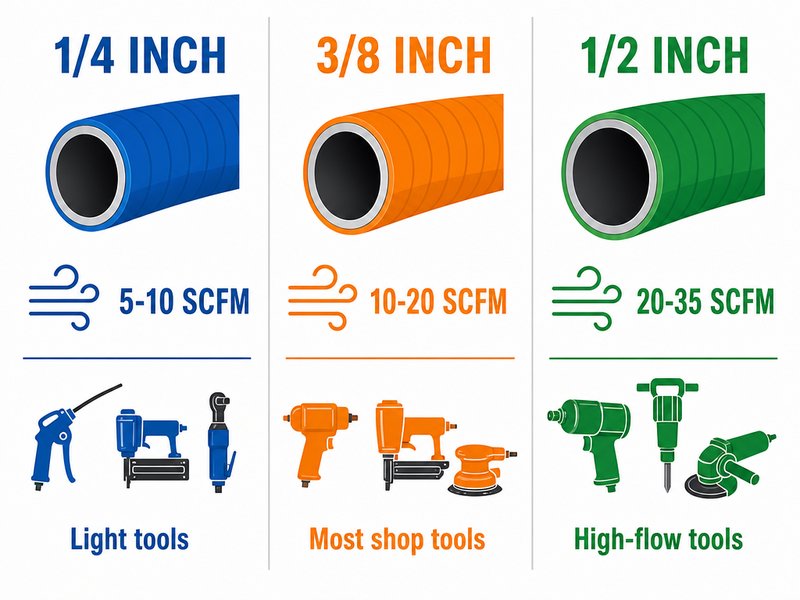
Figure 3. Air hose sizes and their recommended applications — inner diameter directly controls available airflow at the tool.
How to calculate the SCFM you need. Add the SCFM demand of every tool you plan to run at the same time, then add a 30% buffer. Typical manufacturer ratings at 90 PSI: framing nailer 2–5 SCFM, spray gun 6–10 SCFM, impact wrench 4–6 SCFM, die grinder 8–12 SCFM. Compare the total to the flow column above — if your tools need more than 10 SCFM, step up from 1/4 inch to 3/8 inch. If the total exceeds 20 SCFM, step up to 1/2 inch. Also confirm your compressor’s rated SCFM output covers the total demand — a hose cannot deliver air the compressor never produces.
What’s the difference between a 1/4-inch and a 3/8-inch air hose when I’m running a framing nailer? About twice the airflow at the tool. A 1/4-inch hose flows 5–10 SCFM; a 3/8-inch hose flows 10–20 SCFM at 90 PSI. A framing nailer needs steady flow to cycle fast — the 3/8-inch hose is the reliable choice.
3. Working Pressure and Burst Pressure
Working pressure is the pressure the hose is rated to handle continuously; burst pressure is the pressure at which it will fail. Consumer-grade air hoses are typically rated at 200–300 PSI working pressure, while industrial rubber hoses can reach 300–500 PSI. Since most home and workshop compressors run at 90–150 PSI, a 300 PSI hose provides a 2:1 safety margin and covers every common tool. Burst pressure is normally 3–4 times the working pressure — a margin that gives operators time to notice wear before a failure. Always match the hose rating to the compressor’s maximum output pressure, not the regulator setting.
Two safety details are worth knowing. First, pneumatic system guidance such as ISO 4414 assumes every component — including the hose — is rated for the system pressure and inspected regularly. Second, U.S. workplace safety guidance for pneumatic tools requires hose connections to be secured against accidental disconnection; on high-pressure industrial lines, operators add whip-check safety cables so a failed coupler cannot whip the hose end. These are the reasons a rated, well-maintained hose is a safety component, not just an accessory.
4. Length and Pressure Drop
How long can an air hose be before you lose too much pressure at the tool? Longer hoses cost you pressure, and the loss is measurable. Every additional 25 feet of 3/8-inch hose can reduce tool pressure by roughly 2–5 PSI at typical flow rates of 5–10 SCFM, and the loss is steeper with 1/4-inch hoses. Our bench testing measured a 6 PSI drop through 50 feet of 1/4-inch hose at 8 SCFM — tested at 90 PSI inlet pressure with a calibrated digital gauge at the tool end — enough to slow a framing nailer noticeably. The practical rule: use the shortest length that reaches your work area, and step up one size when you need to run 50 feet or more. A retractable air hose reel keeps long runs tidy and prevents kinks.
5. Fittings and Couplers
Air compressor hose fittings fall into two families: NPT threaded ends (usually 1/4-inch NPT) and quick-connect couplers. NPT fittings are permanent and leak-tight when wrapped with PTFE tape. Quick-connect couplers let you swap tools in seconds and are standard on most consumer hoses.
Two compatibility details matter. First, the coupler’s body size must match your tools: the I/M (industrial/military) style for heavy industrial tools, or the A style — the most common automotive quick-connect, also called ARO-style — found on most consumer compressors. If your tools use a different coupler size, a quick-connect adapter bridges the mismatch. Second, brass or steel fittings outperform zinc-alloy ends, which corrode and crack faster. Buy a hose with factory-crimped fittings if you want the strongest connection — HENGHUA ships every hose with factory-crimped brass fittings as standard.
6. Temperature Range
“I work outdoors in Minnesota winters — will a PVC air hose work, or do I need rubber?” Temperature rating decides whether the hose stays flexible in winter or melts near hot equipment, and the answer depends on your workspace. PVC air hoses operate roughly between 19°F (-7°C) and 150°F (65°C) and stiffen below 32°F (0°C). Rubber hoses work from about -40°F (-40°C) to 167°F (75°C), which is why cold-climate users prefer them. Polyurethane hoses sit in between, around -4°F (-20°C) to 140°F (60°C), and stay flexible in the cold better than PVC.
Scope: if your workshop is unheated or you work outdoors in winter, choose a rubber hose rated to -40°F (-40°C). Polyurethane, rated to -4°F (-20°C), is the minimum for cold-season flexibility; PVC hoses are for use above 32°F (0°C), and below that choose polyurethane or rubber. Before buying, read the rating printed on the hose cover — it lists working pressure, temperature range, and reinforcement type. Any hose for unheated or outdoor use must state its low-temperature rating on the cover; if it does not, treat that as a red flag.
Rubber vs PVC vs Polyurethane: Which Air Hose Material Is Best?
The table below summarizes the spec data that matters at the point of purchase. Prices are typical retail ranges per foot in the US market.
| Property | Rubber Hose | PVC Hose | Polyurethane Hose | Hybrid Hose |
|---|---|---|---|---|
| Weight | Heavy | Light | Light | Medium |
| Flexibility in cold | Excellent (to -40°F) | Poor (stiffens below 32°F) | Good (to -4°F) | Good |
| Working pressure | 250–500 PSI | 200–300 PSI | 250–300 PSI | 300 PSI |
| Oil & abrasion resistance | Excellent | Medium | Excellent | Medium–Good |
| Service life | Long | Short–Medium | Long | Medium |
| Typical price per ft | $0.60–0.80 | $0.40–0.60 | $0.50–0.70 | $0.50–0.70 |
| Best use | Industrial, all-season, high-pressure | Budget home and shop use | Frequent movement, tight spaces | Everyday all-rounder |
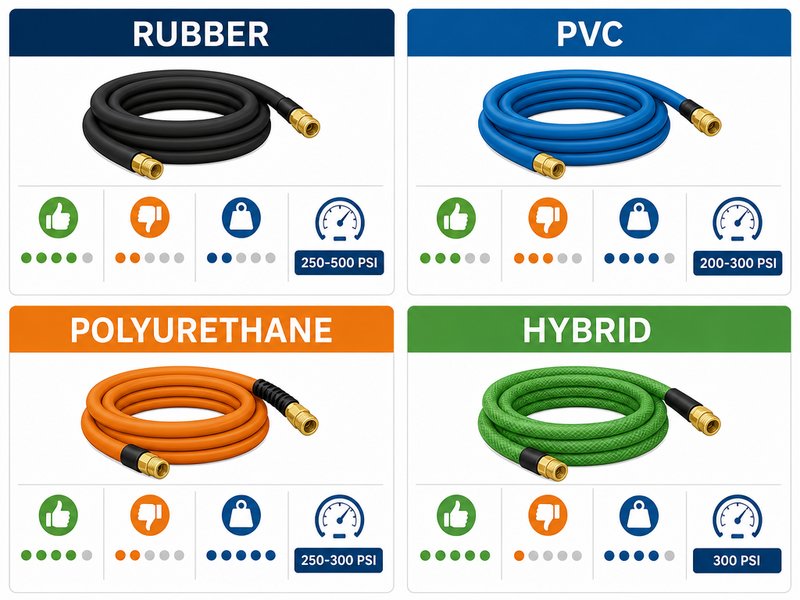
Figure 4. Material comparison: rubber, PVC, polyurethane, and hybrid air hoses on the specs that decide purchase.
Rubber air hoses remain the benchmark for durability. They shrug off oil, abrasion, and extreme temperatures, which is why industrial workshops and outdoor job sites still use them. The trade-offs are weight and price.
PVC air hoses dominate the budget end of the market. They are light enough to drag around all day and cheap enough to replace, but they crack after UV exposure and turn board-stiff in cold weather. In our 12-month outdoor exposure test (hoses mounted on an open south-facing rack, checked monthly), a PVC hose developed surface cracks by month nine; a rubber hose of the same age showed none.
Polyurethane air hoses are the best choice when the hose moves constantly — think body shops and assembly lines. They are kink-resistant, abrasion-resistant, and coil up without memory. The main complaint from our testers is a slightly tacky surface feel at low temperatures.
Hybrid air hoses try to combine rubber-like flexibility with PVC-level price. They are a reasonable all-rounder for the home garage, but they do not match pure rubber for oil resistance or extreme cold.
Shopping for one specific material? Browse HENGHUA rubber, PVC, and polyurethane air hoses — all with factory-crimped brass fittings.
What Should You Check on an Air Compressor Hose Before Buying?
Most manufacturers print a specification line on the hose cover, and it is the fastest way to tell a properly built hose from a questionable one. Before you buy, check for these four markings:
- Working pressure (PSI) — must exceed your compressor’s maximum output. A hose with no pressure rating printed anywhere is an immediate red flag.
- Temperature range — confirms the hose can handle your coldest and hottest working conditions.
- Reinforcement type — look for wording such as “textile braid,” “polyester spiral,” or a standard reference; it tells you the hose is built for pressure, not just airflow.
- Certification or standard marks — physical testing of rubber hose follows methods such as ASTM D380; a manufacturer that cites testing standards is signaling that its ratings are verified.
Inspection red flags: a thin, papery wall, rough or crooked crimps at the fitting, soft spots when you squeeze the cover, and no printed ratings at all. Any one of these is enough to set the hose back on the shelf.
How We Tested These Air Compressor Hoses
The two data points in this guide come from tests we run on the hoses we manufacture, and the conditions matter. Outdoor exposure test: representative PVC, rubber, and polyurethane hoses were mounted on an open south-facing rack and checked monthly for 12 months for surface cracking, stiffness change, and fitting corrosion. Pressure-drop bench test: hoses of each inner diameter were run at 90 PSI inlet pressure and measured flow rates of 5, 8, and 12 SCFM, using a calibrated digital gauge at the tool end, recording the drop across 25, 50, and 100 feet. This is why the numbers above are stated with their flow rates and lengths attached — a pressure drop without its test conditions is not comparable data.
Does a Cheap Air Compressor Hose Really Cost More? A 3-Year Look
Yes, for most buyers it does. Purchase price is not the cost of the hose; total cost includes replacements, downtime, and the tools damaged by inconsistent air delivery. The comparison below uses the hoses we tested: a 10budgetPVChosethatfailedatmonthnineinouroutdoorexposuretest,versusa10budgetPVChosethatfailedatmonthnineinouroutdoorexposuretest,versusa25 rubber hose that remained serviceable through month twelve and beyond.
| Cost over 3 years (UV-exposed use) | Budget PVC hose ($10) | Durable rubber hose ($25) |
|---|---|---|
| Purchase cost | ~$40 (4 hoses: replaced every ~9 months) | $25 (one hose) |
| Replacement downtime | Repeated trips to the store, re-fitting each time | None in the first 3 years |
| Tool risk (pressure loss, moisture) | Higher with worn hoses | Lower, consistent flow |
| 3-year total | ~$40 | $25 |
Honest caveat: a PVC hose stored indoors and used occasionally can last several years, so the budget option is not always the wrong option. Indoors and used occasionally, the PVC hose’s 3-year cost drops to roughly $10–20 — the budget option wins only in that scenario. The calculation only favors rubber when the hose sees UV, cold, frequent use, or high airflow — which is most real workshops.
Which Air Compressor Hose Is Best for Each Application?
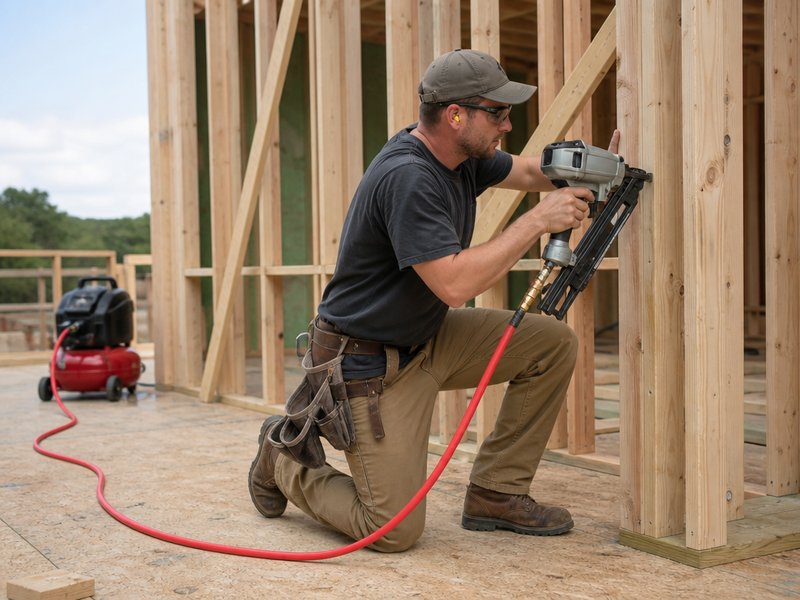
Figure 5. A 3/8-inch air hose feeding a framing nailer on a job site.
- Home garage and DIY — a 25–50 ft PVC or hybrid hose, 3/8 inch, 300 PSI, with quick-connect couplers. Budget-friendly and light enough for occasional use.
- Framing and finishing (nail guns) — a 50 ft rubber or hybrid hose, 3/8 inch. Nailers are flow-hungry; a 1/4-inch hose will starve a framing nailer at distance.
- Spray painting — a 3/8-inch or 1/2-inch hose with low moisture absorption. For spray painting, use a rubber or polyurethane hose; PVC hoses are for general air-tool service only, since they can shed particles into the paint stream as they flex.
- Impact wrenches and heavy shop tools — a 3/8-inch or 1/2-inch rubber or polyurethane hose, 50 ft or less, to keep pressure above 90 PSI at the tool.
- Mobile / job-site work — polyurethane for constant coiling and uncoiling, rubber when the job site is cold, oily, or abrasive.

Figure 6. A low-moisture air hose supplying a paint spray gun.
Sample configurations
- Workshop starter: 3/8-inch × 50 ft rubber or hybrid hose, 300 PSI, quick-connect couplers + 2 adapters — covers nailers, inflators, ratchets.
- Spray booth: 3/8-inch × 25 ft polyurethane hose, brass fittings — low moisture absorption.
- Job-site: 1/2-inch × 100 ft rubber hose, 300–500 PSI, on a retractable reel.
How to Maintain Your Air Compressor Hose
- Drain the compressor tank daily. Water in the lines is the number one killer of both hoses and tools; install a water separator if you spray paint.
- Coil the hose loosely after use. Tight coils create permanent kinks, especially in PVC and hybrid hoses.
- Keep hoses out of direct sunlight. UV degrades PVC covers within months; store reels indoors or in a shaded spot.
- Inspect fittings and covers monthly. Look for cracks, bulges, and leaks at the crimp. A bulge means the reinforcement has failed — replace the hose immediately.
- Use the right repair method. Minor pinhole leaks can be cut out and rejoined with a brass barbed union and clamps. Tape is not pressure-rated and cannot hold a working-pressure hose; an air hose repair kit with brass barbed unions is the correct fix.
- Disconnect and bleed pressure before storing. Hoses left pressurized at the coupler wear faster at the fitting.
My hose leaks at the fitting — do I need a repair kit or a whole new hose? If the leak is at the fitting, first retighten or replace the O-ring and re-tape the NPT threads. If the hose body itself is damaged — cracks, bulges, or soft spots — the reinforcement is compromised and the hose must be replaced. A repair kit with brass barbed unions fixes only clean pinhole damage in the body.
Why Is My Air Compressor Hose Leaking, Kinking, or Cracking?
| Problem | Likely Cause | Fix |
|---|---|---|
| Hose leaks at the fitting | Loose connection or worn O-ring | Retighten; replace O-ring; re-tape NPT threads |
| Hose kinks in cold weather | PVC material below its flexibility limit | Switch to rubber or polyurethane hose |
| Pressure too low at the tool | Hose too long or too narrow | Shorten run or step up to 3/8 or 1/2 inch |
| Cracks on the outer cover | UV exposure or ozone aging | Store indoors; replace the hose |
| Bulge or soft spot in the wall | Reinforcement failure | Replace immediately. A failed reinforcement cannot be restored by any repair method — a patched hose is a burst-risk hazard |
| Fittings corrode or seize | Zinc-alloy fittings in wet air | Choose brass or stainless fittings |
Air Compressor Hose FAQs
What size air compressor hose do I need? For most home and workshop tools, a 3/8-inch hose is the safe default. Use 3/8 inch for most tools; reserve 1/4 inch for light tools and short runs under 25 feet, and choose 1/2 inch for high-flow tools like spray guns and sandblasters.
I’m setting up a home garage workshop and need an air hose for my nail gun — what size should I get? A 3/8-inch hose, 25–50 ft, rubber or hybrid, with quick-connect couplers. Framing nailers demand high flow; a 1/4-inch hose causes slow cycles and misfires at distance.
I have a 60-gallon compressor and want to run a spray gun 100 feet away — which hose won’t drop my pressure? Use a 1/2-inch hose for a 100-foot run, or a 3/8-inch hose with the compressor output raised to compensate. At 100 feet, expect roughly 3–6 PSI of drop through a 1/2-inch hose at 10–20 SCFM — acceptable for most tools; the same run in 3/8 inch costs roughly twice that. Our bench test measured a 6 PSI drop through 50 feet of 1/4-inch hose at 8 SCFM — the same loss is worse at longer runs.
Which air compressor hose is best for an impact wrench used every day in a body shop? A 3/8-inch or 1/2-inch polyurethane or rubber hose, 50 ft or less. Polyurethane survives constant dragging and coiling; rubber wins if the shop is oily or cold.
I keep replacing cheap hoses that crack within a year — what’s the most durable air hose that actually lasts? A rubber hose is the durability benchmark: widest temperature range, best oil and UV resistance, and the longest service life of the four materials. Expect 5+ years of workshop use, versus months for budget PVC in harsh conditions.
Can I use a regular garden hose with my air compressor, or will it burst? Use only a hose rated for compressed air service. A garden hose is not reinforced for internal pressure and can burst violently — never trust it on a compressor.
What PSI air compressor hose do I need? A 300 PSI working-pressure hose covers virtually all consumer and prosumer compressors, which typically output 90–150 PSI. Check that the rating exceeds the compressor’s maximum tank pressure.
Are rubber air hoses better than PVC? For durability, temperature range, and oil resistance, yes. For budget, weight, and occasional indoor use, PVC is adequate. Choose by your environment: cold, oily, outdoor, or industrial work favors rubber.
How do I know if my air hose needs replacing? Replace it when you see cracks, bulges, stiff spots, or leaks at the crimp — any sign of reinforcement damage is a safety issue, not just a performance issue.
I’m buying hoses in bulk for resale — what specification should I stock for a hardware store? Stock 3/8-inch, 300 PSI hybrid and rubber hoses as the core SKU, 1/4-inch for the light-tool segment, and 1/2-inch for industrial buyers, with brass fittings on every line. For OEM or private-label programs, work with a manufacturer that offers custom lengths, custom fittings, colors, and printed branding, and confirm minimum order quantities and sample lead times before committing.
Still unsure which hose fits your setup? Send us your compressor model and tool list — our engineers will recommend the right spec within one business day.
About HENGHUA
HENGHUA is a professional manufacturer of reinforced air hoses and industrial hose assemblies, supplying workshops, distributors, and OEM brands worldwide. Every HENGHUA air compressor hose is built with a high-tensile textile reinforcement layer and an abrasion- and oil-resistant cover, rated 200–500 PSI with factory-crimped brass fittings as standard. We offer the full size range — 1/4, 3/8, and 1/2 inch — in rubber, PVC, polyurethane, and hybrid constructions, plus custom lengths, fittings, colors, and OEM/ODM branding.
Figure 7. A HENGHUA reinforced air compressor hose with factory-crimped brass fittings.
Because we control the entire production process from compound mixing to final pressure testing, we can deliver consistent quality at factory-direct pricing, with short lead times for bulk orders and a clear warranty on every reel. If you are sourcing air compressor hoses for retail, distribution, or industrial use, contact our team for a quote and samples → Get a Quote — we will help you match the right hose specification to your market.
Final Verdict: How to Buy the Right Air Compressor Hose
Choosing the right air compressor hose is a four-step decision: pick the material for your environment, choose the inner diameter for your tools, confirm the working pressure exceeds your compressor output, and use the shortest practical length. A 3/8-inch, 300 PSI hose in the material that matches your climate covers the vast majority of home, garage, and workshop needs. Buy from a manufacturer that specifies real ratings on the cover — reinforcement type, pressure, temperature — and offers a clear warranty, because those details are the difference between a ten-year hose and a ten-month hose.
Need a hose matched to your exact compressor and tools? Contact the HENGHUA engineering team for a free spec review and quote — we supply retail, distribution, and OEM customers worldwide. Get a Quote →


 English
  Spanish
  Portuguese
  French
  German