
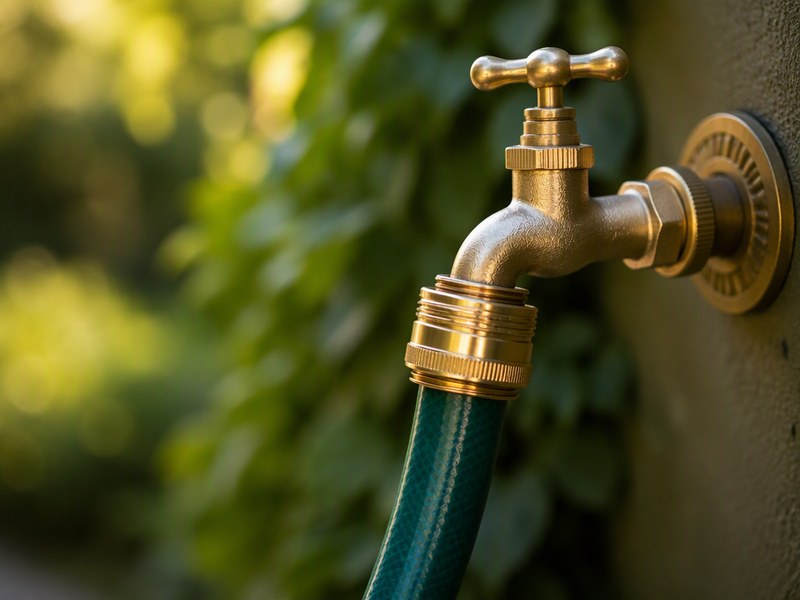
The North American standard is a 3/4-inch GHT thread with 11.5 threads per inch.
Wondering what size garden hose fitting you need for your faucet or hose? Here is the short answer: most North American outdoor faucets and garden hoses use a 3/4-inch GHT (Garden Hose Thread) fitting with 11.5 threads per inch — no matter whether the hose itself has a 1/2-inch, 5/8-inch, or 3/4-inch inner diameter. This guide covers the standard garden hose fitting size, how to measure it, how to read a size chart, which connector types exist, and which adapters convert GHT to NPT, BSP, or metric.
You will also find a decision matrix for choosing the correct fitting, fixes for the most common connection problems, and answers to the questions buyers ask most often.
In This Guide
- The Standard Fitting Size
- What Size Garden Hose Should You Use?
- What Is Garden Hose Thread Size, and Why Doesn’t It Match Pipe Threads?
- How to Measure a Fitting
- Fitting Size Chart
- What Types of Garden Hose Connectors Are There?
- Which Garden Hose Adapter Do I Need?
- How to Choose the Right Fitting
- Why Does My Garden Hose Fitting Leak?
- FAQ: Common Questions
- About HENGHUA and Our Testing
1. What Is the Standard Garden Hose Fitting Size?
The standard in the United States and Canada is a 3/4-inch GHT (Garden Hose Thread) coupling, also known as NH (National Hose Thread). A 3/4 GHT male coupling measures 1.0625 inches (26.99 mm) across the thread crests and cuts 11.5 threads per inch, in line with the ANSI B1.20.7 hose coupling thread standard. This thread appears on virtually every residential outdoor faucet (also called a spigot or hose bib), so the same coupling works across brands — and across the garden hose fittings we cover on this site.
“Fitting size” actually refers to three separate measurements, and confusing them causes most sizing errors:
- Thread size — the GHT coupling on the faucet and hose end, almost always 3/4 inch regardless of hose diameter.
- Hose inner diameter (ID) — 1/2 inch, 5/8 inch, or 3/4 inch; this controls water flow, not the thread.
- Thread type — GHT vs. NPT vs. BSP. The type matters more than the number on the label — use a garden hose adapter to join different thread systems.
GHT threads are straight (parallel). Pipe threads are tapered. Sealing depends on a rubber washer compressed between the male and female faces. That is why most fitting-size mistakes are really three questions in one: which thread, which diameter, and which washer.
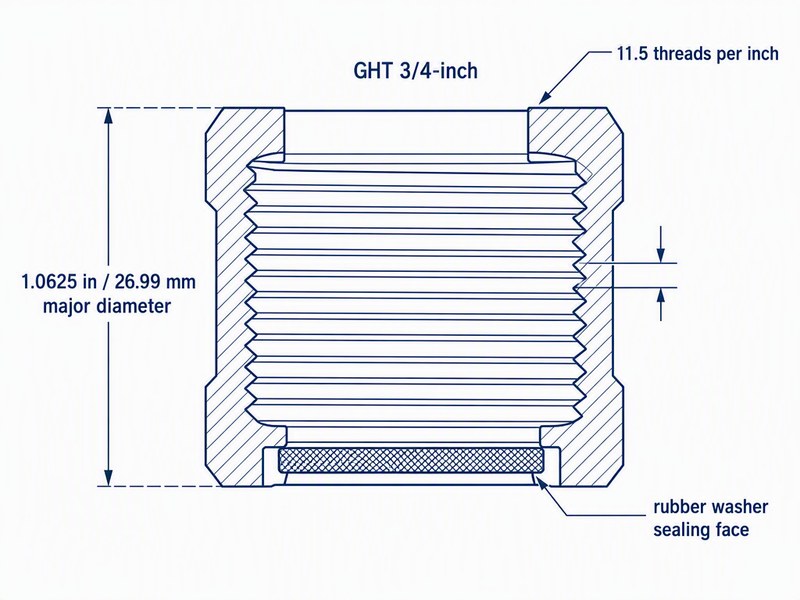
Scope note: the dimensions in this guide apply to the North American (US/Canada) 3/4-inch GHT standard. European, Australian, and imported faucets use BSP or metric threads — see Section 7 for adapter guidance. Before measuring, also check whether your faucet carries a vacuum breaker (anti-siphon) device: some models extend into the outlet and shorten the usable thread depth, so a long coupling can bottom out before the washer seats.
3/4-inch GHT threads are parallel, 11.5 TPI, with a 1.0625-inch major diameter. Sealing relies on a rubber washer, not thread taper.
2. What Size Garden Hose Should You Use? 1/2 vs. 5/8 vs. 3/4 Inch
Garden hose diameter refers to the inner diameter of the hose tube itself. Three sizes dominate the residential market: 1/2 inch, 5/8 inch, and 3/4 inch. The 5/8-inch hose is the most common choice for home use, while 3/4-inch hoses serve high-flow applications such as sprinkler systems, pressure washers, and long supply runs.
Larger diameters move more water at the same pressure, but they are heavier, stiffer, and more expensive per foot. Our field measurements at 50 psi supply pressure over straight hoses produced the practical output ranges below (actual flow falls as hose length grows):
| Hose Inner Diameter | Metric Equivalent | Typical Flow (50 ft, 50 psi) | Typical Flow (100 ft, 50 psi) | Best For |
|---|---|---|---|---|
| 1/2 inch | 12.7 mm | 3–6 GPM (11–23 L/min) | 2–4 GPM (8–15 L/min) | Short runs, watering cans, light-duty watering |
| 5/8 inch | 15.9 mm | 5–9 GPM (19–34 L/min) | 3.5–6.5 GPM (13–25 L/min) | General residential watering, most home tasks |
| 3/4 inch | 19.1 mm | 8–15 GPM (30–57 L/min) | 5–10 GPM (19–38 L/min) | Sprinklers, irrigation, pressure washers, long runs |
Flow figures are HENGHUA 2026 bench measurements: a calibrated flow meter, same-batch hoses, and the average of five runs at 50 psi supply pressure. Real-world flow depends on hose length, fitting restrictions, and local water pressure.
Note that all three hose diameters typically terminate in the same 3/4-inch GHT coupling, so you can connect any of them to a standard faucet directly and step between hose sizes with a simple reducer. For most home watering, a 5/8 inch rubber garden hose balances flow and weight best.
3. What Is Garden Hose Thread Size, and Why Doesn’t It Match Pipe Threads?
Garden hose thread size in North America is standardized as 3/4-11.5 NH (National Hose Thread, the same thread family as GHT). The “11.5” is the thread pitch: 11.5 threads per inch. Because the thread is parallel, it must be tightened face-to-face against a rubber washer to seal. This is the single most important fact to remember when matching fittings. If you are used to plumbing work, note that garden hose thread size is a separate system from pipe threads, even when the nominal numbers look similar.
Other thread systems look similar but are incompatible:
- NPT (National Pipe Thread) — tapered threads used on plumbing, sprinkler manifolds, and some pressure washers. A 3/4-inch NPT thread is 14 TPI, not 11.5, and it seals by wedge action, not with a washer.
- BSP (British Standard Pipe) — the standard in the UK, Australia, and much of Europe. A 3/4-inch BSP thread is also 14 TPI and does not match GHT.
- Metric threads — common on imported faucets and European quick-connect systems; dimensions are in millimeters and are not interchangeable with GHT.
If you force a GHT fitting onto an NPT thread, it will either cross-thread or leak. Use a proper garden hose adapter instead. The table below compares the three main thread families at a glance:
| Thread Standard | Nominal Size | Threads per Inch | Thread Form | Sealing Method |
|---|---|---|---|---|
| GHT / NH | 3/4 inch | 11.5 | Parallel | Rubber washer |
| NPT | 3/4 inch | 14 | Tapered | Thread wedge / sealant |
| BSP | 3/4 inch | 14 | Parallel (BSPP) | Washer or sealant |
The “same” nominal size is not the same thread. A 3/4-inch BSP coupling has a slightly smaller major diameter than a 3/4-inch GHT coupling (about 26.44 mm vs. 26.99 mm) and cuts 14 TPI instead of 11.5, so it will not start on a GHT faucet. This is the most common cross-border sizing trap for buyers who order fittings from overseas catalogs.
Can I use Teflon tape on GHT threads?
No. Apply thread sealant tape only to the tapered NPT side. GHT (Garden Hose Thread) seals with its rubber washer; tape on the GHT side can prevent the washer from seating and cause a leak.
If you are not sure whether your faucet is GHT or NPT, our GHT vs NPT thread differences guide compares both systems side by side.
4. How to Measure Garden Hose Fitting Size
Measuring is straightforward with a ruler, caliper, or thread gauge. Follow these five steps to identify any hose end or fitting within two minutes:
- Measure the hose inner diameter. Look into the open end of the hose and measure the inside of the tube. Standard results are 1/2 inch (12.7 mm), 5/8 inch (15.9 mm), or 3/4 inch (19.1 mm).
- Measure the male thread diameter. Place a caliper across the widest point of the male threads. A reading of about 1.0625 inches (26–27 mm) indicates a 3/4-inch GHT thread.
- Count the threads per inch. Use a thread gauge, or mark 1 inch along the thread and count the peaks. GHT gives 11.5; NPT and BSP give 14. This single number separates GHT from everything else.
- Check the thread form. Run a fingernail along the thread. Tapered NPT threads get visibly narrower toward the end; GHT threads stay parallel.
- Identify the gender. A male fitting has external threads; a female fitting has internal threads. Female couplings always hold the rubber washer.
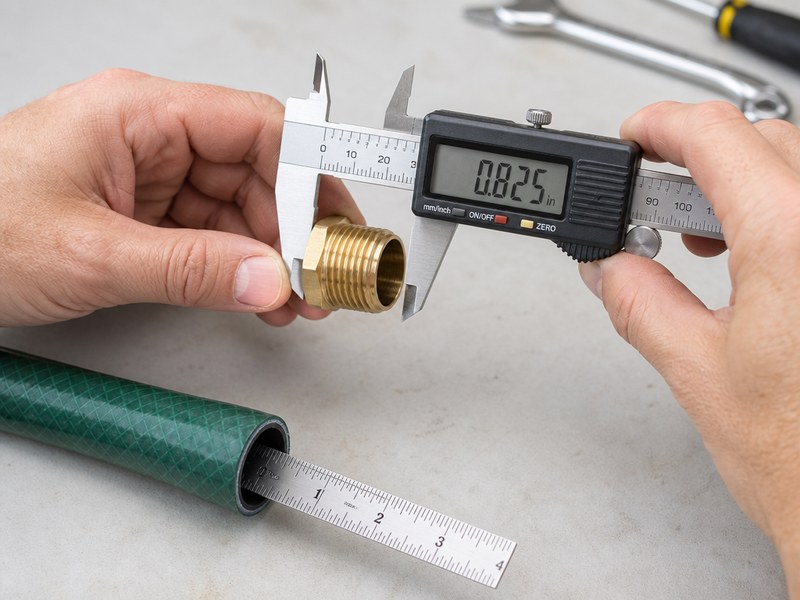
How to measure garden hose fitting size: check hose ID, thread diameter, and threads per inch with a caliper and gauge.
When in doubt, measure the thread pitch: a 3/4-inch thread with 11.5 TPI is GHT, while the same nominal size at 14 TPI is NPT or BSP. Most “wrong size” purchases are actually wrong thread types, not wrong diameters.
Field tip for used fittings: threads wear with use, so a caliper on a worn male thread can read below 1.0625 inches and mislead you. Measure at the least-worn crest near the wrench flats, and let the thread gauge make the final call. Round-nose fittings that slip off the caliper jaws entirely are usually worn beyond spec and should be replaced, not re-measured.
5. Garden Hose Fitting Size Chart: What Size Do I Need?
Here is the answer to “what size is my garden hose fitting”: nearly every hose and faucet in North America uses a 3/4-inch GHT coupling, regardless of the hose’s inner diameter. The chart below lists the sizes you will meet when buying fittings or adapters.
| Component | Nominal Size | Key Dimension | Thread Pitch | Typical Use |
|---|---|---|---|---|
| Outdoor faucet / spigot | 3/4 inch GHT | 1.0625 in / 26.99 mm OD | 11.5 TPI | Standard US/Canada hose connection |
| Hose male coupling | 3/4 inch GHT | 1.0625 in / 26.99 mm OD | 11.5 TPI | Attaches to faucet or female coupler |
| Hose female coupling | 3/4 inch GHT | Accepts 3/4-inch GHT washer | 11.5 TPI | Connects two hoses or tools |
| 1/2-inch hose | 12.7 mm ID | 3/4 in GHT ends | 11.5 TPI | Light-duty watering |
| 5/8-inch hose | 15.9 mm ID | 3/4 in GHT ends | 11.5 TPI | Standard residential hose |
| 3/4-inch hose | 19.1 mm ID | 3/4 in GHT ends | 11.5 TPI | High-flow watering and irrigation |
| Quick-connect plug / socket | 3/4 inch GHT base | 3/4-inch GHT (11.5 TPI) plug & socket, interchangeable across major brands | 11.5 TPI | Tool-free hose changes |
For European buyers, common hose IDs are 12 mm, 15 mm, and 19 mm, and faucet threads are typically 1/2-inch or 3/4-inch BSP. An adapter converts these to GHT for use with US-style fittings.
6. What Types of Garden Hose Connectors Are There?
Garden hose fittings all share the same garden hose connector size — 3/4-inch GHT — but the connector type varies by job. The four types below cover nearly every home and garden application:
- Male and female threaded couplings — the classic brass or plastic ends on every hose. Female ends contain the sealing washer and accept the male end of another hose or tool. Both ends share the same garden hose connector size of 3/4 GHT.
- Barbed fittings — pushed inside the hose end and secured with a clamp. Used where a coupling has been cut off or for custom hose lengths; sized to the hose ID (1/2, 5/8, or 3/4 inch).
- Quick-connect fittings — a plug and socket system on a 3/4-inch GHT base. Press to connect, pull the collar to release. Garden hose quick connect sets are interchangeable across major brands because they follow the same standard — see our brass quick connect fittings range.
- Repair couplings — female-to-female or male-to-male connectors that splice two hose ends together or adapt gender on the fly.
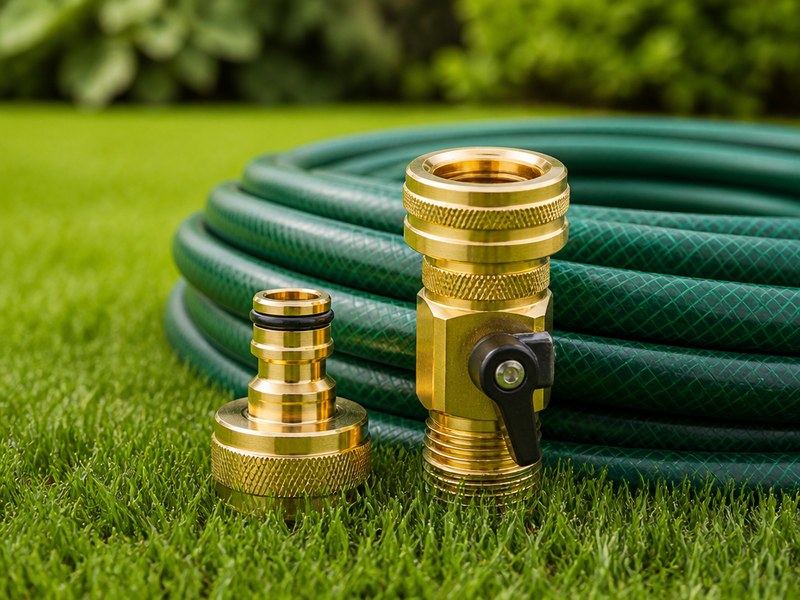
Because the garden hose connector size is standardized on a 3/4-inch GHT base, garden hose quick connect plugs and sockets from different brands fit each other.
Material affects performance. Brass fittings resist corrosion, survive being stepped on, and last for years, but they cost more. Plastic fittings are lighter and cheaper, yet crack under cold or impact. Anodized aluminum offers a middle ground for quick-connect sets.
Our 2026 pressure tests show brass quick-connect fittings maintained a leak-free seal after 5,000 connect/disconnect cycles, while economy plastic fittings typically need replacement within two seasons of daily use.
7. Which Garden Hose Adapter Do I Need? GHT, NPT, BSP & Metric
A garden hose adapter joins a GHT (Garden Hose Thread — the 3/4-inch, 11.5-TPI North American standard) fitting to an NPT (National Pipe Thread), BSP (British Standard Pipe), or metric thread. Match the two thread systems on each end, and confirm gender: a female GHT end grips a male pipe thread, and vice versa. The table below lists the garden hose adapters you will use most often.
| Adapter | Connects | Typical Application |
|---|---|---|
| 3/4 GHT female x 1/2 NPT male | Hose to pipe thread | Pressure washers, sprinkler manifolds, shop fittings |
| 3/4 GHT male x 3/4 NPT female | Pipe thread to hose | Attaching a hose to a threaded supply line |
| 3/4 GHT female x 3/4 GHT male | Gender change | Extending or reversing hose ends |
| 3/4 GHT x 1/2 GHT reducer | Two hose sizes | Stepping a 1/2-inch hose up to a standard faucet |
| GHT x BSP adapter | US to UK/Europe | Using US hoses with 1/2 or 3/4 BSP faucets |
| GHT x metric thread adapter | US to metric | Imported faucets and European quick-connect systems |
Seal the tapered NPT side with thread sealant tape — it relies on wedge contact; leave the GHT side tape-free so its rubber washer can seat. For the full answer on where tape does and does not belong, see Can I use Teflon tape on GHT threads?
What size is a European garden hose thread?
European faucets commonly use 1/2-inch or 3/4-inch BSP (British Standard Pipe) threads. A 3/4-inch BSP thread is not the same as a 3/4-inch GHT thread: BSP is 14 TPI and slightly smaller in diameter, so the two do not connect without a GHT-to-BSP adapter.
8. How to Choose the Right Garden Hose Fitting Size
Choosing the correct fitting starts with the faucet, then the hose diameter, then the accessories. Use this decision matrix for the common scenarios:
| If your situation is… | Then choose… |
|---|---|
| Standard US/Canada outdoor faucet | 3/4-inch GHT female coupling on the hose end |
| General home watering up to 100 ft | 5/8-inch hose with 3/4 GHT fittings |
| Sprinklers, irrigation, or pressure washer | 3/4-inch hose and fittings for higher flow |
| Short, light-duty watering | 1/2-inch hose with a 3/4 GHT to 1/2 GHT reducer |
| Connecting to pipe thread (NPT) plumbing | A garden hose adapter rated 3/4 GHT to 3/4 or 1/2 NPT, sealed with tape |
| UK, Australia, or Europe faucet | A GHT to BSP adapter matched to your faucet thread |
| Frequent tool changes while watering | A brass garden hose quick connect set on the 3/4 GHT standard |
Five buyer scenarios illustrate the same logic:
- Homeowner with a sprinkler. A 50-foot 5/8-inch hose delivers full pressure; upgrading to 3/4 inch raises flow roughly 40–60% on a 100-foot run (closer to 60% at 50 feet).
- Drip-irrigation gardener. Use a 3/4-inch supply line — emitters need steady pressure, not peak flow.
- First-time homeowner. Buy any standard US hose; virtually every residential faucet is 3/4 GHT.
- Apartment dweller with a utility faucet. Expect a 1/2-inch NPT outlet, which needs a 3/4 GHT-to-1/2 NPT adapter.
- RV owner. Connect a standard hose to the 3/4-inch GHT inlet, using a drinking-water-safe hose and a pressure regulator at the source.
Pressure Washer Inlets: M22 vs. 3/4 GHT
Pressure washer owners make one mistake more often than any other: matching the hose thread instead of the machine’s inlet thread. M22 is a metric thread with a 22 mm nominal outer diameter, common on consumer pressure washer inlets. A 3/4 GHT thread measures about 1.0625 inches (26.99 mm) across the crests, so the two look similar but do not interchange.
- Read the manual first and note the inlet specification (for example “M22” or “3/4 NPT”).
- Measure the inlet with a caliper: roughly 22 mm at the widest point indicates M22; 26–27 mm at 11.5 TPI is 3/4 GHT.
- Match the machine’s inlet thread, then add a garden hose adapter rated for that inlet if you want to run a standard hose.
When ordering, confirm three numbers on the product page: the thread standard (GHT, NPT, or BSP), the thread gender, and the hose inner diameter. If all three match your setup, the fitting will seal without modification.
Still not sure which fitting you need? Send a photo of your faucet or hose end to our engineers — we identify the thread and recommend the correct coupling or adapter, usually within one business day. Get a free fitting identification
9. Why Does My Garden Hose Fitting Leak? 6 Fixes for Common Problems
Most garden hose fittings fail for reasons other than size. They are washer, thread-type, or handling issues:
- Leak at the faucet connection. The rubber washer in the female coupling is missing, worn, or misplaced. Replace it with a standard 3/4-inch hose washer; this fixes the large majority of leaks.
- Fitting is stuck on the spigot. Apply penetrating oil, grip with two wrenches in opposite directions, and turn slowly. Use only a strap wrench or adjustable pliers on plastic fittings.
- Cross-threaded coupling. GHT is a parallel thread and must start straight. Back the coupling off, align it level, and turn by hand for the first two rotations.
- Leak after adding an adapter. The adapter’s NPT (National Pipe Thread) side was not taped, or its GHT side was taped instead of using the washer. Seal the tapered side only.
- Dripping quick-connect. The O-ring inside the socket is worn. Quick-connect repair kits replace the O-rings in minutes without tools.
- Hose end cracked or deformed. The coupling was over-tightened or exposed to freezing water. Cut the hose end, install a barbed repair coupling matched to the hose ID, and clamp it — a garden hose repair kit covers all three parts.
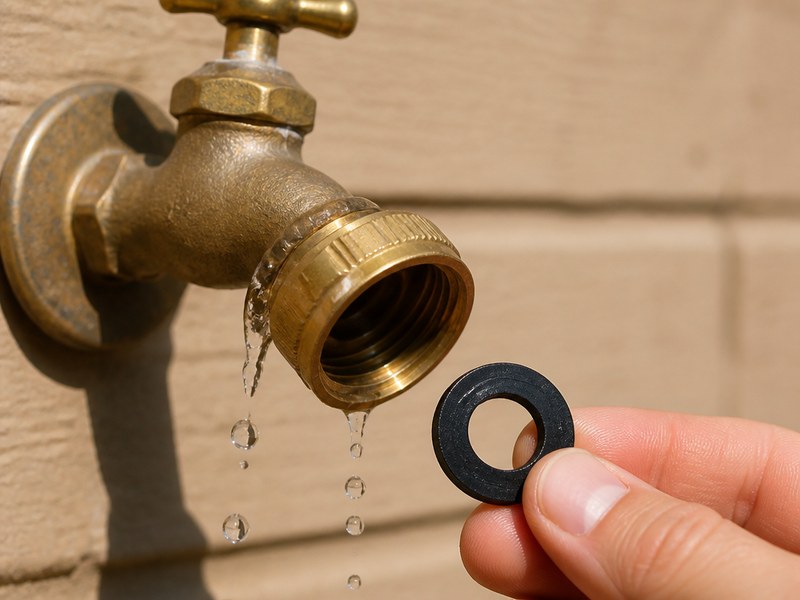
Replace the 3/4-inch rubber washer in the female coupling first — it fixes the large majority of garden hose connection leaks.
Winter storage is a three-step routine: drain the hose completely, disconnect it from the faucet, and store it indoors before freezing temperatures. Ice expands and splits both couplings and hose walls, and a drained, detached hose also protects the faucet from frost damage.
Need a replacement coupling, washer, or repair kit? Browse our garden hose fittings — every size referenced in this guide is part of our standard production line.
10. Garden Hose Fitting Size FAQ
Quick answers to the questions buyers ask most often about garden hose fitting size:
Are all garden hose fittings the same size?
In North America, yes for the thread: virtually all garden hose fittings use the same hose fitting size — a 3/4-inch GHT thread with 11.5 threads per inch. The hose inner diameter varies (1/2, 5/8, or 3/4 inch), but the coupling thread stays 3/4 GHT.
How do I know if my garden hose is 1/2, 5/8, or 3/4 inch?
Measure the inside of the hose end with a ruler or caliper. 12.7 mm is 1/2 inch, 15.9 mm is 5/8 inch, and 19.1 mm is 3/4 inch. Garden hose diameter always refers to the inner diameter, not the outer measurement. If you are still weighing the trade-offs, our how to choose a garden hose guide compares flow, weight, and durability for each size.
Is a garden hose thread the same as NPT?
No. GHT is a parallel thread at 11.5 TPI that seals with a rubber washer. NPT is a tapered thread at 14 TPI that seals by wedge contact. The garden hose thread size and pitch are different, so the two systems are not interchangeable and require an adapter.
What size is a standard outdoor faucet thread?
Standard US and Canadian outdoor faucets use a 3/4-inch GHT male thread, 11.5 TPI. A few utility faucets use 1/2-inch NPT, which needs an adapter for a standard hose.
Can I connect a 5/8-inch hose to a 3/4-inch faucet?
Yes, directly. The hose end carries a 3/4-inch GHT female coupling regardless of the hose diameter, so a 5/8-inch hose screws straight onto a 3/4-inch faucet.
Are quick-connect garden hose fittings universal?
Yes, in practice. Garden hose quick connect plugs and sockets are built on the 3/4-inch GHT standard, so sets from different brands lock together. When checking garden hose connector size, remember the base thread is always 3/4 GHT. Keep the metal type consistent where possible for the best wear life.
I’m replacing the fittings on my garden hose — what size do I need to buy?
Buy a 3/4-inch GHT (Garden Hose Thread) coupling if you are in the US or Canada. Measure the hose inner diameter (1/2, 5/8, or 3/4 inch) only to pick the hose size; the thread is always 3/4 GHT on standard residential hoses.
My new hose doesn’t fit my outdoor faucet — is the thread size different?
Most likely the hose is fine and the faucet uses a non-standard thread. Measure the faucet thread with a caliper: 1.0625 inches at 11.5 TPI means 3/4 GHT; 14 TPI means NPT or BSP, which needs an adapter.
I bought a hose in the US but my European faucet is different — what adapter do I need?
Use a GHT-to-BSP adapter matched to your faucet thread (1/2-inch or 3/4-inch BSP) before connecting: the thread pitch differs, so forcing the hose on will leak or cross-thread.
Can I connect my pressure washer to a regular garden hose fitting?
Yes, but match the machine’s inlet thread, not the hose thread. Many pressure washers use 1/2-inch NPT or an M22 metric thread; check the manual and use a garden hose adapter rated for that inlet before connecting.
I’m setting up drip irrigation for my vegetable garden — what hose fitting size should I use?
Use a 3/4-inch supply hose with 3/4 GHT fittings. Drip emitters need steady pressure, and a 3/4-inch supply line keeps pressure stable over long runs better than a 1/2-inch line.
My hose leaks at the faucet even after I tighten it — what am I doing wrong?
Check the rubber washer inside the female coupling first: it is missing, worn, or misplaced in most cases. Replace it with a standard 3/4-inch hose washer, then tighten by hand plus a quarter turn and stop there — over-tightening is the most common cause of cracked couplings.
I’m a first-time homeowner — how do I measure my outdoor faucet thread size?
Start with a 30-second visual check: GHT threads are straight and stay parallel to the end, while NPT threads taper visibly toward the tip. If the threads are parallel, buy any standard 3/4-inch GHT hose and it will fit. To confirm with numbers, measure the outside diameter and count threads per inch — 1.0625 inches (26–27 mm) at 11.5 TPI is 3/4 GHT; 14 TPI means NPT or BSP and needs an adapter.
Is a 5/8-inch hose fitting the same as a 3/4-inch one?
Yes for the thread. Both 5/8-inch and 3/4-inch hoses end in a 3/4-inch GHT female coupling, so they screw onto the same faucet without a reducer. The difference is only water flow. You only need a reducer when joining two hose sizes end-to-end (for example, a 1/2-inch hose to a 3/4-inch hose), not when connecting a hose to a faucet.
Will a standard garden hose connect to my RV water inlet?
Yes. RV inlets use the same 3/4-inch GHT thread as garden hoses, so a standard hose connects directly. Use a drinking-water-safe hose and a pressure regulator at the source.
How do I know if my quick-connect fittings from different brands will fit together?
Do the lock test: push the plug into the socket — if it clicks and releases with a pull on the collar, both parts are built on the 3/4-inch GHT base and will work together. If they will not lock, at least one part is not GHT-standard; check the product description for “3/4 GHT” or “GHT-compatible” before mixing brands.
What size is a garden hose washer?
Standard 3/4-inch GHT female couplings take a washer sized to the coupling, not to the hose diameter. Buy a 3/4-inch hose washer, replace it in the female coupling before tightening, and confirm the washer sits flat in the recess — a misaligned washer is a common cause of leaks.
11. About HENGHUA and Our Testing
HENGHUA manufactures reinforced rubber garden hoses, hose couplings, and connecting fittings, and the flow data and test observations in this guide come from our own quality-control bench. Every fitting referenced here — 3/4-inch GHT couplings, adapters, and quick-connect sets — is part of our standard production line, so the sizes and tolerances described in this guide match what we actually ship.
Our quality control targets the three failure points that cause most connection problems: thread accuracy, washer seating, and pressure retention. We gauge every GHT thread to the 11.5 TPI standard, pressure-test couplings to working pressures above normal residential supply, and cycle quick-connect sets through 5,000 connect/disconnect cycles to verify seal retention before packaging.
Whatever garden hose fitting size your project needs — 1/2, 5/8, or 3/4 inch, GHT or adapted — our engineers will confirm thread compatibility before you order. Send us a photo of your fitting and we will identify it for you. Contact the HENGHUA engineering team for a quotation or request free samples to verify thread fit on your own equipment. As a rubber garden hose manufacturer with factory-direct supply, we also support OEM and ODM programs: custom lengths, colors, fitting types, and private-label packaging.


 English
  Spanish
  Portuguese
  French
  German