
Verbundschlauch
What Is a Composite Hose, and Which Type Do You Need?
A composite hose is a flexible hose built around a thermoplastic film liner, a woven fabric carcass and a steel helix, instead of a vulcanised rubber tube. It is the standard hose for loading and unloading chemicals, petroleum products and liquefied gas at terminals, tankers, rail cars and ISO tanks. Sixteen builds cover bore 25 to 254 mm, working pressure 10 to 20 bar and temperature -200 to +177 °C. Three questions decide which one you need: what the medium is, where the hose is used, and how hot or cold it runs.
Ergebnisse 1 – 12 von 16 werden angezeigt

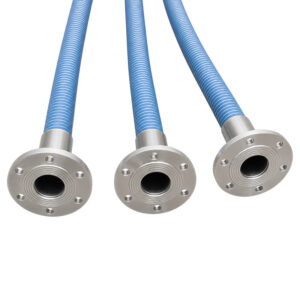


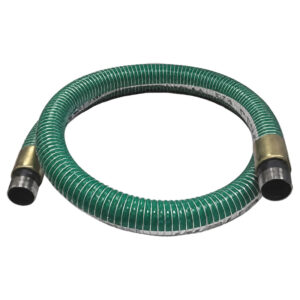
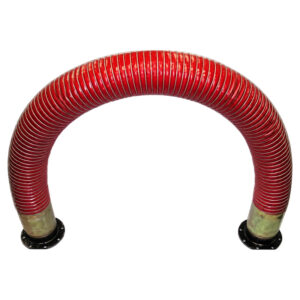

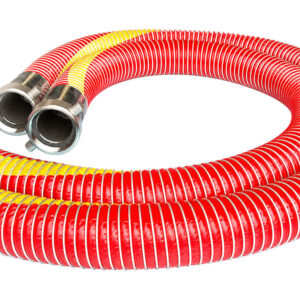

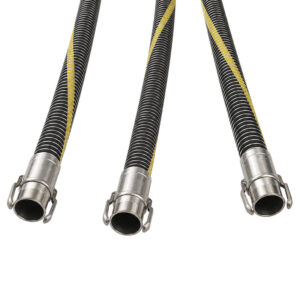
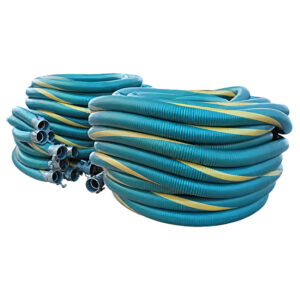

The six families in this range
The range is grouped by what the liner has to survive, not by where the hose is sold. Each family page carries its own size table and test data.
- Chemical composite hose — three builds for acids, alkalis and solvents: a 10 bar plant hose, a 20 bar heavy duty grade for rail and ISO tank discharge, and a 14 bar dockside hose with a stainless bore. Bore 25 to 250 mm, -30 to +100 °C.
- PTFE composite hose — for the media that attack a polypropylene liner: concentrated oxidising acids, aromatic and chlorinated solvents. Bore 25 to 254 mm, 20 bar to 3 inch, -30 to +120 °C.
- Petroleum and biofuel composite hose — five builds across the fuel chain: suction and discharge, light oil, biofuel, bottom loading and fire retardant. 10 to 14 bar, bore 1 to 10 inch.
- Marine and terminal composite hose — five builds for the jetty and the ship: tanker, marine, dock, vapour recovery and nylon rope cover. Bore 50 to 250 mm, 14 to 15 bar, -40 to +180 °C.
- High temperature composite hose — for hot petroleum, hot solvents and heat transfer fluid to +177 °C. Bore 25 to 250 mm, 14 bar, 5:1 safety factor below 100 mm.
- Cryogenic composite hose — LNG at about -162 °C and liquid nitrogen at -196 °C in one build rated -200 to +80 °C. Bore 1 to 10 inch, 10 bar, 20 m maximum.
How a composite hose is built
Four layers do four different jobs, and every service failure can be traced to one of them. Knowing which layer is which is what turns a datasheet into a decision.
| Layer | Material | What it does | How it fails |
|---|---|---|---|
| Inner helix | Galvanized steel, 316L stainless or polypropylene coated steel | Stops the hose collapsing under vacuum and carries static to the fittings | Corrodes when the liner permeates and the wrong steel grade was chosen |
| Liner | Polypropylene, PTFE, ECTFE or polyamide film | The only layer that touches the product | Swells, softens or permeates; the wrong liner is the single most common selection error |
| Carcass | Bonded film plus woven fabric plies | Holds the pressure and resists puncture | Too few plies for the bore shows up as a bulge under pressure, not as a leak |
| Cover | PVC-coated fabric, polyamide, polyurethane or a spiral nylon rope | Abrasion, sunlight and chemical splash protection | Wears through at the bend, then the fabric wicks moisture into the carcass |
What the marking on the hose tells you
A correctly marked composite hose carries the bore, the working pressure, the standard it was built to, the quarter and year of manufacture, and the manufacturer. Read it before you re-order: the marking is the only record that survives when the paperwork is lost, and it is what a replacement is built against.
Two things are worth checking on delivery, on every hose. First, that the working pressure on the marking matches the purchase order, not the catalogue. Second, that the helix is continuous to both fittings, measured with a meter across the assembly; a reading at the fittings alone does not prove the helix is bonded through.
How to choose: three questions, in this order
Most wrong selections come from starting with the bore or the price. Start with the medium, because the liner decides whether the hose survives at all; then the duty, because that sets the pressure class; then the venue, because that sets length, cover and fittings.
| Question | Answer | What it decides |
|---|---|---|
| 1. What is the medium? | Dilute mineral acid or alkali, below 80 °C | Polypropylene liner |
| Concentrated oxidising acid, aromatic or chlorinated solvent | PTFE liner | |
| Low-permeability duty with odour or emission limits | PTFE or ECTFE liner | |
| Petrol, diesel, biodiesel, light oil | Polypropylene liner with a conductive path | |
| 2. Where is it used? | Inside the plant, between vessels and drums | 10 to 14 bar, PVC cover, 15 m lengths |
| Tanker, rail car, ISO tank, loading arm | 14 to 20 bar, 20 m and above | |
| Jetty, dock, ship-to-shore | Stainless bore and cover, 4:1 or 5:1 factor, flange ends | |
| 3. How hot or cold? | Above +100 °C | High temperature build, PTFE and PP combined liner |
| Below -40 °C | Cryogenic build, 316 helices both sides | |
| -40 to +100 °C | Standard builds; the family is set by questions 1 and 2 |
Specification envelope across all 16 builds
This table is the fastest way to see whether a duty falls inside the range at all. If a requirement sits outside every row, the answer is a different hose type, not a different composite hose.
| Familie | Build | Bore | Betriebsdruck | Temperature |
|---|---|---|---|---|
| Chemical | Chemical, plant grade | 25 to 100 mm | 10 bar | -30 to +100 °C |
| Chemical | Chemical marine | 50 to 250 mm | 14 bar | -30 to +100 °C |
| Chemical | Heavy duty chemical | 4 to 8 inch | 20 bar, burst 80 bar | -30 to +80 °C |
| PTFE | PTFE lined | 25 to 254 mm | 20 bar to 3 inch, 15 bar from 4 inch | -30 to +120 °C |
| Petroleum | Suction and discharge | 1 to 10 inch | 370 psi to 3 inch, 345 psi to 8 inch, 225 psi at 10 inch | -40 to +110 °C |
| Petroleum | Light oil | 1 to 6 inch | 10 bar, burst 40 bar | -40 to +200 °C |
| Petroleum | Biofuel and biodiesel | 25 to 250 mm | 14 bar | -20 to +100 °C |
| Petroleum | Bottom loading | 1 to 10 inch | 200 psi, 150 psi at 10 inch | -30 to +100 °C |
| Petroleum | Fire retardant | 25 to 250 mm | 14 bar | -30 to +80 °C |
| Marine | Tanker | 2 to 4 inch | 0.7, 1.05 or 1.52 MPa | -30 to +90 °C |
| Marine | Marine | 50 to 250 mm | 14 bar, 5:1 factor | -40 to +180 °C |
| Marine | Dock | 2 to 10 inch | 15 bar, burst 60 bar | -30 to +100 °C |
| Marine | Vapour recovery | 1 to 10 inch | 150 psi, burst 600 psi | -40 to +150 °C |
| Marine | Nylon rope cover | Built to order | 150 to 500 psi | -40 to +100 °C |
| High temperature | High temperature | 25 to 250 mm | 14 bar, 5:1 below 100 mm, 4:1 above | -30 to +177 °C |
| Cryogenic | Cryogenic | 1 to 10 inch | 10 bar | -200 to +80 °C |
What the standards actually ask for
Composite hoses for hydrocarbons are built against EN 13765 or BS 5842. Both describe a hose of thermoplastic layers reinforced with fabric and helix wire, and both put the same four demands on a supplier. Ask for these four on any quotation, from any factory, including ours.
- A proof test above working pressure. Usually 1.5 times working pressure held for a fixed period, with no leakage at the couplings.
- A burst figure at or above four times working pressure. The 4:1 or 5:1 safety factor is the ratio between that burst result and the rated pressure, not a marketing margin.
- Electrical continuity end to end. Measured on the finished assembly, with the helix bonded to both fittings. On fuel duty, continuity at the hose is necessary but not sufficient; the earthing of the vehicle or vessel is what dissipates the charge.
- Adhesion between liner, fabric and cover. This is what fails first in service, and it is invisible from outside until the liner separates.
Boundary: we supply test data with each assembly and can provide type-test reports for the builds we produce. We do not describe a hose as approved by a standard body unless a certificate has actually been issued for it, and we will tell you which of the 16 builds that applies to.
Where a composite hose is the wrong choice
Composite construction earns its place on chemical and fuel transfer. On these duties it does not:
- Above 40 bar. Use a wire spiral hydraulic or industrial hose; the fabric carcass is not built for it.
- Saturated steam. Use a steam hose with a heat-resistant tube; a thermoplastic liner softens and the plies separate.
- Abrasive slurry and dry cement. Use a rubber slurry hose; the thin liner wears through at the bend.
- Full vacuum without a helix check. Standard builds handle vacuum to about 0.9 bar; deeper vacuum needs the heavy helix variant confirmed at order.
- Direct food and potable water contact. Use a hose with a food-contact declaration for the specific liner; a general purpose composite hose is not that.
Ordering, quantities and lead time
| Familie | Standard length | Minimum order | Lead time |
|---|---|---|---|
| Chemical (three builds) | 15 m, 20 m on request | 100 m per size | 15 to 20 working days |
| PTFE | 20 m | 100 m per size | 20 to 25 working days |
| Petroleum (five builds) | 15 to 30 m by build | 100 m per size | 15 to 20 working days |
| Marine and terminal | Assemblies on drawing | One assembly | 15 to 20 working days |
| High temperature | 15 m | 100 m per size | 15 to 20 working days |
| Cryogenic | Up to 20 m | One length | 20 to 30 working days |
Custom lengths, non-standard flanges (EN 1092, ANSI B16.5, JIS, GOST) and tagged assemblies are built to order. Send the drawing and the medium, and the quotation states the liner, the helix material, the test pressure and the delivery date in writing.
Über HENGHUA
Hebei Henghua Rubber & Plastic Products Co., Ltd. has manufactured industrial hose since 2010 at a 18,000 m² plant with 12 automated production lines, and supplies 70 countries. Composite hose is built on the same lines as our rubber chemical and petroleum hose, which matters when a project needs both types to the same flange standard and the same delivery date.
Frequently asked questions
What is the difference between a composite hose and a rubber hose?
A composite hose uses thermoplastic film layers and a fabric carcass; a rubber hose uses a vulcanised rubber tube with textile or wire reinforcement. Composite hoses are lighter, tolerate a wider chemical range with a thinner wall, and can be built in long continuous lengths. Rubber wins on abrasion, on high pressure and on mechanical abuse.
How long does a composite hose last?
In chemical transfer, typically three to five years; in fuel terminal service, two to three years. The limit is usually the cover and the liner-to-fabric adhesion, not the helix. Hoses that are dragged, run over or stored in sunlight fail earlier than the same hose on a fixed loading arm.
Can a composite hose be repaired?
Couplings can be replaced and covers patched. A damaged liner cannot be repaired: once the liner is perforated the medium reaches the fabric and the hose is replaced. Any hose that has carried a hazardous medium should not be re-used on a different product.
Are all 16 builds certified to EN 13765?
Not all, and we would rather say so than imply otherwise. The builds we produce are designed and tested against the EN 13765 test set, and type-test reports are available for the builds where a third-party report exists. Tell us the build in your enquiry and we confirm in writing which reports apply to it.
What is the smallest quantity you supply?
100 m per size for bulk hose, one assembly for flanged jetty and loading arm hose. Sample lengths of 2 to 5 m can be supplied for trial before a bulk order.
Do you supply complete assemblies?
Yes. Assemblies are supplied with flanges, camlocks or tank couplings, with the helix bonded to both fittings, pressure tested and tagged. Send the flange standard, the face-to-face length and the medium.
Can you match an existing hose?
Yes, if you send the marking, the end fittings and the duty. Where the original manufacturer’s specification is not readable, the working pressure is confirmed from the application rather than guessed from the old hose.
Which build do I need for LPG?
LPG at ambient temperature is a pressure duty, not a cryogenic one: use the suction and discharge or tanker build with a conductive path. The cryogenic build is for liquefied gas at -162 °C and below, such as LNG and liquid nitrogen.
Not sure which of the 16 builds fits your duty? Send the medium, the concentration, the working temperature and the flow rate through the quotation form, and the liner and pressure class come back in writing.
- Hydraulikschlauch2323 Produkte
- Hydraulikschlauch mit Stahldrahtspirale66 Produkte
- Hydraulikschlauch mit Stahldrahtgeflecht1010 Produkte
- Textilverstärkter Hydraulikschlauch33 Produkte
- Thermoplastischer Hydraulikschlauch33 Produkte
- Industrieschlauch7575 Produkte
- Luftschlauch99 Produkte
- Wasserschlauch1111 Produkte
- Ölschlauch1616 Produkte
- Chemikalienschlauch66 Produkte
- Verbundschlauch1616 Produkte
- Chemikalienbeständiger Verbundschlauch33 Produkte
- Verbundschlauch für den Schifffahrtsbereich55 Produkte
- Verbundschlauch für Erdölprodukte55 Produkte
- Hochtemperatur-Verbundschlauch11 Produkt
- PTFE-Verbundschlauch11 Produkt
- Kryogener Verbundschlauch11 Produkt
- Dampfschlauch33 Produkte
- Mehrzweckschlauch22 Produkte
- Schläuche für Lebensmittel und Getränke44 Produkte
- Betonschlauch44 Produkte
- Zementschlauch22 Produkte
- Schlauch für den Materialtransport1111 Produkte
- Baggerschlauch44 Produkte
- Hydraulikarmaturen166166 Produkte
- Wiederverwendbare Schlauchanschlüsse66 Produkte
- Schlauchanschlüsse ohne Überwurfmutter88 Produkte
- JIC-Hydraulikarmaturen1616 Produkte
- Metrische Hydraulikverschraubungen4141 Produkte
- NPT-Hydraulikverschraubungen66 Produkte
- BSP-Hydraulikverschraubungen2626 Produkte
- SAE-Hydraulikverschraubungen3030 Produkte
- Banjo-Hydraulikverschraubungen44 Produkte
- ORFS-Hydraulikverschraubungen1111 Produkte
- Hülse1111 Produkte
- Flanschverbindungen2626 Produkte
- Einteilige Armaturen2424 Produkte
- Hydraulikadapter149149 Produkte
Send a Mail
henghua@hhgpipe.com
Make a Call
+15822925523
86-22-83859963
Mon - Sun: 09:00 am - 22:00 pm
Main Office
Tianjin, China
Hezhong Building, Youyi North Road
 English
 Spanish
 Portuguese
 French
 German
 Arabic
 Russian
 Indonesian
 Japanese
 Korean