
This composite hose glossary defines the terms that appear on datasheets, certificates and purchase orders, from helical shank and leak-before-burst to derating and type approval. The three terms that cause the most specification errors are the helical shank (the wire that supports the bore), proof pressure and floating flange. Each one is defined below with the value it commits a supplier to. Each entry is short enough to scan and precise enough to quote in a specification. Terms are grouped by what they describe: construction, pressure, end fittings, materials, inspection and documents.
The aim is to remove the ambiguity that causes most specification errors. A buyer who knows what “floating flange” or “proof pressure” actually commits the supplier to writes a better order, and a maintenance team that agrees on “retirement” replaces hose before it fails rather than after.
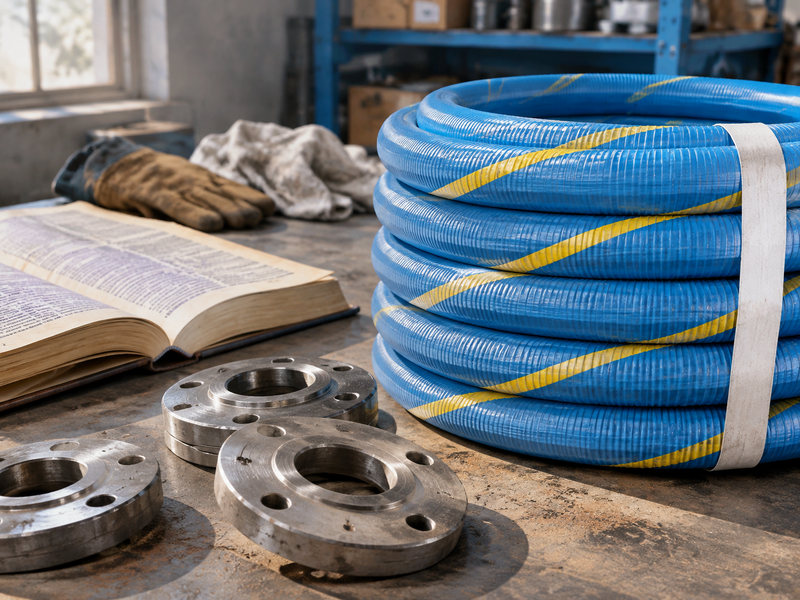
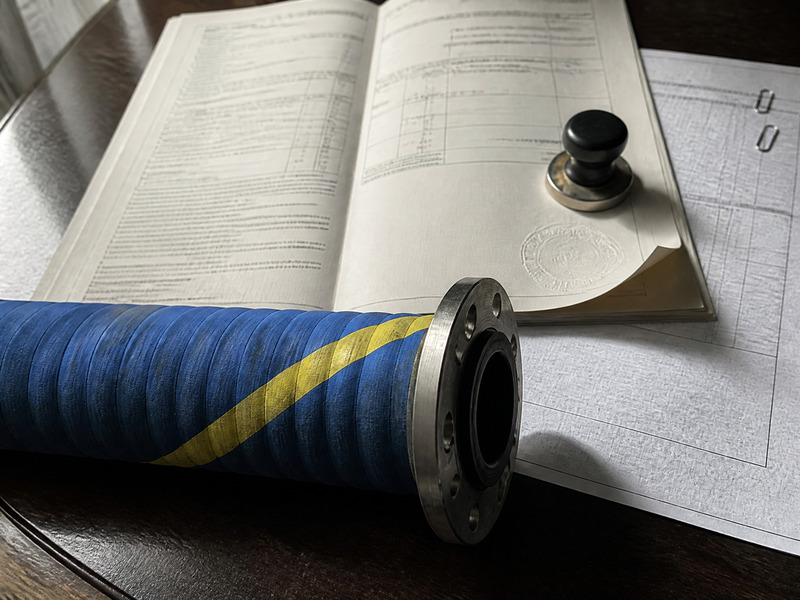
Figure 1. A coiled composite hose and a loose flange beside an open dictionary: this glossary is ordered like a reference page, from construction through to documents, and the entries below follow that order.
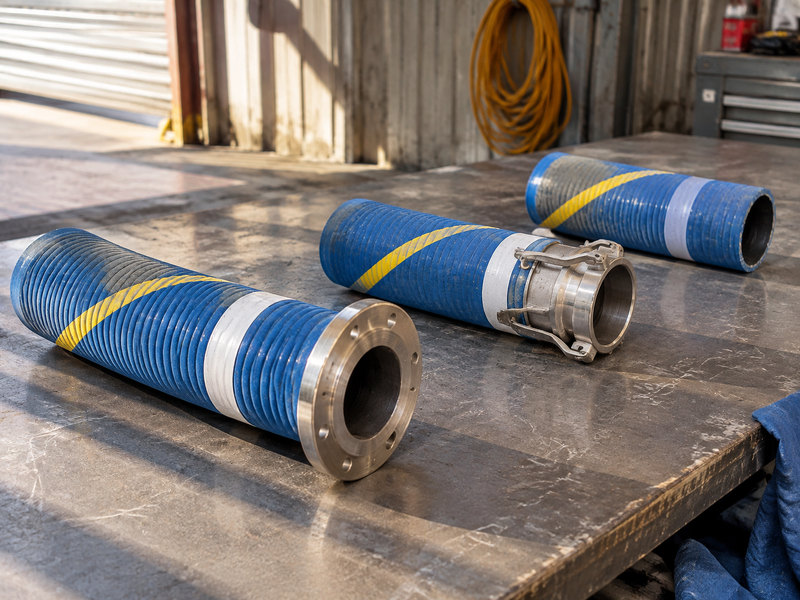
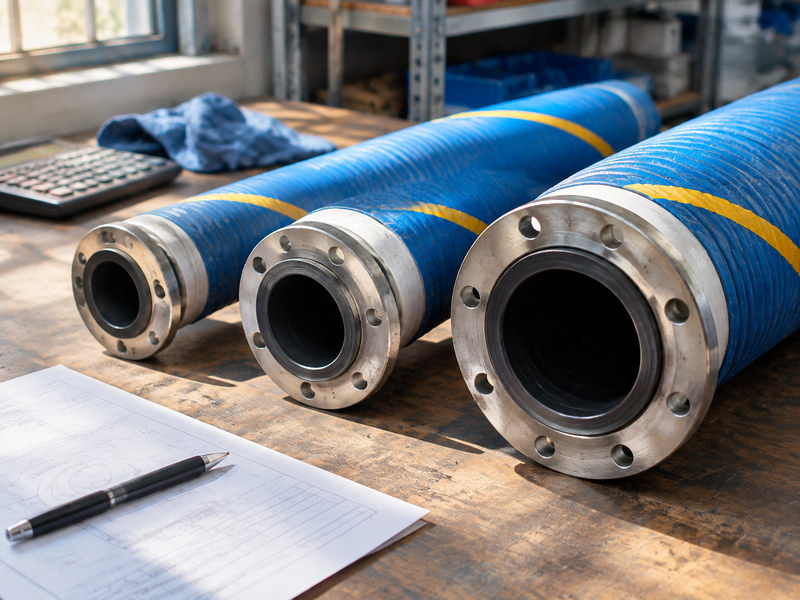
Figure 2. Three bores on one bench, each with its marking band: bore, type and end connection are the three words that fix what the rest of the vocabulary describes. The entries below follow the same order, starting with construction.
What Is the Composite Hose Glossary For?
A composite hose glossary earns its place when two parties use the same word for different things. “Working pressure” is the classic case: one side means the figure on the marking, the other means the pump’s maximum discharge. Defining the term once, in writing, ends the argument before the hose is built.
The glossary below groups composite hose terms so that related ideas sit together. Construction terms come first because they explain why the product behaves as it does, then pressure and test terms, then the hardware that connects the hose to the plant. Material and inspection terms follow, and the document terms close the list.
Definitions are deliberately short, and the composite hose terms are grouped rather than listed alphabetically, so a reader who does not yet know the name of a part can still find it. Where a term needs a full explanation, the entry points to the article that covers it rather than repeating the argument here. That keeps this composite hose definition set usable as a reference instead of a manual.
Construction Terms
| Term | Definition |
|---|---|
| Composite hose | A flexible hose built from separate thermoplastic film, fabric and wire layers rather than one extruded tube. |
| Helical shank | The spiral wire that supports the bore, called the inner wire or internal helix on some datasheets. It holds the bore round under vacuum and provides the conductive path. |
| Internal helix | The wire spiral inside the bore that resists vacuum collapse and holds the bore round. |
| External helix | The wire spiral on the outside of the cover that protects against abrasion and keeps the wall from flattening. |
| Liner or film | The thermoplastic layer, or layers, that seal the conveyed product from the reinforcement. |
| Carcass | The load-bearing fabric layers between the film and the cover. |
| Cover | The outer fabric with a polymeric coating that protects the carcass from abrasion, weather and chemicals. |
| Ply | One film or fabric layer within the wall stack; layer count is part of the build description. |
| Lay length | The axial distance covered by one full turn of a helix, which affects flexibility and crush resistance. |
Table 1. Construction terms in this composite hose glossary. A hose is described by its stack, not by a single material.
Pressure, Vacuum and Test Terms
| Term | Definition |
|---|---|
| Working pressure | The maximum pressure a hose is rated to carry in continuous service at a stated temperature. |
| Maximum allowable working pressure | The system-level limit used in terminal rules; it must sit above the relief valve setting plus static head. |
| Prüfdruck | The test pressure applied to every assembly before release, normally 1.5 times working pressure. |
| Burst pressure | The pressure at which the hose ruptures; standards express this as a minimum, not a target. |
| Safety factor | The ratio between burst pressure and working pressure, commonly four in composite hose standards. |
| Vacuum rating | The negative pressure a hose can hold without the bore collapsing, expressed in bar. |
| Pressure drop | The pressure lost to friction along the hose, which rises sharply as bore falls. |
| Surge | A transient pressure spike from valve closure or pump start, which can exceed the steady rating. |
Table 2. Pressure terms. The difference between working, proof and burst pressure decides what a test record actually proves.
End Fitting and Assembly Terms
| Term | Definition |
|---|---|
| Fixed flange | A flange locked to the hose end so it cannot rotate; used where the mating face is fixed. |
| Floating flange | A flange that rotates on a collar, allowing bolt holes to align without twisting the hose. |
| Swivel flange | Another name for a rotating flange, common in dock and tanker specifications. |
| Flange drilling | The bolt pattern and pressure class of a flange face, such as EN 1092-1 PN16 or ASME B16.5 Class 150. |
| Camlock coupling | A quick-release coupling with cam arms, used on lower-pressure transfer lines. |
| Crimped end | A fitting attached by swaging the ferrule onto the hose wall under controlled pressure. |
| Insertion depth | How far the fitting tail enters the bore; too little insertion is a common cause of pull-out. |
| Gasket | The sealing element between flange faces, chosen for the product and the temperature. |
Table 3. End fitting terms. Most service leaks appear at these interfaces rather than in the hose body.
Material and Chemical Terms
| Term | Definition |
|---|---|
| Polypropylene | A low-cost thermoplastic lining with broad acid and alkali resistance, used for general chemical duty. |
| PTFE | A fluoropolymer lining with the widest chemical range, limited by cost and lower flexibility. |
| UHMWPE | Ultra-high molecular weight polyethylene, a tough lining with wide chemical coverage and moderate temperature limits. |
| XLPE | Cross-linked polyethylene, resistant to many oxidising chemicals but not to aromatic solvents. |
| Derating | The reduction of pressure or temperature capability when service conditions approach a material limit. |
| Chemical compatibility | The suitability of a lining for a specific product at a specific concentration and temperature. |
| Permeation | Passage of product molecules through the lining, which matters for odour, purity and emissions. |
Table 4. Material terms. A material name is a starting point; the compatibility question is always specific.
Inspection, Failure and Retirement Terms
| Term | Definition |
|---|---|
| Leak-before-burst | The failure mode in which the film or helix breaches and the hose leaks before it ruptures. |
| Delamination | Separation between wall layers, often visible as a bulge or a soft spot under pressure. |
| Kink | A sharp bend that closes the bore and damages the helix, usually caused by too tight a radius. |
| Wire corrosion | Attack on the helix, most often where the cover is damaged and moisture reaches plain steel. |
| Hydrostatic test | A pressure test with liquid to confirm integrity, performed before release and at inspection intervals. |
| Electrical continuity | A measured conductive path from end fitting to end fitting, required where static must be drained. |
| Bonding | Connecting two conductive parts to equalise potential; distinct from grounding to earth. |
| Retirement | The decision to remove a hose from service, based on inspection findings rather than age alone. |
Table 5. Inspection terms. Retirement criteria should be agreed before the first hose is installed, not after a failure.
Standards and Document Terms
| Term | Definition |
|---|---|
| EN 13765:2018 | The European specification for thermoplastic multi-layer hose and assemblies for hydrocarbons, solvents and chemicals. |
| BS 5842 | The 1980 British specification for thermoplastic assemblies at docks, on road tankers and on ships, now withdrawn. |
| EN 13766 | The European specification for thermoplastic hose used in LPG and LNG transfer, outside the scope of EN 13765. |
| Type test | A design test performed once to demonstrate that a construction meets the standard. |
| Routine test | A test applied to every assembly produced, such as a hydrostatic proof. |
| Batch test | A test on a sample from a production batch, used to monitor consistency. |
| Type approval | A third-party attestation that a design has passed the type tests, with a defined scope. |
| Marking | The permanent information on the hose, typically type, bore, working pressure and date of manufacture. |
Table 6. Document terms. These decide what a supplier can prove, which is a different question from what a hose can do.
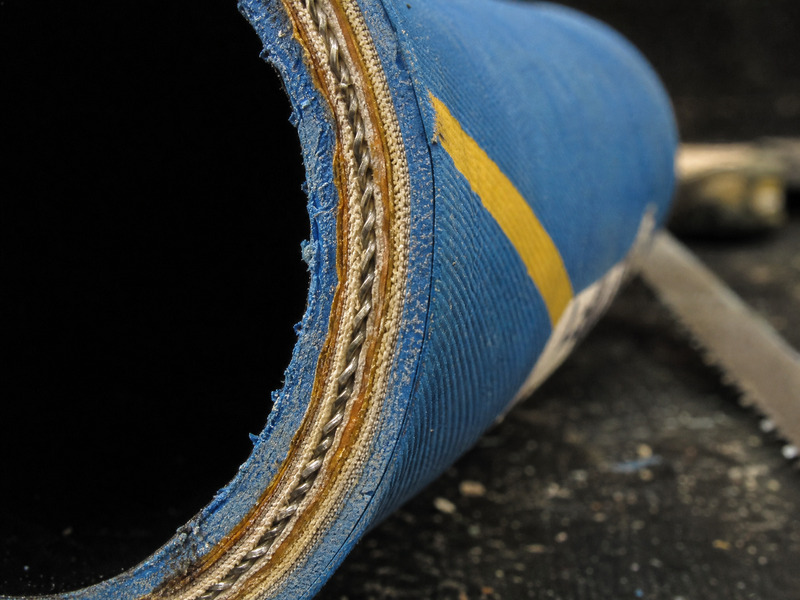
Figure 3. A cut end with the cover, the fabric plies, the film and the inner helix all in view, and a strip of the same wall lying behind. Every term in this glossary points at one of these layers, and the construction entry names them in order.
How Do You Use These Terms in a Purchase Order?
Use the terms exactly as defined, and put the numbers beside them. Terms only work when the buyer and the supplier mean the same thing by them. “Working pressure 14 bar at 80 °C, proof tested at 21 bar, floating flange one end, fixed flange the other” leaves nothing to interpret. “Heavy duty composite hose” leaves almost everything open.
Three habits prevent most disputes. Name the standard and its edition rather than relying on a type alone. State the medium with concentration and temperature, so compatibility can be checked. State which end is fixed and which rotates, because that single detail decides whether the assembly lands flat on a flange face.
When a supplier uses a term differently, ask for their definition in writing. A glossary is only useful when both sides accept the same entry. Where a supplier cannot define a term, treat that term as unagreed and leave it out of the order until it is settled.
Which Terms Cause the Most Disagreement?
Working pressure and maximum allowable working pressure cause more argument than any other pair in this composite hose glossary. The first is a product rating at a stated temperature; the second is a system limit derived from the relief valve setting plus static head. A hose can be rated above the system limit and still be misapplied if the relief valve is set too high.
Pressure and temperature cause the second argument. A supplier quotes 14 bar, a buyer installs the hose on a line running at 70 °C, and neither party has mentioned derating. The rating was true at the test temperature and may be false at the service temperature.
Type and class cause the third. A type is defined in the current European classification; class language comes from older documents and has no row in that table. When both appear in one specification, the type should carry the technical requirement.
These disagreements are cheap to settle in writing and expensive to settle after delivery. That is the practical case for agreeing composite hose terms at enquiry stage rather than at the first inspection.
Do US and European Buyers Use Different Terms?
Partly. European specifications talk about hose assemblies, nominal bore in millimetres and flange classes under EN 1092-1, while US practice uses inside diameter in inches, ASME flange classes and psi ratings. A composite hose definition that ignores the difference reads as precise while leaving the unit ambiguous.
Unit conversion is the usual source of error. A 6 inch hose is 152 mm nominal, not 150 mm, and a Class 150 flange is not the same as PN16 even when the bolt circle looks close. Both details change what fits at the flange face.
Terminology also drifts between markets. “Suction and discharge” in one catalogue becomes “suction and delivery” in another, and “floating flange” appears as “swivel flange”. The hardware is the same; the words are not.
The safe habit is to state the unit and the standard every time. Millimetres or inches, bar or psi, EN or ASME. A glossary entry only helps when the number beside it carries a unit.
Frequently Asked Questions
What does helical shank mean on a composite hose?
The term refers to the spiral wire that supports the bore, usually the internal helix. The shank resists vacuum collapse and keeps the cross-section round under bending.
Is a composite hose the same as a thermoplastic hose?
Largely, yes. Composite hose is a thermoplastic multi-layer hose, and the term is used commercially for the non-vulcanised, film-and-fabric construction described in this composite hose glossary.
What is the difference between proof pressure and burst pressure?
Proof pressure is a test every assembly passes before release, normally 1.5 times working pressure. Burst pressure is the point of rupture, and standards quote it as a minimum, usually four times working pressure.
What does derating mean in practice?
It means the pressure or temperature you can actually use is lower than the headline figure once service conditions approach a material limit. Always ask for the derated value at your temperature.
How is leak-before-burst different from a burst failure?
In leak-before-burst the wall breaches and the product escapes as a leak before the hose ruptures. That behaviour is the reason composite hose is preferred on transfer duties where a sudden rupture would be unacceptable.
Does this composite hose definition set cover fittings?
Yes. End fitting, flange drilling, insertion depth and gasket appear in their own table, because fitting choices cause more service leaks than hose construction does.
Why does this composite hose glossary separate pressure from test terms?
Because a rating and a test answer different questions. A rating states what the hose may carry; a test states what was proved before release. Mixing them is how a proof pressure ends up quoted as a working pressure.
Where can I find the standards these terms come from?
The EN 13765 type guide explains the classification, and the type approval walkthrough covers the documents. The BS 5842 comparison explains the older British reference.
About HENGHUA
Composite hose from HENGHUA is built with PTFE, UHMWPE, XLPE and polypropylene linings, woven fabric carcasses, stainless or coated carbon steel helixes and crimped or flanged ends. If a term in this composite hose glossary needs to be pinned to a value for your project, send the duty. We will answer in the same vocabulary: bore, type, pressure at temperature, end connections and test record. The range is listed in our composite hose range by construction, and the construction detail sits in the multi-layer build guide.

 English
 Spanish
 Portuguese
 French
 German
 Arabic
 Russian
 Indonesian
 Japanese
 Korean