
This composite hose FAQ collects the thirty composite hose questions that arrive most often, answered briefly and linked to the guide that covers each one properly. It is written for buyers who need a straight answer before a meeting, not a treatise.
Where an answer depends on the duty, it says so. Where a figure is a standard value, it names the standard. Nothing here replaces a datasheet for the build you order, and the datasheet guide explains the fields to check.
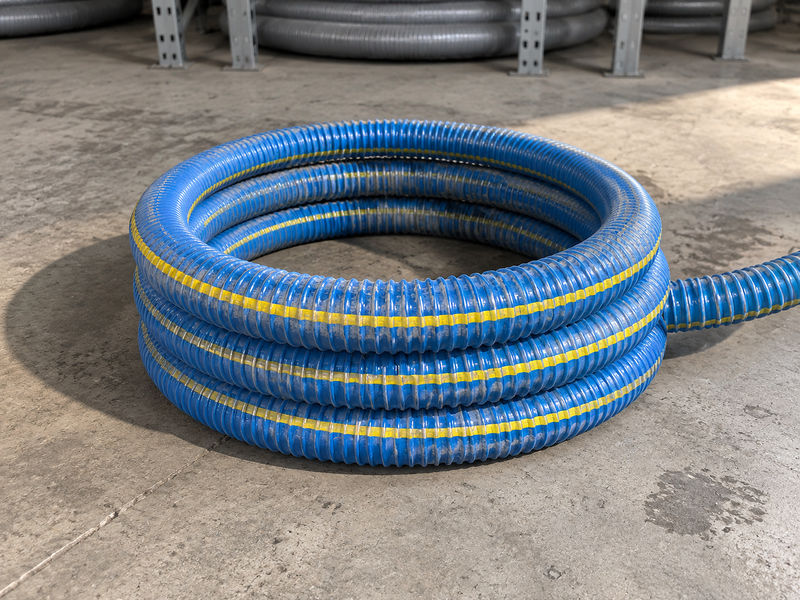
Figure 1. A coil on a warehouse floor. Thirty questions are only useful if the reader can find their group quickly, and most enquiries land in one group and move to a deep guide within two answers.
Pressure and Rating
What is the maximum pressure of a composite hose?
14 bar working pressure for Types 3 and 4 in the European classification, with 21 bar proof and 56 bar minimum burst. Builds above that exist and need their own test values.
Why is the assembly rating lower than the hose rating?
Because the fittings have their own limits. A camlock at 6 inch is rated lower than the same style at 2 inch, and the assembly takes the lower figure.
What is proof pressure?
Proof pressure (the test pressure above working pressure and below burst) is the figure an inspection record refers to, and the one to ask for.
Does pressure capability fall with temperature?
Yes. Each type has a temperature ceiling, and usable pressure falls as the line approaches it. The derating curve governs hot duty, not the headline figure.
What happens if I run above the rating?
The margin between working and burst is what protects you, and running above the rating spends it. The failure is not usually immediate; it is a shorter life and a joint that gives first.
Temperature
What temperature range can a composite hose handle?
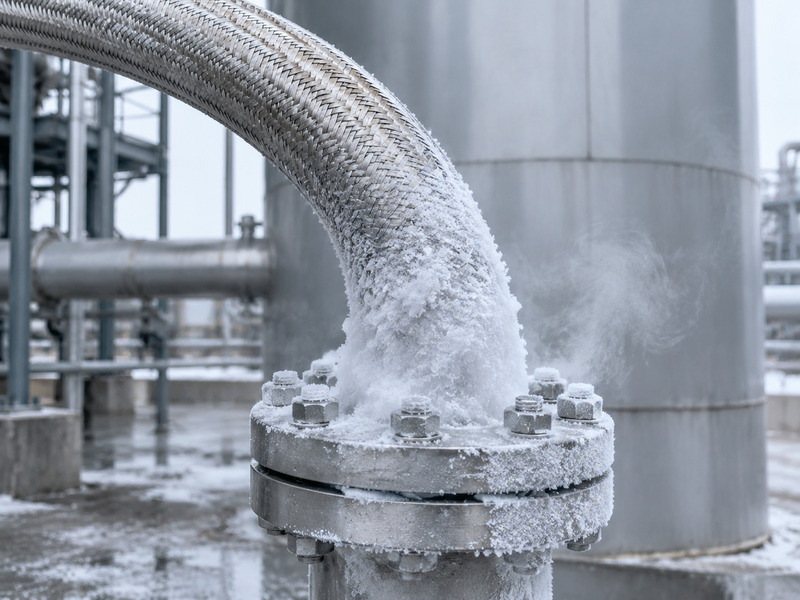
Roughly −30 °C to +150 °C depending on type, with Type 4 covering the top of that band. Cryogenic duty is outside the standard entirely.
Can I use it for saturated steam?
Only with a liner and bond rated for it. PTFE builds can handle steam within their limits; polyolefin builds cannot.
What about freezing?
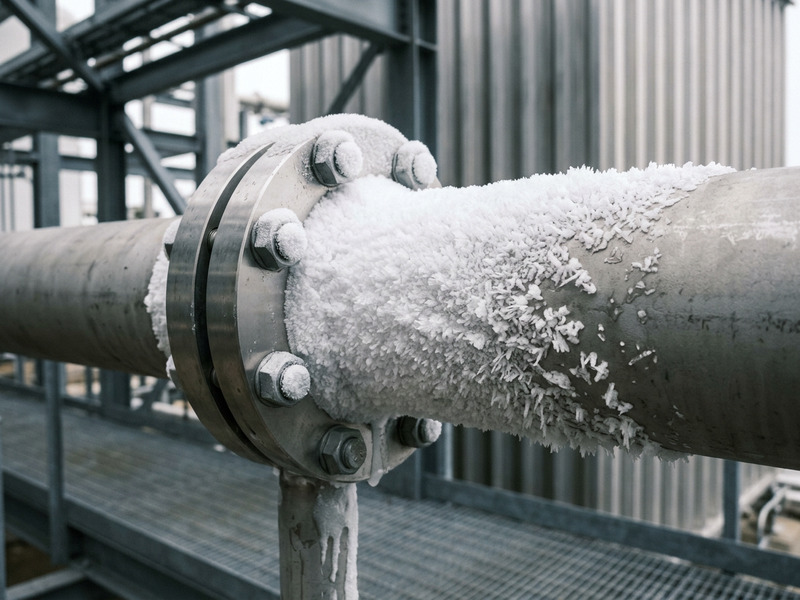
Down to about −30 °C for the standard types. Below that, the liner and bond need separate data, and LNG or LN2 duty needs a different construction.
Why does my hose soften in summer?
Because thermoplastic walls soften as they warm, and pressure capability falls with them. A line that is comfortable at 20 °C may be marginal at 55 °C.
Liner
Which liner do I need for acid?
PP or PTFE for most mineral acids. The concentration and temperature decide, and both belong in the question.
Which liner for solvents?
PTFE for aromatics and chlorinated solvents. Polyolefins swell, and the swell is not reversible.
Which liner for food?
PP, UHMWPE or PTFE in food-contact grades, with a declaration of compliance. The colour of the cover proves nothing.
| Duty | Usual liner | Watch point |
|---|---|---|
| Mineral acids, ambient | PP | Temperature ceiling |
| Aromatic solvents | PTFE | Cost, flexibility |
| Food, aqueous | PP | Cleaning temperature |
| Abrasion and slurry | UHMWPE | Lower ceiling than PTFE |
| Hot chemical | PTFE | Bond above 80 °C |
| Exception | A duty that mixes acid and solvent | PTFE, not PP: one liner for both |
Table 1. Composite hose basics for liner choice. Confirm each against the supplier’s compatibility data.
How do I know which liner I have?
From the marking and the original datasheet. If neither exists, the liner is unknown and the hose should be treated as unsuitable for a critical duty.
Can the liner be changed later?
No. The liner is part of the wall. A different liner means a different hose.
Ends and Connections
Camlock or flange?
Camlock where speed matters and pressure is moderate; flange where pressure, size or vibration demands it. Large bore assemblies often need flanges to reach the hose rating.
Which camlock type do I need?
Type C and Type E are the hose-shank halves. Which one goes on the end depends on what the plant presents: a male adapter takes a Type C, a female coupler takes a Type E.
Which gasket?
Match the product, not the liner. Buna-N for hydrocarbons, EPDM for water and many acids, Viton for aromatics, PTFE for the widest range.
Can I reuse a ferrule?
No. A swaged ferrule cannot be re-swaged, and reuse is a common cause of pull-off.
Why does my hose leak behind the ferrule?
Usually wire fatigue or a creased film from assembly. The fitting is rigid, so all bending happens immediately behind it.
Standards and Marking
Which standard covers composite hose?
The European composite hose specification for ambient chemical and hydrocarbon duty, as the type guide sets out. It classifies hose by type and sets pressure, temperature and marking requirements. A composite hose FAQ that quotes a pressure without that standard is quoting a number rather than a specification.
Is BS 5842 still valid?
It is withdrawn. Legacy tenders still reference it, and the practical answer is to quote the current standard and attach the values the old reference implied.
What does USCG 33 CFR 154.500 require?
Design and marking rules for hose assemblies at US terminals: a burst factor relative to the relief setting, a maximum allowable working pressure, specified connections and marking.
Why does marking matter?
Because it ties a delivered hose to a test record. A hose without marking cannot be traced, and an untraceable hose is treated as unproven.
Cleaning and Life
Can it be cleaned in place?
Yes, within the liner’s cleaning envelope. Caustic concentration, temperature and contact time decide, not the word “CIP”.
Can it be steam sterilised?
With a PTFE build and a bond rated for the temperature. Polyolefin liners soften below typical SIP temperatures.
Why does the cover blister?
Vapour is permeating the liner and collecting under the cover. It is evidence of permeation rather than a cover defect, and it usually appears before any pressure loss.
How long does a composite hose last?
It depends on duty, cleaning and handling. Retire on inspection triggers rather than a calendar: swelling, a soft band at the fitting, cover damage exposing the helix or a failed test.
Buying and Documentation
What is a typical minimum order?
It varies with bore, liner and marking, and it is set at quotation. Composite hose is often made to order, so the quantity and the build interact.
What documents should arrive with the hose?
Three items: the build data sheet, the pressure test record, and the declaration the product needs. Marking should tie the hose to all three.
Can I cross-reference another brand?
Yes, on five values: bore, pressure at temperature, liner, ends and approval scope. The cross-reference method shows the worksheet. A part number alone is not enough.

Figure 2. Racks of coils by bore. Most buyers need pressure, liner and ends before anything else.
Quick Reference
| Question | Short answer |
|---|---|
| Maximum working pressure | 14 bar for Types 3 and 4 |
| Temperature range | About −30 to +150 °C by type |
| Standard liner for acid | PP, or PTFE when hot |
| Standard liner for solvent | PTFE |
| Common hose end | Camlock type C or E |
| Governing standard | European composite hose specification |
| Cleaning limit | Set by liner, not by the word CIP |
| Replacement trigger | Inspection finding, not age |
| Exception | A question this page cannot answer is left to the duty, and the linked guide asks for it |
Table 2. Eight answers that cover most first enquiries. Each links to a deeper guide above.
How Should You Use This Page?
A composite hose FAQ works best as a composite hose basics filter rather than a reference, and the glossary covers the vocabulary.
A composite hose FAQ is useful when it removes options quickly. If you know the product and the temperature, the liner question is nearly answered. If you know the bore and the pressure, the type question is nearly answered.
Every composite hose FAQ answers the same way: short, then a link. The answers here are deliberately short. Each one links to a guide that carries the detail, because the detail is where the decisions live and a short answer cannot hold it.
Where a question has no general answer, the page says so. That is not evasion; it is the honest position for a product whose performance depends on the build.
Where Do These Composite Hose Questions Come From?
From enquiries, returns and audits, in roughly that order.
The pressure and temperature questions arrive first, because they are the numbers a project has. The liner questions arrive second, usually after a compatibility chart has produced three candidates. The end questions arrive third, when someone discovers the plant has a coupling type nobody documented.
The questions in this hose buying FAQ are the ones that recur across industries. A dairy and a terminal ask the same thing about cleaning and marking, and phrase it differently.
A composite hose FAQ that ignores those recurring questions ends up answering questions nobody asked, which is why this hose buying FAQ is built from enquiries, returns and audits rather than from a catalogue.
What Is Missing From a Buying FAQ?
Three things, and this page tries to keep them visible.
The first is the duty. A FAQ answer cannot know your product, so it points back to the duty rather than pretending to a universal answer.
The second is the documentation. Buyers ask what a hose can do and forget what should arrive with it. The documents are half the product on a regulated line.
The third is the failure mode. A hose that is right on paper can still fail at the ferrule, and a buying FAQ that ignores how hoses fail produces buyers who cannot inspect one.
How Do You Use It in a Meeting?
Three questions, in this order.
What is the product and the temperature? That fixes the liner family. What is the pressure at that temperature? That fixes the type. What does the plant present at each end? That fixes the assembly.
If the meeting produces those three answers, the rest of the order is administrative. If it produces none, the page has still done its job by showing which answers are missing.
Used this way it shortens the meeting, and it keeps the conversation on the duty instead of on the catalogue.
Which Questions Should You Ask Your Supplier?
A composite hose basics list only helps if it ends in questions a buyer can ask, so this composite hose FAQ closes with four that are worth putting to any supplier in writing.
What standard is this build tested to, and at what temperature. What is the assembly rating, not the hose rating. Which documents arrive with the delivery. And what are the retirement criteria for this duty.
Those four composite hose questions expose most weak offers, because they cannot be answered from a brochure. A hose buying FAQ that stops at pressure and bore leaves them unasked, which is why this page ends with them.
Ask them once per duty, keep the answers, and the next composite hose enquiry starts from evidence rather than from memory.
Frequently Asked Questions
Is this page a substitute for a datasheet?
No. It answers general questions. A datasheet describes the build you ordered, with the values and the test record.
Which guide should I read first?
Pressure and liner, in that order. They eliminate most of the wrong options before cost is discussed.
Do you cover food and pharmaceutical duty?
Yes, in the food grade guides, including the document chain a hygiene audit expects.
Can you help if I only have a part number?
Yes, up to a point. We will ask for the five values, and where they are unknown we will work from the duty instead.
Are the figures on this page standard values?
Where a standard value exists, yes. Where the answer depends on the build, the page says so rather than quoting a number.
How do I order?
Send the twelve fields of the order checklist, or the duty behind them, and we will quote against them.
About HENGHUA
The range runs with PP, XLPE, UHMWPE and PTFE liners from 1 inch to 8 inch, and enquiries are answered against the duty rather than the part number. Where a question falls outside what we can document, we say so.
Send the question with the duty behind it, and we will answer it in writing.
 English
 Spanish
 Portuguese
 French
 German
 Arabic
 Russian
 Indonesian
 Japanese
 Korean