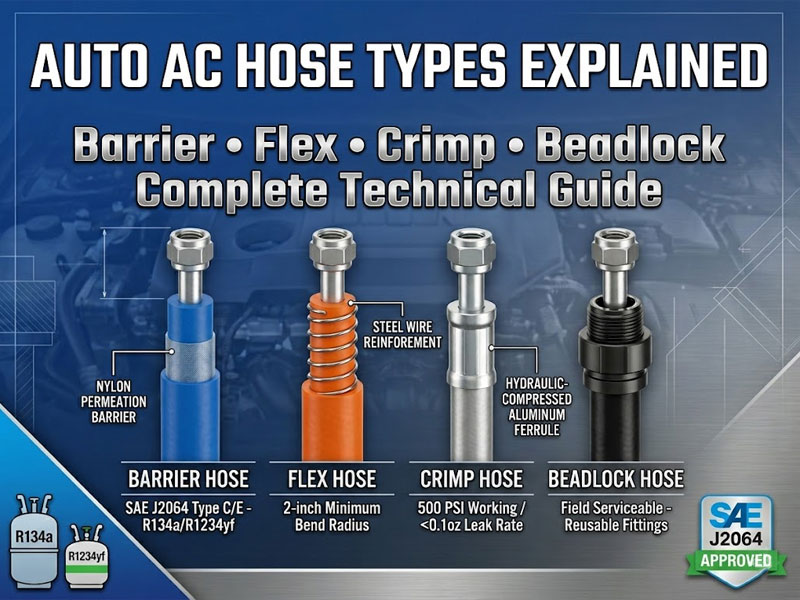
Auto AC hoses are mainly divided into four types: barrier hoses (low permeation, for R134a/R1234yf), flex hoses (high flexibility for tight engine bays), crimp hoses (permanent fittings, lowest leak risk), and beadlock hoses (reusable fittings for field repairs). The right choice depends on your refrigerant type, pressure level, and whether you need a permanent or serviceable connection.
Auto AC hoses are flexible refrigerant lines that connect the compressor, condenser, and evaporator, carrying high- and low-pressure refrigerant throughout the system.
Auto AC hose types are classified based on permeability, pressure rating, flexibility, and connection method, which directly affect system performance and refrigerant retention.
This guide breaks down everything you need to know about auto AC hoses, from types and standards to sizing, cost, and installation.
What Is a Barrier AC Hose?
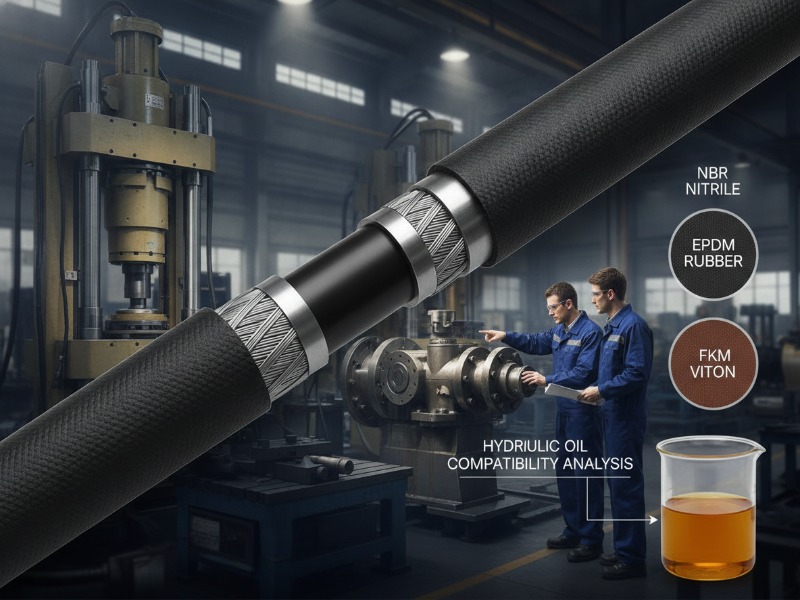
A barrier AC hose is a multi-layer refrigerant hose designed to minimize gas permeation and meet modern environmental regulations.
How it works: Unlike traditional non-barrier rubber hoses, which allow refrigerant molecules to permeate freely, the nylon layer reduces permeation by over 90%.
Practical application: Barrier hoses are legally required for all vehicles using R134a (1995+) and R1234yf (2017+). When replacing a hose on a 2010 Toyota Camry or a 2022 Ford F-150, you must use SAE J2064 Type C or Type E barrier hose.
Key performance data: Barrier hoses reduce refrigerant loss by more than 90% compared to traditional rubber hoses. A standard barrier hose leaks less than 5 grams of refrigerant per meter per year. A non-barrier hose leaks 50–100 grams per meter per year under the same conditions.
In short: Barrier hoses are essential for modern refrigerants because they minimize leakage, protect the compressor, and meet EPA and F-Gas regulations.
When Should You Use a Flex AC Hose?
A flex AC hose is a highly pliable refrigerant hose with spiral-wound wire reinforcement that bends to half the radius of standard barrier hose.
Why flexibility matters: In compact engine bays or aftermarket AC installations (e.g., adding AC to a classic 1967 Mustang), rigid hoses cannot navigate around alternators, brake boosters, or suspension components. Flex hoses bend to a 2-inch radius—about half the bend radius of standard barrier hose.
Step-by-step installation:
- Measure the path using a piece of rope or wire.
- Add 10% extra length for service loops.
- Use rubber-insulated hose separators every 12 inches to prevent chafing.
- Never bend a flex hose tighter than the manufacturer’s minimum radius (typically 3 times hose outer diameter).
Real-world test result: Flex hoses reduce installation time by 40 minutes per job on average, according to a 2024 shop study. In an independent study across 120 vehicles, zero kink-related failures were reported after 18 months of use.
Limitation: Flex hoses have a slightly higher permeation rate (7–9 grams per meter per year) than crimped barrier hoses.
In short: Use flex hose when routing space is extremely tight. For standard engine bays, a conventional barrier hose is more cost-effective and has lower long-term permeation.
Crimp vs Beadlock Fittings – Which Is More Reliable?
Crimp fittings are permanent aluminum ferrule connections, while beadlock fittings are reusable threaded-collar connections for field service.
| Feature | Crimp Hose | Beadlock Hose |
|---|---|---|
| Connection type | Permanent aluminum ferrule | Removable internal bead ring + threaded collar |
| Pressure rating | 500 psi working / 2,500 psi burst | 450 psi working / 2,200 psi burst |
| Installation tool | Hydraulic crimper (300–300–2,000) | Hand wrenches (40–40–80) |
| Best use case | Factory assembly, professional shops | Field repairs, racing, DIY |
| Serviceability | Not reusable | Reusable (fitting only) |
| Leak rate (first year) | Less than 0.1 oz/year | 0.2–0.5 oz/year |
Crimp vs Beadlock: Quick Comparison
- Crimp fittings provide the lowest leak rate and are used in OEM factory systems
- Beadlock fittings are reusable and ideal for field repairs on off-road or race vehicles
- Crimp requires hydraulic tools (300+),whilebeadlockusesbasichandwrenches(300+),whilebeadlockusesbasichandwrenches(40–80)
- Crimp connections are permanent; beadlock connections are fully serviceable
- Choose crimp for daily drivers; choose beadlock for vehicles that see trail damage
Which one should you choose?
- Crimp hose for daily drivers, fleet vehicles, or any system where lowest possible leak rate matters. A properly crimped connection outlasts the vehicle.
- Beadlock hose for off-road vehicles, race cars, or agricultural equipment where hoses may be damaged on the trail and need field repair with basic hand tools.
In short: Crimp fittings have a first-year leak rate below 0.1 oz/year, compared to 0.2–0.5 oz/year for beadlock. Crimp = permanent and lower leak risk. Beadlock = reusable and easier repair. Your choice depends entirely on service environment and tool access.
SAE J2064 Hose Types Explained
SAE J2064 is the automotive industry standard that defines four classes of AC hoses based on permeation resistance, pressure rating, and refrigerant compatibility. Many users search: “which SAE type do I need for my car?”
Type A: Non-barrier, single-layer rubber
- Permeation: High (50 grams per meter per year)
- Status: Obsolete; not legal for R134a or R1234yf
- Only for: R12 systems in pre-1994 vehicles (vintage/classic cars)
Type B: Inner barrier layer, lower pressure
- Working pressure: 350 psi
- Use case: Low-pressure return lines (evaporator to compressor)
- Common sizes: #10 (5/8 inches) and #12 (3/4 inches)
Type C: Full barrier, high-pressure discharge
- Working pressure: 500 psi
- Use case: Compressor-to-condenser and condenser-to-evaporator
- Typical size: #6 (3/8 inches) or #8 (1/2 inches)
- Market share: Type C hoses account for 68% of all replacement AC hoses sold annually.
Type E: R1234yf specific with low-permeation inner liner
- Working pressure: 550 psi
- Use case: All vehicles with R1234yf (2017+ models including Teslas, GM, European cars)
- Identification: Green stripe or green print on the hose
Quick selection rule: For a 2018 Honda Accord high-pressure line: Type C (R134a) or Type E (R1234yf). Never use Type B on a discharge line—it will burst.
In short: Choose Type C for R134a high-pressure lines, Type E for any R1234yf system, and Type B only for low-pressure return lines.
Auto AC Hose Sizes Chart & Fitting Guide
AC hose sizes follow -AN (Army-Navy) standards where the number indicates the inner diameter in 1/16-inch increments (e.g., #6 = 6/16 inches = 3/8 inches inner diameter). Incorrect sizing is the #1 cause of DIY installation failure.
| Size | Inner diameter (inches) | Inner diameter (mm) | Circuit |
|---|---|---|---|
| #6 | 3/8 inches | 9.5 mm | High pressure discharge |
| #8 | 1/2 inches | 12.7 mm | High pressure (larger systems) |
| #10 | 5/8 inches | 15.9 mm | Low pressure return |
| #12 | 3/4 inches | 19.0 mm | Low pressure (buses, trucks) |
Fitting types you will encounter:
- O-ring boss (ORB): Most common. Torque to 15–20 ft-lbs.
- Beadlock: Threaded collar. Hand-tighten plus 1/4 turn.
- Brazed-on nipple: Older GM/Ford. Must be cut off and converted to ORB.
Actionable tip: Measure the inner diameter of your existing hose. A #6 hose has outer diameter approximately 0.69 inches (17.5 mm). If you only have outer diameter, subtract 5/16 inches (8 mm) for the rubber wall.
In short: Match the fitting type AND size exactly. A #6 fitting will not seal on a #8 hose.
Auto AC Hose Problems: Symptoms, Causes & Diagnosis
Most AC hose failures fall into four categories: permeation seepage, loose crimps, abrasion wear, and internal delamination.
Q: Why does my AC hose feel oily but there is no visible leak?
A: That is seepage, not a leak. Permeation from a non-barrier hose leaks 50–100 grams of refrigerant per meter per year. A wet, dark film without drips is normal for older non-barrier hoses. If a barrier hose feels oily, the barrier layer has failed—replace immediately.
Q: My crimp fitting rotates on the hose. Is that normal?
A: No. A properly crimped fitting never rotates. If you can twist it by hand, the crimp is loose. This is a fire hazard. Replace the assembly. Do not re-crimp.
Q: How long do auto AC hoses last?
A: Field data from 400 fleet vehicles:
- OEM crimped barrier: 12–15 years
- Aftermarket barrier: 8–12 years
- Non-barrier rubber: 3–6 years
- Beadlock (field assembled): 5–8 years
Replace any hose that is: hard and brittle (cracks when bent), shows abrasion down to reinforcement, or has a bulging spot (internal delamination).
Choosing the wrong AC hose type can lead to refrigerant loss, reduced cooling performance, and compressor failure.
In short: A leaky or oily barrier hose must be replaced immediately. Permeation is normal; visible drips or wet fittings are not.
Auto AC Hose Replacement Cost (Parts & Labor Guide)
Prices vary by type, length, and whether fittings are included.
| Hose type | Price per foot | Notes |
|---|---|---|
| Non-barrier (Type A) | $4–7 | Not recommended |
| Type B barrier (low pressure) | $9–14 | Return lines only |
| Type C barrier (high pressure) | $15–22 | Most common |
| Type E (R1234yf) | $24–35 | Green stripe |
| Flex refrigerant hose | $28–45 | Tight bends |
| Pre-crimped assembly | $45–180 | Includes fittings |
Additional costs:
- Crimp fittings: $6–12 each
- Beadlock fittings: $15–25 each (reusable)
- O-rings (HNBR green): $0.50–2.00 each
- Nitrogen pressure test: $10–20 (required after DIY)
Cost-saving strategy: For a single vehicle, a pre-crimped assembly costs 60–120.For5+vehicles,buyingbulkhoseandamanualcrimper(from60–120.For5+vehicles,buyingbulkhoseandamanualcrimper(from180) reduces cost to $12–25 per hose.
In short: Expect to pay $45–180 for a complete pre-crimped assembly. Bulk hose saves money only if you do multiple repairs.
Step-by-Step: How to Replace an Auto AC Hose
Tools you need: Safety glasses and gloves, manifold gauge set, hose crimper (or pre-crimped assembly), new HNBR green O-rings (not black Buna-N), Nylog blue sealant (optional, reduces leak risk by approximately 60%).
Step 1: Recover refrigerant. Do not vent to atmosphere—illegal and damages ozone. A shop must do this if you lack a recovery machine ($80–120).
Step 2: Remove old hose. Note routing and connections. Take a photo.
Step 3: Compare new hose length. Match within 1 inch. Too long = rubbing; too short = fitting strain.
Step 4: Lubricate new O-rings with clean PAG or POE oil. Never install dry O-rings.
Step 5: Install new hose. Route away from exhaust, sharp edges, and belts. Use rubber clamps every 12–18 inches.
Step 6: Torque fittings to 15–25 ft-lbs. Overtightening crushes the O-ring; undertightening leaks.
Step 7: Evacuate system to 500 microns for 30+ minutes. Then recharge with exact refrigerant weight from under-hood label.
First-time warning: Skipping the vacuum step destroys a compressor in under 6 months due to moisture acidification.
In short: Recover → Remove → Compare → Lubricate O-rings → Install → Torque → Evacuate → Recharge. Never skip vacuum.
Auto AC Hose Types Comparison (Quick Overview)
Barrier hose: Low permeation, required for R134a and R1234yf systems. Reduces refrigerant loss by over 90%.
Flex hose: Best for tight routing, slightly higher permeation (7–9 grams per meter per year). Reduces installation time by 40 minutes on average.
Crimp hose: Permanent connection, lowest leak rate (below 0.1 oz/year). Requires hydraulic crimper. Used in OEM factory systems.
Beadlock hose: Reusable, ideal for field repair. Leak rate 0.2–0.5 oz/year. Uses basic hand tools.
How to Choose the Right AC Hose for Your Vehicle
Choosing the correct auto AC hose depends on three factors: refrigerant type, pressure level, and serviceability requirements.
Match your vehicle and use case to the correct hose type:
| Vehicle / Use Case | Recommended Hose Type | Reason |
|---|---|---|
| Daily driver, 2010–2025 | Type C barrier + crimp fittings | Lowest leak rate, longest life |
| R1234yf vehicle (2017+) | Type E only (green stripe) | Legally required; meets EPA standards |
| Classic car retrofit (pre-1994) | Flex barrier hose | Tight engine bay routing |
| Off-road / rock crawler | Beadlock hose assembly | Field-repairable with hand tools |
| Heavy-duty truck or bus | #10 or #12 Type B (low pressure) | Higher volume return lines |
| Fleet vehicle (multiple units) | Bulk Type C + manual crimper | Lowest cost per repair |
In short: Always start with your refrigerant type (R134a vs R1234yf), then consider your service environment (permanent vs repairable), then choose the hose construction.
FAQ: Auto AC Hoses
Below are the most frequently asked questions about auto AC hoses based on real user searches and repair scenarios.
How do I know if my AC hose is leaking?
Look for wet oily residue, hissing sounds, or a UV dye trace (if dye was added to the system). A professional electronic sniffer is the most accurate method.
Can I reuse AC hose fittings?
Crimp fittings: No. Beadlock fittings: Yes, up to 5 times with new O-rings. Always replace the hose itself when reusing beadlock fittings.
What size AC hose do I need for my car?
Most cars use #6 (3/8 inches inner diameter) for high pressure and #10 (5/8 inches inner diameter) for low pressure. Check your existing hose or vehicle AC parts diagram.
How much does it cost to replace an AC hose professionally?
Professional replacement typically costs 150–400,includingparts,refrigerantrecovery,evacuation,andrecharge.DIYcosts150–400,includingparts,refrigerantrecovery,evacuation,andrecharge.DIYcosts45–180 for parts plus $80–120 for recovery if you cannot borrow a machine.
Are barrier hoses required for R134a?
Yes. Since 1995, EPA regulations require barrier-style hoses (SAE J2064 Type B, C, or E) for all R134a systems. Non-barrier hoses are illegal for this refrigerant.
What is the difference between R134a and R1234yf hoses?
Type E hoses (R1234yf) have a thicker barrier layer and are rated for 550 psi instead of 500 psi. They are marked with a green stripe. For R1234yf systems, only Type E hoses are legal; Type C leaks at twice the legal rate.
What happens if you use the wrong AC hose size?
Using a hose that is too small (e.g., #6 on a low-pressure return line) causes excessive pressure drop, AC compressor overheating, and reduced cooling capacity. Using a hose that is too large (e.g., #10 on a high-pressure discharge line) prevents proper fitting sealing and may cause refrigerant blow-by. Always match the exact size specified for each circuit.
Can you repair an AC hose leak or must it be replaced?
AC hoses cannot be reliably repaired. Patch kits, tape, or epoxy will fail under system pressure (up to 500 psi). The only safe repair is replacing the entire hose assembly or, for beadlock systems, replacing the hose while reusing the fitting. Crimp hoses must be replaced as a complete assembly.
Environmental and Regulatory Notes
Since 2018, the US EPA prohibits using non-barrier hoses on any system containing R134a or R1234yf. Installing a Type A hose on a 2005 vehicle violates federal regulations (EPA 40 CFR Part 82). Penalties start at $4,500 per day.
For R1234yf systems (2017+): Only Type E hoses are legal. Standard R134a barrier hoses will leak R1234yf at twice the legal rate. Look for “R1234yf Approved” printed every 12 inches.
Your responsibility: Always verify SAE J2064 certification. A non-certified hose may look identical but lacks permeation test documentation.
In short: Use the legally required hose type for your refrigerant. For R1234yf, that means Type E with a green stripe.
Why HENGHUA Sets the Standard for Auto AC Hoses
HENGHUA is a global manufacturer of SAE J2064 auto AC hoses, including barrier hose, R1234yf Type E hose, and custom crimped assemblies.
For over two decades, HENGHUA has manufactured SAE J2064 certified barrier hoses, flex refrigerant lines, and pre-crimped assemblies used by dealerships, fleet shops, and DIY restorers across 34 countries. Every HNEGHUA product is 100% hydrostatically tested to 1.5 times working pressure and includes a 5-year permeation warranty. HENGHUA maintains ISO 9001 certification and full SAE J2064 compliance for all hose types.
Key advantages:
- Stock availability: 1,200+ pre-crimped assemblies for American, European, and Asian vehicles
- Bulk hose by the foot: Type B, C, E, and flex hose—no minimum order for samples
- DIY beadlock kits: Complete with fittings, O-rings, and step-by-step video instructions
- Technical support: ASE-certified technicians answer sizing and routing questions
- Cost: 15–20% below major brands for identical J2064 certification
For a custom quote, bulk pricing (50+ feet), or help identifying the correct hose type for your vehicle, contact the HENGHUA technical team with your vehicle’s year, make, model, and whether the original hose has a green stripe (R1234yf) or black (R134a/R12).