


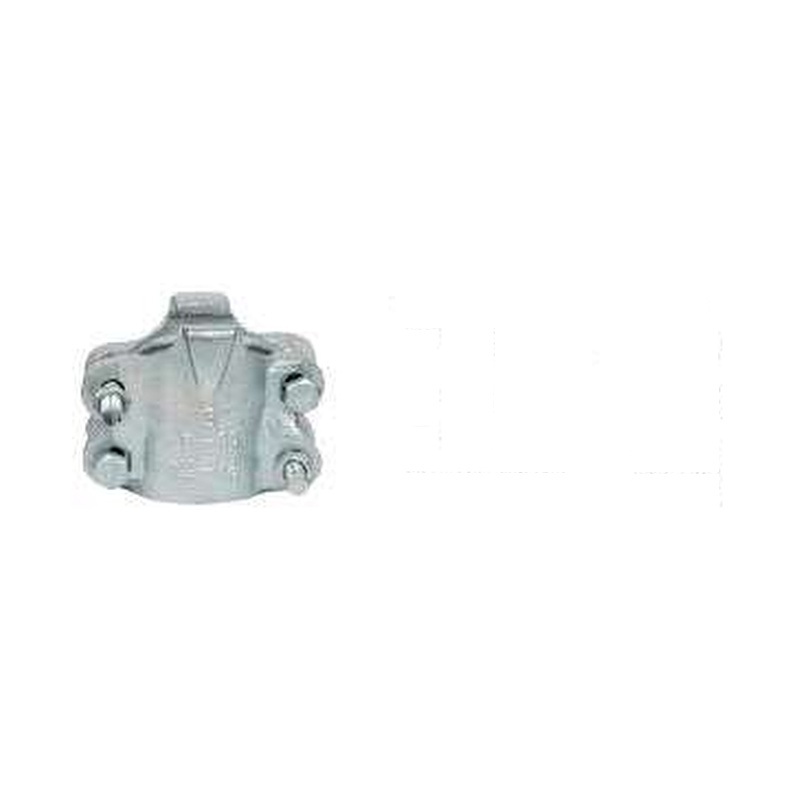
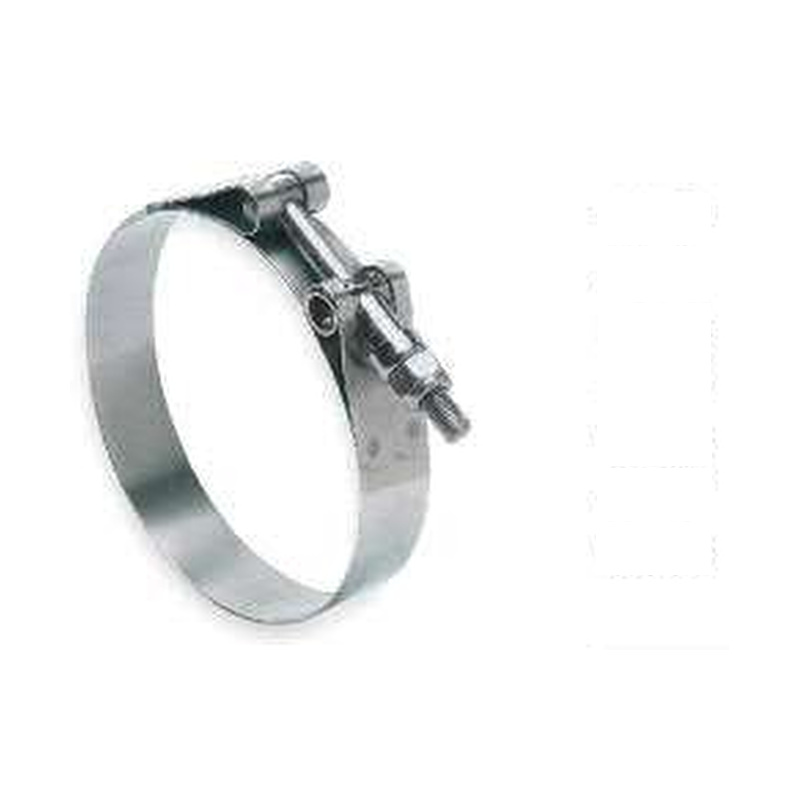
Heavy duty hose clamps are the bolted families used where a worm-drive clip cannot hold: interlock, double bolt, T-bolt and centre punch. They are supplied in stainless steel, zinc-plated carbon steel and plated malleable iron, and they are selected by the clamping range in millimetres rather than by a nominal bore. They are used on air intake and charge-air pipework, coolant lines, steam hose with collared stems, and suction or discharge hose that sees pressure pulses.
|
|
|
|
|
Heavy duty hose clamps: Interlok
| Hose size | Part number | Screw size | Range (in) |
|---|---|---|---|
| 1/2 in | B-4 | 8×35 | 15/16–1-1/16 |
| 1/2 in | B-5 | 8×35 | 1-1/16–1-3/16 |
| 3/4 in | BU-9 | 8×45 | 1-3/16–1-5/16 |
| 3/4 in | B-9 | 8×45 | 1-5/16–1-1/2 |
| 3/4 in | B-10 | 8×45 | 1-1/2–1-11/16 |
| 1 in | BU-14 | 10×60 | 1-17/32–1-23/32 |
| 1 in | B-14 | 10×60 | 1-11/16–1-15/16 |
| 1 in | B-15 | 10×60 | 1-15/16–2-1/8 |
| 1-1/4 in | B-19 | 10×60 | 2-1/8–2-3/4 |
| 1-1/2 in | BU-24 | 12×70 | 2-3/32–2-9/32 |
| 2 in | BU-29 | 12×80 | 2-1/2–2-25/32 |
| 2-1/2 in | B-34 | 16×100 | 3-1/2–3-15/16 |
| 2-1/2 in | BU-34 | 14×70 | 3-3/32–3-7/16 |
| 3 in | B-35 | 16×100 | 3-13/16–4-1/16 |
Two part numbers often share a hose size because each covers a slice of the range: on 3/4 in there are BU-9, B-9 and B-10, and the buyer picks by the measured diameter rather than by the nominal size. The BU prefix is the narrower band in the pair.
Heavy duty hose clamps: double bolt
| Part number | Range (mm) |
|---|---|
| SL22 | 17–22 |
| SL29 | 22–29 |
| SL34 | 27–32 |
| SL40 | 32–39 |
| SL49 | 39–49 |
| SL60 | 48–60 |
| SL76 | 60–76 |
| SL94 | 77–94 |
| SL115 | 94–115 |
| SL400 | 88–96 |
| SL463 | 96–103 |
| SL525 | 103–125 |
| SL550 | 114–128 |
| SL600 | 130–144 |
| SL675 | 151–165 |
| SL769 | 165–192 |
| SL818 | 195–208 |
| SL875 | 210–225 |
| SL988 | 227–239 |
| SL1125 | 252–289 |
| SL1275 | 300–330 |
| SL1450 | 335–381 |
The double bolt numbers are the range in millimetres, rounded: SL60 closes on 48 to 60 mm. Two entries sit outside the sequence, SL400 at 88–96 mm and SL115 at 94–115 mm, because they belong to a different band width and the pair overlaps by design.
T-bolt and centre punch
The T-bolt and centre punch families are ordered by clamping range rather than by a part number, and the range is marked on the band. For these two, quote the measured hose diameter and the band width; the size is confirmed against the range chart rather than against a code.
Selection is by clamping range, not by bore
Every clamp in this range is defined by the diameter it closes on, in millimetres, and the range is marked on the band. Two hoses of the same nominal bore can differ by several millimetres over the cover, and a clamp chosen by bore will either not close or will bottom out before it grips.
Measure the hose with a calliper over the cover at the point the clamp will sit, then pick the clamp whose range contains that reading. On a thick suction hose the cover also varies round the circumference, so take the largest reading; a clamp sized on the average will leak at the high spot.
Materials
SS304 is the general stainless choice for water, coolant and air. SS316 is for chloride and chemical splash, where 304 would pit at the band edge. Zinc-plated carbon steel is the economical option indoors, and it is the one that fails first outdoors: the plating wears at the screw threads and the band rusts from the inside of the housing.
Malleable iron, used for the double bolt pattern, is strong but heavy and is supplied plated. It is not a stainless substitute: on a washdown line the plating at the bolt heads is the first thing to go.
No pressure rating, and why
Hose clamps are not pressure-rated parts. A clamp holds a hose onto a shank, and the pressure capability of that joint depends on the shank, the hose, the medium and the temperature as much as on the clamp. We do not publish a working pressure for a clamp, and a figure carried across from a hose table would be meaningless: the same clamp on a soft hose and a hard hose will behave differently.
What the clamp can be specified on is band tension, which is why the T-bolt pattern is chosen for high-torque joints and the interlock pattern for general duty.
Fitting and re-tensioning
Heavy duty hose clamps are re-tensioned after the first heat cycle. Rubber takes a set, the band that was tight on assembly goes slack, and a joint that held cold starts to weep hot. On steam and charge-air lines the re-tension is part of the fit, not a repair.
Two clamps spaced about a band width apart hold better than one clamp tightened harder, because the grip is spread and the second clamp keeps working if the first loosens. On a collared stem the clamp sits behind the collar, never over it.
Ordering information
- Family: interlock, double bolt, T-bolt or centre punch
- Clamping range in millimetres
- Band width
- Material: SS304, SS316, zinc-plated steel or plated iron
- Spring-loaded version, if thermal cycling is expected
- Quantity per range
Frequently asked questions
What pressure does a heavy duty clamp hold?
None is published, because a clamp is not a pressure part. The joint is limited by the hose, the shank and the medium, not by the band.
Why is a T-bolt clamp better than a worm drive?
It develops higher band tension and spreads the load through a bridge instead of a screw housing, so it holds on thick or stiff hose where a worm drive bottoms out.
Do heavy duty hose clamps need to be spring-loaded?
Only where the joint cycles hot and cold. The spring keeps tension as the hose cover takes a set, which is the usual reason a clamp that was tight in summer weeps in winter.
Can I use two clamps on one shank?
Yes, and on a critical joint it is normal practice: two clamps spaced apart distribute the grip and give a second chance if one loosens.
What is the minimum order, and can I get samples?
MOQ, samples and lead time are confirmed per line with the price, because each range is a separate run.
Related reading
- Hose clamps and whipchecks
- Worm drive and spiral clamps
- Whipchecks
- Industrial hose couplings
Heavy duty hose clamps are quoted by family, clamping range and material, and the range is the measurement that matters.
Send the six fields and we come back with the price.


 English
 Spanish
 Portuguese
 French
 German
 Arabic
 Russian
 Indonesian
 Japanese
 Korean