


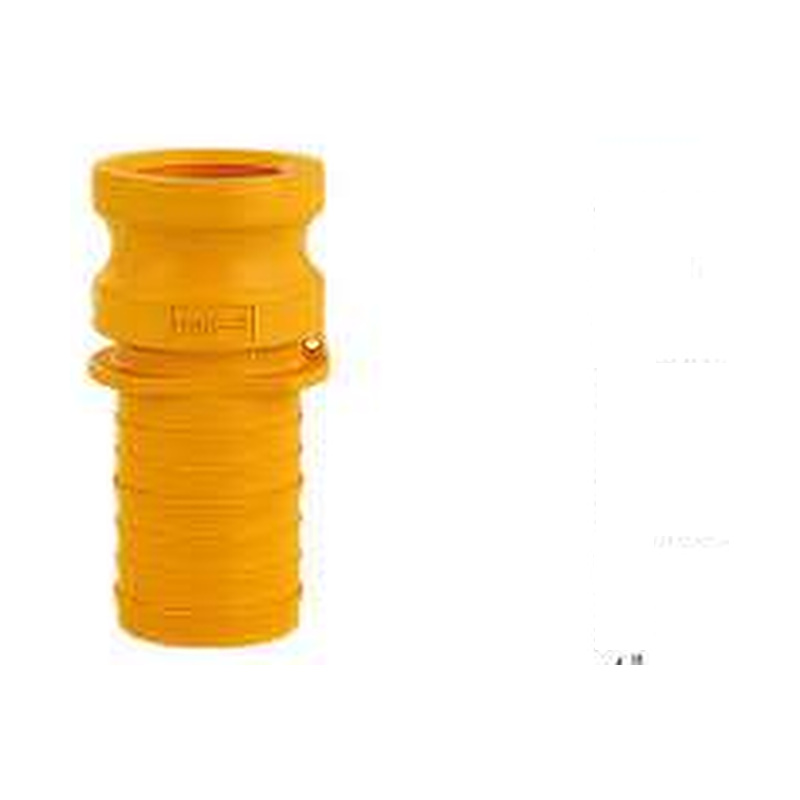

Nylon camlock couplings are quick-connect hose fittings with two cam arms and a gasket, moulded in fiber reinforced nylon. The range covers Types A, B, C, D, E, F, DC and DP from 1/2 in to 4 in. They are used on low-pressure chemical and solvent transfer where a metal body would corrode, spark or set up galvanic contact with another fitting.
Range, types and working limits
| Size | Types | Body | Pressure | Interface |
|---|---|---|---|---|
| 1/2 in | A, B, C, D, E, F, DC, DP | Fiber reinforced nylon | Low pressure; confirm by size and medium | Cam and groove |
| 3/4 in | A, B, C, D, E, F, DC, DP | Fiber reinforced nylon | Low pressure; confirm by size and medium | Cam and groove |
| 1 in | A, B, C, D, E, F, DC, DP | Fiber reinforced nylon | Low pressure; confirm by size and medium | Cam and groove |
| 1-1/4 in | A, B, C, D, E, F, DC, DP | Fiber reinforced nylon | Low pressure; confirm by size and medium | Cam and groove |
| 1-1/2 in | A, B, C, D, E, F, DC, DP | Fiber reinforced nylon | Low pressure; confirm by size and medium | Cam and groove |
| 2 in | A, B, C, D, E, F, DC, DP | Fiber reinforced nylon | Low pressure; confirm by size and medium | Cam and groove |
| 3 in | A, B, C, D, E, F, DC, DP | Fiber reinforced nylon | Low pressure; confirm by size and medium | Cam and groove |
| 4 in | A, B, C, D, E, F, DC, DP | Fiber reinforced nylon | Low pressure; confirm by size and medium | Cam and groove |
Plastic threads behave differently from cut metal threads. Start them by hand, run them down until the faces meet, and add no more than a quarter turn; a moulded thread that is over-tightened spreads at the root and loses its grip on the next assembly.
The nylon range is described as worked under low pressure, and no rating is published for it. The metal pressure table printed on the same page does not apply to it. We confirm the working pressure against size, medium and temperature for each line.
Part numbers: no hyphen after the type letter
| Type | End connections | Part number | Sizes |
|---|---|---|---|
| A | Male adapter × female thread | A075-NY to A400-NY | 3/4 in to 4 in |
| A, 1/2 in | Male adapter × female thread | A050R-NY | 1/2 in × 3/4 in |
| B | Female coupler × male thread | B075-NY to B400-NY | 3/4 in to 4 in |
| C | Female coupler × hose shank | C075-NY to C400-NY | 3/4 in to 4 in |
| D | Female coupler × female thread | D075-NY to D400-NY | 3/4 in to 4 in |
| E | Male adapter × hose shank | E075-NY to E400-NY | 3/4 in to 4 in |
| F | Male adapter × male thread | F075-NY to F400-NY | 3/4 in to 4 in |
| DC / DP | Dust cap / dust plug | DC075-NY, DP075-NY to -400 | 3/4 in to 4 in |
Nylon numbers run the type letter straight into the size code with no hyphen, unlike the aluminium and SS316 ranges. The 1/2 in body is listed as 1/2 in × 3/4 in and carries the suffix R; the 1-1/2 in × 1-1/4 in pair carries it as well, so both -150-NY and -150R-NY exist.
Why choose nylon over polypropylene
Nylon is the tougher of the two plastic bodies. It takes impact and it stands up to cross-threading, which is what happens when a thread is started off-centre and forced; a moulded nylon thread deforms and recovers where a cast one chips. In special applications the material is inert, it does not spark, and it cannot set up galvanic corrosion against a stainless or aluminium mating part.
Those three properties decide most nylon orders: solvent and chemical transfer where a spark is unacceptable, mixed-material assemblies where galvanic contact would attack the metal, and hose that is dragged and dropped rather than carried.
Against polypropylene, nylon gives up some chemical breadth and takes the impact end. Polypropylene resists a wider spread of acids, alkalis and fertilizers; nylon wins where the fitting is knocked about, where threads are crossed under field conditions, and where non-sparking matters. Against aluminium and SS316, both plastics lose on pressure and temperature and win on corrosion of the body itself.
Which hoses do nylon camlock couplings fit?
Type C and Type E take a hose shank sized by bore and fixed with a band or ferrule. Measure the bore, not the outside diameter. On thick-walled suction hose allow for the wall, because the shank only has so much length to grip.
These suit chemical suction and delivery hose, solvent lines and light slurry in drums, IBCs and small tanks. They are not the right fitting for composite hose, whose wall needs a shank cut to the outside diameter.
Combinations that cover most orders
- Drum or IBC to hose: Type A in the port, Type E on the hose.
- Hose to hose: Type C on one hose, Type E on the other.
- Pump to hose: Type F at the outlet, Type C on the hose.
- Blind end: DC over an unused adapter, DP in an unused coupler.
Gaskets and seals
The gasket is the only part of the joint that touches the medium on both faces, so it decides whether the assembly holds. Nitrile is the default for water, oils and mild chemicals; EPDM for water and dilute acids; Viton for solvents and aromatics. A nylon body with a nitrile gasket is not a solvent joint, however good the body is.
Interchangeability with metal camlocks
Nylon uses the same cam and groove interface as the metal ranges, so a nylon Type C mates with an aluminium Type E of the same size. A-A-59326D is written for metal couplings and is not claimed here. Threads sit outside the interface and must be stated as NPT or BSP, because a moulded thread and a cut thread do not always start the same way.
Ordering information
- Type and size for each end
- Thread standard on threaded ends
- Medium and concentration
- Working pressure and temperature
- Gasket compound
- Quantity per type and size
Frequently asked questions
Can nylon camlock couplings be used with solvents?
Yes, that is one of their main uses, provided the gasket matches: a solvent line needs a Viton or PTFE-faced gasket, not nitrile.
What pressure do they hold?
No figure is given and the range is described as low pressure, so we confirm per size and medium. Do not take the metal table on the same page as a rating for these.
Will nylon crack if a thread is cross-threaded?
It deforms rather than chips, which is why the reinforced nylon range is chosen where threads get crossed in the field. A badly crossed thread still damages the thread and should be replaced, not forced.
Nylon or polypropylene for acid?
Polypropylene generally covers a wider spread of acids, alkalis and fertilizers; nylon is the choice where impact, crossed threads or non-sparking decide the order.
What is the minimum order, and can I get samples?
MOQ, samples and lead time are confirmed per line with the price, because each size and type is a separate run.
Related reading
- Camlock couplings range
- Polypropylene camlock couplings
- Stainless steel camlock couplings
- Camlock gaskets
Nylon camlock couplings are quoted by type, size pair and gasket compound, so state all three.
Send the six fields and we come back with the price.


 English
 Spanish
 Portuguese
 French
 German
 Arabic
 Russian
 Indonesian
 Japanese
 Korean