
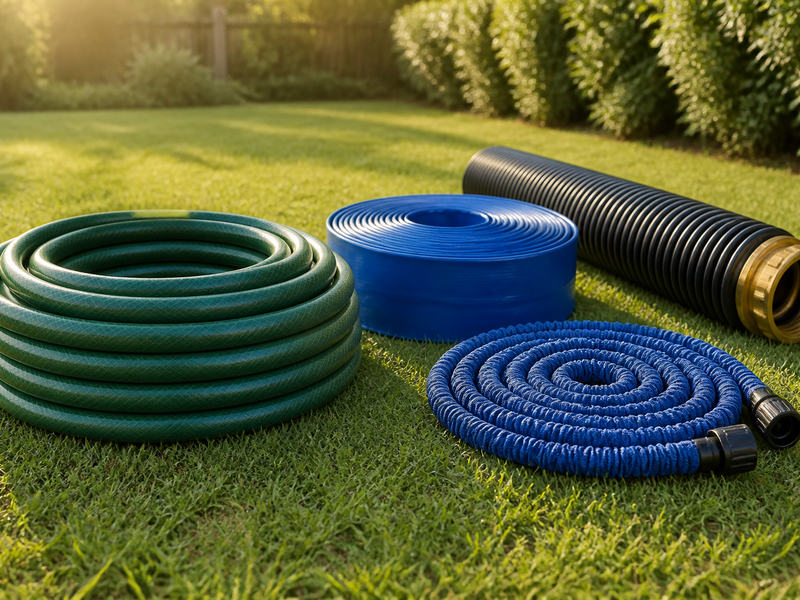
Pressure ratings and temperature bands below were re-checked against EN ISO 1403, ISO 7751, NFPA 1961/1962, NSF/ANSI 61 and FDA 21 CFR 177.2600.
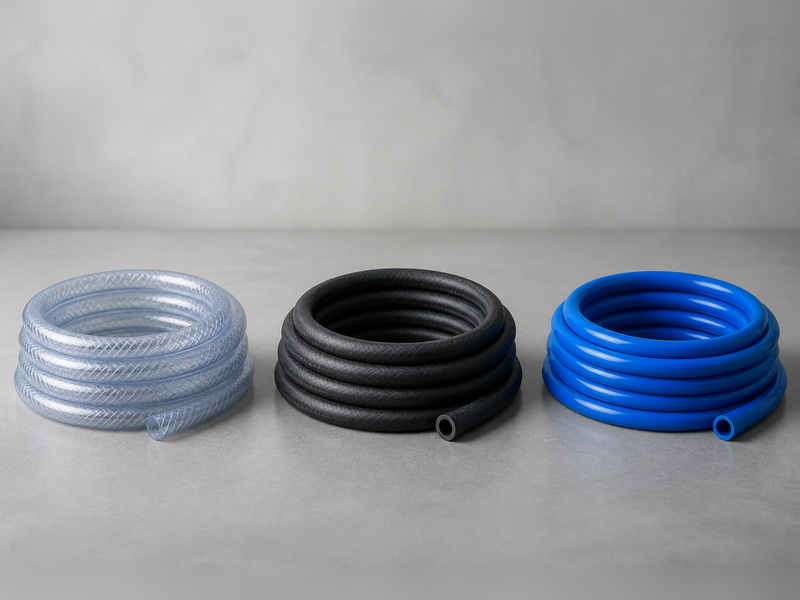
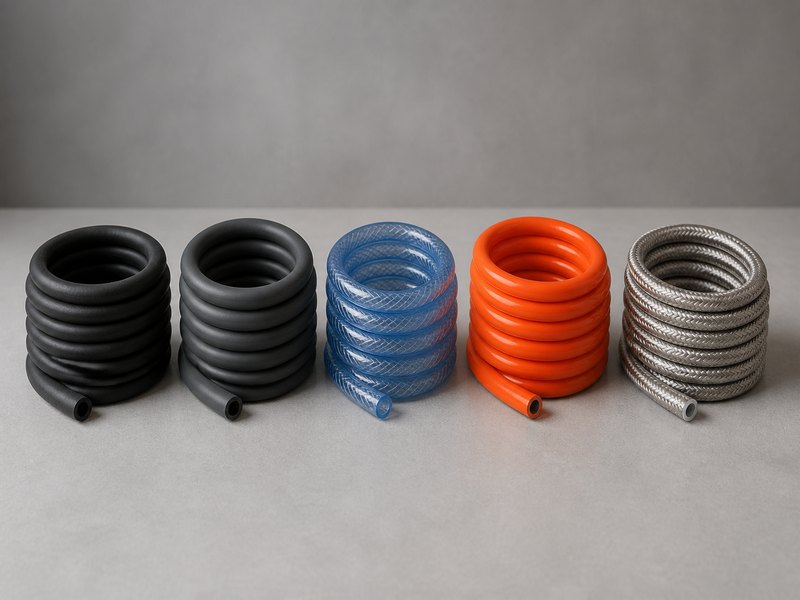
The short answer: the main types of water hoses fall into four material families (rubber, PVC, polyurethane, and TPE or latex hybrids), and each family is produced in several pressure classes and reinforcement builds.
This guide is a specification reference rather than a product catalogue. It sets out the water hose types by material family, a pressure rating chart by hose type, and an application matrix that maps each job to the correct hose. It also covers the standards that govern each category, plus sizing, connection and failure-prevention data. The aim is to let you specify a hose from numbers instead of adjectives.
Every water hose is defined by three things at once: what the tube is made of, how the wall is reinforced, and the pressure class the finished hose is built and marked to hold. That is why one label — “water hose” — covers a porous soaker line running at 10 psi and a fire attack line proof-tested at several hundred psi.
If you want the broad “what exists, and which one am I holding?” walkthrough first, read our companion guide to the types of water hoses, then come back here for the specification depth.
In This Guide
- How Should You Classify the Types of Water Hoses?
- What Are the Water Hose Materials, and Where Does Each One Fit?
- What Does a Water Hose Pressure Rating Actually Mean?
- How Does the Water Hose Pressure Rating Change by Hose Type?
- What Are the Best Uses for Each Type of Water Hose?
- How Do Water Hose Sizes and Connections Affect Flow and Pressure?
- Which Standards Apply to Which Water Hose Category?
- How Do You Choose Between Rubber, PVC and Polyurethane?
- Why Do Water Hoses Fail, and How Do You Prevent It?
- FAQ: Water Hose Materials, Ratings and Uses
- About HENGHUA and Our Testing
1. How Should You Classify the Types of Water Hoses?
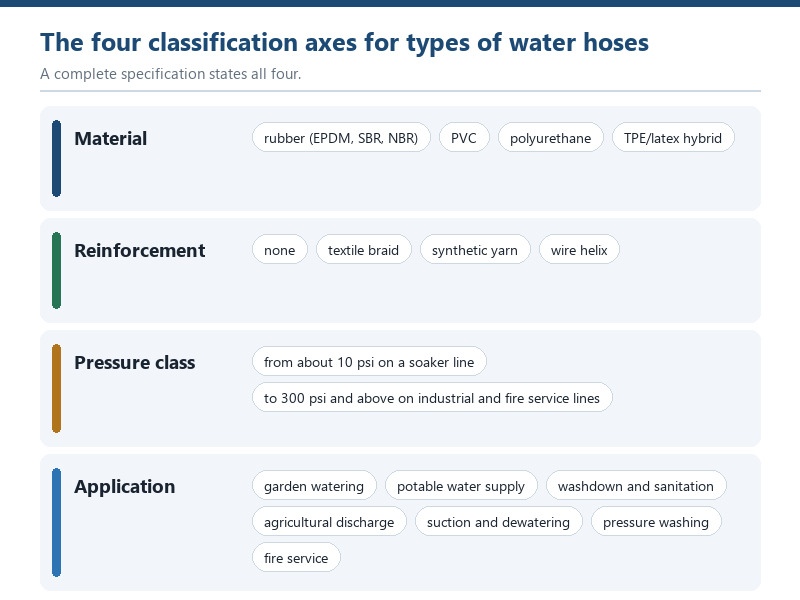
Classification works on four axes, and a usable specification states all four. Material sets temperature and chemical limits; reinforcement sets burst strength and kink resistance; pressure class sets the safe operating ceiling; application sets diameter, length and end connection.
The four axes, in the order that eliminates the most options fastest:
- Material — rubber (EPDM, SBR, NBR), PVC, polyurethane, or a TPE/latex hybrid. Decides temperature range, abrasion life and UV behaviour.
- Reinforcement — none, textile braid, synthetic yarn, or a wire helix. Decides burst strength, vacuum capability and whether the hose can be dragged.
- Pressure class — the marked working pressure, from about 10 psi on a soaker line to 300 psi and above on industrial and fire service lines.
- Application — garden watering, potable water supply, washdown and sanitation, agricultural discharge, suction and dewatering, pressure washing, or fire service.
Getting this wrong is common. In our bench work at HENGHUA, the most frequent specification error we see in returned samples is a PVC hose selected for cold-weather or high-abrasion duty. Buyers classify by application alone and never check the material’s temperature floor. The second most frequent error is a textile-braided hose chosen for a pump suction line, a duty that needs a wire helix instead.
2. What Are the Water Hose Materials, and Where Does Each One Fit?
A garden centre stocking for a summer that reaches 40 °C should check the UV and heat limits before the price bracket. The material determines the temperature window, the abrasion life and the price bracket, and it is the decision that is hardest to reverse later. The four commercial families are rubber, PVC, polyurethane and TPE or latex.
2.1 Rubber water hoses (EPDM, SBR, NBR)
Rubber is the default for anything that must survive sunlight, abrasion or temperature swings. EPDM is the workhorse for water and washdown duty; it resists ozone, UV and hot water well. The polymer itself has a typical service window from about −45 °C to +150 °C, though the finished hose is usually held to a narrower band by its textile reinforcement. SBR and natural rubber are softer and cheaper but age faster outdoors. NBR is chosen when the line may also see oil or fuel contamination.
The trade-off is weight. A 5/8-inch rubber garden hose is roughly twice the weight of the same length in PVC, and that mass is what buys the durability.
2.2 PVC water hoses
PVC is the lightest and least expensive option and dominates budget garden hose, lay-flat discharge hose and clear suction hose. Its limits matter more than its price. A PVC tube stiffens below about +5 °C and a finished PVC garden hose is rated from −5 °C, as Tables 1 and 2 show. PVC also embrittles with long UV exposure, and its maximum service temperature under pressure is typically around 60 °C.
Use it for seasonal, low-abrasion, above-ground work. For year-round industrial duty, specify a reinforced rubber or polyurethane construction.
2.3 Polyurethane water hoses
Polyurethane (PU) sits between rubber and PVC on price and beats both on abrasion resistance and low-temperature flexibility. Typical PU hose ratings run from about −40 °C to +70 °C, and PU stays flexible where PVC has already gone rigid. Standard PU grades are rated to about 70 °C. Above that, specify an EPDM or a high-temperature PU compound. PU costs more per metre than PVC.
2.4 TPE, TPR and latex hybrids
Thermoplastic elastomer, thermoplastic rubber and latex constructions power most expandable hoses and many lightweight “kink-free” designs. They combine PVC-level weight with rubber-level flexibility, which is why they sell well. Their weakness is mechanical, not chemical: the tube wall is thin, the fabric sleeve is the only abrasion protection, and the fitting joint is the usual failure point. Storage rule: depressurise an expandable hose after every use. A pressurised hose stays stretched, and a punctured sleeve makes the hose a replacement item rather than a repair.
2.5 Water hose material comparison
| Property | Rubber (EPDM / SBR / NBR) | PVC | Polyurethane (PU) | TPE / latex hybrid |
|---|---|---|---|---|
| Typical service temperature | −45 °C to +150 °C (polymer); lower once textile-reinforced | −5 °C to +60 °C under pressure | −40 °C to +70 °C | −5 °C to +50 °C, sleeve-dependent |
| Abrasion resistance | Good; measured to ISO 4649 on the DIN drum | Moderate | Best of the four | Poor to moderate |
| UV / outdoor life | Very good (EPDM) | Good at first, embrittles with age | Good | Sleeve protects the tube; fades |
| Weight, same length and bore | Heaviest | Lightest | Light | Lightest |
| Repairability | Good — cut back and re-couple | Fair | Fair | Poor — usually replaced |
| Relative cost per metre | Mid to high | Lowest | Highest | Low |
| Best suited to | Daily watering, washdown, industrial duty, hot water | Seasonal garden use, lay-flat discharge, budget supply lines | High-abrasion and cold-climate work, professional tools | Light residential use, balconies, occasional watering |
Honest limitation: no single water hose material is best in every column. If your duty combines hot water above 70 °C, abrasion and outdoor storage, only a rubber construction with a suitable reinforcement passes all three — and it will be the heaviest and most expensive option on the quotation.
3. What Does a Water Hose Pressure Rating Actually Mean?
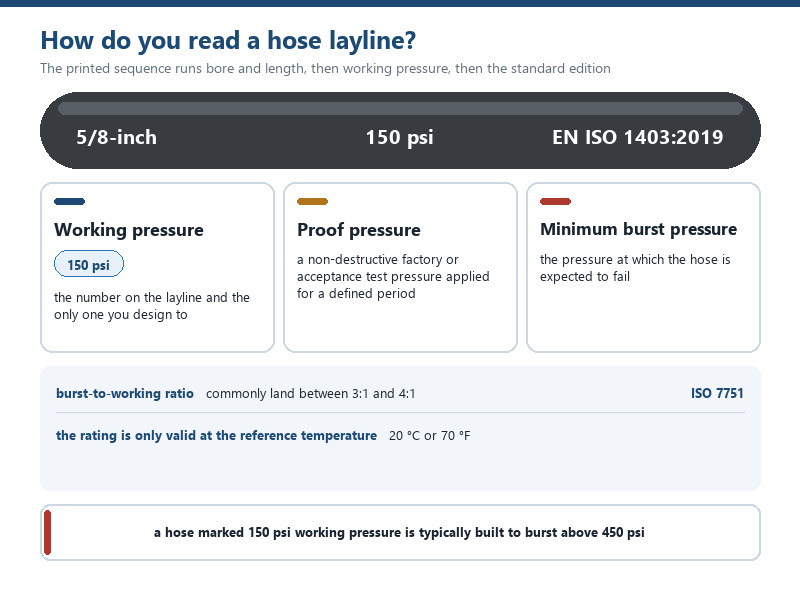
A water hose pressure rating is a set of three numbers, not one, and confusing them is how hoses burst. The three are working pressure, proof pressure and minimum burst pressure. The relationship between them is fixed by ISO 7751, which sets the ratio of proof and minimum burst pressure to maximum working pressure for each category of hose service.
The three ratings, and what each one is for:
- Maximum working pressure (WP) — the highest pressure the hose should see in continuous service. This is the number on the layline and the only one you design to.
- Proof pressure — a non-destructive factory or acceptance test pressure applied for a defined period. It sits above working pressure and below burst, and passing it does not license you to operate there.
- Minimum burst pressure — the pressure at which the hose is expected to fail. It is a safety margin, never a target.
Two practical rules follow from the three ratings above. First, the burst-to-working ratio is set per construction, so the classes in Table 2 commonly land between 3:1 and 4:1 — a hose marked 150 psi working pressure is typically built to burst above 450 psi. That margin exists to absorb water hammer and surge, not to be spent.
Second, the rating is only valid at the reference temperature, which for most published tables is 20 °C or 70 °F. Pressure capacity falls as temperature rises, so a hose quoted at 150 psi for ambient water may be rated far lower in hot-water service.
In our own testing we design and recommend service at no more than 80 % of the marked working pressure. That margin matters whenever pressure spikes or water hammer are possible, because fittings and couplings begin to move before the tube itself does.
3.1 How do you read a hose layline?
A layline is the continuous printed text along a water hose, and it carries the specification. Reading it in order answers most selection questions.
What a complete layline states, and why each field matters:
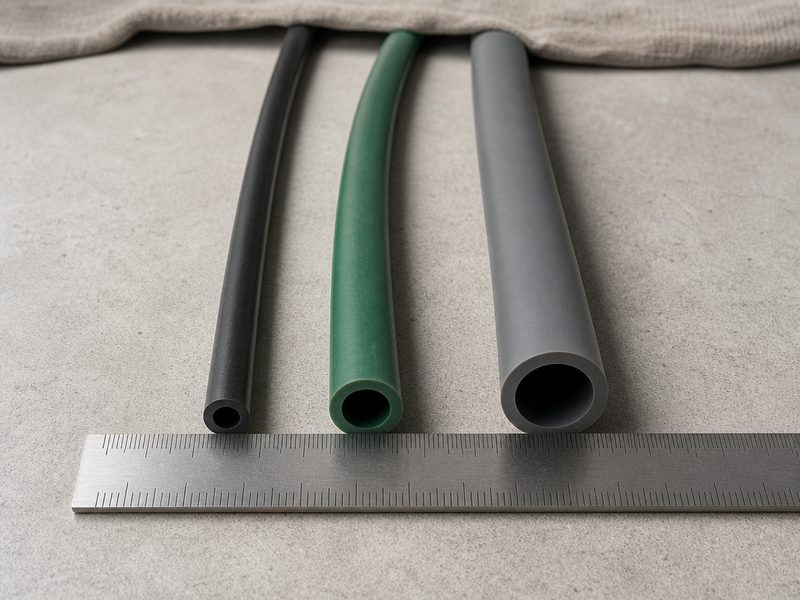
- Inside diameter and length — the bore sets flow, the length sets pressure loss.
- Working pressure — the design ceiling, usually in psi and bar.
- Burst pressure or safety factor — the margin on top of working pressure.
- Temperature range — the band in which the printed pressure rating stays valid.
- Service or media code — for example potable water, hot water or general water discharge.
- Standard and year — the edition the hose was tested against, such as EN ISO 1403:2019.
If a layline omits the temperature range or the standard, treat the pressure figure as unqualified and ask the supplier for the test data behind it.
4. How Does the Water Hose Pressure Rating Change by Hose Type?
The pressure class is where types of water hoses differ most sharply. The same nominal diameter is built to completely different ceilings depending on construction and duty — an industrial water hose and a garden hose of the same bore can sit two pressure classes apart. The chart below is the core specification table for this guide.
Applicability: the figures below apply at the reference temperature and under a static or mildly fluctuating load. For surge, water hammer or hot water service, apply the derating your supplier publishes. The rating belongs to the finished assembly, so once a fitting is crimped or clamped on, the assembly carries the rating.
| Hose type | Typical bore | Working pressure | Approx. burst | Temperature band | Governing standard / control | Primary use |
|---|---|---|---|---|---|---|
| Rubber garden hose | 1/2, 5/8, 3/4 in | 80–150 psi | 300–500 psi | −40 to +60 °C | EN ISO 1403; ISO 7751 ratios | Daily residential watering, heavy-duty use |
| PVC / vinyl garden hose | 1/2, 5/8 in | 60–100 psi | 150–300 psi | −5 to +45 °C | EN ISO 1403-type construction | Seasonal, budget, light watering |
| Expandable / TPE hose | 1/2 in nominal | 60–150 psi | Not published as a design value | +5 to +45 °C | Manufacturer data only | Balconies, light residential, occasional use |
| Soaker hose | 3/8 to 5/8 in | 10–40 psi | Low; porous wall is the weak point | −5 to +40 °C | Manufacturer data only | Flower beds, vegetable rows, foundation watering |
| Sprinkler / flat hose | 1/2 to 3/4 in | 40–80 psi | Not published as a design value | −5 to +45 °C | Manufacturer data only | Rectangular lawns, new seeding |
| Potable water hose | 1/2, 5/8 in | 100–200 psi | 300–400 psi | −30 to +65 °C | NSF/ANSI 61; FDA 21 CFR 177.2600 | Drinking water supply, RV, food trucks, marine |
| Washdown / sanitation hose | 1/2 to 1 in | 150–250 psi | 450–750 psi | −40 to +95 °C | FDA-compliant tube for food areas | Food plants, dairies, breweries, boat decks |
| Lay-flat discharge hose (PVC) | 1 to 12 in | 30–150 psi | 90–450 psi | −5 to +60 °C | Colour-coded classes (e.g. 80 psi blue, 150 psi red) | Irrigation, construction dewatering, transfer |
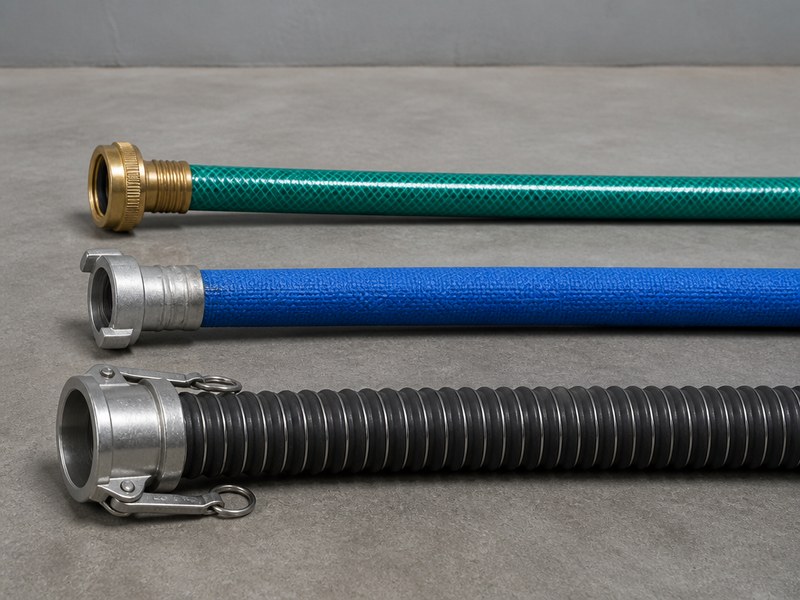
| Water suction hose (wire helix) | 1 to 12 in | 50–150 psi | Category-dependent | −40 to +70 °C | Manufacturer data only; rated to full vacuum, 29 inHg | Pump intake, tanker loading, sump and silt duty |
| Hot water hose (EPDM) | 1/2 to 2 in | 150–300 psi | 450–900 psi | −40 to +120 °C, higher with special compounds | EPDM tube; compound data sheet governs | Hot water washdown, CIP lines, industrial cleaning |
| Fire attack hose | 1.5, 1.75, 2.5 in | Service-test class 300 psi minimum under NFPA 1962; working pressure set by the manufacturer’s marking | Design margin above service test | −40 to +60 °C in service | NFPA 1961 construction; NFPA 1962 testing | Fire service attack lines, standpipe, industrial fire teams |
Pressure washer hose is deliberately not in Table 2. It is a separate high-pressure category, usually 2,000–4,000 psi at 1/4 to 3/8 inch bore, with its own coupling systems and its own selection rules. We cover it separately in our guide to choosing the right pressure washer hose.
4.1 Why is the same bore rated so differently?
If you are setting up a market garden, the hose you cannot improvise is the one that must not collapse on the suction side of the pump. Pressure capacity comes from the reinforcement, not the bore diameter. A 1-inch PVC lay-flat hose and a 1-inch wire-helix suction hose have nearly the same bore, yet one is a thin-walled fabric-reinforced discharge line and the other carries a steel helix bonded into the wall.
What changes the rating, in order of influence:
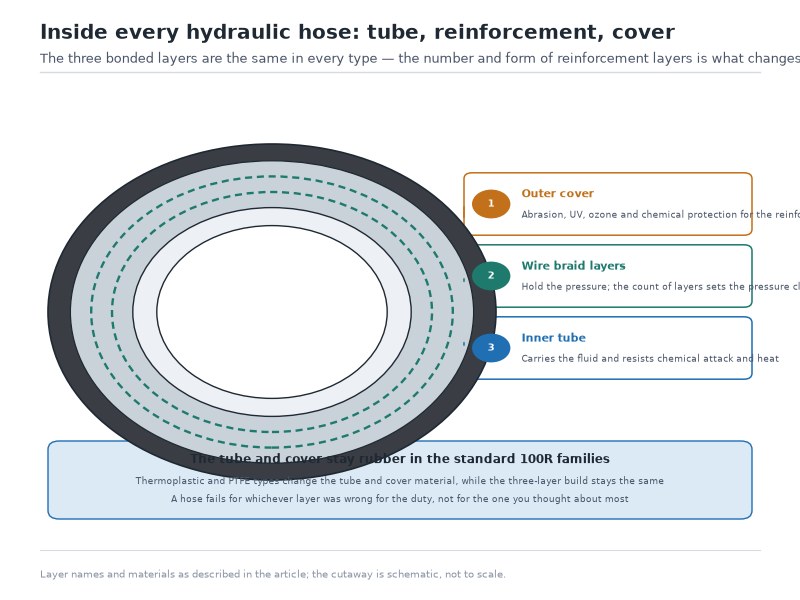
- Reinforcement type and ply count — textile braid, synthetic yarn, wire helix or wire braid. More plies and higher tensile yarn raise burst pressure.
- Wall thickness and tube hardness — a thicker, harder tube resists internal pressure better but kinks more readily.
- Temperature — capacity drops as service temperature rises, which is why the rating is only valid inside the printed band.
- Age and exposure — UV, ozone and abrasion degrade the cover, and a degraded cover stops protecting the reinforcement.
5. What Are the Best Uses for Each Type of Water Hose?
A food plant that washes its floors down with hot water every night needs a different hose from a balcony that is watered twice a week. Best use follows directly from material and pressure class. Matching the main water hose types to the job is mostly a matter of refusing to compromise on the two or three properties the job actually stresses. The matrix below maps the common duties to the hose that performs best in each.
| Duty | Best hose type | Material | Pressure needed | Why this one wins |
|---|---|---|---|---|
| Daily garden watering | Standard or hybrid garden hose | Rubber or rubber-PVC blend | 100–150 psi working | Kink recovery and UV life; heavier but lasts seasons |
| Drinking water supply (RV, food truck, marine) | Potable water hose | EPDM or NSF-listed compound | 100–200 psi working | Certified for contact with drinking water; no plastic taint |
| Washdown in food areas | Sanitation washdown hose | EPDM or PVC, FDA-compliant tube | 150–250 psi working | Hot water tolerance plus a cleanable, food-safe tube |
| Irrigation and field discharge | Lay-flat discharge hose | PVC, textile-reinforced | 30–150 psi, matched to pump | Rolls flat, stores small, moves large volumes at low pressure |
| Pump intake and dewatering | Water suction hose | EPDM or PVC with wire helix | Full vacuum plus 50–150 psi discharge | Helix prevents collapse under vacuum; resists abrasion |
| Hot water and steam-adjacent cleaning | Hot water washdown hose | EPDM | 150–300 psi working | Retains pressure capacity at elevated temperature |
| Cold-climate outdoor use | Polyurethane or EPDM hose | PU or rubber | Matched to duty | Stays flexible below freezing where PVC goes rigid |
| High-pressure surface cleaning | Pressure washer hose | Rubber or thermoplastic, wire-braided | 2,000–4,000 psi working | Dedicated class with rated couplings and burst margin |
The fastest way to use the matrix is as a set of IF–THEN rules, because most buyers already know their duty and only need the specification:
- IF the water is intended for drinking — THEN specify a potable water hose listed to NSF/ANSI 61 with a tube compliant to FDA 21 CFR 177.2600, and reject any hose that cannot produce that documentation.
- IF the line sees hot water above 70 °C — THEN move to EPDM and drop any PVC or standard PU option.
- IF the hose is on the suction side of a pump — THEN specify a wire-helix construction rather than a textile-braided one.
- IF the hose is dragged over concrete daily — THEN abrasion resistance outranks price; PU or a rubber cover with a high ISO 4649 result is the economical choice over its life.
Describe your duty and working pressure and we will size the bore, the pressure class and the coupling for you.
5.1 How do the garden hose types compare for household use?
If you need a hose you can leave outside all winter in a cold climate, the material choice decides whether it survives to spring. Garden hose types are the most familiar branch of the family, and the choice within them is mostly about weight against life span. A standard rubber garden hose resists kinking, handles UV and lasts for years; a vinyl hose is a fraction of the weight and price but stiffens in cold weather and fails sooner at the coupling.
The practical ranking for households, from longest-lived to shortest:
- Rubber garden hose — longest service life, highest weight and price.
- Rubber-PVC hybrid — the common middle choice; lighter than rubber, tougher than vinyl.
- Vinyl / PVC hose — cheapest and lightest; fine for light seasonal use.
- Expandable or TPE hose — easiest to store, least durable, and usually unrepairable.
- Soaker and sprinkler hose — specialist irrigation tools, not general-purpose hoses.
Across the garden hose types, our own season-long comparison found that a 5/8-inch rubber hose with brass fittings outlasted comparable PVC models by a wide margin under the same watering schedule. For a balcony or a small courtyard, though, the extra weight is wasted money.
6. How Do Water Hose Sizes and Connections Affect Flow and Pressure?
If you need to move water out of a flooded basement 40 metres from the nearest outlet, the bore is set by that distance rather than by the tap. Water hose sizes are quoted as inside diameter, and that bore is the single biggest lever on flow. A larger bore passes more water at the same inlet pressure, but it also costs more, weighs more and takes more space when coiled.
Bore-to-flow is not a linear relationship: friction loss rises sharply as velocity climbs. Doubling the bore roughly quadruples the cross-sectional area, so the same flow rate travels at roughly a quarter of the velocity and loses far less pressure per metre. This is why long runs benefit disproportionately from a larger diameter, while short runs at the tap barely notice.
Typical flow at household pressure, with the usual caveat that length, fittings and nozzle all reduce the figure:
| Nominal inside diameter | Common use | Indicative flow at 40–60 psi | Pressure loss behaviour |
|---|---|---|---|
| 1/2 in (12.7 mm) | Light watering, soaker feeds, short runs | About 8–12 gpm | Highest loss per metre; degrades quickly on long runs |
| 5/8 in (15.9 mm) | The residential standard | About 9–17 gpm | Moderate loss; the usual compromise |
| 3/4 in (19.1 mm) | Long runs, high-flow tools, multiple outlets | About 15–25 gpm | Lowest loss; best for runs beyond about 30 m |
| 1 in and above | Lay-flat discharge, suction, industrial transfer | Volume-driven, sized from the pump curve | Sized to keep velocity low and loss acceptable |
The flow ranges in Table 4 describe a short hose at a household tap supplying 40–60 psi, and published flow figures vary with test conditions. Treat the numbers as planning values and confirm the actual flow on your own installation. A 30-metre run with a partially blocked screen can deliver less than half the table value.
6.1 Which Water Hose Fittings and Thread Systems Do You Need?
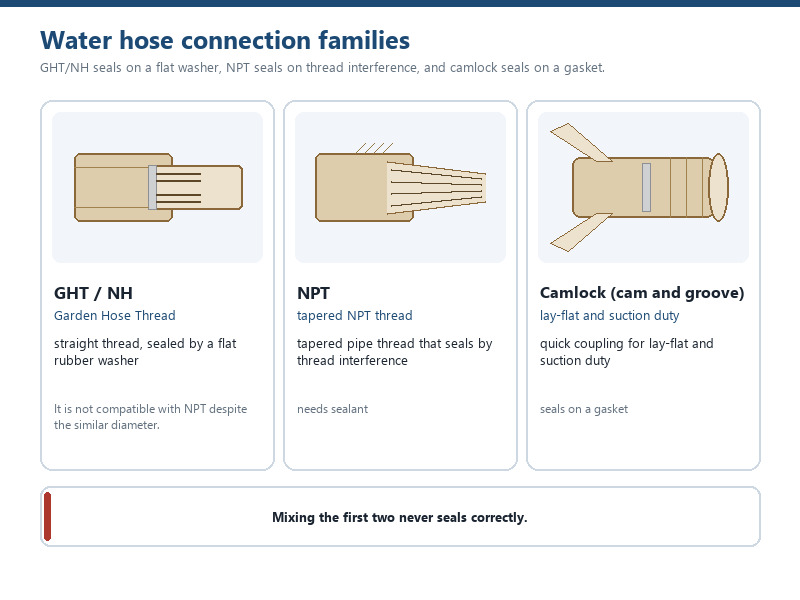
Fittings decide whether the installation seals and whether it can be serviced, and mixing thread families is the most common cause of a leak that no amount of tape fixes.
The thread and coupling systems you will meet on water hose work:
- GHT / NH (Garden Hose Thread) — 3/4-11.5 NH straight thread, sealed by a flat rubber washer. It is not compatible with NPT despite the similar diameter.
- NPT — tapered pipe thread that seals by thread interference; needs sealant and appears on pumps, valves and process equipment.
- BSP / BSPT — the international pipe-thread family; common on European and Asian equipment and incompatible with NPT by design.
- Camlock (cam and groove) — quick coupling for lay-flat and suction duty, where speed matters more than pressure class.
- Barbed insert with clamp — the standard repair joint on discharge and low-pressure lines.
- Quick connect — push-fit garden couplings and pressure-washer fittings, which are convenient but add a flow restriction and a leak point.
For a full comparison of thread families, including the sealing mechanisms and the adapter you need to bridge each pair, see our hose thread size chart guide for GHT, NPT, BSPP, BSPT and NPSH. If your issue is specifically sizing on standard garden threads, the garden hose fitting and adapter guide covers the dimensions and compatibility rules.
7. Which Standards Apply to Which Water Hose Category?
Filling a 200-litre drinking water tank on a boat is where the paperwork decides which hose is acceptable, not the price. Standards are how you convert a supplier’s claim into something verifiable, and the main water hose types each have a governing test framework. Quoting the right standard by name and edition is the difference between a specification and a wish.
| Standard | Scope | Where it applies |
|---|---|---|
| EN ISO 1403 | Rubber hoses, textile-reinforced, for general-purpose water applications — specification | General water hose construction, pressure classes, marking |
| ISO 7751 | Ratios of proof and burst pressure to maximum working pressure | Setting the safety margin for every pressure class |
| ASTM D380 | Standard test methods for rubber hose, including burst and inspection procedures | Verifying the burst figure a supplier publishes |
| ISO 4649 | Resistance of rubber to abrasion using a rotating cylindrical drum (DIN abrader) | Comparing covers for drag and abrasion duty |
| NSF/ANSI 61 | Drinking water system components — health effects of materials in contact with drinking water | Any hose feeding potable water |
| FDA 21 CFR 177.2600 | Rubber articles intended for repeated use in contact with food | Food-grade and sanitation hose tubes |
| NFPA 1961 | Standard for fire hose construction and performance | Fire attack and supply hose |
| NFPA 1962 | Care, use, inspection and service testing of fire hose | Annual service testing, including the 300 psi minimum for attack hose |
| SAE J20R3 | Coolant and hot-water hose specification | Engine and hot-water circuits that also carry water |
Use the table as a checklist rather than decoration. If a hose is sold into a regulated application, ask which edition of the relevant standard it was tested to and request the test report. In our experience, the inability to name the edition is a reliable predictor that the published pressure figure came from a marketing brief rather than a test bench.
8. How Do You Choose Between Rubber, PVC and Polyurethane?
If you are buying for a rental fleet and want the lowest total cost over five years, the calculation starts with replacement frequency rather than unit price. Choosing between the three main water hose types is a short decision once you write the duty down as numbers instead of adjectives. Work through temperature, abrasion, pressure and stored life in that order, and the material usually selects itself — the same test separates a garden hose from an industrial water hose.
A repeatable decision sequence:
- Write the temperature window, including the coldest night the hose will be stored in and the hottest water it will carry. Below 0 °C, PVC is out. Above 70 °C, standard PU is out.
- Grade the abrasion duty as light, moderate or severe. Dragging over concrete or gravel daily is severe, and it points to PU or a rubber cover tested to ISO 4649.
- Fix the pressure class from the pump or supply, then add the surge allowance. Choose the working pressure, not the burst pressure, and keep service under about 80 % of it.
- Decide whether water quality matters. If people will drink from the line, the water hose material must be a potable-listed compound, and no amount of mechanical performance substitutes for that listing.
- Weigh stored life against purchase price. A hose replaced every second season is rarely the cheaper option once labour and downtime are counted.
The deciding factors, stated plainly:
- Rubber — choose it when temperature range, UV exposure or abrasion matter, and accept the weight.
- PVC — choose it when the duty is seasonal, low-pressure and low-abrasion, and protect it from frost and sunlight.
- Polyurethane — choose it when the hose is dragged, the climate is cold, and the water stays below about 70 °C.
- TPE or latex hybrid — choose it only for light, occasional residential use where storage space is the real constraint.
For a fleet or a distribution catalogue, the fuller material analysis in our flexible hose materials guide covers compound-level differences, and our comparison of PVC against rubber garden hose covers climate and use-case trade-offs in more depth.
9. Why Do Water Hoses Fail, and How Do You Prevent It?
Water hoses almost always fail at a predictable point, and the cause is usually one of six mechanisms rather than simple wear. Knowing which one applies to your site tells you what to change.
The six failure modes, with the fix for each:
- Kinking and fatigue cracking at the same bend, caused by too small a bend radius or a hose routed around a tight corner. Fix: reroute, fit a bend restrictor, or move to a reinforced construction.
- UV and ozone ageing of the cover, which then stops protecting the reinforcement. Fix: store out of sunlight, or specify an EPDM cover.
- Abrasion and cover wear from dragging, which exposes the reinforcement to water and grit. Fix: use a protective sleeve or a higher-abrasion cover.
- Pressure surge and water hammer, the usual cause of a burst that happens moments after a valve slams shut. Fix: size for the surge, use slow-closing valves, and keep service pressure below the marked working pressure.
- Freeze damage, where trapped water expands and splits the tube from inside. Fix: drain the hose and store it dry indoors. A cold-rated construction widens the working window; every water hose still needs draining before a hard frost.
- Fitting and coupling failure, including crimp pull-off, cracked inserts and perished washers. Fix: match fitting material to the hose, respect the crimp specification, and replace washers at the first sign of hardening.
Two failure modes deserve special mention because they are induced by the user rather than the environment. Leaving an expandable hose pressurised keeps the tube stretched and the sleeve under load, which shortens its life sharply.
Using a garden hose on a pressure washer is the other one: it puts an assembly rated for 150 psi into a 2,500 psi duty. If you need a high-pressure line, specify one, and use our guide to quick connect couplings when specifying the couplings. If the hose on your pressure washer has just burst, the replacement must match the rated working pressure rather than the diameter.
10. FAQ: Water Hose Materials, Ratings and Uses
What are the most common types of water hoses?
The most common types of water hoses are rubber garden hoses, PVC or vinyl garden hoses, PVC lay-flat discharge hoses, wire-helix suction hoses, potable water hoses and washdown hoses. Rubber and PVC cover most residential demand, while lay-flat, suction and washdown constructions cover agriculture, construction and food processing.
What is the best water hose material?
There is no single best water hose material. EPDM rubber gives the widest temperature range and the longest outdoor life, PVC is the lightest and cheapest, and polyurethane offers the best abrasion resistance and cold flexibility. The correct choice is the material whose weak points fall outside your duty.
How many PSI is a garden hose?
A rubber garden hose is typically rated 80 to 150 psi working pressure with a burst pressure roughly three to four times higher. PVC garden hoses usually sit lower, around 60 to 100 psi working pressure. Your household tap generally supplies 40 to 80 psi, so the hose rating should comfortably exceed the supply pressure.
What is the difference between working pressure and burst pressure?
Working pressure is the ceiling for continuous service; burst pressure is the failure point and is never a target. Design to the working pressure and treat the difference between the two numbers as a surge allowance. Their ratio is set by hose category, commonly between 3:1 and 4:1 for general water service.
What is the best water hose for garden watering?
For daily garden watering, a 5/8-inch rubber or rubber-PVC hybrid hose with brass fittings is the most durable choice. Choose a 3/4-inch hose instead when the run exceeds roughly 30 metres, and a 1/2-inch hose only for light or short connections.
Is a rubber water hose better than a PVC water hose?
If you keep replacing a cheap hose every season, the rubber version is the one that pays for itself. A rubber water hose lasts longer, stays flexible in cold weather and resists kinking better, but it weighs about twice as much and costs more. A PVC hose is lighter and cheaper and performs adequately for light seasonal watering. For year-round or heavy use, rubber is the better long-term value.
What type of water hose is safe for drinking water?
RV owners often ask which bore and pressure class to order for a 3/4-inch inlet, and the answer is a 3/4-inch potable hose rated 100–200 psi working pressure. Only a hose listed to NSF/ANSI 61 with a tube compliant to FDA 21 CFR 177.2600 is suitable for drinking water. Standard garden hoses are not made for potable use and can leach plasticisers and stabilisers into the water, so they should never be used to fill drinking water tanks.
How do I choose the right water hose size?
Match the bore to the run length and the flow you need. Half-inch bore suits light watering and short runs, 5/8 inch is the residential standard, and 3/4 inch is best for long runs or high-flow tools. Oversizing a short run adds weight and cost without improving flow noticeably.
Can I use a garden hose for a pressure washer?
A dedicated pressure washer hose is the correct part. Garden hose is rated 80 to 150 psi, while a pressure washer feed or discharge line runs at 2,000 psi and above. A garden hose in that duty can rupture without warning, so always fit a hose and couplings rated for the machine.
Why does my water hose keep kinking?
Kinking usually comes from too small a bend radius, a hose stored on a tight coil, or a construction with too few reinforcement plies. Rubber and reinforced constructions resist it better than thin vinyl, and a hose reel or a larger coil diameter removes most of the problem.
How long do water hoses last?
A rubber garden hose used seasonally typically lasts five to ten years, while a PVC hose often lasts two to four and an expandable hose usually less than two. Service life depends far more on UV exposure, storage and abrasion than on the purchase price.
11. About HENGHUA and Our Testing
HENGHUA builds water hose to specification as well as to a standard catalogue, and the ratings discussed in this guide come from our own quality-control bench rather than from catalogue copying. Every category described here is part of our standard production line, so the pressure classes and temperature bands in this article match what we actually ship.
Our quality control targets the four points that cause most field failures: wall thickness consistency, reinforcement tension, coupling crimp quality, and pressure retention over time. We pressure-test each production batch above its marked working pressure, cycle quick-connect couplings through repeated connect and disconnect operations, and verify kink recovery on reinforced constructions before packing.
What we offer, stated as facts rather than claims:
- Factory-direct supply — consistent pricing and lead times for distributors, retailers and private-label brands.
- Full specification coverage — 1/2-, 5/8- and 3/4-inch garden hose plus industrial water hose in larger diameters, with GHT, NPT, BSP and camlock-compatible terminations.
- Material options — EPDM, SBR, PVC and polyurethane compounds matched to your market, climate and price point.
- Potable and food-grade lines — constructions built to NSF/ANSI 61 and FDA 21 CFR 177.2600 requirements for drinking water and sanitation duty.
- OEM and ODM service — custom lengths, colours, reinforcement constructions, coupling types and private-label packaging.
- Engineering support — pressure and temperature confirmation, sample testing, and the test documentation your catalogue or tender needs.
Honest limitation: we do not recommend a single hose for every duty, and we will tell you when a cheaper PVC construction is the right answer for your application. What we will not do is publish a pressure figure we cannot reproduce on the test bench.
Send us a photo of your application, your working pressure and your temperature range, and our engineers will confirm the correct hose, bore and coupling — usually within one business day. Contact the HENGHUA engineering team for a quotation, request free samples to test on your own equipment, or browse the water hose range in our shop. As a water hose manufacturer working factory-direct, we support OEM and ODM programmes for distributors and brands worldwide.
Whatever types of water hoses your project needs — garden, potable, industrial or high-pressure — confirm the specification with HENGHUA before you order.
 English
  Spanish
  Portuguese
  French
  German
  Arabic
  Russian
  Indonesian