
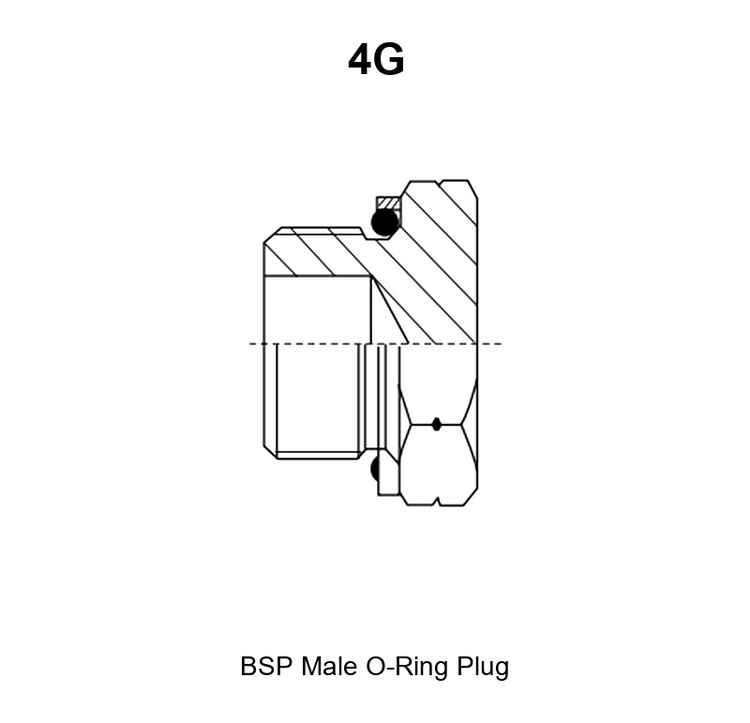
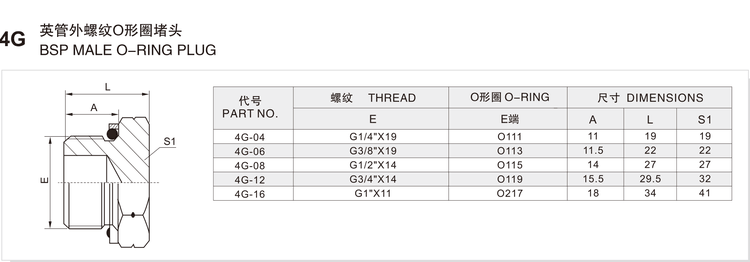
The 4G plug is a BSPP male O-ring blanking plug that closes a G threaded port with an elastomer O-ring seated in the machined recess of the port face. It is the plugging version of the BSP male O-ring stud end, so the parallel thread only clamps and the O-ring does the sealing. This page gives the printed dimension table, the sealing principle, the part number logic and the installation rules for the 4G plug, and it explains what the closed end of the part actually does.
Core Advantages
- Seals with an O-ring in the port recess per ISO 1179-2, so the thread is a clamp and not a sealing element.
- Parallel G thread to ISO 228-1 in five sizes from G1/4″X19 up to G1″X11.
- One external hex across the range, so the plug is driven from outside with a standard spanner or socket.
- No second connection and no through bore, which removes one leak path from the assembly.
- Carbon steel with trivalent chromium zinc plating, or 304 / 316 stainless steel for corrosive service.
- Seal material options of NBR, FKM and EPDM to match the fluid and the temperature window.
1. What a 4G Fitting Does
A 4G plug is a one-ended hydraulic blanking plug: a short steel body with a single G (BSPP) male stud end on one side and a closed end on the other, used to seal a port that is not in use. It is installed into a BSPP port cut to ISO 1179-1, where the port face carries a machined recess that holds the O-ring, and it is run in until the stud end shoulder comes down onto that face. The sealing surface is the elastomer O-ring compressed in the recess.
The core value of this part is dimensional match. The sealing end has to match its mating port exactly, because that match is the precondition for eliminating leakage at the joint. A straight G thread of the right size in a port cut to the same standard gives controlled O-ring compression and a defined metal stop for the hex; if the thread form, the pitch or the recess depth is wrong, the O-ring is either over-compressed and cut, or under-compressed and weeping.
The sealing principle of this series is a straight parallel thread with an elastomeric seal. The 4G plug seals exactly like the other BSPP O-ring stud ends in the ISO 1179 adapter family: the G thread locates and clamps the part, the O-ring in the port recess seals, and no thread tape, paste or sealant is needed. Because the thread is parallel rather than tapered, the plug can be removed and refitted without changing the joint geometry, and tightness never depends on how far the thread has been driven in.
2. 4G Specifications
2.1 Connection 1 – G (BSPP) Male Stud End with O-Ring
Connection 1 is the only connection on the part. It is a male stud end with a parallel G thread to ISO 228-1, the thread family in which pressure-tightness is deliberately not made on the threads. The printed range covers G1/4″X19, G3/8″X19, G1/2″X14, G3/4″X14 and G1″X11, five size steps from smallest to largest. The thread is male and external, and the stud end carries the O-ring groove.
Sealing is by an elastomer O-ring fitted to the stud end and compressed in the machined recess of the mating port face. The mating port is a BSPP port with an elastomer seal recess as described by ISO 1179-1, and the stud end follows the O-ring stud end practice of ISO 1179-2. The smaller sizes G1/4″X19 to G1/2″X14 are commonly grouped as the light duty form and the larger sizes as the heavy duty form; the printed table gives the O-ring reference and the thread length for each step. Within the ISO 1179 adapter range this is the standard single-end plug form.
2.2 Connection 2 – Closed End
The 4G plug has no second connection. Behind the hex the body is a solid closed end with no bore, no thread and no second sealing face. There is nothing to connect to on that side and no flow path through the part, because the purpose of the item is to stop a line or a manifold branch rather than to join two lines.
That closed end has two practical effects. It removes one sealing joint from the assembly, so a plugged port has fewer places to leak than a port closed with an adapter plus a cap. It also fixes the working length: because there is no second thread, the overall length L in the table is simply the stud end plus the hex body, so the plug fits close to a manifold wall or inside a tight enclosure where a two-end fitting would not go.
2.3 Construction and Materials
The body is machined from bar stock on CNC lathes, so the thread, the O-ring groove and the hex are produced in one setup and stay concentric. The external hex is dimension S1 in the table and runs from 19 mm on 4G-04 up to 41 mm on 4G-16. A single hex on an otherwise plain body keeps the outer envelope small.
A blanking plug carries no drive feature inside the body. The 4G is an external hex part rather than a hollow hex part: the hex is the drive, and the closed end is a plain machined face with no internal socket. That is the practical difference between the 4G and an internal-drive port plug, and it decides which one can be used where access is tight.
Body material options are carbon steel, 304 stainless steel, 316 stainless steel and brass. The usual export build is carbon steel with trivalent chromium zinc plating (Cr3+), with zinc-nickel plating available where a harder finish is preferred; both suit general hydraulic service. Stainless steel is selected for corrosive environments, offshore and marine work, and water-based fluids. Plating thickness and salt-spray performance are not stated here and are confirmed per order. Seal options are NBR, FKM and EPDM, and the O-ring can be supplied separately as a spare. Every batch is checked against the drawing with thread gauges and dimensional checks before packing.
2.4 Pressure and Temperature
Working pressure for these sizes is confirmed per order by HENGHUA engineering, based on the thread size, sealing method and material selected. The printed chart for this series carries no pressure column, so no per-size rating is quoted here. On a straight-thread O-ring joint the pressure capability depends on the port wall and the mating housing as much as on the plug itself.
Temperature is a material fact rather than a property of the fitting. NBR suits approximately -30°C to +100°C, FKM approximately -20°C to +200°C, and EPDM approximately -40°C to +120°C. The steel body is not the limiting element in normal hydraulic service; the elastomer is. Select the compound against the fluid first, then confirm the temperature window.
2.5 Part Number and Dimension Table
| PART NO. | E | O-RING E | A | L | S1 |
|---|---|---|---|---|---|
| 4G-04 | G1/4″X19 | O111 | 11 | 19 | 19 |
| 4G-06 | G3/8″X19 | O113 | 11.5 | 22 | 22 |
| 4G-08 | G1/2″X14 | O115 | 14 | 27 | 27 |
| 4G-12 | G3/4″X14 | O119 | 15.5 | 29.5 | 32 |
| 4G-16 | G1″X11 | O217 | 18 | 34 | 41 |
Dimensions are millimetres unless the column states a thread size.
What each column means
- PART NO. – the ordering code for the size, built from the series prefix 4G plus a two digit size code.
- E – the thread size and pitch of the single stud end, written as the nominal G size followed by the thread diameter in millimetres, for example G1/4″X19.
- O-RING E – the O-ring reference for the stud end seal, given as the printed O plus a three digit code that identifies the ring size.
- A – the thread length of the stud end, measured from the sealing face to the end of full thread.
- L – the overall length from the sealing face of the stud end to the outer face of the closed end.
- S1 – the width across the flats of the external hex, which decides the spanner size.
There is no pressure column and no second thread column in the printed chart, because the part has one connection and a closed end.
Thread size and dash chart
| Dash size | Thread | O-ring code | Hex across flats |
|---|---|---|---|
| 04 | G1/4″X19 | O111 | 19 mm |
| 06 | G3/8″X19 | O113 | 22 mm |
| 08 | G1/2″X14 | O115 | 27 mm |
| 12 | G3/4″X14 | O119 | 32 mm |
| 16 | G1″X11 | O217 | 41 mm |
The dash number follows the nominal thread size rather than a sequential count, so the range steps 04, 06, 08, 12, 16 with no 02, 10 or 14 entries.
3. How to Read a 4G Plug Part Number
A 4G part number has two fields: the series prefix and the size code. The prefix 4G identifies the family, a BSPP male O-ring stud end supplied as a blanking plug with a closed end and an external hex. The second field is a two digit dash number that carries the nominal thread size.
Worked example, 4G-08: 4G is the series prefix for a BSPP male O-ring port plug, and 08 is the size code, which the table shows as the G1/2″X14 size with thread length A of 14 mm, overall length L of 27 mm, hex S1 of 27 mm and an O115 O-ring. Worked example, 4G-16: the same prefix with size code 16, the G1″X11 size, A of 18 mm, L of 34 mm, S1 of 41 mm and an O217 O-ring.
There is no suffix in this series. Suffixes such as -WD for a captive seal, -HN for a hollow hex drive or -OG for a SAE O-ring boss plug belong to other families in the same programme and are not part of the 4G range. If a request arrives with a suffix on a 4G number, treat it as a different part and confirm the drawing before matching it.
4. Installation and Fitment
The 4G plug is a straight-thread O-ring stud end, so the O-ring is the seal and the thread is only the clamp. Never ask the thread to seal. Do not wrap it with PTFE tape, do not apply a thread sealant or paste, and never fit the plug without its O-ring. A sealant on a straight-thread joint does nothing useful and can fill the port recess and change how the O-ring is compressed, and contamination in the recess is one of the most common causes of a weeping joint on an otherwise correct assembly.
Torque practice is a sequence rather than a number. Clean the thread and the recess, fit the O-ring dry or with a light film of system fluid, start the thread by hand to be sure it is not cross-threaded, then bring the shoulder down to the port face with the correct spanner and stop when metal contact is reached. Never use the hex to force a plug that has picked up on the thread, and never keep tightening after the shoulder lands. An over-tightened hydraulic plug distorts the O-ring and can flare the port; an under-tightened one leaves the ring short of its designed compression.
Common fitment errors and their symptoms:
- Missing O-ring. Leakage at the shoulder as soon as pressure is applied, however hard the plug is tightened.
- Wrong ring size or cord. An immediate leak at low pressure, or a ring that is visibly pinched or cut on removal.
- Damaged or over-compressed O-ring. A slow weep that grows with temperature, with a flattened ring inside.
- Debris in the recess. An intermittent weep that changes with pressure cycling as the particle moves.
- Cross-threading. High turning effort well before the shoulder lands, with metal particles at the thread.
- Wrong thread form. The plug runs in a short distance and jams, or seats with a gap at the shoulder; the port is usually tapered or of a different pitch.
Assembly steps:
- Confirm the port is a G (BSPP) port with an elastomer seal recess and that the thread matches, using a gauge or a known-good mating part.
- Inspect the recess for burrs, chips and old seal material, and blow it clean.
- Check the O-ring size and cord, and fit it to the stud end groove without stretching it.
- Lubricate the thread and ring with a light film of system fluid compatible with the seal compound.
- Run the plug in finger-tight, then tighten with the correct spanner until the shoulder contacts the port face.
- Run the system or pressure test, inspect the joint and record the seating position for later refits.
Reuse policy: the steel body can be cleaned, inspected and refitted if the thread and the sealing shoulder are undamaged, but the O-ring is a single-use elastomer item. Replace it whenever the plug is removed, whenever it has seen elevated temperature, and whenever its age or storage is unknown.
5. Applications and Industries
This hydraulic plug suits any hydraulic system, water jetting rig, oil and gas skid, industrial machine, construction machine, agricultural implement, marine installation or material handling unit that uses BSPP ports and needs a branch closed or reserved. It is a hydraulic plug first and a thread protector second, so it works wherever a port has to stay sealed and clean between builds, and in maintenance stores it is usually listed simply as a port plug for the sizes found on that machine.
Concrete scenarios:
- Reserved manifold branches. A manifold is machined with more ports than the first build needs so a second circuit can be added later. Each unused port is closed with a 4G plug, which keeps the circuit sealed and the thread protected until the upgrade is ordered.
- Test and purge points. A service port added for pressure testing or flushing is open during commissioning and plugged for normal operation. With no second connection, nothing protrudes from the machine once the plug is installed.
- Shipping and storage of finished assemblies. A hose assembly or cylinder with a BSPP port is plugged to keep the bore clean and stop oil escaping during transport and shelf storage, and the plug is removed at first installation.
- Field isolation of a failed circuit. When one leg of a machine must be isolated to keep the rest running, a plug of the right G size closes the port and restores the machine without draining the whole system.
6. Replacement and Cross-Reference Guide
A hydraulic plug is identified by standard, thread and sealing method, never by brand. The series is a BSPP O-ring stud end supplied with a closed end, so a correct substitute has to satisfy three conditions at once: the same G thread and pitch to ISO 228-1, the same O-ring seal in the port recess to ISO 1179-1, and the same stud end dimensions of thread length and hex as the printed table. Anything else changes either the sealing compression or the seating position.
Measure these three things before ordering:
- Thread. Measure the thread outside diameter and count the threads per inch. A nominal 1/2 in BSPP thread has 14 threads per inch and a major diameter of about 20.9 mm, which is not the same as a 1/2 in NPT or a 1/2 in UNF thread. Record diameter and pitch, not just the nominal size.
- Seal type. Read the port, not only the plug. A BSPP O-ring port has a machined recess in the face; a tapered pipe port has no recess and relies on the thread; a flat face for a bonded seal washer is plain. The seal type decides which family will work.
- Seat and length. Record thread length A and overall length L, and note whether the body has to clear an internal component. A plug longer than the original can foul, and one that is shorter may not reach full thread engagement.
If the port turns out to be a metric O-ring port to ISO 6149 or a SAE straight thread O-ring boss port to ISO 11926-1, the 4G is the wrong family even when the nominal size looks close. Change family rather than forcing the fit, because the thread forms and recess dimensions differ and the joint will not seal. An ISO 1179 adapter plug and a metric adapter plug that share a nominal size are still not interchangeable.
7. Ordering, Packaging and Delivery
To order, give the series code, the full part number, the thread size, the seal material, the body material and plating, and the quantity. A complete line reads: 4G plug, part number 4G-08, G1/2″X14, O-ring in NBR, carbon steel with trivalent chromium zinc plating, 500 pieces. If the plug goes into a corrosive or offshore application, say so at the enquiry stage so that stainless steel and the right seal compound are quoted in the same reply.
Packaging is arranged for two routes. For distributor shelves, these port plugs are packed in labelled cartons marked with the part number, thread size and seal material so a box can be identified without opening it. For direct-to-line OEM delivery, parts are packed in bulk or in kitting trays for line-side handling, with the customer part number on the label alongside the HENGHUA number. Sample orders are available for validation, and lead time is confirmed per order against the selected material, plating and quantity.
8. FAQ
What is the difference between a straight-thread O-ring seal and a tapered pipe thread?
A straight-thread O-ring joint, such as the 4G plug in an ISO 1179-1 port, seals on an elastomer O-ring compressed in a machined recess in the port face, and the parallel thread only clamps the parts. A tapered pipe thread seals by interference between the thread flanks plus a filler such as tape or paste, so tightness depends on how far the thread has been driven. The exception to remember is that a straight-thread joint must never be sealed with thread sealant, and a tapered port cannot accept an O-ring because it has no recess to hold one.
Can BSP and NPT be interchanged?
No. BSP and NPT are different thread families with different flank angles and forms, and they are not interchangeable even when nominal sizes look similar. A nominal 1/2 in BSPP thread and a nominal 1/2 in NPT thread both use 14 threads per inch, but the NPT thread is tapered, so the two start to engage and then bind. The exception is a dedicated cross standard adapter made with one thread of each family; never force one thread into the other.
How do I identify the correct 4G size?
Read the thread marking on the port or measure it. The printed range covers G1/4″X19, G3/8″X19, G1/2″X14, G3/4″X14 and G1″X11, which are the 4G-04, 4G-06, 4G-08, 4G-12 and 4G-16 part numbers. Measure the thread outside diameter and count the threads per inch, match the pair to the table, then confirm thread length A and hex S1 so the plug seats and stays accessible.
What seal material should I select for my fluid and temperature?
NBR is the general-purpose choice for mineral hydraulic oil and covers approximately -30°C to +100°C. FKM suits higher temperatures and many aggressive fluids and covers approximately -20°C to +200°C. EPDM covers approximately -40°C to +120°C and is the usual choice for water-based fluids, but it is not suitable for mineral oil. Confirm the compound against the actual fluid and temperature, and check with HENGHUA if the fluid is outside the common range.
How is the working pressure of this fitting determined?
The printed chart for the 4G series has no pressure column, so working pressure is confirmed per order by HENGHUA engineering, based on the thread size, sealing method and material selected. The reason is that on a straight-thread O-ring joint the pressure capability is governed by the port and housing as much as by the hydraulic plug itself. The rule is that the rating must be set against the actual port, material and duty cycle; the exception is that a larger thread size does not automatically allow a higher pressure in every housing.
What is the minimum order quantity and can I get samples?
Minimum order quantity is confirmed per order, because it depends on the size, the material and the plating selected. Sample pieces can be supplied before a production order so the thread fit and O-ring seating can be checked against the real port on the customer’s machine. Send the part number, thread size and seal material with the request, and state the application so the sample is quoted in the correct configuration.
Does this port plug need a washer or a bonded seal?
No. The 4G seals with an O-ring in the port recess, so adding a bonded seal washer or a flat gasket at the shoulder would hold the shoulder off the face and reduce O-ring compression. Bonded seal washers belong to flat face ports with no recess, which is a different port style. The correct accessory for this blanking plug is a replacement O-ring of the size in the table.
To close, HENGHUA invites your 4G plug enquiry: send the part number, thread size, seal material, body material and quantity, and our engineering team will confirm the configuration, the working pressure for your port and housing, and the lead time for your order.
Related series in the same family: the 1G adapter and the 1H adapter. Browse the full Hydraulic Adapters range for the complete ISO 1179 BSP, ISO 6149 metric, ISO 11926-3 SAE O-ring boss and SAE J513 cone families.


 English
  Spanish
  Portuguese
  French
  German
  Arabic
  Russian