
1. What a 7T9-PK Adapter Does
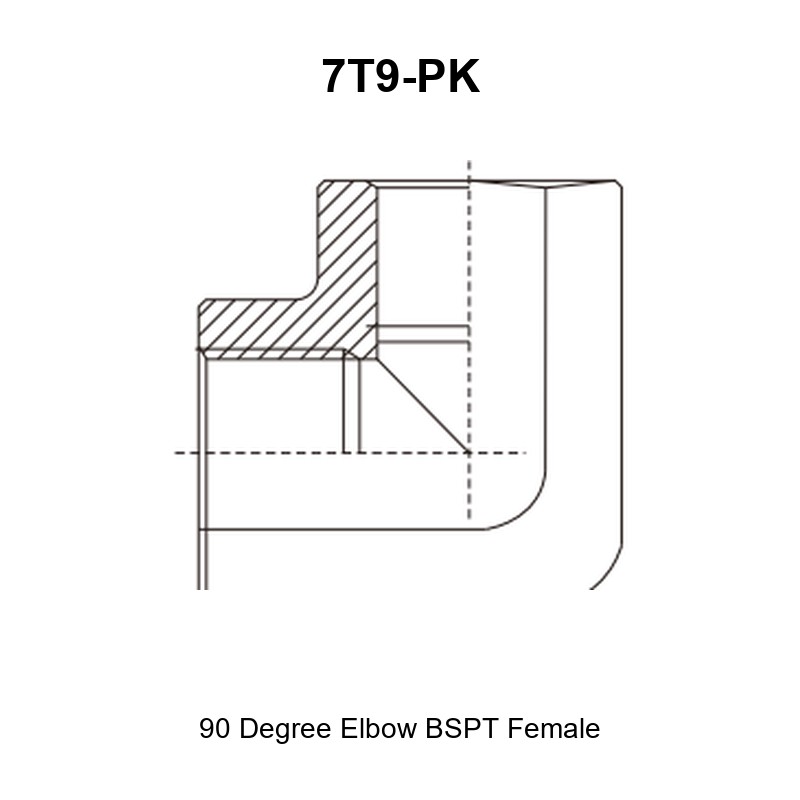
The 7T9-PK adapter is a 90° elbow hydraulic adapter with a BSPT female taper thread at both ends. It joins two BSPT male taper stud ends and turns the fluid path through a right angle, so a line can leave a port that faces an obstructed direction, and it can also step between two different BSPT sizes.
The core value of this part is that both female ends match the external taper threads entering them: the thread form, the size and the taper have to agree, because a matched thread pair is the precondition for a leak-free conversion point. A 7T9-PK adapter that is dimensionally correct accepts each male thread by hand and then tightens progressively as the taper engages.
Sealing on this series follows ISO 7-1, the standard for pipe threads where the pressure-tight joint is made on the threads. The taper presses the crests of the external thread into the flanks of the internal thread, so the metal-to-metal contact along the flanks holds the fluid. Sealing therefore depends on the two male threads, which must carry thread sealant or PTFE tape, and neither joint may be over-tightened, because a taper thread expands the female end as it enters and can split the wall.
2. 7T9-PK Adapter Specifications
| Item | Specification |
|---|---|
| Series | 7T9-PK |
| Configuration | 90° elbow, female x female |
| Thread standard | ISO 7-1 taper pipe thread (BSPT) |
| Thread designation | Rc internal taper thread on both ends, accepting R external taper threads |
| Size range | Rc1/8″X28 to Rc2″X11 |
| Sealing method | Sealing on the thread flanks of both ends, using thread sealant or PTFE tape on the mating male threads |
| Body material | Carbon steel; 304 / 316 stainless steel on request |
| Plating | Trivalent chromium zinc plating (Cr3+); zinc-nickel plating on request |
| Hex | Hex across flats S1 as listed in 2.5 |
2.1 Connection 1 – BSPT female taper thread (end E)
- Thread family: British Standard Pipe taper thread, ISO 7-1.
- Designation: Rc internal taper thread, for example Rc1/4″X19.
- Gender: female.
- Sizes available on end E: Rc1/8″X28, Rc1/4″X19, Rc3/8″X19, Rc1/2″X14, Rc3/4″X14, Rc1″X11, Rc1-1/4″X11, Rc1-1/2″X11, Rc2″X11.
- Sealing method: thread flank interference. The sealant or tape is applied to the male thread of the part that screws into this end, not inside the female thread.
- Mating part: a BSPT male stud end or hose fitting with an R external taper thread to ISO 7-1.
2.2 Connection 2 – BSPT female taper thread (end F)
- Thread family: British Standard Pipe taper thread, ISO 7-1.
- Designation: Rc internal taper thread, for example Rc1/2″X14.
- Gender: female.
- Sizes available on end F: Rc1/8″X28, Rc1/4″X19, Rc3/8″X19, Rc1/2″X14, Rc3/4″X14, Rc1″X11, Rc1-1/4″X11, Rc1-1/2″X11, Rc2″X11.
- Sealing method: thread flank interference, with sealant or tape applied to the male thread entering this end.
- Mating part: a BSPT male stud end or hose fitting with an R external taper thread to ISO 7-1, on the second axis at 90° to end E.
Because both connections are female and the body is an elbow, this series is a female x female right angle coupling. It is used where two male taper threads have to meet, and where the run has to change direction without an additional elbow and without welding.
2.3 Construction and Materials
- The elbow body is machined from bar stock on CNC lathes. Both internal taper threads are cut and checked with thread gauges before finishing, and the two axes are held at 90° through the machining process.
- Body material options: carbon steel, 304 stainless steel, 316 stainless steel, with brass available on request.
- Plating options: trivalent chromium zinc plating (Cr3+) or zinc-nickel plating. Carbon steel with zinc plating suits general hydraulic service; 304 and 316 stainless steel are selected for corrosive and offshore environments.
- No elastomer is fitted in this series. Each joint is made on the taper thread, so the sealant or tape chosen by the installer is part of the sealing system.
- The hex across flats S1 is machined on the body so that the elbow can be held with a spanner on both legs while each male thread is tightened into it.
2.4 Pressure and Temperature
Working pressure for these sizes is confirmed per order by HENGHUA engineering, based on the sealing method, thread size and material selected. No single figure applies across the range, because the strength of a taper threaded joint depends on the thread size, the wall thickness of the body and of the mating parts, and the depth of thread engagement at each end.
Temperature behaviour follows the body material and the thread sealant or tape in use. Carbon steel with zinc plating is suitable for general hydraulic service, while 304 and 316 stainless steel are selected for corrosive service. Where an elastomer is used on a related series in this catalogue, the material ranges are approximately -30°C to +100°C for NBR, -20°C to +200°C for FKM and -40°C to +120°C for EPDM. These are material facts for the seals supplied across the range and help you align a seal choice with the fluid in your circuit.
2.5 Part Number and Dimension Table
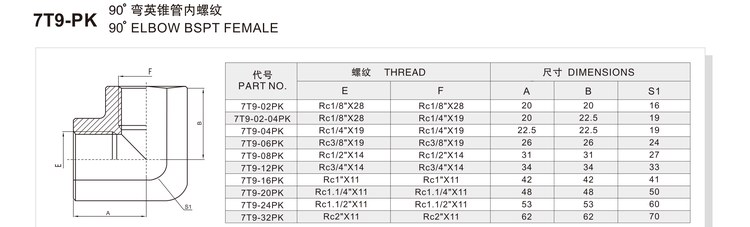
| PART NO. | E | F | A | B | S1 |
|---|---|---|---|---|---|
| 7T9-02PK | Rc1/8″X28 | Rc1/8″X28 | 20 | 20 | 16 |
| 7T9-02-04PK | Rc1/8″X28 | Rc1/4″X19 | 20 | 22.5 | 19 |
| 7T9-04PK | Rc1/4″X19 | Rc1/4″X19 | 22.5 | 22.5 | 19 |
| 7T9-06PK | Rc3/8″X19 | Rc3/8″X19 | 26 | 26 | 24 |
| 7T9-08PK | Rc1/2″X14 | Rc1/2″X14 | 31 | 31 | 27 |
| 7T9-12PK | Rc3/4″X14 | Rc3/4″X14 | 34 | 34 | 33 |
| 7T9-16PK | Rc1″X11 | Rc1″X11 | 42 | 42 | 41 |
| 7T9-20PK | Rc1-1/4″X11 | Rc1-1/4″X11 | 48 | 48 | 50 |
| 7T9-24PK | Rc1-1/2″X11 | Rc1-1/2″X11 | 53 | 53 | 60 |
| 7T9-32PK | Rc2″X11 | Rc2″X11 | 62 | 62 | 70 |
Column notes: PART NO. is the ordering code for the complete elbow. E and F are the thread designations of the two female ends, where E is the first end listed and F the second. A and B are the two leg dimensions of the elbow as drawn on this page, in millimetres. S1 is the hex across flats, in millimetres, used to hold the body during tightening. Confirm the exact measurement scheme against the outline drawing before you design around these figures.
3. How to Read a 7T9-PK Part Number
The code has three parts: the series identifier, the size code and the suffix. 7T9 identifies the elbow range and the PK suffix marks the elbow variant of the female BSPT family in this catalogue; the corresponding straight female series is 7T.
7– female British Standard Pipe adapter family.T– taper thread, ISO 7-1 (BSPT).9– 90° elbow configuration.PK– catalogue suffix for this elbow variant. Match the complete part number, including the suffix, and confirm against the drawing when you are replacing an existing part number.
Two digit size codes use the standard British pipe sizes: 02 = 1/8″, 04 = 1/4″, 06 = 3/8″, 08 = 1/2″, 12 = 3/4″, 16 = 1″, 20 = 1-1/4″, 24 = 1-1/2″, 32 = 2″. A single size code, as in 7T9-06PK, means both ends take the same size. A two part code, as in 7T9-02-04PK, means the ends differ: the first number is end E and the second is end F.
Worked example: 7T9-02-04PK is a 90° elbow with Rc1/8″X28 at end E, Rc1/4″X19 at end F, leg dimensions A 20 mm and B 22.5 mm, and a 19 mm hex across flats. The two ends are of different sizes, so the part is not symmetrical and the code has to be read in order.
4. Installation and Fitment
- Inspect both internal taper threads and the two mating male threads before assembly. Burrs, swarf or a previously stretched thread will not seal, and a damaged female thread is the most common cause of a weeping joint on this series.
- Clean the threads and apply thread sealant or PTFE tape to both male threads that will enter the elbow, keeping the sealant or tape off the first thread crest so that nothing enters the fluid path.
- Plan the final orientation before tightening. Screw the male thread into end E by hand until it seats, then tighten with a spanner on the hex until end F points where the second line has to go. If the elbow passes the required angle, back it out and restart with fresh sealant or tape instead of tightening further.
- Then fit the second male thread into end F and tighten that joint. Work one joint at a time so that the first joint is not disturbed.
- Tighten to snug plus the small additional movement needed to reach the angle. Stop when resistance rises sharply: a taper thread expands the female end as it enters, and over-tightening can split the adapter wall or the port boss.
- Do not use the elbow to pull two misaligned male threads together. Align the parts first; a taper thread loaded sideways will weep and will not hold its position.
- Taper threaded joints are not designed for repeated assembly. Each reassembly distorts the thread slightly and requires fresh sealant. Replace the elbow if either internal thread shows flattening or if a thread gauge shows the taper has been drawn out.
- Common fitment errors and symptoms: cross-threading on the first turn; too little sealant, which shows as a slow weep at the thread; over-tightening, which shows as a cracked adapter or a swollen female end; and screwing a parallel BSPP male thread into an Rc female end, which will not seal because the forms differ.
5. Applications and Industries
Typical application tags for this series: hydraulic systems, water jetting, oil and gas, industrial equipment, construction machinery, agriculture, marine and material handling.
- Elbow selection where the run has to turn. Where two male taper threads have to meet and the second line cannot run straight out of the first, this elbow makes the connection and the direction change in a single machined part, which removes one joint from the circuit compared with a straight coupling plus an elbow.
- Cross-standard equipment integration. A machine with ISO 7-1 taper threads on both the port nipple and the hose end uses this elbow where the hose has to leave at 90°, and the size stepping codes cover the case where the two ends differ.
- Repair and replacement. On older equipment the original right angle coupling is often missing or damaged. A correctly sized BSPT female elbow restores the connection without modifying the hose or re-tapping the port.
- High-pressure test benches. Manifolds fitted with male taper nipples use this elbow to route gauge and instrument lines out of a crowded panel at right angles.
- OEM assembly lines. Because the part is one piece and the orientation is set during installation, it suits production lines where the line layout is fixed and the envelope is defined by leg dimensions A and B.
6. Replacement and Cross-Reference Guide
Identify a replacement by standard and sealing method, never by brand. This catalogue is organised by thread family and sealing method so that you can move between series without a brand reference.
Measure these three things on the part you want to replace:
- Thread size and pitch at both ends. Measure the bore of each internal thread and count threads per inch on the male thread that mates with it. In this range, 1/8″ is 28 threads per inch, 1/4″ and 3/8″ are 19, 1/2″ and 3/4″ are 14, and 1″ and above are 11.
- Taper or parallel, and the body angle. Check the male thread that enters the elbow: a parallel thread holds the same diameter along its length, while a taper thread measures smaller at the first thread and grows towards the shoulder. Only a taper male thread seals in an Rc female end. Then confirm whether the body is straight or 90°.
- Sealing method. This elbow seals on the thread flanks with a sealant. If the part you are replacing seals on a 60° cone seat, a bonded seal or an O-ring on a flat face, it belongs to a BSPP series, not to this one.
| What you measure | What to order |
|---|---|
| Female taper threads at both ends, 90° | 7T9-PK series, matched size codes |
| Female taper threads at both ends, straight | 7T series |
| Male taper end plus female taper end, 90° | 5T9-SP series |
| Male taper end plus female taper end, straight | 5T-SP series |
| Male taper threads at both ends, 90° | 1T9-SP series |
| Parallel female threads with a 60° cone seat | The BSPP elbow series in this catalogue |
7. Ordering, Packaging and Delivery
To order, send us the series code, the full part number, both thread sizes, the seal material or sealant requirement, the plating and the quantity. A complete requirement for this series reads: 7T9-PK, part number 7T9-02-04PK, end E Rc1/8″X28, end F Rc1/4″X19, carbon steel with trivalent chromium zinc plating, 500 pieces.
Parts are supplied in bulk cartons or in individual bags for distributor shelves, with labels showing the part number and both thread sizes. Sample orders and mixed cartons are available so that you can validate thread fit, elbow angle and leg dimensions before a production order. Lead time, packing format and labelling are confirmed per order for your warehouse or your production line. Specials with a longer body or a different end combination are available on request.
8. FAQ
Q1. What is the difference between BSPP and BSPT, and can they be interchanged? BSPP is a parallel thread to ISO 228-1, where the joint is sealed on a 60° cone seat, a bonded seal or an O-ring rather than on the thread. BSPT is a taper thread to ISO 7-1, where the pressure-tight joint is made on the thread flanks with a sealant. They are not interchangeable: a parallel male thread does not seal in an Rc female end, and forcing one in damages the thread.
Q2. What is the difference between a 60° cone seat and a bonded seal, and which should I choose? Both belong to the BSPP family and neither applies to this taper threaded series. A 60° cone seat seals by metal-to-metal contact between the cone of the stud end and the cone of the port, so it needs no separate part. A bonded seal is a metal washer with an elastomer insert that seals on a flat face. Where your circuit uses BSPP ports, choose the cone seat for higher pressures and the bonded seal for plain flat faced ports.
Q3. How do I identify the correct 7T9-PK size? Measure the bore of each female end, count threads per inch on the male threads that will enter them, and match both ends to a row of the table in 2.5. If the ends differ, the part number carries both codes, with end E first. When in doubt, send a photo with a rule across each opening and we will identify the row for you.
Q4. What seal material should I select for my fluid and temperature? This series seals on the thread flanks and carries no elastomer, so the first choice is the thread sealant or tape, which must be compatible with the fluid. Where a related series in this catalogue uses an elastomer, NBR covers approximately -30°C to +100°C, FKM -20°C to +200°C and EPDM -40°C to +120°C. Confirm the sealant choice for your fluid with us before assembly.
Q5. How is the working pressure of this adapter determined? Working pressure is confirmed per order by HENGHUA engineering, based on the sealing method, thread size and material selected. It is not published as one figure for the range, because the strength of a taper threaded joint depends on the thread size, the wall thickness of the body and of the mating parts, and the depth of engagement at each end.
Q6. What is the minimum order quantity and can I get samples? Sample quantities are available so that you can check thread fit, angle and dimensions before committing to a production order. Minimum order quantity depends on the size, material and plating, and is confirmed in the quotation. Mixed cartons can be arranged for distributors who stock several sizes of this series.
Q7. Can the elbow angle be adjusted after the joint is tightened? No. With a taper thread, the angle is set by the final tightening of the first male thread, and turning the elbow back to adjust position breaks the seal. Set the orientation before the final turn; if the elbow passes the required angle, remove it and refit with fresh sealant or tape.
Browse the full Hydraulic Adapters range for the complete family, or contact us to request a quote, mill test reports, and samples.


 English
  Spanish
  Portuguese
  French
  German
  Arabic