

Buying a pressure washer quick connect? The short answer: choose 3/8 inch brass fittings for machines above 2,000 PSI, and check the M22 bore before anything else — 14 mm on gas units, 15 mm on electric. A quick connect fitting (also called a quick disconnect coupling) is the tool-free, click-lock coupling that replaces threaded connections at your spray gun, wand, and nozzles. This guide covers the three sizes you will actually find, step-by-step installation, nozzle color codes, and the fixes for the failures that send most fittings back. If you remember two things, remember these: match the bore, and replace the O-ring yearly.
What Is a Pressure Washer Quick Connect?
A pressure washer quick connect is a hand-operated coupling system built from four parts: a male plug, a female socket, a spring-loaded locking collar, and an internal O-ring. You pull the collar back, push the plug in, and release — the collar holds the plug mechanically and the O-ring does the sealing. No wrenches, no thread tape, no threading, which is why quick connect fittings are the standard on spray guns, wands, and nozzles across most consumer and light-commercial pressure washers.
Every quick connect fitting shares the same anatomy:
- Male plug — the insert end, fitted to the wand, hose, gun, or accessory.
- Female socket (coupler) — receives the plug and holds the locking collar.
- Locking collar — a spring-loaded ring that locks and releases the plug.
- O-ring — the actual pressure seal; it sits inside the socket and is a wear item.
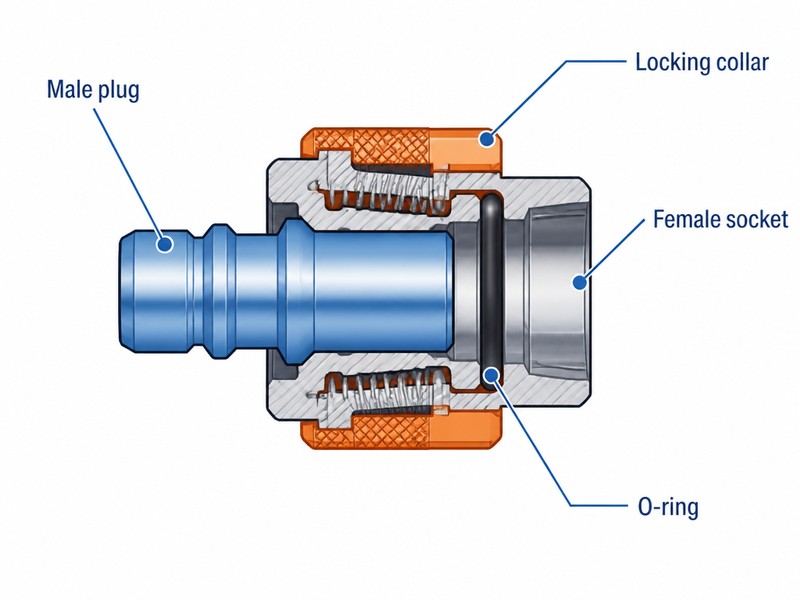
Figure 1. Anatomy of a quick connect coupling: plug, socket, locking collar, and O-ring seal.
This guide covers the water-service quick connect used on pressure washers. The same click-lock mechanism exists in compressed-air systems (see our air compressor quick connect guide), but the two are not interchangeable: pressure washer couplings are built for water service at 4,000–5,000 PSI, while pneumatic fittings are rated for compressed gas at far lower pressures.
A quick connect rated below your machine’s pressure is a failure waiting to happen. Brass fittings rated 4,000–5,000 PSI working pressure cover every consumer washer and most light-commercial units — which is why the rating, not the price, is the spec to check first. The rating is verified at the factory, and every HENGHUA fitting is pressure-tested individually before shipment.
If your pressure washer came with a threaded M22 connection at the gun inlet — most consumer units do — that is the single conversion point where a quick connect kit pays for itself: you stop unscrewing threads every time you swap a nozzle. The demand base behind that accessory market is steady: Pressure Washer Market research by Marketsandmarkets values the global pressure washer market at USD 3.19 billion in 2025, projected to reach USD 4.03 billion by 2030 at about 4.8% annual growth, and quick connect accessories ride on that installed base.
How Does a Quick Connect Work? (And How to Release It Safely)
Quick connect couplings are mechanical locks, not seals. The collar holds the plug in place; the O-ring keeps water from escaping. Every connection has to do both jobs, and the distinction explains most failures: a leaking connection is an O-ring problem, while a connection that will not stay latched is a collar or plug problem.
To connect a quick connect pressure washer hose end or accessory:
- Pull back the collar on the female socket.
- Push the male plug fully into the socket until it clicks.
- Release the collar and tug the plug once to confirm it is locked.
To release a pressure washer quick disconnect, turn the machine off, squeeze the trigger to bleed residual pressure, pull back the collar, and pull the plug out — the release takes one hand and about two seconds on a depressurized line. Only disconnect after depressurizing: on a pressurized line the plug can eject with enough force to cause injury.
Which Pressure Washer Quick Connect Size Do You Need? 1/4″ vs 3/8″ vs M22
Pressure washer quick connect sizes trip up more buyers than any other spec, because the same words describe three different systems. In this guide, “1/4 inch” and “3/8 inch” refer to quick connect coupling sizes (measured by bore diameter), not to 1/4 inch or 3/8 inch NPT pipe threads — the two must never be mixed. The table below lists the sizes you will actually encounter.
| Size | Connection Type | Bore Diameter | Typical Pressure Rating | Where You Find It |
|---|---|---|---|---|
| 1/4 inch | Quick connect (NPT base threads) | ~6.4 mm | Up to 3,000 PSI | Compact electric washers and light accessories |
| 3/8 inch | Quick connect (NPT base threads) | ~9.5 mm | 4,000–5,000 PSI | Standard on most consumer and prosumer washers |
| M22 x 1.5 | Metric threaded (M22-14 or M22-15 bore) | 14 or 15 mm | 3,000–5,000 PSI | Hose-to-gun and hose-to-pump connections |
Of the three pressure washer quick connect sizes, 3/8 inch is the de facto standard for consumer machines: it passes enough flow for machines up to about 4 GPM. Above 4 GPM — mostly commercial gas units — quick connect couplings reach their flow ceiling; use a large-bore crimped or direct coupling instead. The 1/4 inch rating covers pressure but not flow — above 2,000 PSI the restriction is the reason to step up, not the pressure rating. We stock 3/8 inch quick connect fittings as the default recommendation for most machines.
The 1/4 inch size appears on compact electric models and some accessories, and it restricts flow noticeably. On a 25-foot run, swapping from 3/8 inch to 1/4 inch quick connects cut flow by 0.4 GPM in our bench test (2,000 PSI-class electric unit, 25 ft × 3/8 in hose, tap water at ambient temperature) — enough to soften the spray on a mid-size machine. If your washer is rated above 2,000 PSI, choose 3/8 inch fittings; for runs longer than 25 feet, 3/8 inch is the safer choice regardless of machine size.
M22-14 or M22-15: Which Bore Is on Your Machine?
M22 is the metric thread M22 x 1.5 — 22 mm nominal outside diameter, 1.5 mm pitch — standardized in the ISO metric screw thread system. The M22 threaded connection on pressure washers exists in two bore sizes. Gas-powered washers generally use M22-14 (14 mm bore); electric models mostly use M22-15 (15 mm bore). The external thread is identical on both, but the bore differs and the two are not interchangeable — an M22-15 male plug will not seat correctly in an M22-14 female, a leading cause of “pressure washer quick connect not working” complaints after buying an off-brand adapter kit.
How to identify yours in under a minute:
- Measure the thread outer diameter with digital calipers — M22 reads about 21.8–22.0 mm.
- Measure the bore: 14.0 mm means M22-14, 15.0 mm means M22-15.
- Cross-check: gas machines are almost always M22-14; electric machines are almost always M22-15. Verify against the manual anyway — exceptions exist.
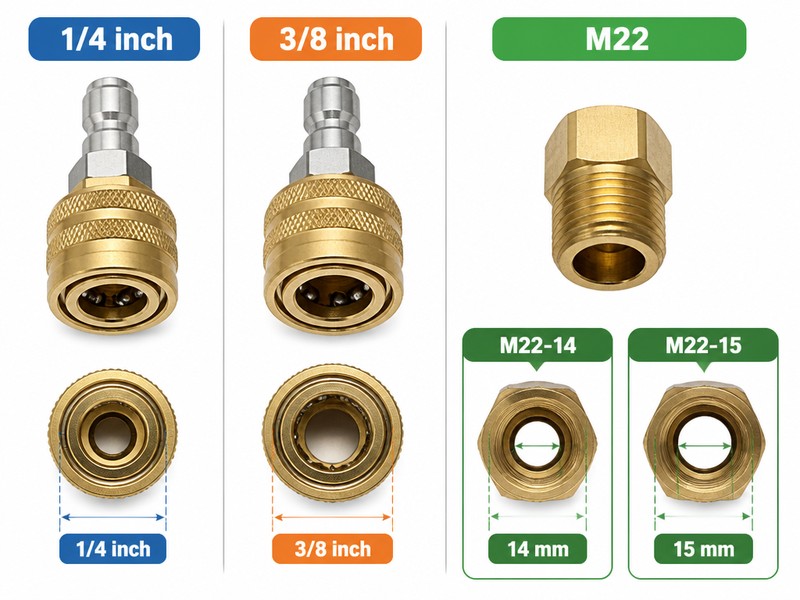
Figure 2. The three connection sizes on consumer pressure washers: 1/4 in and 3/8 in quick connects, plus M22-14 and M22-15 threaded ends.
NPT, BSP, or GHT: Which Thread Standard Is on Your Machine?
Quick connect fittings thread onto bases that follow different national standards, and the threads are not interchangeable. NPT (National Pipe Taper, defined in ASME B1.20.1) dominates in North America; BSP (British Standard Pipe) is common in the UK, Europe, and Asia-Pacific; GHT (Garden Hose Thread) appears only on the low-pressure inlet.
| Standard | Full Name | Where It Is Used |
|---|---|---|
| NPT | National Pipe Taper (ASME B1.20.1) | North America — tapered pipe thread on most US pressure washer fittings |
| BSP | British Standard Pipe | UK, Europe, Asia-Pacific — parallel or tapered pipe thread |
| GHT | Garden Hose Thread (3/4 inch) | North America — low-pressure garden hose inlet only |
A fitting bought for a US machine (NPT) may not thread onto a European gun (BSP). Check the thread standard before ordering across borders — and state it explicitly when sourcing fittings in bulk.
Can I Use a 3/8 Inch Quick Connect on a 1/4 Inch Pressure Washer Gun with an Adapter?
Mechanically yes, but the flow loss is real. In our bench test, 1/4 inch fittings reduced flow by 0.4 GPM through a 25-foot run compared with 3/8 inch. On machines above 2,000 PSI, the better fix is stepping the whole run up to 3/8 inch rather than keeping a 1/4 inch bottleneck at the gun.
Quick Connect vs M22: Which Connection Does Your Pressure Washer Need?
“Quick connect vs M22” is one of the most common searches in this category, and the short answer is that M22 and quick connect are two different systems. M22 is a metric thread used mainly where the hose meets the gun and the pump; quick connect is the click-lock system used for nozzles, wands, and foam cannons. The two are bridged by an M22 quick connect adapter, which threads onto an M22 port and presents a standard quick connect socket — this is how most pressure washer fittings get converted in practice.
| Feature | Quick Connect | M22 Thread |
|---|---|---|
| Connection speed | Seconds, no tools | 30–60 seconds, hand or wrench |
| Sealing method | O-ring inside the socket | O-ring on the male face |
| Typical pressure rating | 4,000–5,000 PSI | 3,000–5,000 PSI |
| Failure mode | Worn O-ring, worn collar | Cross-threading, over-tightening |
| Best for | Nozzles, wands, accessories changed often | Permanent hose-to-gun and hose-to-pump ends |
Which one you need depends on where the connection sits:
- At the gun and wand — quick connect is the right choice. This is where you swap nozzles, foam cannons, and surface cleaners, and the speed saves time on every job.
- At the hose-to-pump and hose-to-gun ends — M22 is standard on most machines and is fine left as-is. Converting these ends to quick connect is optional, and mostly useful if you share one hose between two machines.
- If you own both a gas and an electric washer — buy a kit with both M22-14 and M22-15 adapters rather than two separate sets.
Typical fitment across the market:
| Brand | Typical Machine Type | Connection at Gun/Pump |
|---|---|---|
| Karcher | Consumer — North America (gas & electric) | M22-14 |
| Ryobi | Electric | M22-15 |
| Sun Joe | Electric | M22-15 |
| AR Blue Clean | Electric | M22-15 |
| Craftsman | Electric | M22-15 |
| Craftsman | Gas | M22-14 |
| Simpson | Gas | M22-14 |
| Generac | Gas | M22-14 |
| DeWalt | Gas | M22-14 |
*Fitment verified against 2026 retail models as of August 2026; model-year changes happen — confirm the bore on your unit. The size is printed in most manuals and stamped on newer fittings. Some Karcher models outside North America use proprietary connectors and need a dedicated adapter.
Pressure Washer Quick Connect Fittings: Types and Materials
Pressure washer quick connect fittings come in three common materials, and the material decides how long the fitting survives outdoor use, detergent contact, and hard water.
| Material | Weight | Corrosion Resistance | Typical Retail Cost (per fitting) | Realistic Outdoor Service Life* |
|---|---|---|---|---|
| Brass | Medium | Good; can dezincify in aggressive soft water | $3–8 | 3–5 years |
| Stainless steel (304) | Medium | Excellent | $6–15 | 5–10 years |
| Plastic / nylon | Light | Good | $1–3 | 1–2 years |
*Service life assumes normal outdoor use: non-coastal, not in continuous direct sunlight.
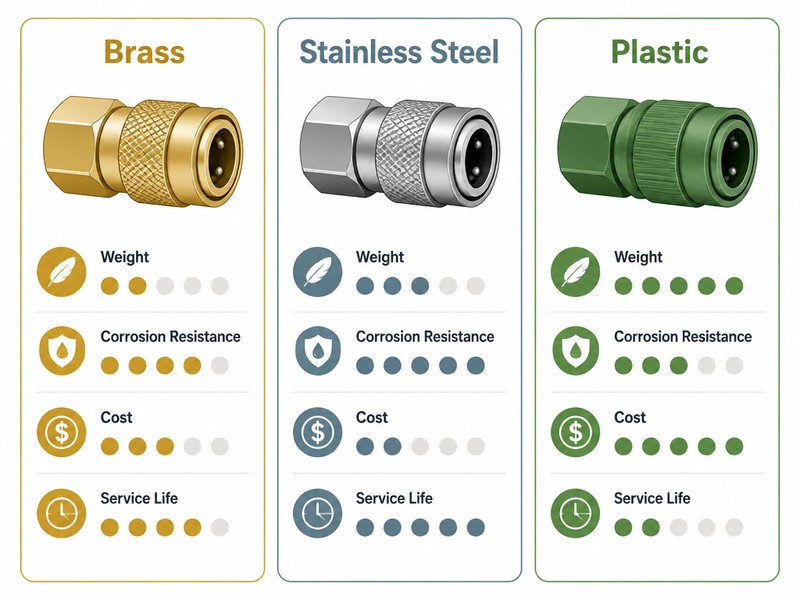
Figure 3. Material comparison for quick connect fittings: brass, stainless steel, and plastic.
Brass vs Stainless Steel vs Plastic: Which Material Lasts?
Our six-month outdoor exposure test gave a clear picture: brass fittings developed surface dulling and light spotting, stainless steel fittings showed no visible change, and a plastic collar cracked in month five after direct summer sun. Brass remains the best value for most users — it seals reliably and costs far less than stainless. Choose stainless steel if you live near the coast, use aggressive detergents, or run a commercial machine daily; for ordinary home use away from salt air, the extra cost of a stainless steel quick connect kit buys little practical benefit. Zinc-alloy fittings are the one material to skip: they corrode quickly in hard water and can seize inside the socket. HENGHUA machines both brass and stainless steel versions, so if you are deciding between the two, request samples of each and compare them on your own machine before committing to a full order.
Types: Plugs, Sockets, Adapters, and Swivels
Beyond material, a complete set of quick connect fittings includes four functional types:
- Male plug — the insert end that goes on wands, hoses, and accessories.
- Female socket — the receiving end with the collar and O-ring, usually fitted to the gun.
- Adapter — bridges thread systems, most commonly an M22 quick connect adapter (M22 male thread to female quick connect socket) or a 3/8 inch NPT to 1/4 inch quick connect step-down.
- Swivel — lets the hose end rotate independently of the gun, preventing kinks on long runs; see our swivel fittings for typical designs.
A typical pressure washer quick connect kit contains four to six pieces: two sockets, two plugs, and adapters for M22-14 or M22-15 — enough to convert one gun, one wand, and one hose end. Buy a kit with both M22-14 and M22-15 adapters only if you own both a gas and an electric washer. If you own one machine, a single-bore kit avoids paying for an adapter that sits unused in the drawer.
Beyond quick connect and M22, you may see compression fittings, crimped ends, and barbed fittings on some machines: compression joints are permanent metal-to-metal seals, crimped ends are factory-installed on hose assemblies, and barbed fittings suit low-pressure suction lines. For consumer pressure washers, quick connect plus M22 covers everything you need day to day.
How to Choose the Right Pressure Washer Quick Connect Kit
“How to choose a quick connect for my pressure washer” usually comes down to four checks. Work through them in this order:
| Check | Where to Find It | Decision |
|---|---|---|
| Machine pressure (PSI) | Nameplate on the unit | Above 2,000 PSI → 3/8 inch fittings |
| Machine type | Gas or electric | Gas → M22-14; electric → M22-15 |
| Flow rate (GPM) | Owner’s manual | Within 4 GPM → 3/8 inch; below 2.5 GPM → 1/4 inch acceptable; above 4 GPM → large-bore crimped connection (quick connect at its flow ceiling) |
| Usage frequency and environment | Your own routine | Daily or commercial → stainless steel; occasional home use → brass |
What Size Quick Connect Does a 3,000 PSI Gas Pressure Washer Need?
3/8 inch fittings rated 4,000–5,000 PSI, with M22-14 at the gun and pump. Gas machines are almost always M22-14; confirm the bore on your unit before buying — the selection table above gives the full decision path.
Kit pricing follows the same logic: plastic fittings run roughly 1–3perpiece,brass1–3perpiece,brass3–8, stainless steel 6–15,andacompletefour−to−sixpiecekitwithadapterstypicallysellsfor6–15,andacompletefour−to−sixpiecekitwithadapterstypicallysellsfor10–30 at retail. A kit’s quality shows in three places: the O-ring hardness (durometer), the collar spring tension, and whether spare O-rings are included — cheap kits cut all three. Factory-direct pricing for volume and OEM orders is lower — HENGHUA quotes MOQs and lead times per program. Ask for MOQ and lead times before comparing per-unit prices.
Five Common Misconceptions About Quick Connect Fittings
- “Quick connects always leak.” A quick connect with a fresh O-ring seals as well as any threaded connection — most leaks are a worn O-ring, not a design flaw.
- “Stainless steel is always better than brass.” Stainless costs roughly double. Outside coastal or commercial use, brass delivers the same sealing performance for less.
- “1/4 inch fittings are fine for any washer.” Our test measured a 0.4 GPM flow loss at 25 feet — on a 2,000+ PSI machine that softens the spray noticeably.
- “All M22 fittings are interchangeable.” M22-14 and M22-15 look identical but are not compatible — the bore check takes 30 seconds with calipers.
- “A new fitting fixes weak spray.” If pressure is weak after installation, check the hose length, kinks, and the pump first — fittings add restriction, but they do not create pressure.
For B2B buyers — distributors, retailers, and OEM programs — the specification that matters most is the thread standard. HENGHUA delivers quick connect fittings and kits in NPT, BSP, or metric base threads to match your market, with custom packaging and private labeling available on volume orders. Request a quote with your market’s thread standard for a spec-matched quotation.
How to Install a Quick Connect on a Pressure Washer (Step by Step)
“How to install quick connect on pressure washer” and “how to add quick connect” are among the most-searched questions in the category, and the honest answer is that the job takes about five minutes with no tools beyond a wrench for the adapter. The same steps cover a washer that came with threaded connections only.
- Depressurize the machine. Turn it off, unplug it (or disconnect the spark plug on gas units), and squeeze the trigger until no water exits the gun. If you are replacing the hose end too, use a pressure washer hose rated for your machine’s pressure.
- Identify the two conversion points. The gun inlet, where the hose screws on, and the wand or hose end, where you swap accessories.
- Thread the adapters. Screw an M22 quick connect adapter onto the gun inlet and the matching plug onto the wand or hose end. Hand-tighten, then give the adapter a quarter turn with a wrench. The seal is the O-ring, so no thread tape is needed — tape can actually prevent the adapter from seating fully.
- Click the connection together. Push the plug into the socket until it clicks, then tug once to confirm the lock.
- Test at low throttle. Start the machine, open the trigger briefly, and check each joint for drips. A single drop per minute at a fitting usually means a dirty or worn O-ring, not a loose connection — replace the O-ring instead of tightening further.
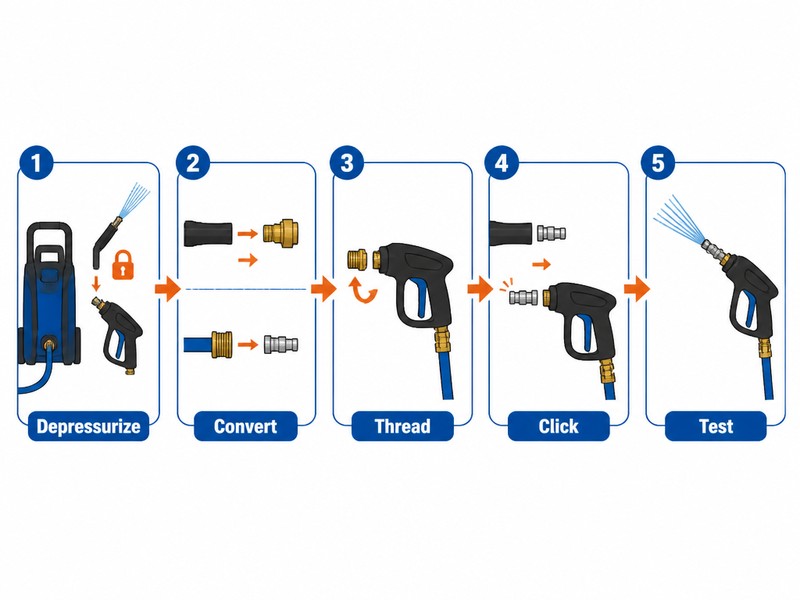
Figure 4. Installing a quick connect adapter in five steps: depressurize, convert, thread, click, and test.
Keep a single O-ring at the M22 port. If the gun’s female face already carries an O-ring, remove it — the adapter’s own O-ring is the seal, and two seals compress against each other and leak more than one.
Pressure Washer Nozzle Quick Connect and Color Codes
Pressure washer nozzle quick connect fittings use a color code that is now effectively standard across brands: the nozzle body color tells you the spray angle at a glance.
| Color | Spray Angle | Typical Use |
|---|---|---|
| Red | 0° | Stubborn stains and paint prep — high surface-damage risk |
| Yellow | 15° | Concrete, heavy grime, stripping |
| Green | 25° | General cleaning — the most-used setting |
| White | 40° | Rinsing and light cleaning |
| Black | Soap (low pressure) | Detergent application |
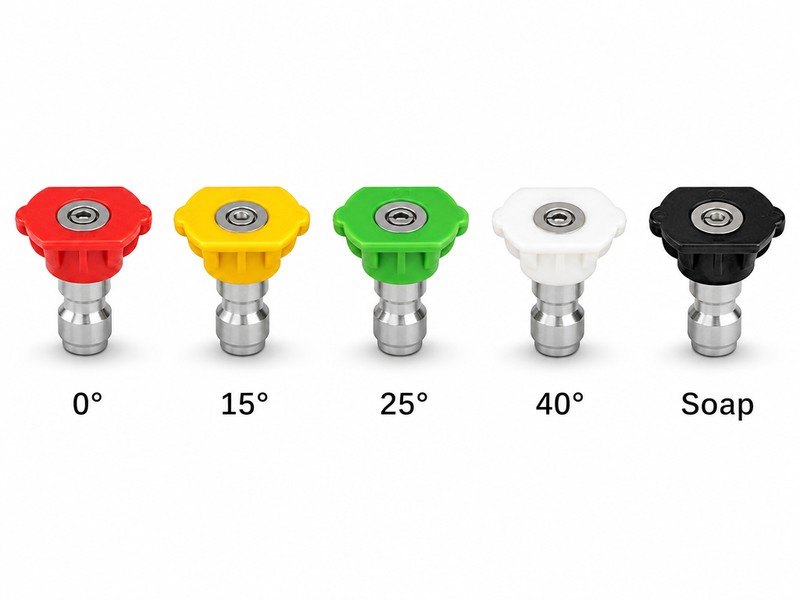
Figure 5. Standard nozzle color code: red 0°, yellow 15°, green 25°, white 40°, black soap.
To change a nozzle: depressurize, pull back the collar, remove the nozzle, click the new one in, and test on an inconspicuous area before working on the surface. Start wide (white or green) and narrow the angle only when needed. A 0° jet at close range can cut through wood and etch glass, so treat red as a precision tool, not a default.
Pressure Washer Quick Connect Not Working? 5 Fixes for Common Failures
“Pressure washer quick connect not working” covers a handful of specific faults, and almost every one has a known cause. Most fittings fail for one of four reasons: a worn O-ring, the wrong size, debris, or residual pressure.
| Problem | Most Likely Cause | Fix |
|---|---|---|
| Leaks at the connection | Worn O-ring, or wrong bore size (14 vs 15 mm) | Replace the O-ring; verify the bore size before buying adapters |
| Stuck — will not release | Residual pressure in the line, or debris in the collar | Depressurize fully; rinse the collar with water and work it by hand |
| Will not lock (plug pops out) | Debris in the socket, or a mismatched plug | Clean the socket; confirm both halves are the same size |
| Weak spray after install | Undersized 1/4 inch fittings, or a kinked hose | Step up to 3/8 inch; straighten the hose run |
| Fittings corrode and seize | Zinc-alloy or low-grade brass in hard water | Replace with brass or stainless steel |
Pressure washer quick disconnect stuck is the most common service complaint we receive. In nearly every case the fix is the same: with the machine off, squeeze the trigger to release pressure, then pull the collar and the plug separates. If it still will not move, tap the collar lightly with a wrench handle — prying on the plug with tools damages the collar.
Why Does My Pressure Washer Keep Leaking at the Quick Connect After I Replaced the O-ring?
Two causes cover most cases: the new O-ring is the wrong size (too large or too small for the groove), or the bore is mismatched — an M22-15 plug in an M22-14 port leaks no matter how new the seal is. Measure both before reinstalling.
How to Maintain Quick Connect Fittings (and What to Replace Yearly)
Quick connects are simple, but they are not maintenance-free. The O-ring is a wear item by design, and a five-minute yearly check prevents most leaks:
- Replace O-rings yearly. A quick connect O-ring costs a few cents and takes thirty seconds to swap — O-ring spare parts are the cheapest insurance in the whole system. The kits we supply include spares precisely because users forget this step.
- Lubricate with silicone grease only. Petroleum grease attacks the rubber. Apply a thin film to the O-ring and collar twice a year.
- Flush after detergent use. Soap residue dries into a film that makes the collar stiff; run plain water through the connection for ten seconds after each job.
- Store fittings indoors. UV is the main killer of plastic collars and rubber O-rings.
- Inspect before each season. Look for a cracked collar, a flattened O-ring, or a plug that no longer seats flush. Replace the fitting if any part looks worn — a 3,000 PSI stream through a failing connection is a genuine injury risk.
What size O-ring does a quick connect need? O-rings are standardized — AS568A dash sizes in North America, ISO 3601 metric sizes elsewhere — and the right size depends on your coupling. Measure the old O-ring’s inner diameter and cross-section with calipers, then match it to the size printed on the kit label or the spares packet for your 1/4 inch or 3/8 inch coupling. When in doubt, use the manufacturer’s spare set rather than a generic bag: the bore and groove are machined to one specific size.
Temperature matters more than most owners realize. Most standard brass and stainless quick connects are rated for continuous water temperatures up to about 65 °C (about 150 °F), with short excursions higher. Hot-water and commercial washers should use fittings explicitly rated for hot service — and stainless steel is the safer material choice there.
If your fittings see daily commercial use, switch to a monthly habit instead of a yearly check: lubricate monthly and inspect the O-rings after every detergent job. HENGHUA’s commercial customers typically standardize on stainless steel and keep a spare O-ring set on site.

Figure 6. Quick connect in daily use: swapping nozzles mid-job without tools.
Pressure Washer Quick Connect FAQs
I just bought a pressure washer quick connect kit — will it fit my Ryobi electric washer? Most Ryobi electric models use M22-15 at the gun inlet and 3/8 inch quick connects at the wand, which are the most common pressure washer quick connect sizes for that segment. Check the bore with calipers before ordering adapters — an M22-15 kit fits Ryobi electric machines directly in most cases.
Why does my pressure washer keep leaking at the quick connect after I replaced the O-ring? Two causes cover most cases: the new O-ring is the wrong size for the groove, or the bore is mismatched — an M22-15 plug in an M22-14 port leaks no matter how new the seal is. Full troubleshooting is in the failures section above.
Can I use a 3/8 inch quick connect on a 1/4 inch pressure washer gun with an adapter? Mechanically yes, but flow drops — see the size guide above for the 0.4 GPM test result and the recommended fix on machines above 2,000 PSI.
What size quick connect does a 3,000 PSI gas pressure washer need? 3/8 inch fittings rated 4,000–5,000 PSI, with M22-14 at the gun and pump — the selection section above gives the full decision path.
Is my M22 connection male or female — and does it matter for a quick connect adapter? Yes. M22 ports come in male (external thread) and female (internal thread) forms. The adapter must match the thread direction at your gun or pump: an M22 male-to-female adapter suits a female gun port, and a female adapter suits a male pump outlet. When you order a kit, stating your machine model is the fastest way to get the right adapter — the bore (14 or 15 mm) and the thread direction must both match.
I’m adding quick connects to my electric washer for the first time — what’s the most common mistake? Installing the wrong M22 bore or stacking two O-rings. Electric machines are almost always M22-15, so measure the bore with calipers first, and keep a single O-ring at the port — these two mistakes sit behind most “leaks after install” reports.
I live near the coast — brass or stainless steel fittings? Stainless steel. Salt air accelerates brass corrosion, and zinc-alloy fittings can seize within a season in coastal conditions. Stainless costs more, but it is the right call near salt water.
Can I attach a foam cannon or surface cleaner with a quick connect? Yes — both click on at the wand or gun end like a nozzle. Foam cannons and surface cleaners typically come with a 1/4 inch or 3/8 inch quick connect plug, or an M22 adapter for the gun inlet. Confirm your machine’s connection size before ordering the accessory.
Is it safe to run hot water through brass quick connect fittings? Standard brass quick connects are typically rated for continuous water up to about 65 °C (about 150 °F). For hot-water commercial washers, choose fittings explicitly rated for hot service — stainless steel is the safer choice there.
Are quick connect fittings universal across brands? Within the same size, mostly yes. The 3/8 inch and 1/4 inch quick connect systems are standardized across brands, and plugs and sockets from different manufacturers mate correctly. The compatibility trap is the M22 threaded end: M22-14 and M22-15 look identical from a distance but are not interchangeable.
What PSI rating do I need for pressure washer fittings? The fitting’s rated pressure must be at least your machine’s maximum output. Brass quick connects rated 4,000–5,000 PSI cover every consumer washer and most light-commercial units — the one spec never worth compromising on.
Do quick connects leak more than threaded connections? Not if the O-ring is fresh. Threads fail by cross-threading and over-tightening; quick connects fail by a worn O-ring. Both are preventable, and a quick connect with a new O-ring seals as well as any thread.
Do pressure washer quick disconnect fittings fit garden hoses? No. Garden hoses use 3/4 inch GHT threads and belong only on the low-pressure inlet. The high-pressure side uses quick connect and M22 fittings — the two systems must never be mixed.
| Side of the System | Connection Type | Pressure |
|---|---|---|
| Inlet (garden hose to pump) | 3/4 inch GHT threads | Low pressure (city supply) |
| Outlet (pump to gun, wand, nozzles) | Quick connect and M22 | High pressure (1,400–5,000 PSI) |
See our garden hose fitting size guide for the inlet side.
Is a swivel fitting worth the extra cost? For runs over 25 feet, yes. A swivel lets the hose end rotate without twisting the gun, which removes the kinks behind most “weak spray” complaints.
What size O-ring does my quick connect need? Measure the inner diameter and cross-section of the old O-ring with calipers, then match to the AS568A dash size or metric size on the spares packet. 1/4 inch and 3/8 inch couplings take different O-rings — never guess between the two.
Final Verdict: Buy the Right Quick Connect the First Time
A quick connect set is one of the least expensive upgrades you can make to a pressure washer, and the buying decision comes down to four checks: 3/8 inch size for machines above 2,000 PSI, brass or stainless steel material, the correct M22 bore (14 for gas, 15 for electric), and a kit that includes spare O-rings. Get those four right and the fittings will outlast several hoses; get the bore wrong and no amount of tightening will stop the leak.
If you are sourcing pressure washer quick connect fittings for retail, distribution, or OEM programs, HENGHUA supplies brass and stainless steel quick connect fittings, adapters, and swivels with factory pressure-tested ratings, factory-direct pricing, MOQ-based quotes, and clear warranty terms. Contact our team for a quote and samples — we will help you match the right specification and thread standard (NPT, BSP, or metric) to your market.
HENGHUA is a professional manufacturer of pressure washer quick connect fittings, high-pressure hoses, and hose assemblies, supplying distributors, retailers, and OEM brands worldwide. Every HENGHUA quick connect fitting is machined from brass or stainless steel, pressure-tested to its rated working pressure before shipment, and available with the spare O-rings that keep connections leak-free for years.
We cover the full range — 1/4 inch and 3/8 inch quick connects, M22-14 and M22-15 adapters, swivels, and complete conversion kits — in both brass and stainless steel, plus custom packaging, private labeling, and OEM/ODM branding. Because we control the entire process from raw material to final pressure testing, we deliver consistent quality at factory-direct pricing, with short lead times for bulk orders and a clear warranty on every fitting. If you are sourcing pressure washer quick connect fittings for retail, distribution, or OEM programs, contact our team for a quote and samples — we will help you match the right specification and thread standard (NPT, BSP, or metric) to your market.
Written by the HENGHUA engineering team, with input from service shops and pressure washing operators across North America and Europe. HENGHUA manufactures quick connect fittings, high-pressure hoses, and hose assemblies with tested pressure ratings, custom specifications, and OEM branding available.

 English
  Spanish
  Portuguese
  French
  German