In industrial systems, hose failure is one of the top causes of unplanned downtime—yet most failures come from incorrect selection, not manufacturing defects.
Definition: Industrial hoses are flexible conduits used to transfer liquids, gases, or bulk solids in industrial systems while handling internal pressure, vibration, and environmental stress.
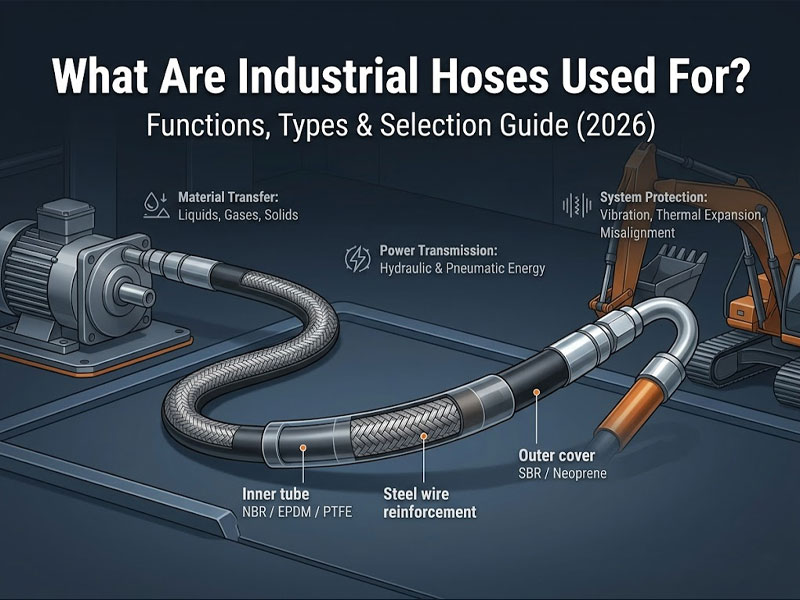
They serve three primary functions: the safe transfer of materials; the transmission of hydraulic or pneumatic pressure for power; and the absorption of vibration, thermal expansion, or misalignment to protect rigid components. This guide covers the engineering principles behind these functions, application-specific types (hydraulic, chemical, bulk material), a side-by-side comparison of rubber vs. PTFE vs. metal hoses, common failure modes, and procurement best practices.
What Are Industrial Hoses Used For?
Industrial hoses are used to transfer materials, transmit pressure, and protect industrial systems from vibration and thermal stress.
- Material transfer: Moving liquids, gases, or bulk solids from one point to another.
- Power transmission: Carrying hydraulic or pneumatic energy to power cylinders, tools, or actuators.
- System protection: Absorbing vibration, expansion, and misalignment where rigid pipes would crack or fail.
How Do Industrial Hoses Work? (The 3-Layer Structure)
To understand these functions, it is important to look at how industrial hoses are constructed. Industrial hoses function through the synergy of three distinct layers.
| Layer | Function | Material Example |
|---|---|---|
| Tube (Inner) | Contains the media; resists chemical attack or abrasion. | NBR (oil), EPDM (water), PTFE (acids), Polyurethane (abrasion) |
| Reinforcement (Middle) | Withstands internal pressure; prevents bursting or kinking. | Steel wire spiral, textile braid, synthetic fiber |
| Cover (Outer) | Protects against abrasion, UV, ozone, and weather. | SBR, Neoprene, CSM (Hypalon) |
Conclusion: Each layer must be correctly matched to the application; failure in any single layer can lead to system breakdown. The reinforcement layer determines 80% of the hose’s pressure rating.
What Are the Main Functions of Industrial Hoses? (Detailed)
1. Material Transfer (Moving Liquids, Gases & Solids)
The most visible function is moving media from a source to a destination. The engineering changes entirely based on the state of matter.
- Liquids (Hydraulic & Water): Transfers fluid under pressure. Example: A high pressure industrial hose moves oil from a pump to an excavator’s arm cylinder.
- Gases (Pneumatic & Fume): Transfers compressed air or exhaust. Example: A PVC air hose powers a pneumatic wrench.
- Solids (Dry Bulk): Transfers abrasive materials like sand or cement. Requirement: A thick, static-dissipative inner tube.
2. Pressure Conduction (Power Transmission)
In hydraulic and pneumatic systems, the industrial hose working principle involves transmitting energy. When a pump pushes oil, the hose transfers that pressure without expanding.
- Data Point: A standard SAE 100R2 hydraulic hose operates at working pressures up to 5,000 PSI with a 4:1 safety factor (burst pressure is 4x working pressure).
- Risk: A 5,000 PSI leak can cut through steel or create a whip hazard.
3. System Protection (Vibration & Misalignment)
Hard metal pipes cannot handle vibration. A pump running at 1,800 RPM shakes constantly. The flexible industrial hose functions as a shock absorber.
- Vibration Absorption: Isolates hard piping from machine movement, preventing metal fatigue.
- Thermal Expansion: A 100-foot steel pipe expands several inches when hot; a hose loop absorbs this.
- Misalignment: Bridges gaps of 1 inch or more without custom fabrication.
Best Practice: Always route hoses to avoid abrasion and excessive bending. Even the best hose will fail prematurely if rubbed against a sharp edge or bent tighter than its minimum bend radius.
Types of Industrial Hoses by Application
Industrial hoses can be classified into four main application categories:
1. Hydraulic Hoses (High Pressure)
- Function: Transmit hydraulic energy.
- Reinforcement: Steel wire braid or spiral (1 to 6 layers).
- Use: Excavators, injection molding machines.
2. Chemical Transfer Hoses (Corrosion Resistance)
- Function: Move aggressive acids or solvents.
- Tube: PTFE (Teflon) – chemically inert.
- Range: -73°C to 232°C.
3. Material Handling Hoses (Abrasion Resistance)
- Function: Transfer dry bulk solids.
- Tube: 4-6mm thick static-dissipative rubber.
- Feature: Copper static wire to prevent sparks.
4. Steam Hoses (High Heat)
- Function: Transfer saturated steam.
- Safety: Steam expands 1,600x in volume when released.
Summary: Each type is engineered for a specific combination of pressure, temperature, and media compatibility. There is no single “universal” industrial hose.
How to Select the Right Industrial Hose for Your Application
Choosing the wrong hose is the #1 cause of downtime. Use this decision matrix.
| If you need… | Choose… | Why? |
|---|---|---|
| High flexibility, general oil/water/air | Rubber (NBR/SBR) | Lowest cost, good kink resistance. |
| Extreme chemical resistance | PTFE with stainless braid | Chemically inert, -73°C to 232°C. |
| Lightweight, visual flow | PVC or Polyurethane (Clear) | See blockages, cheap for air/water. |
| Extreme abrasion (rock, cement) | UHMWPE or Gum Rubber | 4x longer wear life against sliding abrasion. |
The Key to Selecting the Right Industrial Hose: Match the tube material to the media compatibility and the reinforcement layer to the system pressure and impulse conditions. Ignoring impulse spikes is the most common engineering mistake.
Mini Case Study: Hydraulic Excavator Failure
- Problem: Hose burst on a 20-ton excavator after 2 weeks.
- Investigation: User used a 2-wire braid hose (3,000 PSI WP). Peak pressure spikes reached 4,500 PSI.
- Cause: Incorrect reinforcement selection for impulse spikes.
- Solution: Upgraded to 4-spiral steel wire hose (SAE 100R12 / 5,000 PSI WP).
- Result: Zero failures in 12 months.
Lesson: Always select a hose based on peak pressure, not average working pressure. A hydraulic hose vs industrial hose comparison must consider impulse cycle life (1 million cycles vs. 200k cycles).
Common Hose Failures and Causes
- Hardening: Heat leaches plasticizers → Leaks at fittings.
- Swelling: Incompatible media (water hose for oil) → Blocks flow.
- Abrasion: Cover worn through → Rusted wires → Sudden burst.
- Blistering: Gas permeation → Impending catastrophic failure.
Installation and Maintenance Best Practices
- Minimum Bend Radius (MBR): Bending tighter than MBR reduces burst pressure by up to 70%.
- Clamp Retorquing: Retorque fittings after 24 hours. Clamping force drops by 50% due to rubber cold flow.
- Visual Inspection (Monthly): Check for cracks, rust, blisters, or kinks.
Frequently Asked Questions (FAQ)
How long does an industrial hose last?
Storage life is 5-6 years for rubber hoses. Service life: hydraulic hoses average 1-3 years in heavy use; water hoses last 5-10 years.
What pressure can industrial hoses handle?
Low-pressure pneumatic hoses handle 150-300 PSI. High-pressure hydraulic hoses handle up to 6,000 PSI (working). Ultra-high pressure hoses (water jetting) handle 40,000 PSI.
How do I choose the right industrial hose size?
- Inner Diameter (ID): Determines flow rate. Too small = pressure drop; too large = heavy/costly.
- Outer Diameter (OD): Determines fitting and clamp compatibility.
- Rule: Match ID to the port size of your pump or nozzle. For long runs (over 50 feet), increase one ID size to compensate for friction loss.
What is the difference between hydraulic hose and industrial hose?
Hydraulic hoses are a subset of industrial hoses specifically designed for high-pressure fluid power transmission (steel wire reinforced). Industrial hoses is a broader category including water, air, chemical, and material handling hoses (textile or light wire reinforced).
Can I use a water hose for air?
No. Water hoses are not rated for compressed air energy storage. If a water hose bursts under air, it can shatter and send shrapnel. Always use a dedicated air hose.
Looking for a Reliable Industrial Hose Supplier? Why HENGHUA
If you are searching for a trusted industrial hose supplier or need a custom industrial hose solution, HENGHUA delivers through vertical integration and application-specific engineering. While many suppliers resell generic stock, we manufacture to ISO and SAE standards with a focus on failure prevention.
- Technical Expertise: We analyze your pressure spikes, media compatibility, and environmental exposure to recommend the correct reinforcement layer (braid vs. spiral) and tube material (NBR, EPDM, PTFE, UHMWPE).
- Trusted Supply Chain: With global exports exceeding $50M annually and sub-24-hour response times, HENGHUA ensures your production line stays active.
- Quality Assurance: All hoses are tested for burst pressure, impulse cycles, and material compatibility before shipment. No exceptions.
- Custom Solutions: Custom lengths, color-coded safety covers, pre-assembled fittings (JIC, metric, NPT, ORFS), and static wires for explosive dust environments.
- Transparent Policy: Clear working pressure limits, burst pressure safety factors (4:1), and warranty terms.
Need help selecting the right hose for your specific pressure and media? Contact HENGHUA’s engineering support team for a personalized selection sheet and bulk quotation.