
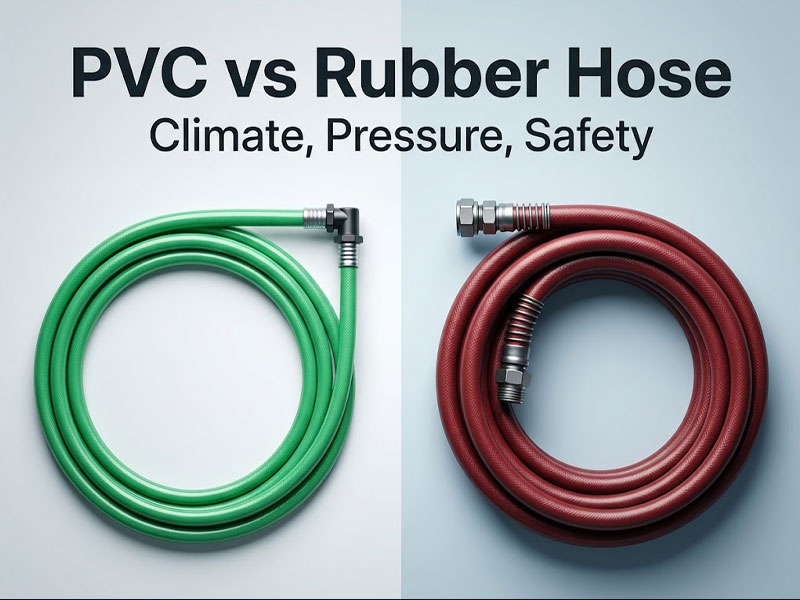
PVC garden hoses are lightweight and affordable for basic residential watering in mild climates. Rubber garden hoses offer superior durability, all-weather flexibility, and longer service life for freezing temperatures, daily commercial use, or drinking-water applications. If you live in a warm climate, water occasionally, and store hoses indoors, a reinforced PVC hose is a cost-effective choice. If you face freezing winters, drag hoses on concrete daily, need potable water safety for an RV, or store equipment in an unheated shed, rubber is commonly the more reliable long-term investment. This guide compares material science, pressure ratings, temperature tolerance, safety certifications, diameter options, and fittings to help you match the right hose to your specific needs.
Quick Decision Matrix: PVC vs Rubber vs Hybrid
| Your Primary Need | Recommended Material | Why |
|---|---|---|
| Budget-friendly, light-duty watering (mild climate) | PVC (reinforced, 350+ PSI) | Lowest upfront cost, lightweight, easy to handle |
| Freezing weather or unheated shed storage | Rubber | Remains flexible below -20°F; PVC may become brittle and crack |
| Drinking water (RV, garden, pets, camping) | Rubber or Hybrid (Look for NSF-61 / lead-free certified) | Many PVC hoses are not labeled for potable water |
| Daily commercial / professional landscaping | Rubber | Higher abrasion resistance and burst strength (400+ PSI) |
| Kink resistance | Rubber or Hybrid | Better shape memory than standard PVC |
| Elderly or strength-limited users | PVC or Hybrid | Rubber is traditionally heavier (7–10 lbs vs 4–5 lbs for 50ft) |
| Pressure washer or frequent drag use | Rubber | Withstands high PSI and concrete abrasion |
What Is the Difference Between PVC and Rubber Garden Hoses?
One-sentence definition: PVC (polyvinyl chloride) is a thermoplastic that softens with heat and stiffens with cold, while rubber is an elastomer that remains flexible across a much wider temperature range.
Decision rule: If temperatures regularly fall below freezing where you live or where you store your hose, rubber is commonly the safer choice. If you live in a mild climate (USDA zones 8+) and store hoses indoors, PVC is sufficient.
Based on manufacturer specifications and field-use patterns across residential, commercial, and agricultural settings, here is how the two materials compare.
Which Hose Handles Cold Weather Better?
Decision rule: If you store your hose in an unheated shed, garage, or outdoors through winter, rubber is commonly the safer choice. PVC can become stiff below 40°F and may crack if water freezes inside.
| Temperature Parameter | PVC Garden Hose | Rubber Garden Hose |
|---|---|---|
| Minimum flexible temperature | ~40°F (4°C) – becomes stiff below this | -40°F (-40°C) on high-grade models |
| Maximum continuous use temperature | ~120°F (49°C) – softens above this | 140°F (60°C) – suitable for water heaters |
| Freezing risk | Moderate to high – may rupture if water freezes inside | Low – remains elastic, rarely bursts |
| Storage recommendation | Indoors only in winter | Unheated shed or outdoor acceptable |
Best for: Commercial landscapers, northern climate gardeners, and anyone with an unheated storage space. Casual users in warm climates (USDA zones 8–11) may find PVC adequate when drained and stored indoors.
Which Hose Lasts Longer Outdoors? (Durability, Burst Pressure, UV)
Decision rule: For daily dragging on concrete, high-pressure nozzles, or continuous UV exposure, rubber commonly offers longer service life than standard PVC.
| Parameter | PVC Garden Hose | Rubber Garden Hose |
|---|---|---|
| Typical burst pressure (5/8″) | 250–400 PSI | 400–500+ PSI |
| Working pressure (safe continuous) | 150–200 PSI | 250–350 PSI |
| Abrasion resistance | Moderate wear after repeated dragging | Minimal marking after comparable use |
| UV resistance | Moderate – may become brittle after 2–3 years | High – resists cracking for 5–10 years |
| Kink resistance | Low to moderate | High (natural shape memory) |
Best for: Pressure washer operators, contractors, and frequent users. Homeowners watering flower beds once daily can save money with a reinforced PVC hose rated above 350 PSI, provided they store it out of direct sunlight.
Which Hose Is Safer for Drinking Water? (RV, Camping, Pets, Garden)
Decision rule: Never assume a hose is safe for drinking water unless the label explicitly states “Drinking Water Safe,” “Lead-Free,” “NSF-61 Certified,” or “FDA Compliant.” This applies regardless of material.
| Safety Factor | PVC Garden Hose | Rubber Garden Hose | Hybrid Polymer |
|---|---|---|---|
| Lead content | Some low-cost PVC historically contained lead stabilizers | High-grade rubber is typically lead-free | Usually lead-free |
| Plasticizer leaching | Possible with non-food-grade PVC | Not applicable | Minimal |
| NSF-61 certification | Available on premium models | Available on potable-water-specific models | Common |
| Best for RV / camping | Only if explicitly labeled | Only if explicitly labeled | Only if explicitly labeled |
Best for: RV owners, campers, organic gardeners, pet owners, and anyone filling children’s pools.
How to Read Hose Specs: A Quick Reference
Understanding product labels helps you make an informed choice regardless of material.
| Term | What It Means | Why It Matters |
|---|---|---|
| Burst pressure | Maximum pressure before rupture | Higher = safer for pressure spikes |
| Working pressure | Safe continuous operating pressure | Should exceed your water supply pressure |
| Temperature rating | Min/max safe operating range | Critical for freezing or hot water use |
| NSF-61 | Certified for potable (drinking) water | Required for RV and food garden use |
| Lead-free | Meets federal lead content standards | Not the same as full drinking water certification |
| Reinforced | Contains internal yarn or mesh | Increases burst strength and kink resistance |
| Kink-resistant | Engineered to resist folding shut | Improves usability during dragging |
Common Mistakes to Avoid When Buying a Garden Hose
| Mistake | Why It’s a Problem | Better Approach |
|---|---|---|
| Only comparing price | Cheapest hoses often fail within months | Compare burst pressure and material first |
| Using any hose for RV drinking water | May contain lead or plasticizers | Look for NSF-61 or explicit “Drinking Water Safe” |
| Ignoring fittings | Plastic fittings crack easily | Choose brass fittings for longevity |
| Not draining before winter | Freezing water can rupture any hose | Drain fully after each use in cold climates |
| Buying 1/2″ for long distances | Low flow rate for runs over 50ft | Choose 5/8″ or 3/4″ for distance |
| Storing PVC in unheated shed | Becomes brittle and cracks in cold | Bring PVC indoors; rubber can stay |
Best by Use Case: 6 Typical Scenarios
| Use Case | Recommended Material | Key Specification to Check |
|---|---|---|
| Home gardener on a budget (mild climate) | Reinforced PVC | 350+ PSI burst, brass fittings |
| RV / camping potable water use | Rubber or hybrid | NSF-61 certified or lead-free label |
| Cold climate / winter / unheated shed | Rubber | -20°F or lower temperature rating |
| Commercial landscaping (daily drag) | Rubber (commercial grade) | 400+ PSI burst, abrasion-resistant cover |
| Elderly or strength-limited users | PVC or lightweight hybrid | Under 6 lbs for 50ft length |
| Pressure washer / frequent drag on concrete | Rubber | 400+ PSI burst, brass fittings |
Which Fittings Should You Choose? (Brass vs Aluminum vs Plastic)
Decision rule: The best hose material is wasted if the fitting fails. Brass fittings are recommended for any hose expected to last more than one season.
| Fitting Material | Durability | Crush Resistance | Best For |
|---|---|---|---|
| Brass | High | Excellent | All users, especially commercial |
| Aluminum | Moderate | Good | Mid-range residential |
| Plastic | Low | Poor | Budget hoses only (one season or less) |
What Diameter Do You Need? (1/2″ vs 5/8″ vs 3/4″)
Decision rule: For most home gardens (under 100ft), 5/8 inch diameter offers the best balance of flow rate and weight.
| Diameter | Typical Flow | Best For | Weight |
|---|---|---|---|
| 1/2 inch | Low | Drip irrigation, light watering | Lightest |
| 5/8 inch | Medium (standard) | Most home gardens, 50–100ft runs | Moderate |
| 3/4 inch | High | Long runs (100+ ft), commercial watering | Heaviest |
Note: A 5/8 inch rubber hose at 100ft will be significantly heavier than a 5/8 inch PVC hose of the same length. Consider your physical strength and the distance you need to drag the hose.
The Third Option: Hybrid Polymer Garden Hoses
Hybrid polymer hoses combine a polymer tube with high-tenacity polyester yarn reinforcement.
Definition: A hybrid hose is a middle-ground option – lighter than rubber, safer than budget PVC, but less cold-tolerant than rubber.
Pros:
- Lightweight (close to PVC)
- High burst strength (400–450 PSI)
- Often drinking-water safe (NSF-61 or lead-free labeled)
- Moderate kink resistance
Cons:
- Lacks rubber’s cold-weather flexibility below freezing
- Can soften in extreme heat (above 130°F)
Decision rule: Choose hybrid for moderate climates (USDA zones 6–10) when you want a balance of safety and weight without freezing extremes. Not recommended for commercial use or unheated winter storage.
Buying Checklist: 6 Points to Verify Before Purchase
Before buying any garden hose – PVC, rubber, or hybrid – check these six specifications:
- Material type – Matches your climate and use case
- Burst pressure – Minimum 350 PSI for residential; 400+ PSI for commercial
- Working pressure – At least 150–200 PSI for standard use
- Temperature rating – Check minimum and maximum operating temperatures
- Potable water certification – Look for NSF-61, lead-free, or “Drinking Water Safe” if needed
- Fitting material – Brass preferred over aluminum; avoid plastic
Frequently Asked Questions (FAQ)
Q1: Which garden hose is better in freezing weather?
A: Rubber is commonly the better choice. High-grade rubber hoses remain flexible down to -40°F. PVC becomes stiff below 40°F and may crack if water freezes inside. If you store hoses in an unheated shed, rubber is recommended.
Q2: Are rubber hoses safe for drinking water?
A: Not automatically. Only hoses explicitly labeled “Drinking Water Safe,” “Lead-Free,” “NSF-61 Certified,” or “FDA Compliant” are safe for potable use. Check the label regardless of material.
Q3: Which hose lasts longer in commercial use (daily dragging, high pressure)?
A: Rubber commonly offers longer service life in heavy-duty conditions. Commercial-grade rubber hoses provide higher abrasion resistance and burst strength (400+ PSI).
Q4: Is a PVC hose good for everyday watering?
A: Yes, for light to moderate daily use in mild climates. Choose a reinforced PVC hose with burst pressure above 350 PSI and brass fittings. Drain and store indoors after each use.
Q5: Which hose material is more kink resistant?
A: Rubber and hybrid polymer hoses are generally more kink-resistant than standard PVC. Look for “kink-resistant” or “non-kink” in product specifications.
Q6: What hose material is best for pressure washers?
A: Rubber is typically recommended. Pressure washers require hoses that handle high PSI and constant movement, where rubber’s abrasion resistance and burst strength are advantageous.
Q7: Is a lead-free garden hose the same as drinking water safe?
A: Not always. “Lead-free” addresses one contaminant, but drinking-water-safe hoses also address plasticizers and other chemicals. Look for “NSF-61” or “Drinking Water Safe” for complete certification.
Q8: Can I leave my hose outside in winter?
A: Rubber hoses can survive outdoor winter storage better than PVC, but no hose is freeze-proof. Drain any hose completely before winter. For unheated sheds, rubber is the safer choice; PVC should be brought indoors.
Conclusion: PVC vs Rubber Garden Hose – Which Should You Buy?
Returning to the core question of pvc vs rubber garden hose, the answer depends on your climate, storage conditions, frequency of use, and safety requirements.
- Choose PVC if: You live in a mild climate (USDA zones 8+), water occasionally, want the lowest upfront cost, and can store hoses indoors.
- Choose rubber if: You face freezing winters, store hoses in an unheated shed, use a hose daily, drag it on concrete, need drinking-water safety for an RV, or want a 5–10 year lifespan.
- Choose hybrid if: You want a middle ground – lighter than rubber, safer than budget PVC, for moderate climates (USDA zones 6–10) without freezing extremes.
Review your local conditions and usage patterns, then use the Buying Checklist above to verify specifications before purchase.

 English
  Spanish
  Portuguese
  French
  German