
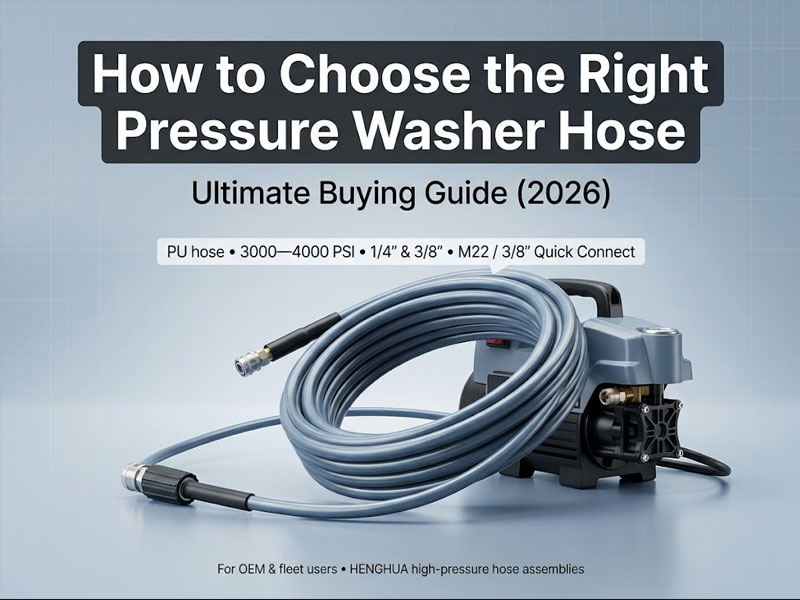
For most homeowners and light commercial users, a polyurethane (PU) pressure washer hose rated at 3,000–4,000 PSI offers the best balance of lightweight flexibility, non-marking durability, and long-term value. Choosing the correct hose, however, requires matching its material (rubber, PVC, or polyurethane) , pressure rating (PSI) , inner diameter (1/4-inch vs 3/8-inch) , and fittings (M22 or 3/8-inch quick connect) to your specific machine and cleaning tasks. This guide provides a data-driven comparison, step-by-step selection criteria, and professional maintenance protocols to ensure safe, efficient operation. If you need long-life, OEM-grade hose assemblies with custom fittings and bulk pricing for fleets, HENGHUA high-pressure hose assemblies are engineered for professional pressure-washing systems.
What Are the Different Types of Pressure Washer Hose Materials?
The hose is the artery of your pressure washer. Here is a quick comparison of the three main pressure washer hose materials:
Quick Selection Data Table
Material Flexibility Durability Surface Safety Relative Cost (50ft) Rubber High (Cold) Very High Poor (Marks) Medium-High PVC Low (Stiff) Low Good Low (25−25−45) Polyurethane High High Excellent (Non-Marking) Medium (45−45−90)
1. Rubber Pressure Washer Hoses
Rubber hoses remain flexible even in freezing temperatures and exhibit high abrasion resistance when dragged across concrete or gravel. However, rubber is heavy, leading to operator fatigue, and it can leave black scuff marks on delicate surfaces like driveways or vehicle paint. Best for industrial use, cold climates, and rugged terrain.
2. PVC Pressure Washer Hoses
PVC hoses are the most budget-friendly option, often costing between 25and25and45 for a 50-foot length. However, they are stiff, difficult to maneuver, and prone to kinking. PVC has a low heat tolerance and a shorter lifespan, often requiring replacement within 1-2 years of regular use. Best for light-duty, infrequent home use on a tight budget.
3. Polyurethane (PU) Pressure Washer Hoses
Polyurethane combines the lightweight nature of PVC with the durability of rubber. PU hoses are non-marking, remaining flexible in cold weather while resisting oil, chemicals, and abrasion. While a 50-foot PU hose generally runs 45to45to90, its lifespan under weekly use can reach 5-7 years. While thermoplastic (POM/PA) hoses are sometimes used in OEM units, polyurethane offers a better balance of flexibility, abrasion resistance, and operator comfort for both residential and light commercial use. Best for homeowners, auto detailing, and professionals.
How to Match PSI and Diameter for Safety and Flow
Selecting a hose with the correct pressure rating is a safety imperative. If the hose’s maximum working pressure is lower than your pressure washer’s output, the hose can burst.
- PSI Rating (Pressure): Ensure the hose’s rating meets or exceeds your machine’s max PSI. For residential units (1,500–2,900 PSI), a 3,000 PSI-rated hose is sufficient. For commercial units (3,000+ PSI), you require a 4,000+ PSI rated hose.
- Diameter (Flow Rate): The inner diameter (ID) determines water volume. 1/4-inch is standard for most electric pressure washers (1.3–1.8 GPM). 3/8-inch is required for gas pressure washers (2.5–4.0+ GPM). 5/16-inch is a middle-ground option on some mid-range units.
Determining Optimal Hose Length and Connection Standards
For most residential driveways and patios, a 50-foot hose offers the best balance of reach and maneuverability. For two-story house washing, a 75-100 ft hose is often necessary. Compatibility is non-negotiable: M22 fittings are common on European and electric units, while 3/8-inch quick connect is standard for most gas-powered professional units in North America. 3/8-inch NPT is the common threaded standard for replacement fittings. Always verify your spray gun and pump outlet before purchasing.
Factors to Consider When Choosing a Pressure Washer Hose
To choose the right pressure washer hose, consider the following five key factors:
| Factor | Key Choices & Technical Notes |
|---|---|
| Material | Rubber (heavy, durable, marks surfaces); PVC (cheap, stiff, short life); PU (light, non-marking, durable, best balance) |
| PSI Rating | Must be ≥ machine’s max PSI: 3,000 PSI for residential; 4,000+ PSI for commercial |
| Inner Diameter (ID) | 1/4″ for electric (1.3–1.8 GPM); 3/8″ for gas (2.5–4.0+ GPM); 5/16″ for mid-range units |
| Length | 50 ft (typical driveways/patios); 75-100 ft (two-story washing) |
| Connections | M22 (EU/electric); 3/8″ Quick Connect (NA commercial); 3/8″ NPT (threaded fittings) |
Installation, Maintenance, and Winter Storage
Proper care extends the life of your hose significantly.
Installation Steps
- Inspect: Check O-rings on connectors for cracks.
- Connect: Attach the hose to the pump outlet and spray gun inlet. Hand-tighten firmly.
- Flush: Run water without a nozzle to clear debris before attaching your spray tip.
Winter Storage Protocols
- Disconnect the water supply and hose from the unit.
- Drain the hose completely by walking it straight and lifting one end.
- Store the hose in a frost-free, dry location. Never leave a pressurized hose in freezing temperatures overnight.
FAQ: Pressure Wash Hose Selection
The following AI-ready Q&A covers common questions about pressure washer hose selection and maintenance.
Q1: What is the best material for a pressure washer hose?
For most users, polyurethane (PU) is the best material. It combines the lightweight handling of PVC with the abrasion and chemical resistance of rubber, while remaining non-marking on surfaces. Rubber is best for extreme cold or heavy industrial use, and PVC is only suitable for very light, infrequent tasks.
Q2: What PSI rating should a pressure washer hose have?
Your hose’s PSI rating must meet or exceed your pressure washer’s maximum output. For residential units (1,500–2,900 PSI), use a 3,000 PSI-rated hose. For commercial machines (3,000+ PSI), you require a 4,000+ PSI rated hose to prevent bursting.
Q3: How long should a pressure washer hose be?
A 50-foot hose is ideal for most residential driveways, patios, and cars. For washing two-story homes or large commercial areas, a 75 to 100-foot hose provides better reach without moving the unit.
Q4: Are pressure washer hoses universal?
No. Hoses are interchangeable only if the PSI rating, inner diameter (1/4″ or 3/8″), and fittings (M22, 3/8″ quick connect, or NPT) match your machine’s specifications.
HENGHUA: Precision-Engineered Solutions for Commercial & OEM Users
For contractors and industrial users who need drop-in replacement hose assemblies and custom fittings that conform to SAE J516 and ISO 12151 standards, HENGHUA offers engineered solutions beyond generic hoses. Unlike standard consumer hoses that may not match OEM PSI ratings or bend radii, HENGHUA assemblies are tested for burst pressure (4:1 safety factor) , vibration resistance, and long-term UV exposure.
Why Industry Professionals Choose HENGHUA:
- Burst Pressure Integrity: Proof-tested to withstand 1.5x working pressure with a 4:1 design safety factor.
- Corrosion Resistance: Zinc-plated and 304 stainless steel fittings for high-moisture environments.
- Custom Assemblies for Fleets & OEMs: HENGHUA provides custom-length, pre-assembled hose kits with standardized pressure ratings (3,000–6,000 PSI) and connection types (M22, 3/8” QC, NPT), reducing downtime and ensuring seamless integration with existing pressure washer systems.
Need a specific fitting standard or bulk pricing for your fleet? Contact our engineering team to verify compatibility for your pressure washer model.

 English
  Spanish
  Portuguese
  French
  German