
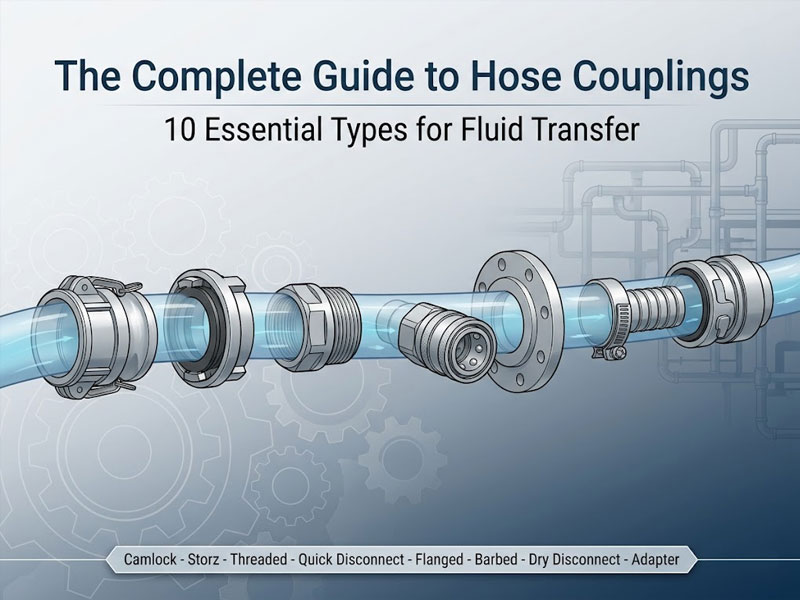
Hose couplings are standardized connectors that join hoses to equipment, valves, or other hoses, enabling safe fluid or gas transfer under specific pressure and temperature conditions. Selecting the correct coupling type – whether Camlock, Storz, Threaded (NPT/BSP) , or Quick Disconnect—is critical for preventing leaks, ensuring operator safety, and avoiding costly system downtime. This guide provides a technical breakdown of 10 common coupling types, including their pressure ratings, material compatibility, industry use cases, and five key selection factors.
Quick Selection Matrix: 10 Common Hose Coupling Types
| Coupling Type | Connection Mechanism | Typical Pressure Range | Common Materials | Primary Industry | Key Limitation |
|---|---|---|---|---|---|
| Camlock (Cam & Groove) | Dual cam levers | Up to 250 PSI | Aluminum, Brass, SS, Polypro | Agriculture, Petroleum | Not for compressed air/vibration |
| Storz | Quarter-turn symmetrical lugs | 150–250+ PSI | Aluminum, Brass | Firefighting, Municipal | Higher initial cost |
| Threaded (NPT/BSP/NH) | Helical threads (tapered or straight) | Up to 3,000+ PSI | Brass, Steel, SS | Plumbing, Hydraulics | Slow connect; torque-sensitive |
| Quick Disconnect (QD) | Ball-locking sleeve | 1,000–5,000 PSI | Steel, Brass, SS | Pneumatics, Hydraulics | Flow restriction vs. full-port |
| Barbed | Ridges + hose clamp | <150 PSI (suction) | Plastic, Brass, SS | Irrigation, Cooling lines | Blow-off risk under pressure |
| Flanged | Bolted flat discs with gasket | Up to 3,000+ PSI | Carbon Steel, SS | Chemical, Oil & Gas | Heavy; not for temporary use |
| Bauer | Toggle-style lever | Up to 150 PSI | Aluminum, Galvanized Steel | Agricultural irrigation | Low pressure only |
| Dry Disconnect | Flat-face valve system | 150–500 PSI | SS, PTFE-coated | Chemical, Pharma | 3–5x more expensive |
| Universal Air (Chicago) | Push-to-connect + locking sleeve | Up to 300 PSI | Steel, Brass | Automotive, Manufacturing | Style mismatch (A/T/F style) |
| Combination (Adapter) | Hybrid (e.g., Camlock x NPT) | Depends on base type | Steel, SS, Brass | Cross-system adaption | Not a primary coupling type |
1. Camlock Couplings (Cam & Groove)
What are Camlock couplings and why are they standard for temporary lines?
Camlock couplings use a two-arm cam lever mechanism that locks a male adapter (with a groove) into a female coupler, compressing a gasket for a leak-resistant seal without tools.
- Typical Pressure: Up to 250 PSI (working); higher for stainless steel variants.
- Temperature Range: -40°F to 250°F (depending on gasket: Buna-N, EPDM, Viton, PTFE).
- Common Materials: Aluminum (lightweight, water/fuel), Brass (corrosion-resistant), 304/316 Stainless Steel (sanitary/chemicals), Polypropylene (aggressive acids).
- Best For: Low to medium pressure temporary transfer – fuel delivery, water suction, food-grade liquids.
- Key Limitation: Cam arms can break under impact; not recommended for compressed air (risk of blow-off). Requires periodic gasket replacement.
2. Storz Couplings
How do Storz couplings achieve reliable sealing without threads?
Storz is a hermaphroditic (identical ends) coupling that uses two cam lugs on each side. A quarter-turn locks the lugs into ramped slots, compressing a rubber gasket without needing to identify male/female ends.
- Typical Pressure: 150–250 PSI working; burst pressure typically 4x higher.
- Common Sizes: 1.5” to 6” (firefighting standard), up to 12” for municipal water.
- Materials: Lightweight aluminum (firefighting), brass, or stainless steel.
- Best For: Firefighting suction/discharge lines, large-volume water transfer, dredging.
- Key Limitation: Dirt-resistant but not self-sealing if gasket is damaged; higher cost than threaded fittings.
3. Threaded Couplings: NPT vs. BSP vs. NH
What is the difference between NPT and BSP threaded couplings?
Threaded couplings rely on helical ridges. However, sealing principles differ:
- NPT (National Pipe Tapered): Uses interference fit – threads deform to seal. Requires PTFE tape or pipe dope. Common in North America.
- BSP (British Standard Pipe): Parallel (BSPP) uses a gasket/O-ring; tapered (BSPT) is similar to NPT but different thread angle (55° vs. 60°). Common globally except North America.
- NH/NST (National Hose): Straight thread fire hose coupling – seal is a rubber gasket, not the threads.
| Thread Standard | Sealing Method | Thread Angle | Typical Use |
|---|---|---|---|
| NPT | Interference (threads) | 60° | General plumbing, hydraulics (US) |
| BSPP (G) | Gasket or O-ring | 55° | Hydraulics, instrumentation (EU/Asia) |
| BSPT (R) | Interference (threads) | 55° | Gas, water lines (EU/Asia) |
| NH (NST) | Rubber gasket | Straight | Fire hose connections |
Key Limitation: NPT and BSP are not interchangeable – mixing causes leakage or thread damage. Always verify thread standard before purchase.
4. Quick Disconnect Couplings (QDs)
How do Quick Disconnect couplings prevent spills when uncoupling?
QDs incorporate a double shut-off valve – spring-loaded poppets in both socket and plug. When connected, they open each other. When disconnected, springs instantly close the valves, trapping fluid inside the hose and equipment.
- Typical Pressure: Up to 5,000 PSI (hydraulic); 250–300 PSI (pneumatic/industrial).
- Configurations: Single shut-off (one side seals), double shut-off (both sides seal), straight-through (no valve – highest flow).
- Standards: ISO 7241-1 Series A (agricultural/hydraulic) and Series B (industrial). Do not mix brands – flow paths and valve designs vary.
- Best For: Hydraulic tools, pneumatic lines, chemical transfer where spillage is unacceptable.
- Key Limitation: Smaller internal diameter than the hose can cause flow restriction.
5. Barbed Couplings (Barb Fittings)
Why use a barbed fitting when it requires a separate clamp?
Barbed fittings rely on friction and mechanical interference – raised ridges (barbs) bite into the inner wall of the hose. A hose clamp (worm gear, spring, or crimp) prevents the hose from expanding and lifting off the barbs under pressure.
- Typical Pressure: Limited to suction or low-pressure (generally <150 PSI, depends on hose construction).
- Common Materials: Polypropylene/ nylon (low-cost, single-use), Brass (good corrosion resistance, potable water), Stainless Steel (high-temperature steam).
- Best For: Irrigation lines, coolant hoses, vacuum lines, low-pressure fuel lines.
- Key Limitation: Not suitable for high-pressure, pulsating flow, or high-vibration systems – the hose can balloon and slip off, causing sudden failure.
6. Flanged Couplings
When should you use a flanged coupling over a threaded one?
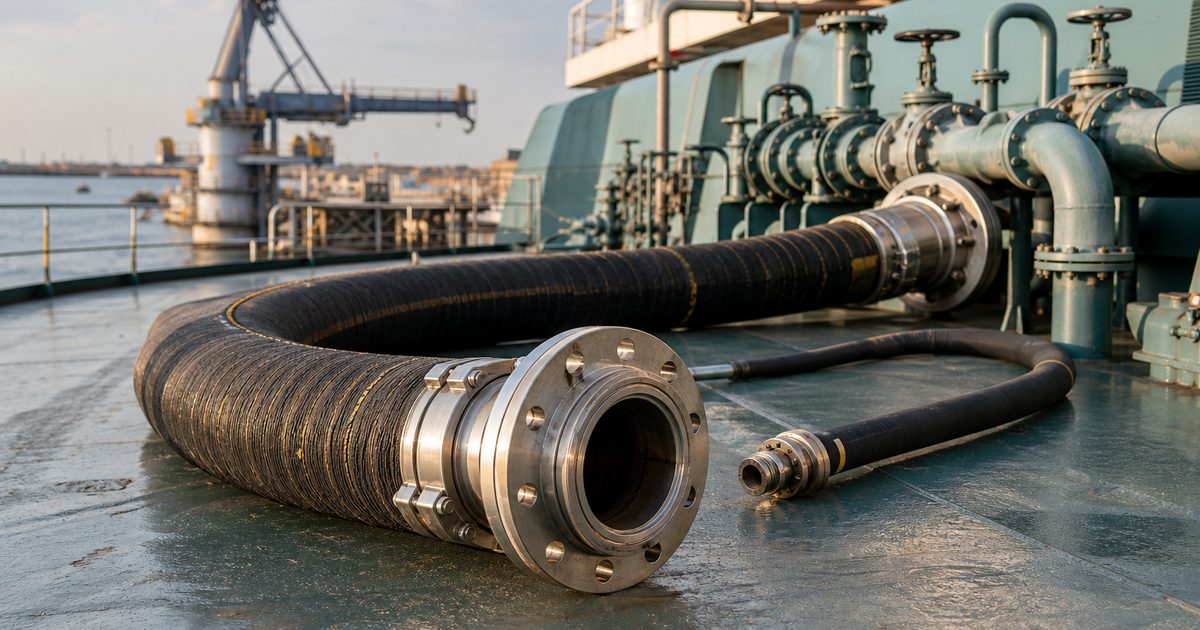
For large diameters (3” and above) or pressures exceeding the safe handling limit of threaded connections. Flanged couplings use a flat, circular disc (flange) welded to the hose end. Two flanges are bolted together with a compressed gasket (non-asbestos, PTFE, or spiral-wound).
- Typical Pressure: Up to 3,000+ PSI (Class 150, 300, 600, 1500, 2500 ratings).
- Temperature Range: -200°C to 800°C+ (material dependent).
- Standards: ANSI/ASME B16.5 (US), DIN (European), JIS (Japanese). Not interchangeable between standards.
- Best For: Refineries, chemical plants, high-pressure steam, permanent pipeline connections.
- Key Limitation: Heavy, slow to connect/disconnect (requires tools and bolts), high installation cost.
7. Bauer Couplings
Where are Bauer couplings preferred over Camlocks?
Bauer couplings are a lever-operated quick coupling primarily for agricultural irrigation and large-volume water pumps. Unlike Camlocks, they use a toggle-style lever on the side to pull the male stub tightly against a rubber ring.
- Typical Pressure: Lower pressure – typically up to 150 PSI.
- Flow Capacity: Very high – minimal internal restriction, suitable for large volumes (e.g., 6” to 12” irrigation lines).
- Key Feature: Self-aligning – easier to connect in muddy or low-visibility field conditions compared to threaded or Camlock.
- Best For: Irrigation, dewatering, transfer of water and slurry.
- Key Limitation: Pressure rating is significantly lower than Camlock or QD. Not for hydrocarbons or chemicals.
8. Dry Disconnect Couplings (Dry Break)
How do dry disconnect couplings achieve near-zero fluid loss?
Unlike standard QDs that may leak a few drops, dry disconnects use a flat-face valve technology. As the coupling is twisted (bayonet style) or rotated, the flat faces wipe fluid from the surface before separation, often achieving less than 0.1 mL per disconnect (manufacturer-dependent).
- Typical Pressure: 150–500 PSI (dependent on material and size).
- Materials: Stainless steel (316), PTFE-coated, Hastelloy for aggressive chemicals.
- Best For: Hazardous chemicals (acids, bases, solvents), expensive fuels (aviation, racing), pharmaceutical transfer where contamination is critical.
- Cost Premium: Typically 3–5x more expensive than a standard Camlock, justified by safety compliance (OSHA, EPA) and product recovery.
- Key Limitation: High cost; requires clean fluid – particulates can damage flat sealing faces.
9. Universal Air Couplings (Chicago / A-Type / Tru-Flate)
Are Chicago couplings the same as universal air couplers?
“Chicago” is often used as a general term for industrial pneumatic couplings, but three common styles exist in the market, and they are not fully interchangeable:
| Style | Also Known As | Locking Mechanism | Typical Use |
|---|---|---|---|
| Industrial A | Chicago, A-style | External sleeve pullback | Manufacturing, general shop air |
| Automotive (T-style) | T-style, Tru-Flate (specific type) | Push-to-connect + release collar | Tire inflators, garages (higher flow) |
| Tru-Flate (M-style) | Milton-style (brand) | Push-to-connect | Home workshops, light duty |
- Typical Pressure: Up to 300 PSI.
- Key Limitation: An Automotive plug will often jam inside an Industrial coupler. Verify which style your existing equipment uses before purchasing.
10. Combination Couplings (Adapters)
Can you connect a Camlock to an NPT thread?
Yes, via a combination coupling (also called a hybrid adapter). One end features one coupling type (e.g., Camlock female), while the other end has a different fitting (e.g., Male NPT). These are not a primary coupling type but essential adapters for cross-system compatibility.
- Common Combinations: Camlock x NPT/BSP, Storz x NH, QD x NPT, Flange x Camlock.
- Material: Typically matches the higher-grade requirement (e.g., stainless steel if chemicals are involved).
- Best For: Connecting new hoses to legacy equipment, temporary setups, or emergency repairs where mismatched brands are present.
- Key Limitation: Each adapter adds two potential leak points. Minimize adapter stacking.
How to Select the Correct Hose Coupling: 5-Step Checklist
Choosing the wrong coupling leads to downtime, leaks, or safety incidents. Use this systematic checklist:
Step 1: Identify the Fluid (Media)
- Water or Air? Camlock or Universal Air (Chicago) is generally sufficient.
- Chemicals / Acids? Stainless steel or polypropylene dry disconnect, or PTFE-lined Camlock.
- Fuel / Oil? Brass or aluminum Camlock or QD with Buna-N/Viton seals.
- Food / Beverage? 316 Stainless steel, sanitary flanged, or quick disconnect.
Step 2: Determine Operating Pressure
- <150 PSI: Barbed, Bauer, low-pressure Camlock.
- 150–250 PSI: Camlock, Storz, Universal Air.
- 250–3,000+ PSI: Threaded (NPT/BSP), QD, Flanged.
Step 3: Define Connection Frequency
- One-time / permanent: Threaded or flanged.
- Daily connection / disconnection: Camlock, QD, Storz.
- Hazardous materials (frequent disconnects): Dry disconnect.
Step 4: Verify Size and Thread Standard
- Measure hose Inside Diameter (ID) – coupling should match ID to avoid flow restriction.
- For threaded: Identify NPT vs. BSP (use a thread pitch gauge). Confusion causes 90% of fitting returns.
Step 5: Check Regulatory or Industry Standards
- Firefighting: NFPA 1963 (Storz / NH).
- Hydraulics: ISO 7241-1 (Series A or B).
- Potable water: NSF/ANSI 61 certification required.
Common Coupling Mistakes (And How to Avoid Them)
| Mistake | Consequence | Prevention |
|---|---|---|
| Mixing NPT with BSP | Leakage, thread galling | Use a thread gauge; buy adapters. |
| Aluminum Camlock with caustic chemicals | Rapid corrosion, failure | Use stainless steel or polypro. |
| Barbed fitting without clamp | Hose blow-off under pressure | Always use correct clamp type/torque. |
| Over-tightening NPT | Cracked female port | Hand-tighten + 1–2 turns max; use sealant. |
| Using standard QD for hazardous chemicals | Spills, exposure risk | Specify dry disconnect with flat-face valves. |
Frequently Asked Questions (FAQ)
Q: Can I use a Camlock coupling for compressed air?
A: Generally not recommended. Camlocks are rated for liquid transfer; vibration can cause cam arms to loosen, leading to sudden blow-off. Use ISO 7241-1 QDs or universal air couplings for compressed air.
Q: What is the difference between NPT and BSP thread?
A: NPT has a 60° thread angle and seals via thread deformation. BSP has a 55° angle – BSPP seals with a gasket, BSPT seals like NPT. They are not interchangeable.
Q: How do I know if my coupling material is compatible with my chemical?
A: Check a chemical compatibility chart. As a general rule: use brass or PTFE for fuels, 316 stainless steel for acids/caustics, and avoid aluminum with high or low pH fluids.
Q: Which coupling type has the highest pressure rating?
A: Threaded (NPT/BSP) and flanged couplings can exceed 3,000 PSI. Flanged connections (Class 2500) are used for extreme high-pressure steam and hydraulics.
Q: What does “double shut-off” mean in quick disconnect couplings?
A: Both the socket and plug contain spring-loaded valves that close automatically when disconnected, preventing fluid from escaping from either side. Standard for hydraulic and chemical QDs.
HENGHUA: Engineering-Grade Couplings for Critical Applications
At HENGHUA, we treat couplings as mission-critical components, not accessories. Our engineering team provides:
- Full Material Traceability: Mill certificates for stainless steel (304/316) and brass alloys, ensuring dezincification resistance and chemical compatibility.
- Precision Threading: CNC-machined NPT (ANSI/ASME B1.20.1) and BSP (ISO 7-1) threads – no cheap cast fittings that leak.
- Documented Specifications: Each coupling comes with rated working pressure, burst pressure, temperature range, and gasket material data.
- Compliance Support: We supply couplings meeting NFPA (Storz), ISO 7241 (QD), and NSF/ANSI 61 (potable water) standards.
- Advisory Services: Submit your fluid, pressure, temperature, and connection frequency – we will provide a written coupling compatibility matrix and a bill of materials.
Need a coupling for a high-risk application? Contact HENGHUA technical sales with your system specs for a documented recommendation and certified quotation.

 English
  Spanish
  Portuguese
  French
  German