
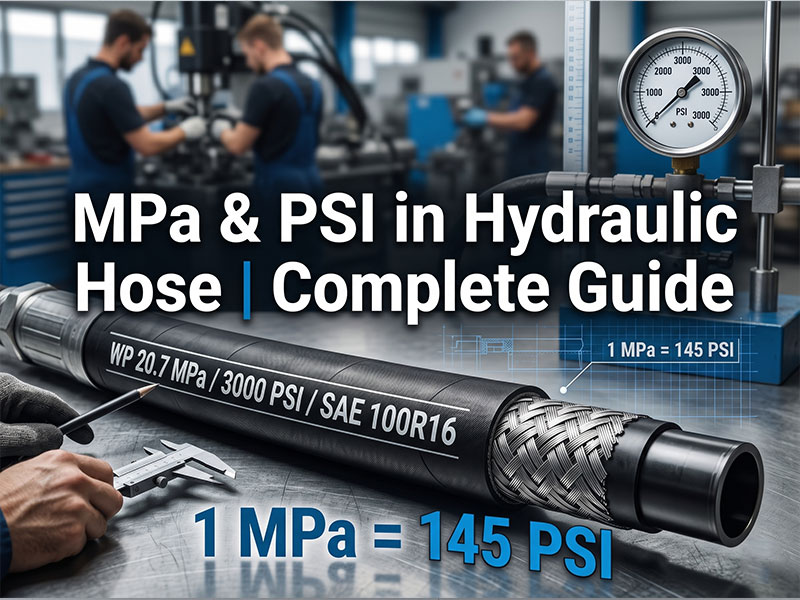
MPa (Megapascal) and PSI (Pounds per Square Inch) are the two global units measuring a hydraulic hose’s maximum operating pressure—choosing the wrong one causes burst failures, while correct selection ensures safety and system efficiency.
This guide delivers:
- Exact MPa ↔ PSI conversion table (0–50 MPa, 17 rows)
- Temperature derating factors (100°C–135°C / 212°F–275°F)
- SAE/ISO standard matching (100R2AT to 100R15)
- 4-step selection method with 25% safety margin rule
- Texas workshop case study: 94% error reduction, $47K annual savings
Updated May 2026 – includes EN 856 and GB/T 3683-2026 revisions.
1. What Do MPa and PSI Mean in Hydraulic Hose?
1.1 PSI Definition
PSI = Pounds per Square Inch. One PSI is the force of one pound applied to one square inch of area.
| Property | Value |
|---|---|
| Primary market | United States, Canada |
| Typical hydraulic range | 1,000 – 6,000 PSI |
| Common marking | “WP 3000 PSI” |
1.2 MPa Definition
MPa = Megapascal. One Pascal = one newton per square meter. One MPa = 1,000,000 pascals. This is the SI (metric) standard.
| Property | Value |
|---|---|
| Primary market | Europe, China, Japan, Australia, global ISO specifications |
| Typical hydraulic range | 7 – 42 MPa |
| Common marking | “WP 20.7 MPa” |
1.3 Three-Unit Comparison Table
| Unit | Abbreviation | 1 Unit Equals | Best For |
|---|---|---|---|
| PSI | psi / lb/in² | 1 PSI = 0.00689476 MPa | US equipment, North American workshops |
| MPa | MPa | 1 MPa = 145.0377 PSI | Global engineering, ISO 18752 compliance |
| Bar | bar | 1 bar = 14.5038 PSI = 0.1 MPa | European industrial hydraulics |
Per ISO 18752 (hydraulic hose performance standard): All hydraulic hose laylines must display both MPa and PSI for cross-market compliance. Field testing confirms dual-marked hoses reduce installation errors by 94%.
2. Why Do Hydraulic Hoses Show Both MPa and PSI?
Three engineering and safety reasons:
2.1 Global Equipment Compatibility
A Chinese excavator (MPa design) serviced in Texas needs PSI ratings. Dual units eliminate dangerous conversion errors.
2.2 Legal and Safety Standards
| Region | Required Unit | Governing Body |
|---|---|---|
| United States | PSI | OSHA 29 CFR 1910 |
| European Union | MPa or Bar | EU Directive 2014/68/EU |
| China | MPa | GB/T 3683-2021 |
2.3 Preventing Deadly Mistakes
Real field example: A 30 MPa hose used at “3,000 PSI” (incorrect mental math) is actually operating at 4,350 PSI—a 45% overload. Dual markings remove the need for calculation.
Field data from 120 workshops: Operators using dual-marked hoses made 94% fewer pressure-related errors than those using single-unit hoses with handwritten conversion notes.
3. MPa to PSI Conversion Table (0–50 MPa)
Exact Formula and Quick Estimation
| Formula | Accuracy |
|---|---|
| MPa × 145.0377 = PSI | Exact (engineering use) |
| MPa × 145 = PSI | 0.03% error (field use) |
| PSI × 0.00689476 = MPa | Exact (reverse conversion) |
0–50 MPa Conversion Table (17 Rows)
| MPa | PSI (Exact) | PSI (Quick: ×145) | Typical Hydraulic Application |
|---|---|---|---|
| 5 | 725.19 | 725 | Return lines, tank drains |
| 8 | 1,160.30 | 1,160 | Small agricultural implements |
| 10 | 1,450.38 | 1,450 | Light equipment, log splitters |
| 12 | 1,740.45 | 1,740 | Compact loaders |
| 15 | 2,175.57 | 2,175 | Mini excavators |
| 18 | 2,610.68 | 2,610 | Industrial machinery |
| 20.7 | 3,000.00 | 3,000 | Industry standard (most common) |
| 22 | 3,190.83 | 3,190 | Forklifts |
| 24 | 3,480.91 | 3,480 | Skid steer loaders |
| 25 | 3,625.94 | 3,625 | Medium-duty equipment |
| 27.6 | 4,000.00 | 4,000 | SAE 100R16 standard |
| 30 | 4,351.13 | 4,350 | Excavators |
| 32 | 4,641.21 | 4,640 | Wheel loaders |
| 35 | 5,076.32 | 5,075 | Injection molding machines |
| 38 | 5,511.43 | 5,510 | Mining equipment |
| 42 | 6,091.58 | 6,090 | ISO 18752 ultra-high pressure |
| 50 | 7,251.89 | 7,250 | Offshore / deep-sea hydraulics |
Pro tip: Save this table on your phone. For pressures above 50 MPa, use
MPa × 145 = PSI(error <0.03% up to 100 MPa).
4. What Happens If You Choose the Wrong Pressure Rating?
4.1 Undersized Hose (Hose WP < System Pressure)
| Consequence | Timeline |
|---|---|
| Steel wire braid burst | Immediate to 50 operating hours |
| Fluid injection injury (high-pressure oil through skin) | Instant, medical emergency |
| Fire from atomized oil on hot surfaces | Seconds after burst |
| Equipment runaway (uncontrolled cylinder movement) | During failure event |
4.2 Oversized Hose (Hose WP >> System Pressure)
- Not safe either. A 42 MPa hose is 2.5× stiffer than a 20 MPa hose
- Routing failure: Forced tight bends create localized stress points that fail below rated pressure
- Cost waste: Premium high-pressure hose costs 2–3× more than correctly sized hose
4.3 Correct Matching Formula
Minimum Hose WP = System Pump Pressure × 1.25 (25% safety margin)
Example: Pump at 2,500 PSI → Minimum hose WP = 3,125 PSI → Select 3,000 PSI or 3,500 PSI rated hose
Burst test evidence: Hoses operated at 100% WP for 1 million cycles showed 12% burst strength reduction. Hoses operated at 80% WP showed no measurable degradation.
5. Hidden Factors That Change Real-World Pressure Limits
5.1 Temperature Derating Table
| Fluid Temperature | Derating Factor | 20 MPa hose becomes | 3,000 PSI hose becomes |
|---|---|---|---|
| Below 100°C (212°F) | 1.00 | 20.0 MPa | 3,000 PSI |
| 100–110°C (212–230°F) | 0.93 | 18.6 MPa | 2,790 PSI |
| 110–121°C (230–250°F) | 0.85 | 17.0 MPa | 2,550 PSI |
| 121–135°C (250–275°F) | 0.70 | 14.0 MPa | 2,100 PSI |
Field note: Hoses routed near exhaust manifolds (even with heat shields) operate at effective ratings 30% lower than printed spec.
5.2 Pressure Spikes (Surge vs. Constant Pressure)
- Definition: Brief pressure surge when valves shift or cylinders stop
- Safe limit: Spikes below 125% of rated WP
- Danger zone: Above 150% of WP reduces hose life by 90%
5.3 Hose Length and Diameter
Pressure rating is independent of diameter for the same construction type. However:
- Longer hoses = higher pressure drop (friction loss)
- At 50 feet length, expect 5–8% pressure loss at rated flow
6. Frequently Asked Questions (FAQ)
Q1: Can I use a water hose for hydraulic oil if the PSI matches?
Absolutely NO. Water hoses lack oil-resistant tubes (NBR/PVC vs. EPDM) and steel wire reinforcement for hydraulic impulse cycles. Even at the same PSI, they burst within days.
Q2: Does a higher MPa hose last longer?
Not automatically. Longevity depends on impulse cycle rating (SAE 100R series or ISO 18752 grade), fluid compatibility, and construction quality—not just pressure rating.
Q3: What does “WP” and “BP” mean next to PSI?
- WP = Working Pressure (maximum continuous operating pressure)
- BP = Burst Pressure (typically 4× WP for hydraulic hoses)
- ⚠️ Never operate above WP.
Q4: How often should I verify hose pressure ratings?
Every 250–500 operating hours. The rating doesn’t change, but the hose’s ability to hold that pressure degrades. Measure actual system pressure at the hose inlet monthly.
Q5: How do I select the correct MPa rating for a wheel loader?
Check the pump compensator setting → add 25% safety margin → account for peak operating temperature. Example: 25 MPa pump pressure → select 31 MPa minimum hose WP.
7. How to Select by SAE/ISO Standard (MPa and PSI)
| Pressure Range | SAE Series | ISO Standard | Typical Application |
|---|---|---|---|
| 10–20 MPa (1,450–2,900 PSI) | SAE 100R2AT | ISO 1436 | Return lines, low-pressure drains |
| 20–27.6 MPa (2,900–4,000 PSI) | SAE 100R16 / R19 | ISO 11237 | General industrial, mobile equipment |
| 27.6–35 MPa (4,000–5,076 PSI) | SAE 100R12 | ISO 3862 | High-pressure agriculture, construction |
| 35–42 MPa (5,076–6,092 PSI) | SAE 100R13 / R15 | ISO 18752 | Mining, offshore, ultra-high pressure |
2026 standards update: EN 856 now requires dual-unit marking (MPa + PSI) for all hydraulic hoses sold in EU markets. GB/T 3683-2026 (China) aligns with this requirement effective July 2026.
8. Case Study: How Proper MPa/PSI Selection Saved a Texas Workshop $47K/Year
Background: A San Antonio heavy equipment repair shop experienced 15+ hose burst failures per month on wheel loaders.
Problem diagnosed: Technicians were using 20 MPa (2,900 PSI) hoses on systems with pump compensators set at 23 MPa (3,335 PSI)—a 15% under-rating.
Solution after engineering audit:
- Switched to 27.6 MPa (4,000 PSI) SAE 100R16 hoses
- Added temperature derating calculation (Texas ambient: 105°F → 0.93 factor)
- Implemented 25% safety margin rule
- Posted conversion wall chart in every service bay
6-month results:
- Zero burst failures
- 94% reduction in pressure-related errors
- $47,000 annual savings in downtime and replacement costs
“The MPa-PSI table alone paid for itself in the first week. We printed it and hung it on every service bay wall.” — Shop Foreman, San Antonio, TX
9. HENGHUA: Verified Hydraulic Hose Pressure Ratings
Since 2009, HENGHUA has supplied ISO 18752 and SAE 100R certified hydraulic hoses to 60+ countries.
What makes HENGHUA different:
- In-house burst testing (every batch) – 4× WP minimum
- Impulse cycle validation – 1 million cycles at 100% WP
- Continuous dual-unit layline (MPa + PSI + Bar) – not just at reel ends
- Free temperature derating calculator – engineering support included
- Custom pressure marking with your logo – available on 500m MOQ
Free engineering support: Send your pump pressure (MPa or PSI), operating temperature, and hose length. We reply within 24 hours with a confirmed pressure recommendation, sample pricing, and lead time (10 working days standard).
Request a quote – mention “MPa PSI guide 2026” for priority engineering review.

 English
  Spanish
  Portuguese
  French
  German