
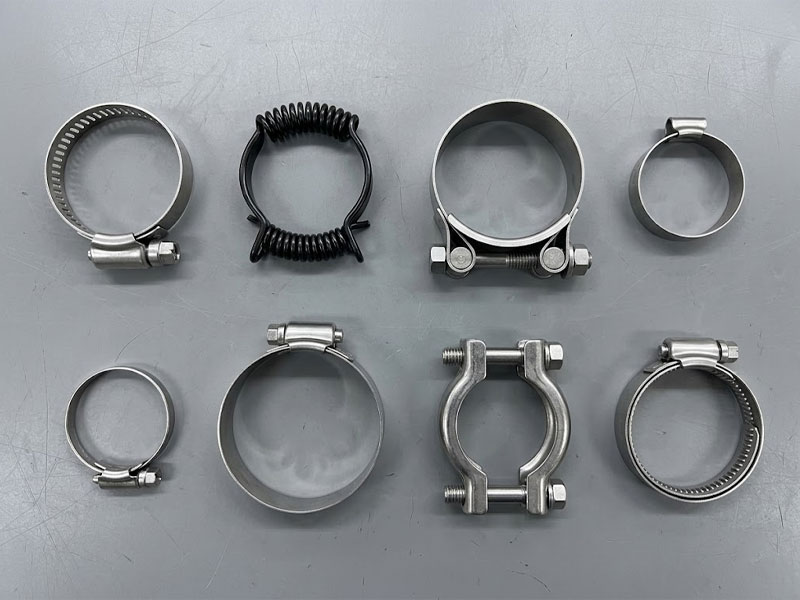
What Are Hose Clamps and Why Does Type Selection Matter?
Hose clamps are mechanical fasteners that secure hoses onto fittings by creating uniform radial compression to prevent leaks and blow-offs. Choosing the right clamp type is critical because hose material, operating pressure, temperature range, vibration exposure, and environmental corrosion risk all directly affect sealing performance. This guide compares 8 hose clamp types for automotive, industrial, and marine applications, provides material selection criteria, typical torque ranges, and the STAMPED selection framework.
Quick Selection: Decision Table by Application
| Application Scenario | Recommended Clamp Type | Key Reason | Typical Material |
|---|---|---|---|
| Silicone hose (soft, heat-resistant) | Lined Worm Gear or Constant Tension Spring | Prevents slot extrusion and tearing | 304 SS |
| Turbocharger / intercooler ducting | T-Bolt | High blow-off resistance | 304 SS |
| Marine salt spray / below waterline | Worm Gear or Ear | Chloride corrosion resistance required | 316 SS |
| High-pressure fuel injection | Ear (Oetiker) or Smooth-Band Fuel Clamp | Tamper-proof, vibration-proof | 304 SS |
| Automotive cooling system (high thermal cycle) | Spring (Constant Tension) | Maintains seal through expansion/contraction | 304 SS |
| Large irrigation hose (>4 inch ID) | Band (two clamps, offset buckles 180°) | Wide load distribution | 304 or 316 SS |
| Vacuum or low-pressure air | Wire | Low cost, quick removal | Spring steel |
| Heavy-duty hydraulics | Bolt (Two-Piece) | Even 360° compression | Carbon steel or ductile iron |
8 Hose Clamp Types: Complete Breakdown
1. Worm Gear Clamps (Jubilee Style)
- What it is: A perforated metal band with a screw mechanism (worm) that engages band slots to reduce diameter.
- How it works: Rotating the screw pulls the band tighter, compressing the hose onto the fitting.
- Best applications: Coolant lines, air intake ducts, general industrial plumbing, irrigation systems.
- Limitations: Band slots can cut or extrude soft hoses (silicone, thin-wall rubber) under higher torque.
- Typical material options: 304 SS, 316 SS, zinc-plated carbon steel (depending on environment).
- Reusable? Yes.
- Installation notes: Position housing for tool access. Typical torque range for 9mm band on rubber is 2.5-3.5 Nm, though exact values vary by manufacturer, band thickness, and hose material.
2. Spring Clamps (Constant Tension)
- What it is: A spring steel ring with gripping ears that applies variable mechanical force.
- How it works: As hose material expands with heat or contracts with cold, the spring adjusts diameter to maintain relatively constant radial tension.
- Best applications: Automotive cooling systems, radiator hoses, applications with significant thermal cycling.
- Limitations: Limited size range; requires constant tension pliers for removal.
- Typical material options: Hardened spring steel (zinc or phosphate coated).
- Reusable? Yes.
- Installation notes: Use pliers to expand ears; inspect for rust or deformation before re-use.
3. Wire Clamps
- What it is: A single continuous loop of spring steel wire.
- How it works: The wire loop compresses the hose onto the fitting via spring tension when the ears are expanded and released.
- Best applications: Vacuum lines, windshield washer fluid hoses, low-pressure air assist systems.
- Limitations: Typical pressure rating below 30 PSI (varies by wire gauge and hose compatibility). Narrow contact patch increases stress concentration.
- Typical material options: Spring steel (zinc-plated), 304 SS.
- Reusable? Yes.
- Installation notes: Use pliers to expand ears; ensure full seating on barb.
4. Ear Clamps (Pinch / Oetiker Style)
- What it is: A single-use clamp with a pre-formed ear that is permanently deformed with a pneumatic pincer tool.
- How it works: The tool closes the ear, reducing circumference; a tongue-and-groove lock secures the clamp permanently.
- Best applications: Fuel injection lines, brake vacuum boosters, washing machines, dishwashers (leak-critical applications).
- Limitations: Single use only; requires specialized crimping tool; must be cut off for removal.
- Typical material options: 304 SS, 316 SS.
- Reusable? No.
- Installation notes: Use calibrated ear clamp pliers; verify full ear closure per manufacturer gap specification.
5. T-Bolt Clamps
- What it is: A wide band with T-shaped bolt and hex nut, providing higher mechanical advantage than worm gear designs.
- How it works: Tightening the hex nut pulls the T-bolt, compressing the band uniformly around the hose.
- Best applications: Turbocharger outlet hoses, intercooler pipes, heavy-duty diesel intake, EGR systems.
- Limitations: Bulkier than worm gear clamps; higher cost.
- Typical material options: 304 SS, 316 SS (band and hardware).
- Reusable? Yes.
- Installation notes: Torque to manufacturer specification (typical range 8-15 Nm depending on size, though exact values vary). Consider thread locker for high-vibration applications.
6. Band Clamps
- What it is: A wide stainless steel band with a bridge housing; includes V-band variants for exhaust connections.
- How it works: The housing tightens the band, distributing load over larger diameters (typically 4 inches and above).
- Best applications: Large irrigation hoses, DEF lines, sanitary fittings, exhaust V-band connections.
- Limitations: Not recommended for tight radii or small diameters (under 2 inches).
- Typical material options: 304 SS, 316 SS.
- Reusable? Yes.
- Installation notes: When using two band clamps on larger hoses, offset buckles 180 degrees to balance compression.
7. Bolt Clamps (Heavy-Duty Two-Piece)
- What it is: Two semi-circular metal halves joined by bolts.
- How it works: Bolts draw the halves together, compressing the hose uniformly from all sides.
- Best applications: High-pressure hydraulics, pneumatic connections, industrial process lines.
- Limitations: Often single-use (bolts may deform to conform); heavier and slower to install than other types.
- Typical material options: Carbon steel with plating, ductile iron.
- Reusable? Generally no (bolts may deform during torque application).
- Installation notes: Replace after removal; torque in alternating sequence.
8. Specialty Clamps (Spiral / Convoluted)
- What it is: A spiral wire clamp designed specifically for grooved or ribbed hoses.
- How it works: The wire spiral fits into the convoluted grooves, preventing axial slip-off under pressure or movement.
- Best applications: Convoluted/ribbed hoses, low-pressure dust collection.
- Limitations: Only suitable for grooved hoses; not effective on smooth hoses.
- Typical material options: Spring steel, zinc-plated carbon steel.
- Reusable? Yes.
- Installation notes: Align wire with hose groove; avoid overtightening.
Common Mistakes by Clamp Type
| Clamp Type | Common Mistake | Consequence |
|---|---|---|
| Worm Gear | Using on silicone hose without lined band | Slot extrusion, tearing, eventual leak |
| Spring | Using in static, low-temperature system | No benefit gained; extra cost |
| Wire | Using above 30 PSI | Blow-off or clamp deformation |
| Ear | Attempting to reuse after crimping | Incomplete seal, leak path |
| T-Bolt | Undertorquing | Blow-off under boost/vibration |
| Band | Single clamp on large diameter (>4″) | Uneven compression, leak |
| Bolt | Reusing deformed bolts | Uneven load, fastener failure |
| Specialty (Spiral) | Using on smooth hose | Axial slip-off |
Material Selection: 304 vs 316 Stainless Steel
| Material Grade | Freshwater | Saltwater / Marine Exposure | Chemical Resistance | Typical Use Case |
|---|---|---|---|---|
| Zinc-Plated Carbon Steel | Limited (coating degrades over time) | Not recommended | Not recommended | Indoor dry applications only |
| 304 Stainless Steel | Good (general purpose) | Limited — pitting may occur under prolonged chloride exposure | Low to moderate | Automotive, general industrial, freshwater |
| 316 Stainless Steel | Excellent | Preferred for chlorides and salt spray | Moderate to good | Marine, coastal, chemical environments |
| Alloy 625 | Excellent | Excellent (severe service) | Excellent | Offshore, high-temperature acid, extreme chemical |
Marine note: In below-waterline or regular salt-spray environments, 304 SS is generally not recommended. Pitting corrosion may develop after prolonged chloride exposure, typically within 6-12 months depending on conditions. 316 SS is the more common standard for marine hardware where extended service life is required.
Galvanic corrosion note: When combining different metals in the presence of an electrolyte (saltwater, coolant), select compatible materials or isolate contact points to accelerate corrosion.
Engineering Selection: The STAMPED Method
STAMPED is a practical selection framework used to avoid mismatch between clamp and application.
| Letter | Stands For | Required Information |
|---|---|---|
| S | Size | Installed OD of hose + fitting (not nominal hose size) |
| T | Temperature | Max/min fluid temperature and ambient range |
| A | Application | Vibration level, hose flexing, duty cycle |
| M | Material | Media being conveyed (oil, coolant, fuel, acid, water) |
| P | Pressure | Max working pressure and surge/spike pressure |
| E | Ends | Fitting type: barbed, smooth, threaded, or quick-connect |
| D | Delivery | Installation tool available (crimper, torque wrench, pliers) |
Installation Torque: Typical Ranges
| Clamp Type | Band Width | Rubber Hose (Nm) | Silicone Hose (Nm) | Note |
|---|---|---|---|---|
| Worm Gear | 9 mm | 2.5 – 3.5 (typical) | 2.0 – 2.8 (typical) | Silicone generally requires lower torque |
| Worm Gear | 12 mm | 3.5 – 5.0 (typical) | 2.8 – 4.0 (typical) | Lined clamp recommended for silicone |
| T-Bolt | Various | 8.0 – 15.0 (typical) | 6.0 – 12.0 (typical) | Exact range varies by size and band design |
| Ear Clamp | N/A | Per tool calibration | Per tool calibration | Follow manufacturer crimp specification |
Important: All torque values shown are typical ranges observed for common sizes and materials. Actual specifications vary by manufacturer, band thickness, width, and hose compound. Always verify with the specific clamp manufacturer’s data sheet.
Frequently Asked Questions (FAQ)
Best hose clamp for silicone hose?
A lined worm gear clamp (smooth inner sleeve) or a constant tension spring clamp. Standard perforated worm gear bands can cut into soft silicone under higher torque.
Can worm gear clamps be used on fuel lines?
For low-pressure fuel lines (carbureted engines, gravity feed), generally yes. For high-pressure fuel injection (typically 40-60+ PSI), dedicated fuel injection clamps (smooth-band ear or specific screw clamp designs) are typically recommended.
What torque should I use for a hose clamp?
Typical torque for a 9mm worm gear clamp on rubber hose is 2.5-3.5 Nm, but this varies. Always verify with the clamp manufacturer’s data sheet, as band width, thickness, and hose material all affect the correct value.
Are ear clamps reusable?
No. Ear clamps are designed for single use only. Once crimped, they should be cut off and replaced with a new clamp.
When should I choose a T-bolt clamp over a worm gear?
When the application involves higher pressure (typically 150+ PSI, though thresholds vary), significant vibration (turbo, diesel engines), or risk of blow-off. T-bolt clamps generally provide higher and more uniform compression than worm gear designs.
Best hose clamp for marine use?
316 stainless steel is the more common standard for marine environments. Below the waterline or in regular salt spray, 304 SS may develop pitting corrosion over time, depending on exposure conditions.
Can I reuse a hose clamp after removing it?
Worm gear, spring, wire, band, and T-bolt clamps: Yes, if undamaged and not deformed. Ear clamps: No. Bolt clamps: Generally no (bolts may deform during initial torque).
Why does my hose clamp leak after tightening?
Possible causes include: wrong clamp type for hose material, clamp too wide or narrow for the barb fitting, aged or cracked hose, torque too low (leak path) or too high (cut hose), or misaligned screw housing.
HENGHUA: Technical Capabilities for Clamp Sourcing
HENGHUA supplies hose clamps and fluid handling components with an emphasis on specification accuracy and material traceability.
- Traceable mill certifications for 304 SS, 316 SS, and alloy grades
- Inventory from 1/4″ to 12″ diameter across major clamp types
- Technical resources including torque specifications and installation tooling
- Batch testing for breakaway torque and tensile strength per applicable SAE/DIN standards
For OEM and MRO buyers: Request bulk clamp kits by hose size, material, and application. Engineering support available for BOM recommendations, torque guidance, and production installation tooling.

 English
  Spanish
  Portuguese
  French
  German