goodheart786@gmail.com

Marine oil hose types on a ship deck: transfer hose flanges and a bunker hose connection at a fuel manifold

Marine Oil Hose: Offshore and Shipboard Applications

A marine oil hose is a large-bore, heavy-duty rubber hose that transfers crude oil, heavy fuel oil, diesel, and lubricating oil between ships, terminals, and offshore structures without leaking, kinking, or building up static charge. In short, it is the certified, salt-water-grade member of the oil hose family. If you are specifying or replacing a […]

Marine Oil Hose: Offshore and Shipboard Applications Read More »

Coils of black SAE 100R4 suction hose for hydraulic oil service on a workshop bench, cut end showing the dual spiral wire helix reinforcement

Hydraulic Suction Hose: High-Temperature, MSHA-Certified Guide for Oil Suction & Delivery Lines

A hydraulic suction hose is a flexible, vacuum-rated rubber hose that carries hydraulic oil from the reservoir to the pump inlet, built to SAE 100R4 with an oil-resistant NBR tube, textile reinforcement and dual spiral wire helix, rated from -40 °C to +100 °C (with high-temperature grades to +125 °C) and, in its mining version,

Hydraulic Suction Hose: High-Temperature, MSHA-Certified Guide for Oil Suction & Delivery Lines Read More »

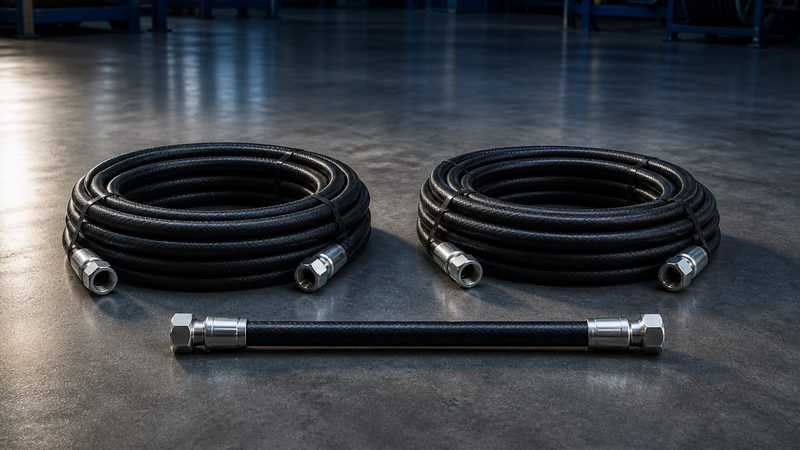
Hydraulic hose and couplings guide cover: coiled reinforced hydraulic hoses with steel fittings on industrial background

Hydraulic Hose and Couplings: Complete System Guide

Which hose and couplings keep your machine running longest? The answer is a validated combination: a hydraulic hose is a flexible, reinforced tube that carries pressurized fluid between pumps, valves, cylinders, and tools, and couplings are the precision connectors that lock the hose to those components. Selection comes down to five factors — working pressure

Hydraulic Hose and Couplings: Complete System Guide Read More »

Fuel transfer hose with a nozzle connected to a 12-volt transfer pump beside a diesel tank on a farm or service yard, typical refuelling setup

Fuel Transfer Hose: Selection, Sizes & Safety

A fuel transfer hose is a flexible rubber hose engineered to move gasoline, diesel, petrol, and fuel oil between tanks, pumps, trucks, and machines — and choosing the right one comes down to five checks: fluid compatibility, inner diameter, working pressure, end fittings, and static-safety construction. This guide explains what a transfer hose is, provides

Fuel Transfer Hose: Selection, Sizes & Safety Read More »

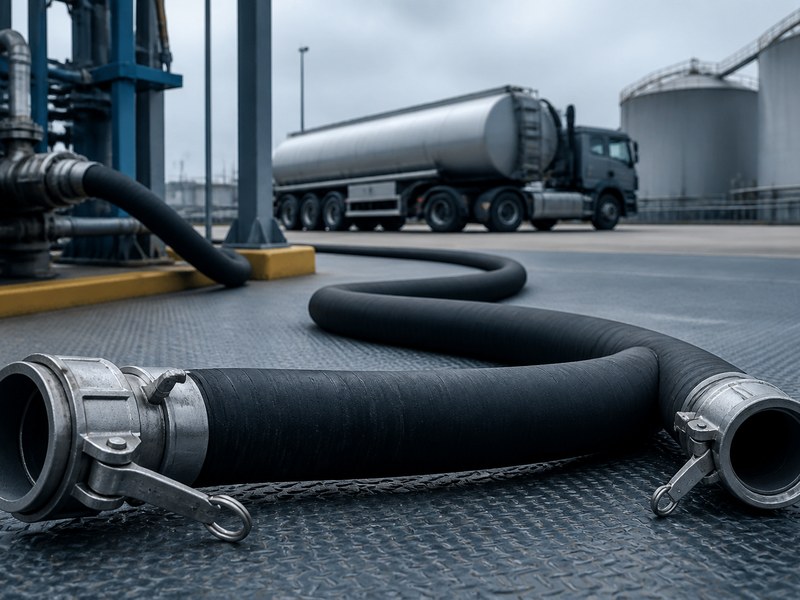
Oil transfer hose with camlock coupling coiled on a workshop floor beside a tank truck loading point, showing a typical bulk transfer setup

Oil Transfer Hose: How to Choose the Right One

The right oil transfer hose is chosen by matching five specifications — inner diameter, working pressure, temperature range, end fittings, and construction (suction, discharge, or both) — to the fluid, flow rate, and duty of the line. This guide walks through every step of oil hose selection in order, provides the size chart and pressure

Oil Transfer Hose: How to Choose the Right One Read More »

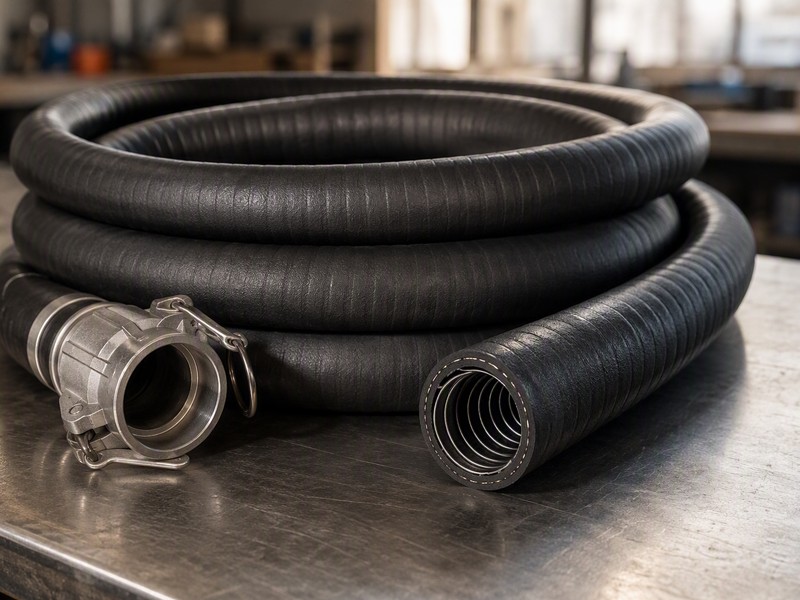
Coils of black rubber petroleum hose with steel camlock couplings on a workshop bench, cut end showing the spiral wire helix reinforcement

Oil Suction and Discharge Hose: Sizes, Ratings & Applications

An oil suction and discharge hose is a flexible rubber hose engineered to move petroleum products such as diesel, fuel oil, lubricating oil, and mineral oil under both suction (vacuum) and discharge (pressure) conditions, commonly built to EN 1765 or DIN 20023 in 10 bar and 20 bar working pressure classes, with sizes from 3/4

Oil Suction and Discharge Hose: Sizes, Ratings & Applications Read More »

Coiled oil resistant rubber hose beside a steel drum of hydraulic oil in an industrial workshop

Oil Resistant Hose: What Makes a Hose Oil-Resistant?

If you are choosing an oil resistant hose for hydraulic, fuel, suction, or transfer service, the answer starts with one material decision: nitrile (NBR) rubber is the industry-standard tube for oil contact, with the right cover compound and reinforcement. Oil resistance is a measured property, not a marketing claim — ASTM D471 immersion testing rates

Oil Resistant Hose: What Makes a Hose Oil-Resistant? Read More »

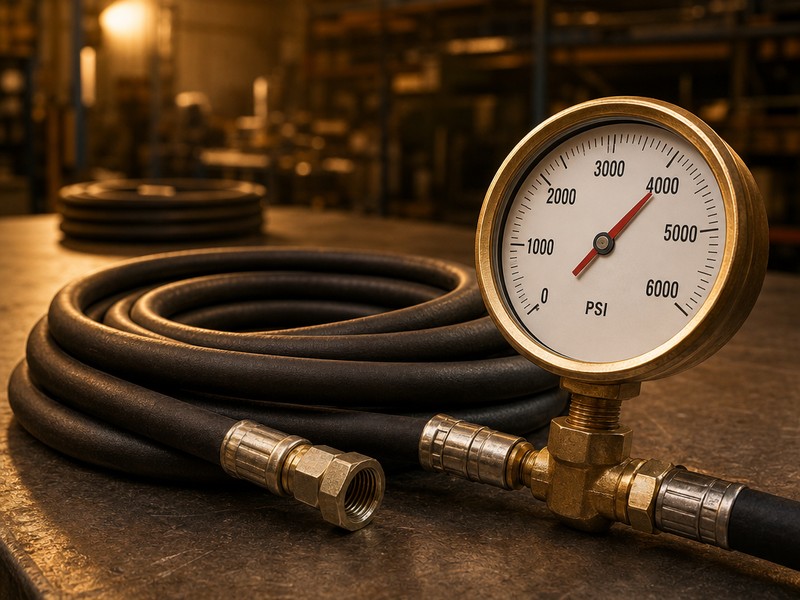
oil hose with a hydraulic pressure gauge showing working pressure in an industrial workshop

Oil Hose Working Pressure vs Burst Pressure: What You Need to Know

Oil hose working pressure is the maximum internal pressure an oil hose can carry continuously and safely at its rated temperature, while burst pressure is the destructive-test pressure at which the hose ruptures — and for most oil hoses the two are separated by a 4:1 safety factor, meaning the minimum burst pressure is four

Oil Hose Working Pressure vs Burst Pressure: What You Need to Know Read More »

Oil hose types arranged side by side: hydraulic, suction, transfer, and fuel oil hose on an industrial workbench

Oil Hose: Types, Applications & Selection Guide

An oil hose is a flexible rubber or thermoplastic tube engineered to carry petroleum-based fluids — hydraulic oil, lubricating oil, engine oil, and diesel fuel — without swelling, softening, or shedding particles into the fluid. This guide explains the main oil hose types, the industries and machines that use each one, and the selection steps

Oil Hose: Types, Applications & Selection Guide Read More »