
Нефтяной композитный шланг
Petroleum Composite Hose for Petrol, Diesel and Biofuel
A petroleum composite hose moves fuel without swelling, without losing vapour through the wall and without building static in the line. Five builds cover one fuel chain: suction and discharge for road and rail tankers, light oil for low-permeation pipeline work, biofuel for alcohol blends, bottom loading for terminal racks, and fire retardant where the product is flammable. Working pressure runs 10 to 14 bar and bore 1 inch to 10 inch. The liner and the vapour barrier change between builds; the helix does not.

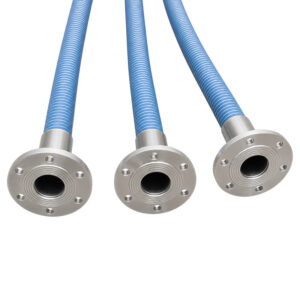
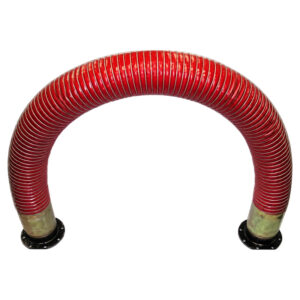


Five Builds, One Fuel Chain
| Build | Bore | Рабочее давление | Temperature | Liner | Where it sits on the chain |
|---|---|---|---|---|---|
| Suction & Discharge | 1 to 10 inch | 370 psi to 3 inch, 345 psi 4 to 8 inch, 225 psi at 10 inch | -40 to +110 °C | PP film with polyethylene vapour barrier | Road and rail tanker transfer, including LPG and light distillates |
| Light Oil | 1 to 6 inch | 10 bar (145 psi), burst 40 bar (580 psi) | -40 to +200 °C | Modified nylon or crosslinked polyethylene | Pipeline transfer where permeation is the problem |
| Biofuel & Biodiesel | 25 to 250 mm | 14 bar, 250 psi maximum | -20 to +100 °C | Polyamide or nylon | B100, bioethanol, methanol and propanol blends |
| Bottom Loading | 1 to 10 inch | 200 psi, 150 psi at 10 inch | -30 to +100 °C | PP and polyester | Refinery and bulk terminal loading racks |
| Fire Retardant | 25 to 250 mm | 14 bar | -30 to +80 °C | PP and polyamide, fibreglass cover | Flammable product where a nearby fire must not become a hose failure |
How a Fuel Hose Is Put Together
Two layers decide whether a fuel hose works: the liner that holds the product and the barrier that stops it leaving through the wall.
- Inner helix — galvanized or stainless steel in the bore, holding the shape under vacuum and carrying static to the fittings.
- Liner — polypropylene film on petrol and diesel duty, polyamide or nylon on biofuel, modified nylon or crosslinked polyethylene on light oil.
- Vapour barrier — a polyester or polyethylene film behind the liner. On aromatic blends this is what keeps the product inside the hose over months of static service, and it is the layer buyers never ask about until they smell fuel in the depot.
- Carcass — bonded film and fabric plies carrying hoop stress; ply count rises with bore.
- Cover — abrasion resistant PVC coated fabric, or fibreglass with fire retardant PVC on the fire retardant build, which also gives thermal insulation from outside to inside.
Why the Liner Changes Along the Chain
Petrol, diesel and light oil are hydrocarbon mixtures. A polypropylene liner with a polyethylene vapour barrier holds them, and the barrier is what keeps the aromatic fraction from migrating through the wall. Light oil raises the temperature ceiling to +200 °C, which needs a different polymer in the bore.
Alcohol blends are the exception that catches buyers. B100, bioethanol and methanol attack the liner that handles mineral diesel without complaint: the alcohol absorbs into the polymer, the liner softens, and permeability climbs. That is why biofuel is a separate build with a polyamide or nylon liner rather than an option on the fuel page.
Static, Bonding and Earthing
Static is the failure mode that does not announce itself. On every fuel grade we build the helix bonded to the end fittings so the assembly has a continuous path from the bore to the flange, checked at 1 ohm/m below 100 mm bore and 2 ohm/m at 100 mm and above. A conductive hose is necessary and not sufficient: the assembly still has to be bonded to the tank and to earth before transfer starts, and the bond has to be rechecked after any fitting work.
Pressure Steps and Why They Exist
| Build | Bore | Рабочее давление | Burst or factor |
|---|---|---|---|
| Suction & Discharge | 1 to 3 inch | 370 psi | 3:1 |
| Suction & Discharge | 4 to 8 inch | 345 psi | 3:1 |
| Suction & Discharge | 10 inch | 225 psi | 3:1 |
| Bottom Loading | 1 to 8 inch | 200 psi | on drawing |
| Bottom Loading | 10 inch | 150 psi | on drawing |
Both steps follow the same logic: hoop stress rises with diameter at constant pressure, so the pressure class is reduced rather than the wall thickness growing without limit. Size the hose to pump discharge plus surge, then check pressure drop at your flow — a 10 inch line at 225 psi is carrying a lot of product and a long run will cost head.
Приложения
- Road tankers — bottom loading and top loading, unloading at depot gantries
- Rail tankers — crude, diesel, gasoline and ethanol blends
- Bulk terminals — rack service, vapour return, line pigging connections
- Fuel depots and aviation fuelling — Jet A-1 transfer where the liner is confirmed for the additive package
- Biodiesel blending — B100, B20 and ethanol blends at the blend header
- Marine bunkering — the transfer legs that are not ship-to-shore; see the marine category for jetty duty
Installation, Inspection and Service Life
Installation
Bond and earth before the first transfer, not after commissioning. Support horizontal runs every 1.5 to 2 m, respect the bend radius at the bore centreline under pressure, and never twist the hose to meet a flange — a twisted fuel hose ends its life at the fitting. On loading racks, use a swivel or a breakaway coupling so the hose is not the component taking the pull.
Inspection
Check for cover cracking and exposed fabric, a flattened or polished outer helix, loose collars and worn seals, and a bore that has narrowed or softened. Check continuity after any fitting work. Retire the assembly after a kink that does not recover, a cover softened by product, or a failed continuity test — patching a conductive hose invalidates the continuity record.
Service life
Two to three years is typical on terminal duty with daily movement; longer where the hose is static and supported. Cover abrasion and ply fatigue at the fitting are the usual limits, not the liner. A hose that passes product continuously at the top of its pressure class wears faster than one used at half.
Customization, MOQ and Price
- Length — 60 ft standard on bottom loading, up to 80 or 100 ft; 20 m standard on suction and discharge
- Ends — camlock, flange, tank coupling and threaded adapters; TTMA patterns for loading arms
- Marking — cover colour, brand, batch code, fuel type and pressure text, multilingual warning labels
- MOQ — standard sizes from 100 m; custom bore, colour and OEM marking from 500 m per size
- Lead time — 7 to 15 days after order confirmation; assemblies with fixed flanges 10 to 15 days
Price is set by bore, ply count, liner grade and end connection. A light oil build with a nylon liner and a vapour barrier costs more than a standard suction and discharge hose of the same bore, and a fire retardant build costs more again because of the fibreglass cover. Tell us the fuel and the connection and the comparison is made on landed cost, not on list price per metre.
Manufactured in Hengshui on 12 production lines across an 18,000 m² site, supplying 70 countries since 2010, with the film lot, ply count and test pressure recorded on every assembly.
What This Category Does Not Cover
- Acids, alkalis and ketones belong to the chemical composite hose category; a bottom loading liner will not survive them.
- LNG and liquid nitrogen need the cryogenic build, not a chilled fuel grade.
- Above 40 bar specify a wire spiral hose. A composite hose is a transfer product, not a pressure product.
- Saturated steam needs a steam hose; the thermoplastic liner softens.
Products in This Category
- Suction and discharge composite hose, 1 to 10 inch
- Light oil composite hose, 10 bar, to +200 °C
- Biofuel and biodiesel composite hose, 14 bar
- Bottom loading hose, 200 psi, 60 ft
- Fire retardant composite hose, 14 bar
Part of the composite hose range, which covers six families from 25 to 254 mm.
Часто задаваемые вопросы
What is a petroleum composite hose used for?
Moving petrol, diesel, light oil, biodiesel, ethanol blends and their vapours between tank truck, railcar, terminal rack and vessel. It is a transfer hose at 10 to 14 bar, not a pressure hose, and it is supplied as a tested assembly with flanges, camlocks or threaded ends fitted.
Can one hose handle both diesel and biodiesel?
Not reliably. A liner that handles mineral diesel for years can soften in B100 or bioethanol within months, because alcohol absorbs into polypropylene. Specify the biofuel build where the alcohol content is above about 10 %, and keep a separate hose for mineral diesel.
Why does the 10 inch version have a lower pressure rating?
Hoop stress scales with diameter, so a 10 inch bore at 345 psi would need a ply stack and wall thickness no loading rack can handle. The class drops to 225 psi on suction and discharge, and to 150 psi on bottom loading.
How is static controlled?
The helix is bonded to the fittings and continuity is checked end to end before dispatch, at 1 ohm/m below 100 mm bore and 2 ohm/m above. Bond the assembly to the tank and to earth before transfer, and recheck the bond after any fitting work.
What is the temperature range?
-40 to +110 °C on suction and discharge, -40 to +200 °C on light oil, -20 to +100 °C on biofuel, and -30 to +100 °C on bottom loading. The fire retardant build is limited to +80 °C because the fibreglass cover is the temperature ceiling, not the liner.
Can it be used for LPG?
LPG at ambient or chilled to -40 °C runs on the suction and discharge build with a conductive helix. Cryogenic builds are for LNG at about -162 °C and liquid nitrogen at -196 °C, not for cylinder or tanker LPG.
Does a fire retardant cover replace a conductive build?
No, they answer different risks. The fibreglass cover slows fire spread from outside; conductivity drains static from the product. A flammable product line normally needs both, and they are specified together.
What are the order quantity and lead time?
Standard sizes start at 100 m. Custom bore, colour and OEM marking start at 500 m per size, with tiered discounts above that and framework pricing for distributor programmes. Standard builds ship 7 to 15 days after order confirmation.
Tell us the fuel and the connection. Send the product, the alcohol content if it is a blend, the flow rate and the flange pattern through the quotation form and the build, the pressure class and the landed cost come back within one working day.
- Гидравлический шланг2323 товара
- Промышленный шланг7575 товаров
- Воздушный шланг99 товаров
- Водяной шланг1111 товаров
- Масляный шланг1616 товаров
- Шланг для химических веществ66 товаров
- Композитный шланг1616 товаров
- Шланг из химического композитного материала33 товара
- Морской композитный шланг55 товаров
- Нефтяной композитный шланг55 товаров
- Высокотемпературный композитный шланг11 товар
- Шланг из PTFE-композита11 товар
- Криогенный композитный шланг11 товар
- Паровой шланг33 товара
- Многофункциональный шланг22 товара
- Шланги для продуктов питания и напитков44 товара
- Бетонный шланг44 товара
- Цементный шланг22 товара
- Шланг для транспортировки материалов1111 товаров
- Шланг для дноуглубительных работ44 товара
- Гидравлические фитинги166166 товаров
- Многоразовые фитинги для шлангов66 товаров
- Фитинги для шлангов без муфт88 товаров
- Гидравлические фитинги JIC1616 товаров
- Гидравлические фитинги метрической системы4141 товар
- Гидравлические фитинги NPT66 товаров
- Гидравлические фитинги BSP2626 товаров
- Гидравлические фитинги SAE3030 товаров
- Гидравлические фитинги Banjo44 товара
- Гидравлические фитинги ORFS1111 товаров
- Втулка1111 товаров
- Фланцевые соединения2626 товаров
- Однокомпонентные фитинги2424 товара
- Гидравлические переходники149149 товаров
Why HENGHUA is Your Trusted Partner in Power
HENGHUA: Your Global Water Hose Solution Partner
For over 15 years, HENGHUA has evolved from a regional rubber hose producer into a top-tier china-based manufacturer serving 70+ countries. Our water hose division combines German engineering standards, American testing protocols, and Chinese manufacturing efficiency to deliver High Pressure Hose solutions that rival Parker, Gates, and Eaton at 30-40% lower cost.
Why Industry Leaders Choose HENGHUA:
Vertical integration: We control every step – from rubber mixing to final hose assembly. No hidden defects, no quality variations.
Certification readiness: All products meet SAE, ISO, EN, and GB standard with pdf specification available for audit.
Flexible supply: Bulk orders, just-in-time delivery, or wholesale distribution – we scale with your business.
Technical support: Our 25-person engineering team provides application engineering, failure analysis, and custom solution design.
One-stop shopping: fittings, adapters, flanges, protective sleeves – complete fluid connection source.
Commitment to Partnership: HENGHUA doesn’t just supply hoses. We become your reliability partner. Request a sample, visit our factory, or audit our lab. Experience the HENGHUA difference.
Contact us for discount price quotes and OEM ODM collaboration.
Send a Mail
henghua@hhgpipe.com
Make a Call
+15822925523
86-22-83859963
Mon - Sun: 09:00 am - 22:00 pm
Main Office
Tianjin, China
Hezhong Building, Youyi North Road
 English
 Spanish
 Portuguese
 French
 German
 Arabic
 Russian
 Indonesian
 Japanese
 Korean