
The composite hose price is set by five inputs: bore, lining, helix material, end fittings and the test and document regime. Length and order quantity scale the result, and freight moves it again. No two quotes are comparable until those five inputs match, which is why a per-metre figure on its own says very little.
This guide breaks the number into its parts and shows which choices move it most. It explains why a per-metre figure is a useful unit for a long run and a misleading one for an assembly. It also sets out the fields a quote needs before you can compare two suppliers, and the questions that stop a cheap offer from becoming an expensive installation.
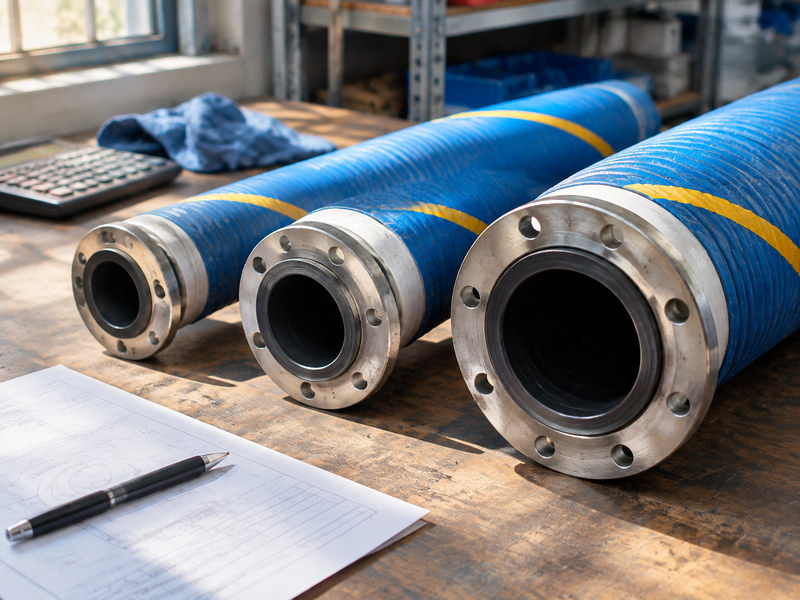
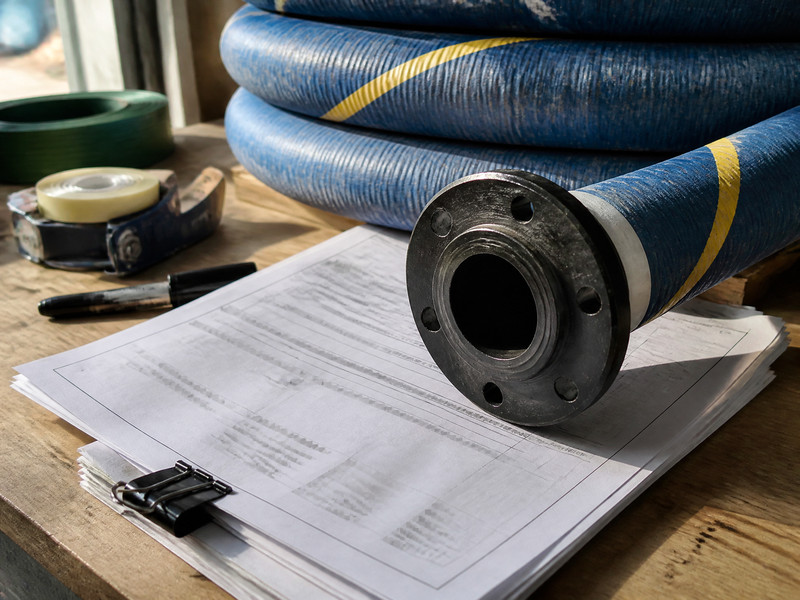
Figure 1. Three hose ends of different bores beside the paperwork they are priced from.

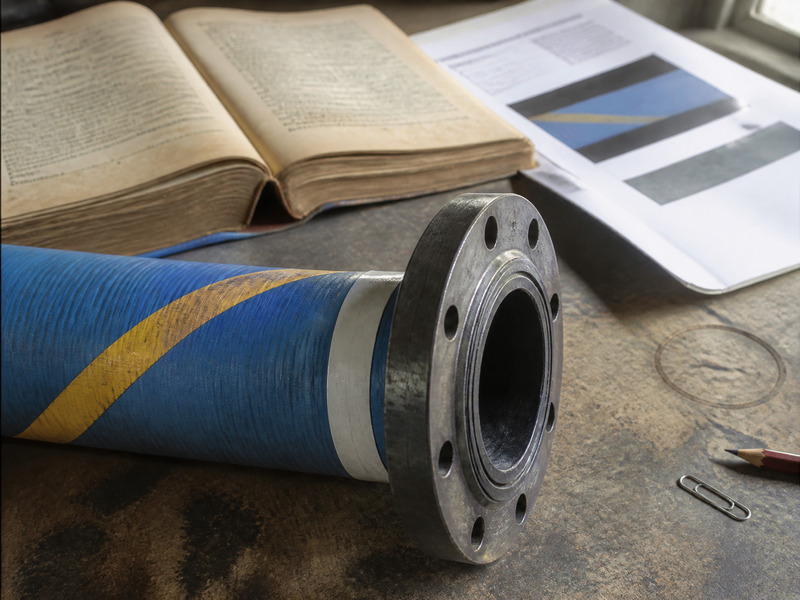
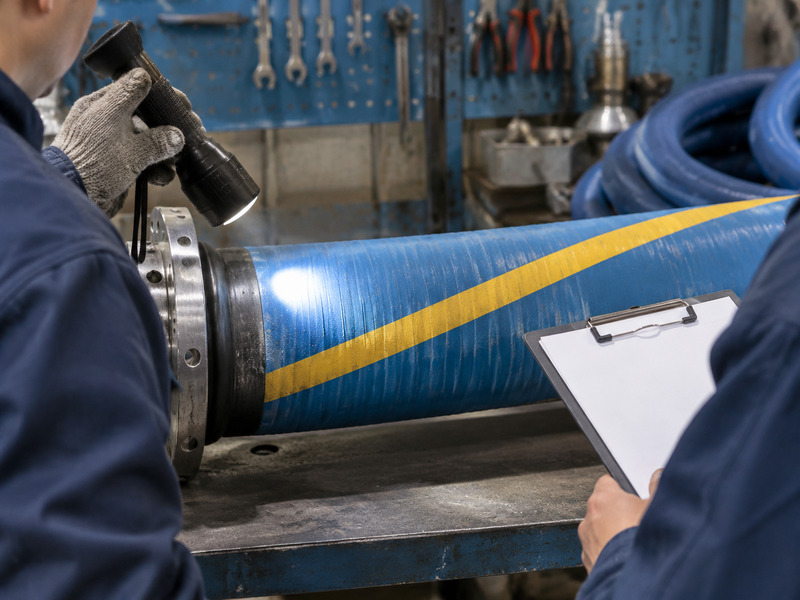
Figure 2. Three coils of rising bore on one floor, with the tape run out beside them: each step up in size moves material, weight and freight together. The cost of each input is set out per metre in Table 1, and the rise is not proportional.
What Drives the Composite Hose Price Most?
Bore comes first, because material consumption per metre scales with circumference. A hose at twice the bore uses roughly twice the film, fabric and cover per metre, before any change in wall construction. That makes bore the largest single lever in most enquiries, and the reason a size range rarely has one rate.
Lining comes second. Polypropylene is the workhorse and the least expensive lining. XLPE and UHMWPE cost more because the material and the process are more demanding. PTFE sits at the top, because fluoropolymer film and the bonding process that goes with it are expensive relative to polyolefins.
End fittings and documentation come third and fourth, and they matter out of proportion to their material value. A pair of stainless flanges with a floating end can add more to an assembly than several metres of hose. A witnessed test and a certificate add cost too, and they are the parts a buyer is most tempted to trim.
Is Composite Hose Price per Meter the Right Measure?
It is the right measure for a long run of the same build, because the rate is stable and the comparison is simple. It is the wrong measure for assemblies, where the ends, the test and the packing are fixed costs that do not scale with length.
The practical distinction is between a rate and a unit price. A rate tells you what an extra metre costs once the setup is paid. A unit price tells you what one delivered assembly costs. Short assemblies therefore look expensive per metre even when the rate is competitive, and buyers who compare on rate alone often reject the better offer.
Use the per-metre rate to compare the hose, and the assembly price to compare the delivery. Keep both columns in the same spreadsheet, and the rate becomes a diagnostic rather than a verdict.
How Much Does Bore Change the Number?
Material scales with circumference, so a jump from 50 mm to 100 mm roughly doubles the film, fabric and cover per metre. The wall may also gain a layer at large bore to hold the pressure, which adds a second effect on top of the first.
Large bore has a third cost that buyers forget: handling. A 150 mm hose is heavy, needs a longer bend radius and takes more space on a reel, so packing and freight per metre rise faster than material does. On dock and jetty work this is a real line in the budget, not a rounding error.
Small bore has the opposite profile. The hose is cheap per metre but the fittings are not, so the assembly price is dominated by the ends. That is why a 25 mm assembly can cost several times its hose value, and why a minimum order expressed in metres behaves differently across a size range.
Which Lining Choice Moves the Composite Hose Cost Most?
| Lining | Relative cost | Temperature window | Typical duty |
|---|---|---|---|
| Polypropylene | Lowest | Moderate | Acids, alkalis, general chemical transfer |
| XLPE | Low to medium | Moderate | Oxidising chemicals where PP is marginal |
| UHMWPE | Medium | Moderate | Broad chemical coverage, abrasion resistance |
| PTFE | Highest | Widest | Aggressive acids, aromatics, chlorinated solvents |
Table 1. Lining options in ascending cost order, with the duty each is chosen for. Relative cost is qualitative; the composite hose price depends on the specific build and volume.
The step from polypropylene to PTFE can change the hose portion of the price by a large multiple. It can also change the fittings, because a PTFE build may need a different liner termination. Buyers who compare two quotes on the same duty should check that the lining is the same before looking at the number.
The reverse mistake is over-specifying. A PTFE lining on a duty that polypropylene handles adds cost without adding service life, and it may reduce flexibility. Lining selection belongs to the compatibility question, not to the budget.
Do End Fittings Cost More Than the Hose?
Sometimes. A flanged assembly in stainless steel, with one floating end, can carry more value in the ends than in several metres of hose. The drivers are material, size, drilling standard and the amount of machining.
Four fitting choices move the price most:
- Material: carbon steel, galvanised steel or stainless, in ascending cost.
- Type: fixed, floating or swivel, with floating ends adding a collar and machining.
- Drilling: EN 1092-1 or ASME B16.5, with non-standard patterns costing more.
- Attachment: crimped ends are the norm, while bolted or clamped arrangements add labour.
List 1. Fitting choices that change the assembly price. On small bore, this list can outweigh the hose entirely.
A buyer comparing assemblies should compare the flange standard and the fixed-to-floating arrangement explicitly. Two quotes that look far apart often differ in one of those two fields, and the cheaper one may simply not fit the berth.
What Do Tests, Marking and Documents Add?
A proof test on every assembly is part of normal production, and its cost is small per unit. What adds cost is the evidence layer: witnessed testing, third-party inspection, individual test certificates, and marking that has to survive the service environment.
Documents cost money because they consume time from people who could be making hose. A batch record, a certificate with a scope, a packing list that matches the invoice and a marking layout that was approved rather than assumed all require someone to check them. That is the part of the composite hose price buyers most often cut, and the part that causes the most trouble at a terminal.
Our advice is to decide the evidence layer before the price negotiation, not during it. Removing a certificate to hit a target price turns a comparable offer into an incomparable one, and the saving is usually smaller than the cost of the first inspection failure.
How Do Volume and MOQ Change the Composite Hose Price?
Volume changes the price because setup is spread over more metres. The first metre of a run carries the material order, the line setup and the marking setup. The hundredth metre carries material and labour, and very little else.
MOQ is the point where setup stops being spread. Below that quantity the buyer pays for a full setup on a short run. That is why small orders look expensive per metre, and why the composite hose price for a trial order should never be used to judge a production order.
Two structures help. Ordering several lengths of the same bore and lining in one run spreads the setup across the lengths. That is the simplest way to move the composite hose price without changing the build. Accepting a standard label instead of printed cover artwork removes a printing setup altogether. Both reduce the effective minimum without changing the hose.
How Do You Build a Composite Hose Quote That Compares?
Ask for the same fields from every supplier, in the same order, and refuse to compare until they are filled. A composite hose quote that omits the test regime or the flange standard is not a lower price; it is a different product.
| Поле | What to require |
|---|---|
| Type and standard | EN 13765 type with edition, or the declared specification |
| Bore and length | Millimetres and metres, with tolerance |
| Lining and wall | Material and layer count or ply description |
| Рабочее давление | Value at the stated service temperature |
| End connections | Flange standard, size, material, fixed or floating |
| Test regime | Proof pressure, hold time, record format |
| Marking and packing | Fields, method, coil or crate |
| Quantity and validity | Metres, assemblies, MOQ basis, quote validity |
Table 2. Fields that make a composite hose quote comparable. Fill every row or the comparison is guesswork.
The same fields, applied to two constructions rather than two suppliers, are in our composite hose versus rubber hose comparison.
Cost per year is the last column worth adding. A hose that lasts three seasons at a higher price can be cheaper than one that lasts one season at a lower price, provided the duty is identical. That comparison only works when the specification is the same, which is why the table comes first.
What Does Landed Cost Include?
The composite hose price is the factory gate figure. Landed cost adds freight, insurance, duty, inland transport and the cost of holding stock, and on bulky hose those additions can rival the product value. A 150 mm coil occupies volume that a 25 mm coil does not, so freight per metre is not a constant across a size range.
Packaging is part of the calculation. A crate that protects flange faces adds volume and weight, and a coil wrap that fails in transit turns a saving into a claim. Decide the shipping form at quotation stage, when it can still be priced into the offer rather than discovered on the dock.
Duty and tariff treatment depend on the classification, and the classification depends on material and fittings rather than on the trade name. Our guide to the composite hose HS code explains why an assembly with flanges sits on a different line from a coil of hose.
How Does the Number Behave Over Service Life?
The composite hose cost over a decade is dominated by replacement frequency, not by the first invoice. A hose that lasts three seasons at a higher price beats one that lasts one season at a lower price, provided the duty and the inspection regime are the same.
The calculation is worth doing on a spreadsheet rather than in a meeting, because the assumptions are easy to argue and hard to compare. Put the purchase price, the expected service life, the labour hours per change and the downtime cost per hour in separate columns. The answer is usually obvious once the columns exist, and the argument moves from opinion to assumption.
Replacement carries hidden cost: labour to drain and disconnect, downtime on the line, disposal of the used hose and the paperwork that goes with a new certificate. On a terminal with a fixed maintenance window, a failure in service costs far more than the hose ever did.
That is why the specification should be fixed before the price is negotiated. Trimming the lining or the test regime to win a purchase order usually moves cost into the maintenance budget, where it is harder to see and easier to blame on the product.
Why Do Two Suppliers Quote So Differently?
Usually because they are quoting different products. One includes a proof test and a certificate, the other assumes both. One prices a stainless floating flange, the other a carbon steel fixed flange. One quotes a rate for a full run, the other a unit price for a short run.
Timing is a fourth reason, and it is easy to miss. A quote issued before a material price movement and one issued after it can differ without either supplier changing its margin, which is why validity matters as much as the number.
The second reason is the material basis. A composite hose price built on a specialty film behaves differently from one built on a commodity grade, and the difference may not appear in the description. Ask which film and which fabric, then compare.
The third is currency and validity. A quote in one currency with a thirty-day validity is not comparable with one in another currency held for a year, and the gap grows when exchange rates move.

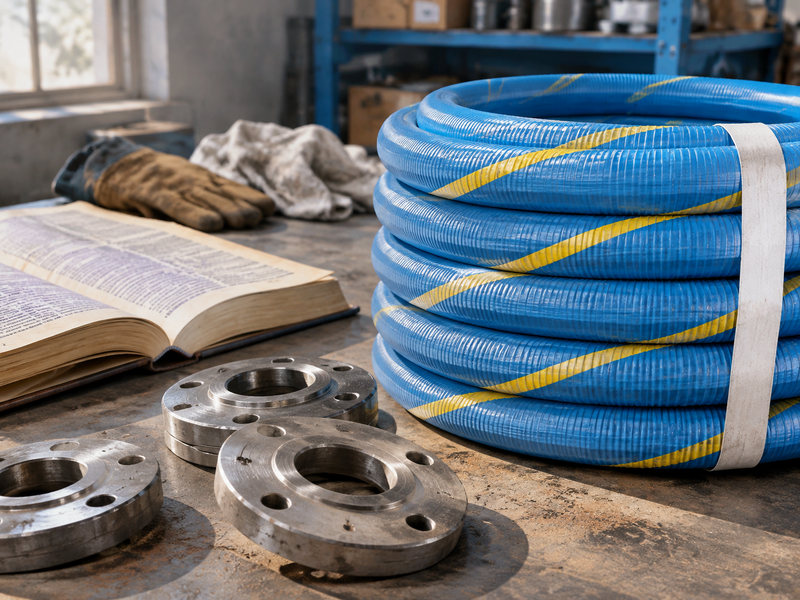
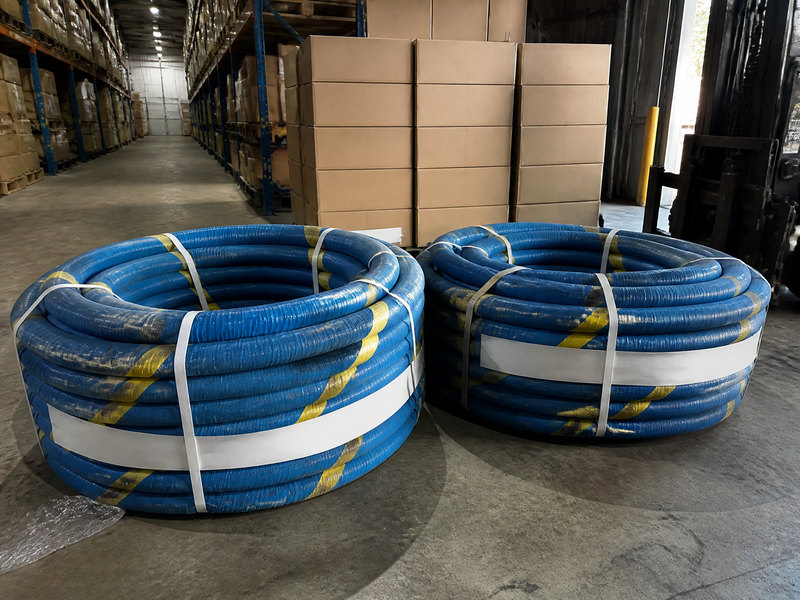
Figure 3. Two men and a wrapped pallet at the container door: from here the buyer pays for volume and handling as well as for hose. The split between product, freight and duty is in Table 2, and the freight share grows faster as bore rises.
Часто задаваемые вопросы
Why is the composite hose price per meter higher for small orders?
It is because setup is spread over fewer metres. Either spelling of the unit, metre or meter, refers to the same figure. Material ordering, line setup and marking setup are fixed costs, so a short run carries them on a small base and the rate rises.
Is PTFE always the most expensive lining?
It is the most expensive of the common linings, and it is also the widest in chemical coverage and temperature. On duties where polypropylene is adequate, PTFE adds cost without adding life.
Do flanges really change the price that much?
On small bore, yes. A stainless floating flange can carry more value than the hose it is fitted to, and a non-standard drilling adds machining on top.
How much does certification add?
The added cost sits in the evidence layer, not in the test. A proof test is routine production, while a witnessed test with an individual certificate is a service, and that service is what carries the price.
Should I compare price per metre or price per assembly?
Both, for different jobs. Per metre compares two quotes of the same build and the same bore. Per assembly compares what you actually install, because two flanges, a test and a crate do not scale with length. Comparing short assemblies on rate alone favours the wrong supplier.
Does a longer hose cost proportionally more?
Roughly, once setup is covered. Above a certain length, handling and packing add more than material does, so the relationship is close to linear but not exactly so.
How do I get a lower composite hose cost without losing quality?
Reduce variety rather than specification. Fewer bores, fewer lengths and a standard label spread the setup across a run, which lowers the rate without touching the wall or the test.
About HENGHUA
Every composite hose from HENGHUA is built with XLPE, polypropylene, PTFE and UHMWPE linings, so a quotation can be built from the parts that actually drive the number. We quote with the type, lining, end connections, test regime and marking stated, which makes the offer comparable instead of merely cheaper.
Send the bore range, the duty and the annual volume through our contact page and we will return a quote in the same format as the table above. The range is listed in our composite hose range, and the construction behind the price sits in the multi-layer build guide. The OEM route is covered separately in the private label guide. Buyers weighing materials can start from the composite hose versus rubber hose comparison.
 English
 Spanish
 Portuguese
 French
 German
 Arabic
 Russian
 Indonesian
 Japanese
 Korean