

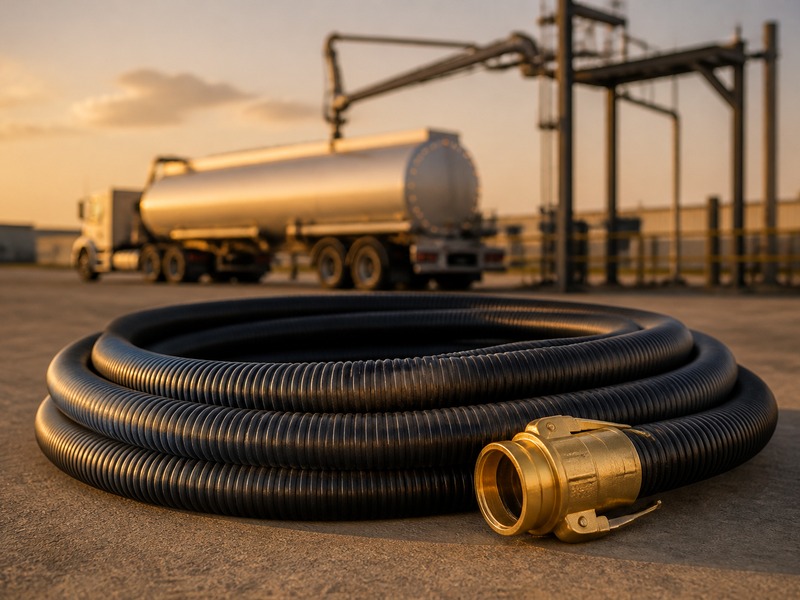
A coiled hose with brass quick-connect fittings, ready for workshop duty.
An air hose is a flexible, reinforced tube that carries compressed air from an air compressor or a plant air supply to pneumatic tools, inflators, and other equipment. It is also called a pneumatic hose or an air line. It contains pressurized air, measured in PSI (pounds per square inch), and delivers it as flow, measured in SCFM (standard cubic feet per minute); the reinforcement layer stops the tube from ballooning or bursting under pressure. If you are still choosing the compressor, our air compressor hose selection guide covers the matching logic in detail.
This guide explains what an air hose is, then walks through the main hose types you will meet in workshops and industry. It compares the four common materials — rubber, PVC (polyvinyl chloride), polyurethane (PU), and hybrid — and covers sizes, fittings, safety, and maintenance, so you can identify, use, and buy the right hose for any compressed-air job.
What Is an Air Hose?
An air hose is a flexible conduit built specifically to transport compressed air from a source to a point of use. One end connects to the compressor outlet or a plant air header; the other end connects to a tool, nozzle, or inflator. Unlike a garden hose, it contains a reinforcement layer that prevents the tube from expanding and bursting under internal pressure.
The most common jobs are powering pneumatic tools such as nail guns, impact wrenches, and paint spray guns; inflating tires and air mattresses; blowing dust and chips from workpieces; and operating pneumatic cylinders in automated production lines. This four-layer design — inner tube, reinforcement, cover, end fittings — serves a home garage, an automotive workshop, and a factory floor alike; only the size, pressure rating, and material change.
Every hose shares the same four-layer anatomy:
- Cámara de aire — the bore that carries the air, made from an oil- and moisture-resistant compound.
- Capa de refuerzo — one or more braided textile or wire layers that absorb the hoop stress created by internal pressure.
- Cubierta exterior — protects the reinforcement from abrasion, ozone, oil, and UV damage.
- End fittings — usually 1/4-inch NPT (National Pipe Thread) threads, barbed stems, or quick-connect couplers that join the hose to the compressor and the tool.
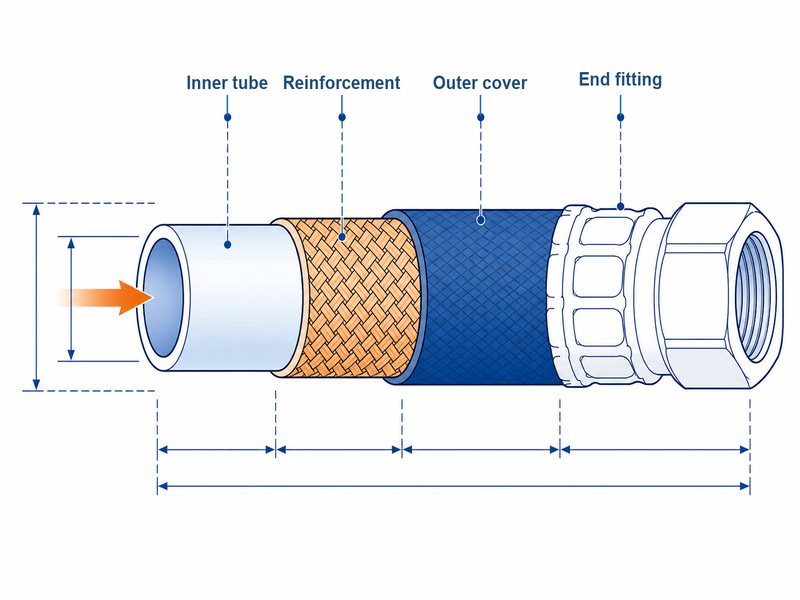
Figure 1. The four layers of a reinforced hose: inner tube, reinforcement, cover, and end fittings — the reinforcement is what separates it from a garden hose.
Consumer-grade hoses are typically rated at 200–300 PSI working pressure, while industrial rubber hoses run 300–500 PSI. Because most workshop compressors operate between 90 and 150 PSI, a 300 PSI hose leaves a safety margin of at least 2:1 over the compressor’s maximum output.
How Does an Air Hose Work?
Here is how an air hose works in one line: a hose does not create pressure — it only conducts it. The compressor stores compressed air in a tank at high pressure; the hose provides a sealed path that lets that air expand and flow toward the tool, where it drives a piston or spins a vane motor.
Two numbers describe everything a hose does:
- PSI (pounds per square inch) is the pressure of the air inside the hose. It decides how hard the air pushes.
- SCFM (standard cubic feet per minute) is the volume of air flowing through the hose each minute. It decides whether the tool receives enough air to run at full power.
A tool needs both. A framing nailer, for example, needs roughly 90 PSI and about 4–5 SCFM at the tool; a paint spray gun may need 10 SCFM or more. If either number falls short, the tool slows down, misfires, or stalls.
Why does the hose need reinforcement? Compressed air pushes outward against the hose wall in every direction — the same force that inflates a balloon. A plain rubber tube would swell and eventually burst. The braided layer carries that outward force, which is why a hose rated for 300 PSI working pressure does not visibly expand at 150 PSI. Burst pressure on a properly built hose is normally three to four times the working pressure; a 300 PSI hose, for instance, should not burst below roughly 900–1,200 PSI.
Why does pressure drop along the hose? Air rubbing against the inner wall creates friction, and friction converts pressure into heat. Longer hoses and narrower bores add more friction, so the pressure at the tool is always lower than at the compressor. In our bench testing, 50 feet of 1/4-inch hose at 8 SCFM lost about 6 PSI — enough to slow a framing nailer noticeably — while the same length of 3/8-inch hose lost roughly half that. The practical rules: keep runs as short as the job allows, and step up one size when you need to run 50 feet or more.

Figure 2. How air moves through a hose: compressor pressure (PSI) in, tool flow (SCFM) out, and friction loss along the way.
What is an air hose reel and when do you need one?
An air hose reel works on the same principle as a retractable tape measure: the hose coils around a spring-loaded drum, and a swivel joint at the hub conducts the air while the drum turns. A reel suits anyone who uses a hose in the same spot all day — a tire bay, a workbench, or a service truck — because it keeps the hose out of the way without interrupting the air supply. When buying one, match the reel’s rated hose length to your longest reach; a 50-foot reel on a 100-foot bay will not work. Wall-mounted reels save floor space and keep the hose at working height; ceiling-mounted reels suit a workbench where the hose must drop straight down. Either way, a swivel inlet keeps the supply line stationary while the drum turns.
Reels are sold as bare units or with the hose factory-fitted. The factory-fitted option avoids mismatched fittings and saves setup time. If you already own a hose, check that its end fittings match the reel’s swivel before you order. For our own line, see the air hose reel page.
Types of Air Hoses
The main types of air hoses are distinguished by their form and construction, not by brand. Each type exists to solve a specific handling problem.
- Standard straight hoses — a plain straight tube, usually 25–100 feet long. They lie flat, coil for storage, and are the default choice for workshop benches and compressor carts.
- Coiled air hoses (recoil hoses) — molded in a tight spiral so they spring back to a small bundle when released. They suit fixed workstations where a short, tangle-free reach matters, such as a tire-inflation station or an assembly bench.
- Braided reinforced hoses — the reinforcement is woven textile, or wire for heavy-duty service, giving the highest pressure ratings and the longest service life. Most industrial and professional hoses are braided.
- Spiral-reinforced hoses — reinforcement wound in a helix rather than braided, which suits very high working pressures and large diameters in fixed installations.
- Hybrid hoses — combine two materials, such as a PVC or polyurethane body with a rubber-like cover, to balance flexibility, weight, and cost.
| Type | Construcción | Ideal para | Trade-offs |
|---|---|---|---|
| Standard straight | Single tube, braided or plain | General workshop use, reels | Can kink if tightly coiled |
| Coiled / recoil | Molded spiral | Fixed workstations, inflation | Shorter reach, holds coil memory |
| Braided | Textile or wire braid | High pressure, professional use | Heavier and stiffer than plain tube |
| Spiral-reinforced | Helix wire or textile | High pressure, large diameters | Least flexible, industrial only |
| Hybrid | Multi-layer composite | Everyday all-rounder | Rarely matches pure rubber in extremes |
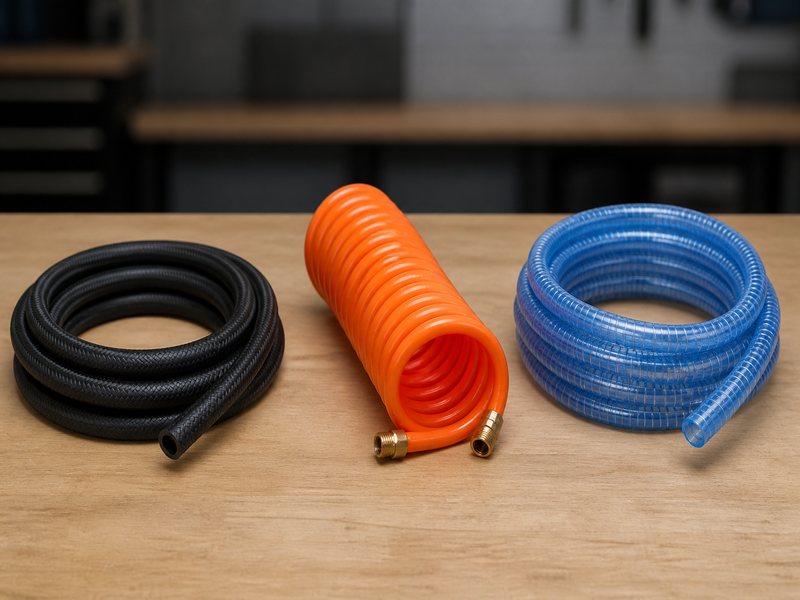
Figure 3. The main types of air hoses: straight, coiled, and reinforced constructions solve different handling problems.
Which type of air hose is best for a workshop?
For a general workshop, a straight 3/8-inch braided hose is the best starting point. It reaches across a bench, stores flat, and handles the pressure and flow that most shop tools need. Add a coiled hose at a fixed station and a reel at the bay where you work most, and you cover the three main working positions. If the shop runs several tools at once, size the main line at 1/2 inch and branch with 3/8-inch drops — the same pattern a workshop manager would specify for a production bay.
Choosing between a straight, coiled, or reinforced hose? Ask where it will spend its working life. Fixed, repetitive work favors a coiled hose or a reel; moving work favors a straight hose of the right length.
When should I use a coiled air hose?
Use a coiled air hose at a fixed workstation where the tool stays near the hose outlet — tire inflation, a bench vise, or an assembly line. The coil retracts out of the way between uses, which keeps the floor clear and the hose out of tool paths. The trade-off is reach: a coiled air hose extends only a fraction of its relaxed length, so it is wrong for moving work.
Textile braid vs wire braid: which reinforcement do you need?
Reinforcement comes in two forms, and the choice changes the hose’s character. Textile braid bends easily and resists flex fatigue, which suits moving tools, coiled hoses, and reels. Wire braid handles higher pressure and mechanical abuse, which suits fixed industrial lines and large diameters. Most consumer hoses use textile braid; specify wire braid when your system exceeds 300 PSI or sees heavy impact.
Air Hose Materials Compared
Material is the biggest single factor in weight, flexibility, durability, and price. The four materials used in the vast majority of hoses are rubber, PVC, polyurethane, and hybrid compounds. The table below summarizes the specifications that matter in practice; typical prices are 2026 retail ranges per foot in the US market.
| Property | Rubber Air Hose | PVC Air Hose | Polyurethane Air Hose | Hybrid Air Hose |
|---|---|---|---|---|
| Weight | Heavy | Light | Light | Medio |
| Flexibility in cold | Excellent (to -40°C / -40°F) | Poor (stiffens below 0°C / 32°F) | Good (to -20°C / -4°F) | Bien |
| Presión de trabajo | 250–500 PSI | 200–300 PSI | 250–300 PSI | 300 PSI |
| Oil and abrasion resistance | Excellent | Medio | Excellent | Medium–Good |
| Service life | Long | Short–Medium | Long | Medio |
| Typical price per ft | $0.60–0.80 | $0.40–0.60 | $0.50–0.70 | $0.50–0.70 |
| Best use | Industrial, all-season, high pressure | Budget home and shop | Constant movement, tight spaces | Everyday all-rounder |
Matching these specs to your compressor and tools? Browse our reinforced air hoses — 200–500 PSI, rubber/PVC/PU/hybrid, factory-crimped brass fittings — or ask our engineers to recommend a specification.
Which air hose material is best for cold weather?
If your compressor sits outdoors and you work in winter, choose rubber. PVC turns board-stiff below 0°C (32°F) and cracks under repeated flex; polyurethane stays workable to about -20°C (-4°F). Rubber keeps its flexibility to roughly -40°C (-40°F), which is why outdoor and truck-mounted hoses are almost always a rubber air hose.
| Ambient temperature | Recommended material |
|---|---|
| Indoor, above 0°C / 32°F | PVC or hybrid |
| Outdoor, 0°C to -20°C / 32°F to -4°F | Polyurethane or rubber |
| Outdoor, below -20°C / -4°F | Rubber (EPDM preferred) |
Below the compound’s limits, a hose that feels fine at room temperature can crack on the first flex of a cold morning — match the material to the coldest month, not the average.
Rubber air hose remains the benchmark for durability. It resists oil, abrasion, ozone, and extreme temperatures, which is why industrial workshops and outdoor job sites still use it. The costs are weight and price. In our 12-month outdoor aging test (1/4-inch samples on a horizontal rack in direct sun, covers inspected monthly), a rubber hose showed no surface cracks, while a PVC air hose on the same rack developed cracks by month nine. If your work is cold, oily, outdoors, or continuous, rubber is the safe default.
Not all rubber is the same. Most rubber hoses use one of two compounds. EPDM (ethylene propylene diene monomer) resists ozone, UV, and weathering best, which is why it is the preferred compound for outdoor and truck-mounted hoses. SBR (styrene-butadiene rubber) offers higher mechanical strength at a lower cost, making it a strong choice for indoor shop duty. A hose marked simply “rubber” is usually SBR — check the cover printing if outdoor life matters to you.
Which air hose is best for constant movement?
When the hose moves constantly — body shops, assembly lines, and mobile service work — a polyurethane air hose is the best choice. It is kink-resistant, highly abrasion-resistant, and coils back without permanent memory. Our testers’ only consistent complaint is a slightly tacky surface feel at low temperatures.
PVC hose dominates the budget end of the market. It is light enough to drag around all day and cheap enough to replace, and it resists water and many chemicals. Its two known weaknesses are cold and sunlight: below about 0°C (32°F) it turns board-stiff, and long UV exposure makes the cover crack. PVC is a reasonable choice for warm, indoor, occasional use.
Hybrid hoses blend a PVC or polyurethane body with rubber-like additives to capture some of rubber’s flexibility at a lower price. It is a decent all-rounder for home garages, but it does not match pure rubber for oil resistance or extreme cold.
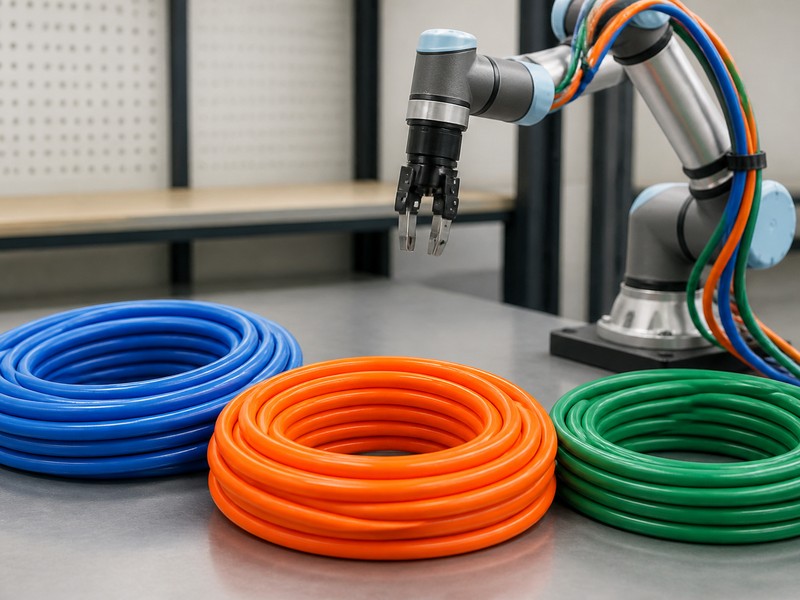
Is there one best air hose material? No. The honest answer is that the best material matches the environment: rubber for cold, oily, or industrial work; PVC for warm indoor budgets; a polyurethane air hose for constant movement; hybrid when you need a compromise. Nylon tubing is a separate category used for small-diameter air lines in automated machinery, where its stiffness and low moisture absorption are advantages. For a deeper comparison of flexible hose materials, see our flexible hose materials guide.
Air Hose Sizes and Fittings
Air hose sizes are defined by inner diameter (I.D.), which controls how much air can flow through the bore. The three standard sizes are 1/4 inch, 3/8 inch, and 1/2 inch. A 1/4-inch hose suits light tools like brad nailers and tire inflators. A 3/8-inch hose is the all-rounder for most workshop tools. A 1/2-inch hose is needed for high-volume tools such as spray guns, sandblasters, and large impact wrenches. In metric markets, polyurethane hose is commonly sold in 6 mm, 8 mm, and 10 mm sizes for push-in fittings.
| Inner Diameter | Typical Flow (SCFM at 90 PSI) | Typical Tools | Max Practical Run |
|---|---|---|---|
| 1/4 inch | 5–10 | Brad nailer, inflator, blow gun | 25 ft |
| 3/8 inch | 10–20 | Impact wrench, ratchet, most shop tools | 50 ft |
| 1/2 inch | 20–35 | Spray gun, sandblaster, die grinder | 100 ft |
What size air hose do I need for a framing nailer?
A framing nailer needs roughly 90 PSI and 4–5 SCFM, which a 3/8-inch hose delivers easily over a 50-foot run. A 1/4-inch hose can also feed it on short runs, but you will notice the tool slow down as the run grows. If the nailer is part of a larger kit with spray guns, step straight to 1/2 inch for the main line.
Every quality hose has its specifications printed on the cover — for example, “3/8 in. I.D. 300 PSI W.P.” — and reading that line before buying prevents most sizing mistakes. Need a custom length or metric bore (6/8/10 mm)? Request a quote and free samples — HENGHUA manufactures 1/4–1/2 inch plus metric sizes with custom fittings.
Air hose fittings come in two families, and the two should not be confused. NPT threaded fittings (usually 1/4-inch NPT, National Pipe Thread) are permanent, leak-tight connections that need PTFE tape on the threads. Quick connect air hose fittings — quick-connect couplers — let you swap tools in seconds and are standard on most consumer hoses; the two common body styles are the automotive A-style and the industrial I/M-style. The plug profile must match your tools, and most couplers are made for one style only, so check before buying. Quick connect fittings also standardize a multi-tool bench: one coupler on the hose, one plug per tool, and every tool swaps in seconds. For thread details and interchangeability, our NPT fittings guide explains the differences.
Fitting material matters as much as the thread. Brass or steel fittings outlast zinc-alloy ends, which corrode and crack faster in wet air. For the strongest connection, buy a hose with factory-crimped fittings rather than clamping fittings on yourself; a crimped joint holds the reinforcement and tube together under full working pressure.
Air Hose vs Water Hose vs Hydraulic Hose: What Is the Difference?
People often ask whether a water hose can carry compressed air, or whether a pneumatic hose can be used for hydraulic oil. The short answer to both is no, and the reason is pressure — specifically, how the hose is built to contain it.
Use only hoses rated and labeled for compressed-air service. An unreinforced water hose cannot contain internal gas pressure and bursts when pressurized — compressed air can balloon and rupture it violently, which is a genuine safety hazard. The reverse also fails: hoses for air systems are not rated for the higher pressures and oil compatibility of hydraulic service. If you are connecting anything to a garden tap, our garden hose fitting sizes guide covers that world separately.
A hydraulic hose carries oil at pressures from 1,000 PSI up to 5,000 PSI or more, using multiple wire braids and oil-resistant compounds. The textile reinforcement and rubber tube of a pneumatic hose are not built for that pressure or that fluid. Air systems, by contrast, rarely exceed 300–500 PSI.
| Tipo de manguera | Typical Working Pressure | Refuerzo | Safe for Compressed Air? |
|---|---|---|---|
| Water / garden hose | 40–100 PSI | Usually none | No — burst hazard |
| Air hose | 100–500 PSI | Textile or wire braid | Yes |
| Hydraulic hose | 1,000–5,000+ PSI | Multiple wire braids | No — not for gas service |
Use each hose only for the fluid and pressure it is rated for. When a label says “air only,” that is a safety instruction, not a suggestion.
Air Hose Working Pressure, Standards, and Inspection
Working pressure is the maximum pressure the hose is rated to carry continuously; burst pressure is where it will fail. Quality manufacturers build compressed-air hoses with a burst rating of roughly 3:1 to 4:1 times the working pressure — a hose rated 300 PSI working pressure is tested to a burst pressure of roughly 900–1,200 PSI. The air hose working pressure printed on the cover must exceed the compressor’s maximum tank pressure, not the regulator setting you normally use.
Reputable hoses are manufactured and tested to recognized industry standards for compressed-air service, such as ISO 2398 for rubber hose, and carry their ratings printed on the cover. When you buy from a manufacturer, ask to see the pressure test data behind those numbers — a printed rating is only as good as the testing that backs it.
How long does an air hose last?
Service life depends more on environment than on age. A rubber hose kept indoors and out of sunlight typically lasts 5–10 years; a PVC air hose in the same duty lasts 2–3 years before the cover stiffens or cracks. UV is the main accelerator: in our 12-month outdoor aging test, PVC cracked at month nine while rubber on the same rack showed no surface damage.
To get the full service life out of any hose, store it out of direct sun, coil it without tight kinks or small-diameter loops, and drain the compressor tank daily so moisture does not sit inside. Abrasion matters as much as sunlight: dragging a hose across concrete wears the cover faster than any other habit, so keep runs elevated or use a hose guide where the floor is rough. Oil and solvent splashes also soften some covers over time, which is why industrial shops wipe hoses down at the end of a shift.
Inspect any hose before use, and at least monthly in continuous service:
- Look for cracks, cuts, or stiff spots in the cover.
- Feel along the length for bulges or soft areas — a bulge means the reinforcement has failed and the hose can burst; replace it immediately.
- Check fittings and crimps for leaks, corrosion, or loose movement.
- Keep the hose out of direct sunlight when stored; UV degrades PVC and some rubber covers.
- Drain the compressor tank daily so moisture does not sit in the hose.
Common Problems and How to Fix Them
Most hose failures are gradual and visible — catch them before they become a burst with the fixes below.
| Problem | Likely Cause | Fix |
|---|---|---|
| Pressure too low at the tool | Hose too long or too narrow | Shorten the run or step up to 3/8 or 1/2 inch |
| Hose kinks in cold weather | PVC below its flexibility limit | Switch to rubber or polyurethane |
| Air leaking at the fitting | Loose connection, worn O-ring | Retighten, replace the O-ring, re-tape threads |
| Cracks on the cover | UV or ozone aging | Store indoors and replace the hose |
| Bulge or soft spot in the wall | Reinforcement failure | Replace immediately — do not repair |
| Fittings corrode or seize | Zinc-alloy ends in wet air | Choose brass or stainless fittings |
The inspection checklist in the previous section pairs with this table — check monthly, and fix early while the problem is still cheap to solve.
Preguntas frecuentes
What is an air hose used for?
It carries compressed air from a compressor to tools and equipment — powering nail guns, impact wrenches, and spray guns, inflating tires, blowing dust, and operating pneumatic cylinders in production lines.
What size air hose do I need?
For most home and workshop tools, a 3/8-inch hose is the safe default. Choose 1/4 inch only for light tools and short runs, and 1/2 inch for high-flow tools like spray guns and sandblasters.
How much pressure can a hose handle?
Check the working pressure printed on the hose cover, not the regulator setting. If it is 300 PSI and your compressor’s maximum tank pressure is 150 PSI, you have a 2:1 margin — the standard safe zone for workshop use. Consumer hoses are typically rated 200–300 PSI; industrial rubber hoses run 300–500 PSI, so a 300 PSI hose covers virtually every workshop application.
Can I use a water hose for compressed air?
Water hoses lack the reinforcement that contains gas pressure, so they burst under compressed air. Use only hoses rated and labeled for compressed-air service.
How long can a hose be?
There is no hard limit, but every extra foot costs pressure. Keep runs under 50 feet for 3/8-inch hose and under 100 feet for 1/2-inch, or expect to raise the compressor’s output to compensate.
How do I repair a damaged air hose?
Repair minor end damage by cutting it out and rejoining with a barbed union and clamps from an air hose repair kit. Replace the hose if it bulges — a bulge means the reinforcement has failed, and no repair restores it.
Which air hose should I buy for my first air compressor in a home garage?
A 3/8-inch, 300 PSI rubber or hybrid hose is the safe default for a first home garage compressor. It handles nearly every tool you are likely to run — nailers, ratchets, inflators — and leaves a comfortable pressure margin even on a 25-foot run.
What should a workshop manager specify for a compressed air system with several workstations?
Run a 1/2-inch main line over long distances, drop 3/8-inch short hoses to each workstation, and add a hose reel where tools are used repeatedly. Match every hose’s working pressure to the compressor’s maximum tank pressure, not the regulator setting.
Is a conductive air hose required for spray painting?
Yes. Spray painting calls for a conductive (antistatic) hose that bleeds static charge to ground, because a static spark can ignite solvent vapor. This service requires a conductive hose rated for spray painting.
Scope of this guide: The specifications and recommendations in this guide cover consumer and light-industrial hoses in 1/4–1/2 inch (about 6–13 mm) bores at up to 500 PSI. High-pressure industrial pneumatic systems above 500 PSI should be specified to the corresponding ISO 2398 / ISO 5774 grades; the data in this guide does not apply there.

About HENGHUA: Built to the Ratings We Print
HENGHUA is a manufacturer of reinforced air hoses and industrial hose assemblies, and the figures in this guide — pressure ratings, temperature ranges, flow data, and aging behavior — come from our own compounding and quality-control records. Every HENGHUA hose is built with a high-tensile textile reinforcement layer and an abrasion- and oil-resistant cover, rated 200–500 PSI with factory-crimped brass fittings as standard. We manufacture the full size range — 1/4, 3/8, and 1/2 inch, plus metric bores — in rubber, PVC, polyurethane, and hybrid constructions, and we pressure-test every production batch before it ships.
Because we control the process from compound mixing to final testing, we can publish the real ratings behind each hose and stand behind them with a clear warranty. If you are sourcing hoses for retail, distribution, or industrial use — or simply want to verify a specification before you buy — contact our engineering team for a quote and free samples, usually within one business day. Tell us your working pressure, temperature range, and tools, and we will recommend the right air hose specification for your market.
Written by the HENGHUA engineering team, with input from workshop users across the US and Europe. HENGHUA manufactures reinforced hoses and industrial hose assemblies in sizes from 1/4 inch to 1/2 inch, rated 200–500 PSI, with custom lengths, fittings, and OEM branding available.

 English
  Spanish
  Portuguese
  French
  German