
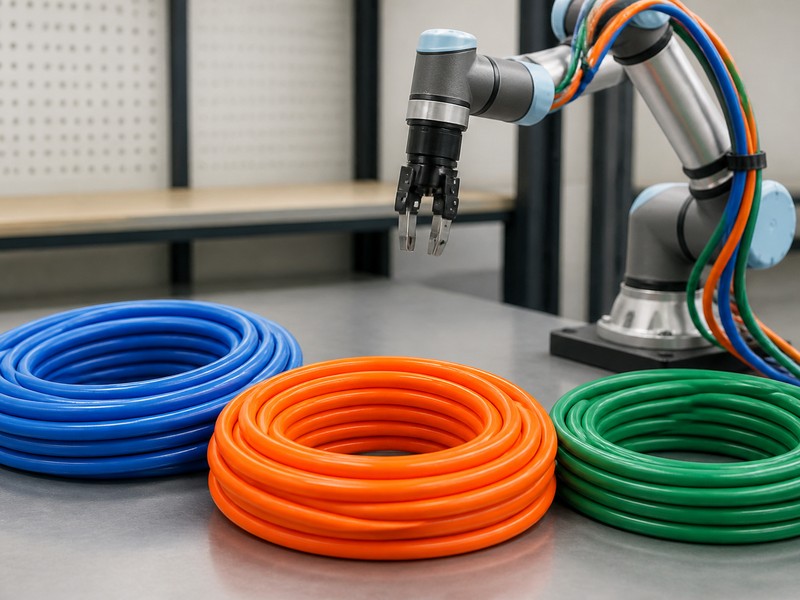
A thermoplastic fuel hose is a lightweight alternative to rubber for oil and fuel lines: instead of a rubber tube wrapped in steel wire, it uses a polymer tube, synthetic-fibre reinforcement, and a polyurethane cover, which cuts weight by roughly 30-50% at an equivalent pressure rating. The savings show up where rubber is weakest: tight routing, moving machine parts, UV and ozone exposure, and daily handling of long lines. This guide compares thermoplastic and rubber constructions fairly, lists the sizes and pressure ratings you can actually order, explains which fuels and oils each tube polymer tolerates, and finishes with a step-by-step selection method and practical buying notes.
What Is a Thermoplastic Fuel Hose?
A thermoplastic fuel hose is a hose whose tube, reinforcement, and cover are all made from thermoplastic polymers rather than cured rubber. The tube is extruded from a polymer such as polyamide (nylon 11 or 12) or thermoplastic polyurethane (TPU), the reinforcement is one or two braids of high-tenacity synthetic fibre instead of steel wire, and the cover is an abrasion- and weather-resistant polyurethane or polyester compound. Because the materials are melted and re-formed rather than vulcanised, production is continuous, tolerances are tight, and the bore stays smooth and pinhole-free.
The same construction family is sold under several names. You will see it as a thermoplastic oil hose for hydraulic, lubrication, and oil-return circuits, and as a nylon fuel hose in vehicle fuel systems, where nylon 12 is a standard automotive material. Whatever the name, the anatomy is the same:
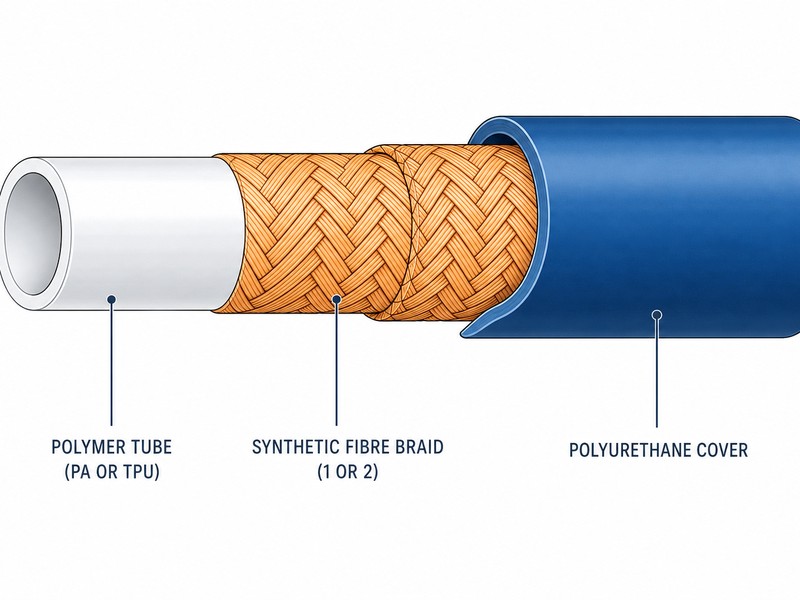
Figure 1. A thermoplastic hose is a tube-reinforcement-cover assembly; the fibre braid is what carries the pressure.
Thermoplastic hose construction, layer by layer
| Layer | Typical material | Job |
|---|---|---|
| Tube | Polyamide (nylon 11/12) or thermoplastic polyurethane (TPU) | Carries the oil or fuel; sets the chemical compatibility |
| Refuerzo | 1 braid (SAE 100R7) or 2 braids (SAE 100R8) of synthetic fibre | Carries pressure with far less weight than steel wire |
| Cover | Polyurethane (PU) or polyester | Protects against abrasion, oil splash, ozone, and UV |
Three practical details separate good thermoplastic hose from cheap tubing. First, the cover is often pin-pricked with micro-holes to vent gas that permeates the tube, which prevents blistering between layers — those tiny holes are a design feature, not damage. Second, covers come in blue, green, orange, and yellow for circuit colour-coding. Third, standard thermoplastic hose is electrically non-conductive, a property we return to in the safety section below.
For a structured comparison of the wider material families — rubber, PVC, polyurethane, and nylon — see our flexible hose materials guide.
How Much Lighter Is a Thermoplastic Hose Than Rubber?
Weight is the reason this product family exists, so it deserves its own section. The difference comes from materials, not marketing: a typical rubber compound has a density around 1.3-1.5 g/cm³, nylon and TPU sit near 1.1-1.2 g/cm³, and steel reinforcement wire is 7.8 g/cm³. Replace the rubber with polymer and the wire braid with synthetic fibre, and the finished hose is typically 30-50% lighter at the same working pressure.
Real numbers make the point. HENGHUA’s published SAE 100R8 data lists 1/4 in (6.3 mm) hose at about 0.097 kg/m and 3/4 in (19 mm) at about 0.360 kg/m — roughly one-third to one-half the mass of an equivalent wire-braided rubber hose. On a machine with 50 metres of hose, that difference is 10-20 kg of dead weight removed from booms, arms, and sprung masses.

Figure 2. At the same size and pressure rating, the fibre-reinforced construction weighs a fraction of the wire-reinforced one.
Weight is not the only handling advantage. Fibre reinforcement does not work-harden the way wire does under repeated flexing, so thermoplastic hose bends with noticeably less force and shows less springback in tight routes. Marketing sheets often claim 30-50% tighter minimum bend radii than rubber; in our test bench the advantage varied by size and construction, so verify the minimum bend radius on the exact datasheet before you route to a tight corner. Fibre hoses can kink if forced below their published radius, and a kink is permanent damage.
Thermoplastic Hose vs Rubber Hose: Where Each Construction Wins
When engineers compare thermoplastic hose vs rubber hose for oil and fuel service, four factors decide the argument: weight and routing, fluid temperature, pressure ceiling, and how the line is used. The table below summarises the honest differences.
Thermoplastic vs rubber hose for oil and fuel lines at a glance
| Property | Thermoplastic (R7/R8 class) | Rubber (wire-braid class) |
|---|---|---|
| Typical weight | 30-50% lighter at equal pressure | Heavier; steel wire dominates mass |
| Presión de trabajo | R7 medium to ~3,000 psi; R8 to ~5,000 psi | 1,000-6,000 psi across R1-R15 classes |
| Continuous temperature | Typically -40°C to +93°C (+100°C short-term) | Often -40°C to +100/121°C in high-temp compounds |
| Abrasion resistance | High; smooth PU cover | Good; thicker covers available |
| UV / ozone / weathering | Excellent; polymer resists ozone cracking | Good only with CR/EPDM cover compounds |
| Flexing fatigue | Excellent; no wire fatigue under flex | Good, but wire braid fatigues with flex cycles |
| Electrical behaviour | Non-conductive (by design) | Conductive or non-conductive options |
| Cost per metre | Moderate; competitive at volume | Low to moderate depending on class |
When rubber still wins. Be direct about the limits. For fluid continuously above roughly +100°C, or near flame and hot surfaces, a high-temperature rubber construction with the right cover is usually the safer answer. For suction and bulk oil transfer, where the hose must hold full vacuum and dissipate static charge, use a rubber oil suction and discharge (OS&D) hose — a thermoplastic hose has no vacuum rating and is not static-dissipative. And if the line carries constant oil splash in a hot environment, a purpose-built rubber oil resistant hose with a thick chloroprene cover may outlast a polymer cover. In short, thermoplastic does not replace the whole rubber catalogue; it replaces the hoses that flex, move, and carry their own weight.
When thermoplastic wins. Weight-critical machines (robotic arms, aerial platforms, agricultural booms), constant-flex circuits, outdoor UV and ozone exposure, chemical washdowns, and applications that need electrical isolation are where the polymer construction earns its keep. For oil return lines, pilot lines, and medium-pressure hydraulics, a thermoplastic oil hose typically wins on weight and service life; for fuel feed and return lines it removes kilograms from vehicles that carry the hose around all day.
Can a Thermoplastic Fuel Hose Carry Gasoline, Diesel, and Hydraulic Oil?
Short answer: yes for most petroleum products, with one honest caveat — compatibility is set by the tube polymer, and no single hose handles everything. Nylon 12 tubes resist gasoline, diesel, and biodiesel well, which is why nylon fuel hose is standard in vehicle fuel systems. TPU tubes resist mineral oils, greases, and diesel superbly and are common in small-engine fuel lines. Polyester tubes sit between the two and are valued for hydrolysis resistance in warm, humid service. Match the polymer to the fluid before you match the price.
Tube polymer compatibility for common fluids (planning guide — confirm on the datasheet)
| Fluid | Polyamide (nylon 11/12) | Thermoplastic polyurethane (TPU) |
|---|---|---|
| Gasoline | Excellent (low-pressure fuel-line grades) | Good (small-engine fuel lines) |
| Diesel / biodiesel | Excellent | Excellent |
| Mineral hydraulic oil | Excellent | Excellent |
| Synthetic esters / phosphate esters | Bien | Limited — check compound |
| Lubricating oil and grease | Excellent | Excellent |
| Water-glycol | Bien | Bien |
| LPG / compressed gases | Not rated — use a certified gas hose | Not rated — use a certified gas hose |
Two warnings belong next to that table. First, high-pressure fibre-reinforced hoses (SAE 100R7/R8) handle mineral oil — the classic thermoplastic oil hose duty — and, within their temperature window, diesel; most manufacturers do not recommend them for gasoline service, because fuel permeation and hot soak can soften the tube at high pressure. For gasoline duty, choose a low-pressure thermoplastic fuel line hose (nylon or TPU) designed for it. Second, always confirm that the continuous fluid temperature sits inside the hose rating — typically -40°C to +93°C — especially on hot diesel return lines near an engine.
Static electricity deserves its own note. Standard thermoplastic hose is non-conductive, which is a genuine safety feature in mining and electrical work where an accidental conductor is the hazard. But non-conductive is the opposite of what a fuel transfer line needs: flowing fuel generates static, and a non-conductive hose cannot drain it. For dispensing or bulk fuel transfer, use a conductive or static-dissipative rubber hose with bonded fittings and grounding, following the established practice behind NFPA 77 and API RP 2003 — our oil transfer hose guide details the suction-and-discharge constructions. Our hydraulic fluid compatibility guide covers the matching rules for rubber inner tubes in more depth.
Thermoplastic Fuel Hose Sizes and Pressure Ratings: SAE 100R7 vs 100R8
The two industrial grades you will order against are SAE 100R7 and SAE 100R8, both defined by SAE International in J517 and mirrored internationally by ISO 3949. R7 uses a single synthetic-fibre braid and covers medium pressure — roughly 1,000-3,000 psi depending on size. R8 uses two braids and reaches higher pressure, up to about 5,000 psi on small bores. Both share the polymer tube and PU cover, both are non-conductive, and both are impulse-tested for dynamic service. The R8 size table below is production data from HENGHUA’s published datasheet.
SAE 100R8 thermoplastic hose — HENGHUA production data (size, pressure, weight)
| Hose code | Size (ID) | Dash | Working pressure (MPa / psi) | Min burst (MPa / psi) | Min bend radius (mm) | Weight (kg/m) |
|---|---|---|---|---|---|---|
| SAE100R8-01 | 5 mm (3/16 in) | -3 | 35 / 5,075 | 140 / 20,300 | 90 | 0.086 |
| SAE100R8-02 | 6.3 mm (1/4 in) | -4 | 35 / 5,075 | 140 / 20,300 | 100 | 0.097 |
| SAE100R8-03 | 10 mm (3/8 in) | -6 | 28 / 4,060 | 112 / 16,240 | 125 | 0.178 |
| SAE100R8-04 | 12.8 mm (1/2 in) | -8 | 24.5 / 3,550 | 98 / 14,210 | 180 | 0.215 |
| SAE100R8-05 | 16 mm (5/8 in) | -10 | 19.2 / 2,780 | 77 / 11,165 | 205 | 0.312 |
| SAE100R8-06 | 19 mm (3/4 in) | -12 | 15.7 / 2,275 | 63 / 9,135 | 240 | 0.360 |
| SAE100R8-07 | 25 mm (1 in) | -16 | 14 / 2,030 | 56 / 8,120 | 300 | 0.505 |
Burst pressure is at least four times working pressure, which is the 4:1 safety factor the SAE specification requires. Dynamic ratings matter too: R8-class hose must survive hundreds of thousands of impulse cycles at 133% of working pressure while the fluid is held near maximum temperature; HENGHUA publishes 200,000+ cycles across its thermoplastic range. For vehicle fuel plumbing at low pressure, the relevant reference is the polyamide fuel-line standard DIN 73379, which covers nylon hose for fuel and oil lines — a different, lower-pressure product family from the hydraulic R7/R8 grades above. When in doubt, read the layline: the printed standard and size on the hose cover tell you exactly what you are holding.
Where Are Thermoplastic Oil and Fuel Hoses Used?
The machines that benefit most are the ones that move, vibrate, or carry their own hose around all day. Applications cluster into a few repeatable jobs:

Figure 3. Thermoplastic hoses colour-coded by circuit on mobile equipment — the light harness saves weight on every boom and arm.
- Agricultural equipment. Sprayer booms and tractor plumbing are the classic retrofit. OEMs replace wire-braided rubber return lines with R7 hose to cut harness weight and install time; diesel fuel feed and return lines on tractors and harvesters are the textbook thermoplastic fuel line duty. Chemical resistance of the PU cover survives washdowns that attack rubber covers.
- Construction and mining machinery. Pilot lines, brake lines on rock drills, and non-conductive circuits on roof bolters and bolter miners, where electrical isolation is a safety requirement. Weight saving on booms and dippers reduces counterweight demand and fuel burn.
- Robotics and factory automation. Constant-flex circuits on robotic arms punish wire reinforcement; fibre braids do not work-harden, so flex life is the selling point. Machine-tool lubrication and oil-return lines are straightforward, low-risk conversions.
- Marine and offshore. Salt air attacks steel wire over time; a fibre-reinforced construction removes the corrosion path entirely. Steering and deck machinery circuits are common fits.
- Small engines and gensets. TPU fuel lines are standard on chainsaws, generators, and pumps, where kink resistance and fuel compatibility matter more than pressure.
The honest counter-list is short but important. Do not use a thermoplastic hose for suction service, bulk fuel transfer, or any line that must hold full vacuum — that is OS&D territory. Do not use a non-conductive hose where static-dissipative construction is mandated. If the duty is heavy oil splash at high temperature in a fixed plant, a rubber oil resistant hose with a thick cover remains the standard choice. In our work with agricultural OEMs, the pattern is consistent: thermoplastic earns its place on anything that articulates, while rubber keeps the static, suction, and high-heat duties.
How to Choose the Right Thermoplastic Fuel Hose for Your Application
Selection is a six-step sequence. Work through it in order and you will not need to re-specify the hose later.
Step 1. Identify the fluid and its temperature. Confirm the tube polymer against the fluid — nylon for gasoline-family fuels, TPU or nylon for diesel and oils — and check the continuous temperature of the fluid, not just the ambient air. If the line is a fuel line on a road vehicle, also check evaporative-emission (permeation) rules such as CARB or EPA requirements; only a hose certified for that duty is legal there.
Step 2. Set the working pressure. Read the maximum system pressure including spikes, not the pump’s nameplate. Choose a hose whose working pressure exceeds the worst case, remembering that burst is four times working pressure and that pressure spikes above rating accumulate damage even when brief.
Step 3. Choose the size. Size is inner diameter, expressed in millimetres or dash numbers (-3 through -16 in the R8 table above). Match the ID to the flow and the port, not to the outer diameter of the old hose. For return and drain lines, keep flow velocity moderate so pressure drop and heat stay low.
Step 4. Plan the routing. Compare the minimum bend radius with every corner of the route, and allow extra length where the hose moves with a cylinder or arm. This is also where the weight calculation pays: on a boom or robotic axis, each kilogram of hose removed is a kilogram of counterweight and energy saved.
Step 5. Match the fittings. Thermoplastic hose needs fittings and ferrules designed for its construction — a wire-braid ferrule profile is wrong for a fibre-braid hose. Choose crimped for factory assemblies or reusable for field repair, and match the thread family (JIC, BSP, NPT, metric) to the existing ports.
Step 6. Verify standards and test evidence. Ask for the standard (SAE 100R7/R8 or ISO 3949), the test report, and the date code. A manufacturer that cannot show impulse and burst data for the batch is selling you tubing, not hose.
Use this checklist when you compare quotes:
- Tube polymer verified against the fluid and temperature?
- Working pressure covers the worst-case spike, with 4:1 burst margin?
- ID sized to flow, not to the old hose OD?
- Minimum bend radius fits every corner of the route?
- Fittings and ferrules specific to the hose construction?
- Standard and batch test report available?
- Permeation and static requirements checked for the duty?
- Continuous service temperature inside the rating?
What Fittings and Assembly Do Thermoplastic Hoses Need?
Fitting practice is where most field failures start, and thermoplastic hose is less forgiving than rubber. Because the reinforcement is fibre, the ferrule must grip a softer, thinner structure; use the fitting family designed for the specific hose series. Factory crimped assemblies are the reliable default: the crimp diameter is controlled, the insertion depth is verified, and the assembly is proof-tested. Reusable fittings exist for R7/R8 and are useful for field repair, but they must be the correct profile — never reuse a rubber-hose fitting on a thermoplastic hose.
Two installation details surprise first-time users. First, do not skive the cover unless the fitting instructions say so; most thermoplastic fittings are designed no-skive. Second, the pin-pricked holes on the cover are intentional vents for gas that permeates the tube — do not treat them as damage, and never let paint or sealant block them. On thread selection, the same rules as rubber hose apply: identify the port thread before ordering (JIC and BSP look alike to the eye), and keep the two families separate in one system. Our hydraulic hose couplings guide covers the connector families and their pressure ratings in full.
How Much Does Thermoplastic Hose Cost? (Price, MOQ, Lead Time)
Price is where buyers make the mistake of comparing only the unit price. As a 2026 planning benchmark in USD, fibre-reinforced thermoplastic hose typically runs roughly $1-$4 per metre for small R7 sizes, $3-$8 per metre for mid-size R8, plus fittings at $3-$15 each depending on size and material — and consumer nylon or TPU fuel line sells for $1-$3 per foot in retail rolls. Treat these as planning ranges, not quotes: confirm with the supplier because currency, volume, and specification move them.
When you compare thermoplastic hose vs rubber hose on price alone, the polymer product can look similar or slightly higher per metre. The total-cost case is different: lighter hose means lower freight and easier handling, longer flex life means fewer replacements on moving equipment, and resistance to ozone and UV removes the “hard cover after two summers” failure mode entirely. A 20% higher unit price routinely pays for itself inside one maintenance cycle on articulated equipment.
Buying direct changes the arithmetic again. Factory-direct manufacturers typically undercut distributor prices by 20-40% on equivalent specification, which is why volume buyers request manufacturer quotes. Ask for the MOQ per size (commonly one production roll or a few hundred metres for standard sizes), the lead time for standard and custom lengths, sample policy, and the warranty in writing before you commit. One procurement detail: thermoplastic hose classifies under HS heading 3917 (plastic hose), commonly 3917.31 or 3917.39 depending on construction, which is different from rubber hose under heading 4009 — confirm the exact code with your broker, because it changes duty treatment.
Thermoplastic Oil and Fuel Hose FAQ
What is a thermoplastic fuel hose made of?
It has three layers: a tube of polyamide (nylon 11 or 12) or thermoplastic polyurethane, a reinforcement of one or two synthetic-fibre braids, and a polyurethane or polyester cover. The materials are extruded and heat-formed rather than vulcanised like rubber, which gives a smooth bore, tight tolerances, and a lighter finished product. A nylon fuel hose for vehicle fuel systems and a TPU small-engine fuel line are both members of this family.
Can you use rubber hose for a fuel line?
Yes, rubber fuel hose is common in low-pressure fuel systems, and it remains the right choice for many applications. But where weight, ozone resistance, and long-term fuel compatibility matter, a thermoplastic fuel line usually outperforms it: nylon and TPU tubes resist fuel swelling better than many rubber compounds, and the polymer cover does not crack under UV the way rubber covers can. Match the hose to the fuel, the pressure, and — on road vehicles — the permeation rules.
Is a thermoplastic hose oil resistant?
Yes. TPU and polyamide tubes rate excellent against mineral oils, lubricating oil, grease, and diesel, which is why thermoplastic hose is widely used for hydraulic oil return lines and lubrication circuits. The one caution is fluid temperature: oil resistance ratings assume the fluid stays inside the hose’s continuous temperature window, typically -40°C to +93°C. Above that window, a rubber oil resistant hose with a high-temperature compound is the safer specification.
What is the difference between SAE 100R7 and SAE 100R8?
Both are thermoplastic hydraulic hose grades in SAE J517, mirrored by ISO 3949. R7 has a single synthetic-fibre braid and covers medium pressure, roughly 1,000-3,000 psi depending on size. R8 has two fibre braids and reaches higher pressure, up to about 5,000 psi on small bores. R8 is also tested to a higher impulse standard, so it is the default for high-pressure dynamic circuits; R7 suits return lines, pilot lines, and medium-pressure duties where weight matters more than pressure ceiling.
How long does a thermoplastic hose last in fuel service?
In clean, correctly rated service, thermoplastic hose typically outlasts rubber in the same position because it does not suffer ozone cracking or wire fatigue. Ten-plus years is realistic for indoor and sheltered lines; outdoor service shortens that depending on UV and abrasion. There is no universal lifetime — inspect at every maintenance interval for cover cuts, kinks, leaks at the fittings, and hardening, and replace on those signs regardless of age.
Is thermoplastic hose conductive?
Standard SAE 100R7/R8 thermoplastic hose is non-conductive by design, which is an advantage where electrical isolation is required, such as mining and electrical equipment. It is the opposite of what fuel transfer needs: a non-conductive hose cannot drain static charge from flowing fuel. For dispensing or bulk fuel transfer, use a conductive or static-dissipative rubber hose with bonded fittings and grounding rather than a standard thermoplastic hose.
Can a thermoplastic hose handle high-pressure hydraulic oil?
Yes. R8-class thermoplastic hose is rated up to about 5,000 psi (35 MPa) on small bores with a 4:1 burst margin, and it carries mineral hydraulic oils, synthetic esters, and water-glycol fluids within its temperature window. It is a legitimate substitute for wire-braided rubber in many high-pressure circuits where weight, flex life, or non-conductive behaviour is the deciding factor. Confirm the specific fluid and temperature against the datasheet before substituting.
Final Verdict: When Should You Switch to a Lightweight Thermoplastic Fuel Hose?
Switch when the line moves, the weight is carried by the machine, the environment attacks rubber, or the circuit needs electrical isolation — and the fluid and temperature sit inside the ratings. Stay with rubber when the duty is sustained heat above about +100°C, suction or bulk fuel transfer, or ultra-high-pressure spiral service beyond the R8 ceiling. For the majority of oil and fuel lines on modern mobile equipment, the thermoplastic construction delivers the same pressure with less weight, tighter routing, and a longer life outdoors, which is exactly what the name promises: a lightweight alternative.
HENGHUA manufactures SAE 100R7 and SAE 100R8 thermoplastic hoses in 3-25 mm (3/16-1 in) inner diameters with working pressures up to 35 MPa, a 4:1 burst ratio, and a -40°C to +100°C range, in standard and custom colours, with matching ferrules, fittings, and factory crimped assemblies. If you are comparing thermoplastic against rubber for a specific machine or fuel system, send us the fluid, pressure, and routing sketch — our engineers will confirm the right thermoplastic fuel hose for the job and quote within one working day. Request a quote and free samples, or browse the thermoplastic hydraulic hose range.
This guide was prepared by the HENGHUA Engineering Team, the application engineers behind the HENGHUA thermoplastic hydraulic hose range. Specification figures are drawn from HENGHUA production datasheets and from public industry standards including SAE J517, ISO 3949, and DIN 73379; confirm final ratings against the datasheet of the exact hose you order.


 English
  Spanish
  Portuguese
  French
  German