
Why This Metric Male 74° Cone to BSPT Adapter Passes the Compliance Gate
One end of this fitting seals on a wide metal cone and the other seals on a tapered thread — two completely different principles in the same body, and both have to be right. Every 1QT-SP metric male 74° cone to BSPT adapter is produced with the metric cone cut in the same setup as its thread, the cone measured for included angle and seat diameter on a profile projector, and the BSPT (R) thread formed to ISO 7-1 and verified with go / no-go plug gauges on 100% of production. Threads that fail the gauge are rejected, not reworked, because a re-cut taper thread cannot be brought back to the gauge line.
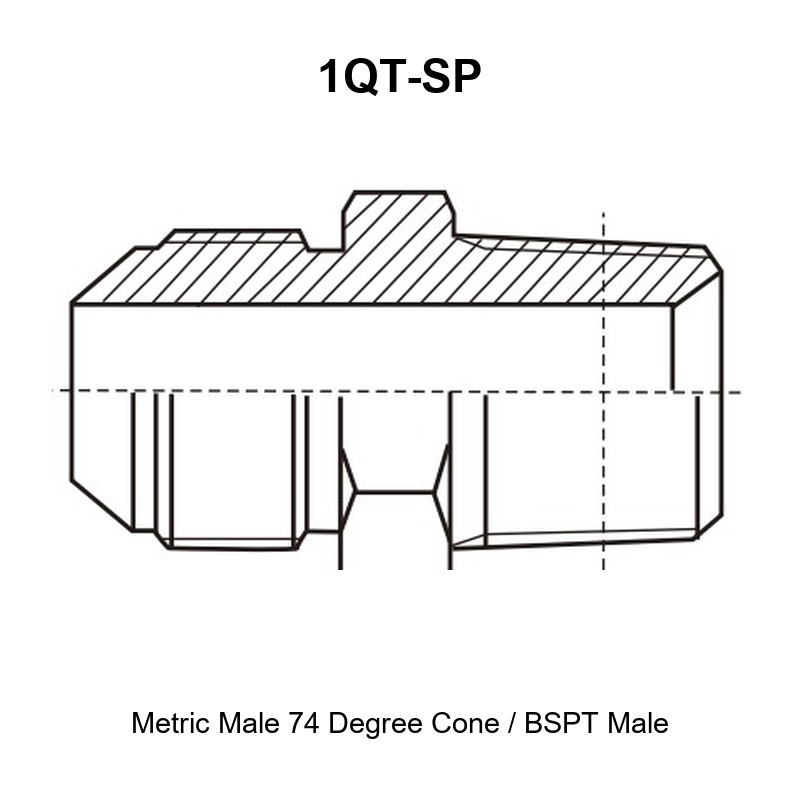
The adapter converts a metric male 74° cone connection into a BSPT male — R thread to ISO 7-1 / GB/T 7306 — and is supplied with the metric end ready for a sleeve and nut connection.
Ventajas principales
- Direct conversion, one joint saved. A 74° cone tube run goes straight into a tapered BSPT port without a nipple and a second connection.
- Gauged taper thread. The R thread is formed to full depth with a controlled 1:16 taper, so it reaches interference in two to three turns rather than depending on sealant to fill a loose fit.
- Low profile. The BSPT end is short and the body hex is sized to the metric side, so the fitting stays compact in a port cluster.
- Wide size range. Tube 5 mm to 34 mm, from R1/4″ up to R1-1/4″.
- Complete-set option. The catalogue notes state that adding the suffix /RN supplies the metric end as a set with cutting ring and nut (sleeve NB500-Q, nut NB200-Q).
Especificaciones técnicas
What Is a 74° Cone to BSPT Adapter?
It is a straight adapter with a metric male 74° cone on one side and a BSPT male tapered thread on the other. The 74° cone seals on a wide metal cone face; the BSPT end screws into a tapered port and seals by interference between the two tapered threads, with the help of a thread sealant. It is the standard interface where a 74° cone tube run has to terminate in an R-ported component.
Cone Geometry — 74°, 60° and 37° Are Not Interchangeable
The tube-side end is a metric 74° cone. It does not interchange with the other two systems in common use:
| System | Included angle | Typical thread | Sealing location |
|---|---|---|---|
| Metric 74° cone (this family) | 74° | Metric | On the 74° cone face |
| 60° cone (DIN 3861 / ISO 1179) | 60° | BSP parallel (G) | On the 60° cone face |
| 37° flare (JIC, SAE J514) | 37° | UNF | On the 37° flare face |
| Metric 24° cone (DIN 2353) | 24° | Metric | On the 24° cone face |
Different included angles put the contact band at a different diameter and a different axial position. A mismatched pair makes edge or line contact, passes a cold static test and weeps when the system reaches temperature. Confirm the seat on both halves of every joint.
Tapered Threads — BSPT, BSPP and NPT
The port side is BSPT, which is a tapered thread. Three thread systems are routinely confused:
| Thread | Angle | Form | Sealing |
|---|---|---|---|
| BSPT (R, ISO 7-1) | 55° | Taper 1:16 | On the thread, with sealant |
| BSPP (G, ISO 228) | 55° | Parallel | On a 60° cone or a bonded washer, never on the thread |
| NPT (ANSI B1.20.1) | 60° | Taper 1:16 | On the thread, with sealant |
BSPT and NPT will start into each other because the taper is the same, but the 55° and 60° flank angles differ and the joint will not seal reliably — and forcing it can split a cast-iron or aluminium port boss. A parallel G thread in a tapered R port has no interference at all and cannot seal. The threads per inch are a quick sanity check on the port you are holding: 28 TPI at R1/8″, 19 TPI at R1/4″ and R3/8″, 14 TPI at R1/2″ and R3/4″, and 11 TPI at R1″ and above.
Dimensional Data
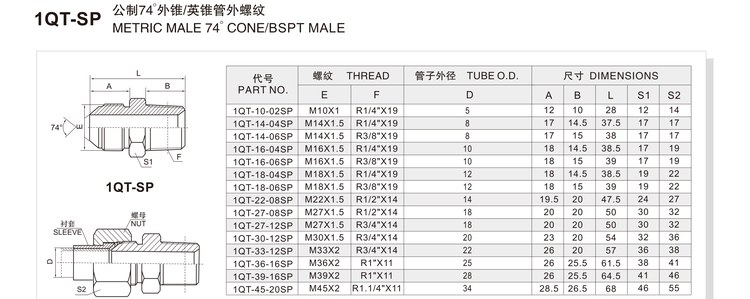
In the drawing, E is the metric thread of the 74° cone end, F the BSPT (R) thread of the port end, D the tube outside diameter, A the length of the cone end from the hex to its face, B the length of the BSPT end from the hex to its face, L the overall length, and S1, S2 the across-flats hexes of the body and the port end.
B is the dimension that governs assembly: it must allow the required number of turns of thread engagement before the hex approaches the port face. On a shallow casting boss, a long B will bottom out early; on a deep boss, a short B can leave the threads short of full engagement. Check B against the port, not against the old fitting.
Full Dimension Table (Part Number Matrix)
Values as published in the HENGHUA catalogue drawing. Dimensions in millimetres.
| PART NO. | E — 74° cone end | F — BSPT (R) thread | D | A | B | L | S1 | S2 |
|---|---|---|---|---|---|---|---|---|
| 1QT-10-02SP | M10×1 | R1/4″×19 [to be confirmed] | 5 | 12 | 10 | 28 | 12 | 14 |
| 1QT-14-04SP | M14×1.5 | R1/4″×19 | 8 | 17 | 14.5 | 37.5 | 17 | 17 |
| 1QT-14-06SP | M14×1.5 | R3/8″×19 | 8 | 17 | 15 | 38 | 17 | 17 |
| 1QT-16-04SP | M16×1.5 | R1/4″×19 | 10 | 18 | 14.5 | 38.5 | 17 | 19 |
| 1QT-16-06SP | M16×1.5 | R3/8″×19 | 10 | 18 | 15 | 39 | 17 | 19 |
| 1QT-18-04SP | M18×1.5 | R1/4″×19 | 12 | 18 | 14.5 | 38.5 | 19 | 22 |
| 1QT-18-06SP | M18×1.5 | R3/8″×19 | 12 | 18 | 15 | 39 | 19 | 22 |
| 1QT-22-08SP | M22×1.5 | R1/2″×14 | 14 | 19.5 | 20 | 47.5 | 24 | 27 |
| 1QT-27-08SP | M27×1.5 | R1/2″×14 | 18 | 20 | 20 | 50 | 30 | 32 |
| 1QT-27-12SP | M27×1.5 | R3/4″×14 | 18 | 20 | 20 | 50 | 30 | 32 |
| 1QT-30-12SP | M30×1.5 | R3/4″×14 | 20 | 23 | 20 | 54 | 32 | 36 |
| 1QT-33-12SP | M33×2 | R3/4″×14 | 22 | 26 | 20 | 57 | 36 | 38 |
| 1QT-36-16SP | M36×2 | R1″×11 | 25 | 26 | 25.5 | 61.5 | 38 | 41 |
| 1QT-39-16SP | M39×2 | R1″×11 | 28 | 26 | 25.5 | 64.5 | 41 | 46 |
| 1QT-45-20SP | M45×2 | R1.1/4″×11 | 34 | 28.5 | 26.5 | 68 | 46 | 55 |
[to be confirmed]: the F thread printed against 1QT-10-02SP reads R1/4″×19 in the catalogue scan, while the “-02″ suffix normally denotes R1/8”. Confirm this row against the drawing before ordering.
Thread Size and Dash Chart
| Tube O.D. | 74° cone end (E) | BSPT port options (F) |
|---|---|---|
| 5 mm | M10×1 | R1/4″×19 [to be confirmed] |
| 8 mm | M14×1.5 | R1/4″×19 · R3/8″×19 |
| 10 mm | M16×1.5 | R1/4″×19 · R3/8″×19 |
| 12 mm | M18×1.5 | R1/4″×19 · R3/8″×19 |
| 14 mm | M22×1.5 | R1/2″×14 |
| 18 mm | M27×1.5 | R1/2″×14 · R3/4″×14 |
| 20 mm | M30×1.5 | R3/4″×14 |
| 22 mm | M33×2 | R3/4″×14 |
| 25 mm | M36×2 | R1″×11 |
| 28 mm | M39×2 | R1″×11 |
| 34 mm | M45×2 | R1.1/4″×11 |
Material y tratamiento térmico
Carbon steel bodies, machined from bar or forged, hardened according to pressure class and plated in trivalent chromium or zinc-nickel. Plating thickness on the BSPT thread is controlled so that gauge fit is not lost — an over-plated taper thread will not enter the port. Stainless 304 / 316L is available to order.
Working Pressure and Operating Envelope
The 74° cone end is rated with its sleeve and nut assembly. The BSPT end is rated by the housing that contains the port: a tapered thread concentrates load at the port boss, and the casting — not the fitting — is very often the limiting part. A 4:1 burst ratio is typical of the steel body.
Rango de temperatura
−40 °C to +120 °C with standard sealants and NBR components; up to +200 °C with FKM and a high-temperature thread sealant. The steel joint itself is not the limiting factor.
Cómo interpretar la tabla de referencias
1QT-16-06SP reads: family 1QT-SP (metric 74° cone to BSPT male), 16 = the 74° cone end for 10 mm tube / M16×1.5, and 06SP = the BSPT port size R3/8″. The suffix “SP” identifies the BSPT male end in this catalogue, and the two numbers always describe the cone side first and the port side second. Add /RN to receive the cone end as a complete set with cutting ring and nut.
Selección y pedido
Selection Checklist / Decision Table
| Requirement | Choose |
|---|---|
| 74° cone tube run into a tapered R port | This family |
| Port is BSPP (G) parallel with a 60° cone | BSP 60° cone family |
| Port is NPT | NPT family — do not substitute BSPT |
| Port is a metric O-ring port | 1QH (ISO 6149-3) family |
| Port has a flat face and no groove | 1QL (bonded seal) family |
| Cone end needs sleeve and nut | Add suffix /RN |
Servicio de referencias cruzadas
Send the port callout, the tube OD, the OEM part number or a photograph of the port thread. We verify R against G against NPT, confirm the TPI, and return a mapped part number with the A, B and L dimensions filled in.
Embalaje y logística
Thread protectors on both ends, plastic bag, carton and pallet; certificates and gauge records referenced to the heat number. Air, sea and express shipping available.
Installation and Fitment Guide
Step-by-Step Assembly
- Confirm the port is a tapered R thread and that the TPI matches (28 / 19 / 14 / 11). A G port needs a different fitting.
- Clean both threads and inspect the port for cracks, previous over-torque and debris.
- Confirm the tube side is a 74° cone — not 60° or 37°.
- Apply a compatible thread sealant to the BSPT thread: PTFE tape wound in the direction of the thread, or an anaerobic pipe sealant. Keep the first thread clean so nothing enters the circuit.
- Hand-start the BSPT end and turn it in until it seats by hand — typically two to three turns.
- Snug it with the S2 hex. The taper does the sealing; extra force only loads the port boss.
- Assemble the 74° cone end with its sleeve and nut, holding the body with S1 so the BSPT joint is not disturbed.
- Re-check after the first thermal cycle.
Torque and Sealing Notes
The BSPT joint is a taper interference joint — the metal flanks must meet, and the sealant fills the helical gap. Torque values for tapered threads are low compared with an O-ring port, and over-torquing splits cast-iron and aluminium bosses; the housing usually fails before the fitting. The 74° cone end is a separate metal-to-metal joint with a separate torque value and no sealant at all. One fitting, two sealing principles, two practices.
Advertencias sobre la instalación
- Never fit a BSPT male into an NPT or a G port, or the reverse.
- Do not back the BSPT end out to correct the angle after it has seated; the seal is broken.
- Do not use a sealant that hardens and fragments inside the bore.
- Do not reduce thread engagement to gain a dimension.
- Do not use thread sealant on the 74° cone end.
Applications and Industries
Typical installations include machine tools, presses, injection-moulding machines, hydraulic power units, gearboxes, pump and valve ports, construction and agricultural machinery, shipboard systems and test benches. The metric male 74° cone to BSPT male adapter is chosen whenever a 74° cone tube run has to terminate in an R-ported housing.
Personalización OEM y trazabilidad de la calidad
Non-standard lengths, special hex, alternative materials, other R sizes and customer plating are produced to drawing. Incoming material verification, first-article inspection, thread gauging on both ends (metric 6g and BSPT go / no-go), cone angle measurement, proof pressure testing on sample lots and final inspection are recorded against the order, with EN 10204 3.1 certificates on request.
Preguntas frecuentes
Is BSPT the same as NPT? No. BSPT is 55° thread angle, NPT is 60°. They may start into each other but will not seal reliably, and the mismatch can crack the port.
Does the BSPT end need sealant? Yes — a thread sealant or PTFE tape. The 74° cone end does not; it seals metal to metal.
Will this fit a G (BSPP) port? No. A parallel G thread in a tapered R port has no interference and cannot seal.
Can I re-orient the BSPT end after tightening? Only by backing it out, which breaks the seal. If the angle must be adjustable, use an adjustable stud end design.
What does SP mean in the part number? It identifies the BSPT (R) male end in this catalogue series.
Do I need the /RN set? Only if you want the cutting ring and nut supplied with the adapter (sleeve NB500-Q, nut NB200-Q).
Solicitar un presupuesto
Send the R thread size, the tube OD and thread, the material, the quantity and the working pressure. We will confirm the cone size, the R size and the sealant recommendation, and quote with the gauge and inspection records included.
Related products in this range: metric male 74° cone adapter 1Q · metric 74° cone to ISO 6149-3 adapter 1QH · 74° cone adapter with bonded seal 1QL · metric male 74° cone plug adapter 4Q · metric male 74° cone bulkhead adapter 6Q.
Browse the full Adaptadores hidráulicos range for the complete family, or contact us to request a quote, mill test reports, and samples.


 English
  Spanish
  Portuguese
  French
  German
  Arabic