


Need socketless hose fittings that attach in seconds, with no crimping machine and no clamp? The 15611-PO is a push-on NPT male hose fitting: male NPT thread on one end, machined barbs on the other. Lubricate the hose, push it on, and the line is done. Eight part numbers cover male NPT from 1/8″ to 3/4″ for push-on hose from 1/4″ to 3/4″ bore (dash -04 to -12). For air lines, coolant loops, oil return lines, and low-pressure hydraulic circuits, this is the fastest termination you can stock. For maintenance teams that standardize on socketless hose fittings, the 15611-PO range covers the thread sizes that appear on compressors, machine tools, and process skids.
Why Buyers Choose This Socketless Fitting
| No crimper, no clamp, no ferrule | The barbs hold the hose mechanically. Assembly takes seconds with hand pressure – ideal for field work and production lines alike. |
| NPT male to ASME B1.20.1 | Tapered 60-degree pipe thread, 1/8-27 through 3/4-14, sealed per standard NPT practice. |
| Push-on hose family | Machined for textile-reinforced push-on (socketless) hose, the low-pressure workhorse of air and fluid circuits. |
| Fastest fitting in the toolbox | Cut, lube, push, done. Re-terminate a line in the time it takes to find the crimper. |
What Are Socketless Hose Fittings?
A socketless fitting (also called a push-on or push-lock fitting) connects to the hose without a ferrule, clamp, or crimping step. The hose end carries machined barbs that grip the hose bore; when the hose is pushed on, the elastomer cover and tube lock around the barb profile. Because there is no metal ferrule to compress, the fitting works only with hoses built for push-on service – typically textile-reinforced hose with a soft rubber cover that seals around the barbs. In short, socketless hose fittings trade a machine step for a barb profile – and for the right hose family, that trade pays off every day.
Why choose socketless? Three reasons: speed, tooling cost, and simplicity. A crimp line needs a machine, dies, and a trained operator. A reusable fitting needs two hands and a wrench. A socketless line needs one person and a bottle of soapy water. That is why push-on fittings dominate pneumatic controls, coolant loops, and low-pressure oil lines on everything from compressors to agricultural sprayers.
How the 15611-PO Is Built
- Port end: male NPT taper thread to ASME B1.20.1 (60-degree form, 1:16 taper), 1/8-27 to 3/4-14. Seals by thread interference with PTFE tape or sealant.
- Hex section: wrench flats (S1 in the table) for holding the fitting while you tighten the port connection.
- Stop flange: a machined shoulder that sets the insertion depth – push the hose until it bottoms against the flange and the barbs are fully covered.
- Barbed spud: precision-machined barbs sized to the push-on hose bore. Barb profile and hose ID must match, so we machine each dash to the standard push-on hose range.
- Material and finish: carbon steel with trivalent zinc plating (Cr3+), salt-spray verified per batch; 304/316L stainless steel available for washdown and corrosive duty.
Technical Specifications – 15611-PO Socketless NPT Male
Dimension Table (Part Numbers, Threads and Key Dimensions)
| Part No. | Thread E (Male NPT) | Hose Bore DN (mm) | Dash Size | A (mm) | C – Thread Length (mm) | S1 – Hex (mm) |
|---|---|---|---|---|---|---|
| 15611-02-04PO | 1/8-27 NPT | 6 | -04 | 18.2 | 10.5 | 12 |
| 15611-04-04PO | 1/4-18 NPT | 6 | -04 | 22.7 | 15 | 14 |
| 15611-04-06PO | 1/4-18 NPT | 10 | -06 | 22.5 | 15 | 14 |
| 15611-06-06PO | 3/8-18 NPT | 10 | -06 | 23.5 | 16 | 19 |
| 15611-06-08PO | 3/8-18 NPT | 12 | -08 | 23.7 | 16 | 19 |
| 15611-08-08PO | 1/2-14 NPT | 12 | -08 | 29.2 | 19.5 | 22 |
| 15611-08-10PO | 1/2-14 NPT | 16 | -10 | 29 | 19.5 | 22 |
| 15611-12-12PO | 3/4-14 NPT | 20 | -12 | 31.5 | 19.5 | 27 |
Reading the part number. 15611-06-08PO = series 15611-PO (push-on NPT male) – male NPT 3/8-18 – hose dash -08 (1/2″ push-on hose). Reducer codes such as 15611-04-06PO (1/4″ NPT to 3/8″ hose) are standard.
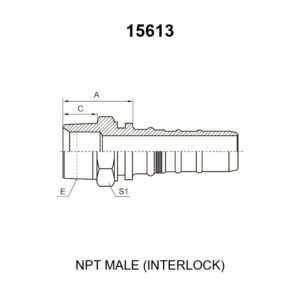
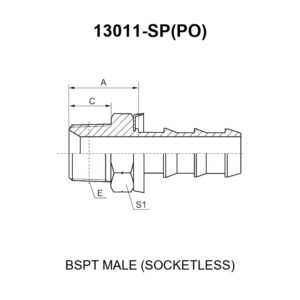
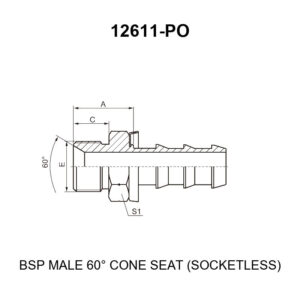
Dimensional note: A is measured from the thread end to the hose stop flange per the factory dimension sheet; C is the effective thread length. Full barb dimensions are on the CAD drawing supplied with your quotation.
Materials and Surface Treatment
- Material: high-strength carbon steel (cold-forged and machined, 20# / 35# / 45# grades as standard). 304 / 316L stainless steel option.
- Surface: trivalent chromium zinc plating (Cr3+), salt-spray verified per batch. Zinc-nickel and Dacromet upgrades available.
- Documentation: material certificates (MTR), dimensional reports, and third-party inspection (BV / SGS) available per batch.
Pressure and Temperature – What the Assembly Can Do
The 15611-PO is designed for push-on hose service, and the honest rule is: the assembly is only as strong as the hose and its grip on the barbs.
- Typical push-on hose ratings run up to roughly 350 psi (24 bar) in the smaller sizes for pneumatic service, with lower ratings as bore grows. Some textile push-on hoses are rated for low-pressure hydraulic oil service – always follow the hose manufacturer’s rating, not the fitting.
- Service temperature follows the hose and fluid: typically -20 C to +80 C for standard rubber push-on hose; confirm against the hose datasheet.
- For hot-oil, high-pressure, or impulse-heavy circuits, do not use push-on fittings – use crimp fittings (the standard 15611 series) or reusable fittings instead. We will say so before you order, not after.
Honest limitation: socketless fittings must be matched to push-on hose. Wire-braided hose (1SN / 2SN), spiral hose, and PTFE hose will not push on correctly and must never be forced onto these barbs – the wire reinforcement prevents the barb grip that makes the connection work.
By Hose Series
The 15611-PO is machined for push-on (socketless) hose:
- Textile-reinforced push-on hose with elastomer tube and cover – the standard family for pneumatic, coolant, and low-pressure fluid circuits.
- Confirm the hose brand and inside diameter before ordering so the barb size matches. Push-on hose IDs vary slightly between brands at the same dash; a barb that is too loose leaks, a barb that is too large splits the tube.
If your application runs 1SN / 2SN braided hose or needs a swivel or reusable connection, tell us – those are different families in our range and we will route you correctly. For buyers new to push-on hose fittings, the rule is: match the hose maker’s push-on family to the fitting dash, and confirm the barb seats inside the tube, not the cover. If you are consolidating suppliers for socketless hose fittings, we can quote the whole dash range with one hose recommendation per size.
By Thread Size
| Part No. | Male NPT Thread | Hose Dash | Typical Port / Use |
|---|---|---|---|
| 15611-02-04PO | 1/8-27 | -04 | Gauges, pilots, small pneumatic lines |
| 15611-04-04PO | 1/4-18 | -04 | Air tools, lubrication lines |
| 15611-04-06PO | 1/4-18 | -06 | 1/4″ port to 3/8″ hose |
| 15611-06-06PO | 3/8-18 | -06 | Pneumatic manifolds, coolant loops |
| 15611-06-08PO | 3/8-18 | -08 | 3/8″ port to 1/2″ hose |
| 15611-08-08PO | 1/2-14 | -08 | Water and oil return lines |
| 15611-08-10PO | 1/2-14 | -10 | 1/2″ port to 5/8″ hose |
| 15611-12-12PO | 3/4-14 | -12 | Large coolant / return lines |
NPT identification tip: NPT is the tapered 60-degree pipe thread. Straight-threaded ports are not NPT and seal with O-rings or washers. Send a photo of your port and our team identifies it free of charge.
Cross Reference
The 15611-PO follows the standard push-on NPT male geometry used across the fluid-power market, making it a direct match for equivalent socketless NPT male fittings from major international brands – same barb concept, same dash coding, same push-on hose.
How to verify a replacement in one step: read the code on your current fitting (a 6-6 or 8-8 style pair), match the NPT thread and dash, and send it to us. Our engineers confirm the equivalent 15611-PO code and check the barb against the push-on hose you use before you order. Distributors can request a full cross-reference list for their hose inventory.
Packaging and Logistics
- Standard packing: poly-bagged fittings in export cartons; typical counts 200-1,000 pcs per carton for small sizes, 50-200 for large sizes.
- Mixed-size cartons and OEM carton printing available.
- We ship worldwide by sea, air, or express; combined orders with push-on hose and other fittings consolidate into one shipment.
Assembly Guide: Fit a Socketless Fitting in Under a Minute
No machine, no dies, no torque specs. Assembling socketless hose fittings is genuinely this simple – the discipline is in hose selection and seating, which is where this guide focuses. But the two rules below are what separate a line that lasts from a line that leaks:
Step 1 – Cut square. Cut the push-on hose square with a sharp blade. A square end lets the barbs engage evenly around the full circumference.
Step 2 – Lubricate and push. Wet the barbs and the hose bore with soapy water or assembly lubricant. Push the hose on with a slight twisting motion until it bottoms against the stop flange. The barbs must be fully covered and the hose end must seat against the flange – that seating is your “crimp check.”
Step 3 – Verify. Pull firmly on the hose: it should not slip. For vacuum service or where vibration is severe, an optional hose clamp over the barb area adds insurance – check the hose maker’s recommendation.
Step 4 – Seal the thread and test. Wrap the male NPT threads with PTFE tape (2-3 wraps, first thread clear) or apply sealant, tighten hand-tight plus 1-2 turns, and pressure-test the line before service.
Installation Warnings (read before tightening)
- Push-on hose only. Never force braided (1SN / 2SN), spiral, or PTFE hose onto these barbs – the connection will not hold and the hose can split.
- Never reuse a fitting on a damaged hose end. Cut back to clean, round hose before refitting.
- NPT threads need sealant. Tape or sealant is part of correct NPT installation; overtightening a taper thread can crack the port or the hex.
- Straight threads are not NPT. If the port thread is parallel, use a straight-thread fitting with O-ring or washer sealing.
- When in doubt, clamp. For high-vibration or vacuum applications, an Oetiker-style or worm-gear clamp over the barb zone is cheap insurance – follow the hose maker’s guidance.
Aplicaciones típicas
- Pneumatic controls and air lines on industrial machines (typical push-on service up to ~350 psi).
- Coolant and water circuits on compressors, welders, and process equipment.
- Low-pressure hydraulic oil return and drain lines.
- Lubrication and grease delivery lines.
- Agricultural sprayers and irrigation equipment.
- Automotive and light-duty fluid lines where NPT ports are used.
Socketless hose fittings earn their place wherever a line must be terminated fast, replaced often, or fixed without a workshop: one fitting, one hose, no machine.
Socketless vs Crimp vs Reusable: Which Fitting Do You Need?
| Factor | Socketless / push-on | Crimp fitting | Reusable fitting |
|---|---|---|---|
| Assembly tools | None (hand push) | Máquina de engaste | Hand wrenches |
| Hose families | Push-on (textile) hose | 1SN / 2SN, spiral etc. | SAE 100R5 family |
| Pressure class | Low-medium (~350 psi typical max) | Alto | Medio |
| Reuse after hose failure | Fitting stays on new hose end if undamaged | No | Yes |
| Best for | Pneumatics, coolant, oil return | High-pressure hydraulics | Field service, R5 hose |
Still unsure? Send us the hose, the pressure, and how the line is installed, and we will recommend honestly – including when the answer is “crimp” or “reusable.”
OEM and Custom Options
- Size and thread customization: non-standard dash combinations and alternate port ends machined to your drawing.
- Coating customization: zinc-nickel, Dacromet, or finishes matched to your salt-spray requirement.
- Laser marking: your logo, part number, and batch code.
- Kitting: fitting + hose kits for distributor programs and machine builders.
- Documentation: MTRs, dimensional reports, and BV / SGS third-party inspection on request.
Quality and Traceability
Every batch is traceable: material incoming inspection, cold forging and machining, plating, 100% thread gauge inspection, dimensional sampling, and salt-spray verification. Ask for sample fittings and test them against the push-on hose you stock – push-on, pressure-test, pull, and keep the sample on the bench. We are confident in what the test will show.
Socketless Fitting FAQ
What is the difference between socketless and push-on fittings? They are the same concept: a barbed fitting that connects without a ferrule by pushing the hose on. “Socketless” and “push-on” are used interchangeably in the industry; push-lock is a similar branded style. The 15611-PO is the NPT male version of this family.
Do socketless fittings need clamps? With a properly matched push-on hose, no – the barb grip alone provides the rated pressure retention. Clamps add insurance for vacuum, high-vibration, or pulse service; follow the hose maker’s guidance. Either way, socketless hose fittings are rated as a system with the hose – keep the pair matched and the rating honest.
What pressure can these fittings handle? The assembly rating follows the push-on hose, typically up to roughly 350 psi (24 bar) for pneumatic service in the smaller sizes and less as bore grows. Do not use them on high-pressure hydraulic circuits – use crimp fittings there.
Can I use the 15611-PO with 1SN or 2SN braided hose? No. Braided hose cannot be pushed onto barbs – the wire reinforcement blocks the grip and forcing it splits the hose. Use the standard 15611 crimp series for braided hose.
Why does my NPT thread leak? NPT seals by thread interference, and tolerance differences leave microscopic spiral paths. PTFE tape or sealant closes them – this is standard NPT practice on every fitting.
Are socketless fittings reusable? The fitting itself can be refitted onto a fresh, clean hose end if the barbs are undamaged, making them economical for frequent line changes – but always inspect the barbs before reuse.
Get a Quote for Socketless Hose Fittings
You now have the full picture: socketless hose fittings for fast, tool-free terminations, NPT from 1/8″ to 3/4″, honest pressure guidance, and the barb-matching support that keeps push-on connections reliable.
Send us your push-on hose brand and dash, the NPT port size, and your quantity – we reply within 24 hours with the fitting recommendation, CAD drawings, and a landed-cost quotation. Distributors: ask for the cross-reference list, kitting options, and volume pricing.

 English
  Spanish
  Portuguese
  French
  German