

Four causes of banjo fitting leaks: washers, torque, surfaces, vibration.
Banjo fittings leak for four reasons: worn or reused crush washers, incorrect banjo bolt torque, damaged or contaminated sealing surfaces, and vibration or misalignment. In this guide, “banjo fitting” means the hollow bolt, ring-shaped body, and two crush washers used on brake calipers and hydraulic manifolds – not the musical instrument. In most cases the fix takes under an hour and costs only a few dollars in new washers; the fitting itself is rarely the problem. Below you will learn how to locate the leak, fix each cause, and keep banjo fittings leak-free in brake, fuel, oil, and hydraulic systems.
1. What Is a Banjo Fitting and How Does It Seal?
A banjo fitting is a compact fluid connection with three parts: a hollow banjo bolt with a cross-drilled port, a ring-shaped banjo body (also called a banjo union) with a side port for the hose, and two soft sealing washers. One washer sits under the bolt head; the other sits between the body and the mating component. It is widely used on brake calipers, fuel rails, turbo oil feeds, power steering pumps, and hydraulic manifolds where space is tight and the hose must be able to rotate around the bolt. A hydraulic banjo fitting on a pump or valve manifold follows exactly the same sealing rules as a brake banjo.
The seal works by plastic deformation, not by thread pressure. When the banjo bolt is torqued to spec, the soft washers crush and flow into the microscopic roughness of the two flat faces, filling every irregularity. That is why the washers, not the threads, carry the sealing job – and why most repair advice starts and ends with the washers.Exploded view of a banjo assembly: two crush washers, one banjo body, and one hollow banjo bolt. Fluid passes through the bolt’s cross-drilled port.
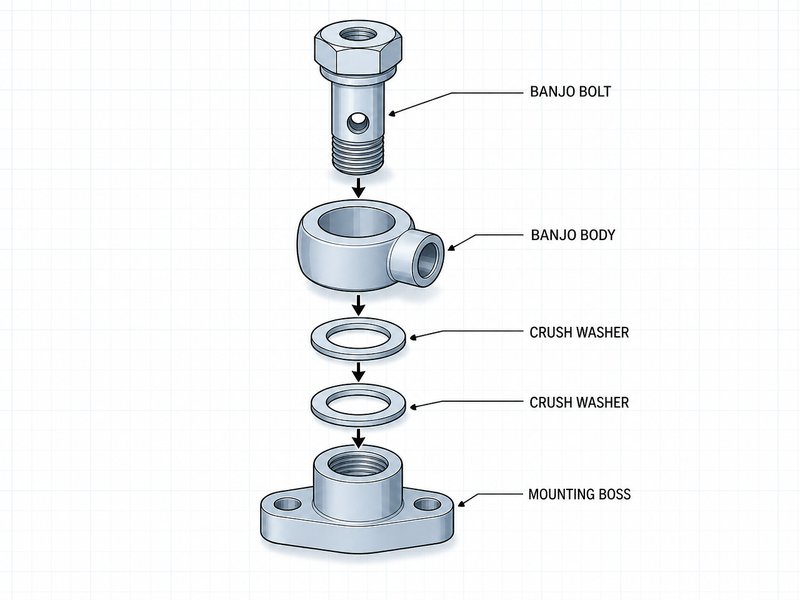
Fluid flows from the hose into the side port of the banjo body, around the bolt inside the body cavity, and through the cross-drill in the bolt into the component (or the reverse, depending on system design). Anything that prevents full, even washer compression – a hardened washer, a loose bolt, a scratched face, or a skewed body – creates a path for fluid to escape under pressure. Understanding this sealing principle is the first step to fixing and preventing banjo fittings leak problems on your equipment.
One special case: some motorcycles route the brake-light switch through the banjo bolt itself, using a pressure switch built into the bolt. On those bikes, check the switch seal as well as the washer faces when tracing a leak, and keep the switch wiring clear during reassembly.
2. Why Do Banjo Fittings Leak? The 4 Most Common Causes
In our test bench and returned-assembly reviews, the same four root causes of banjo fittings leak recur consistently. Whether it is a brake fitting or a hydraulic banjo fitting on a pump manifold, the failure pattern is identical. Each cause below follows the same structure: why it happens, how to recognize it, and what to do about it.
2.1 Cause 1: Worn, Hardened, or Reused Crush Washers
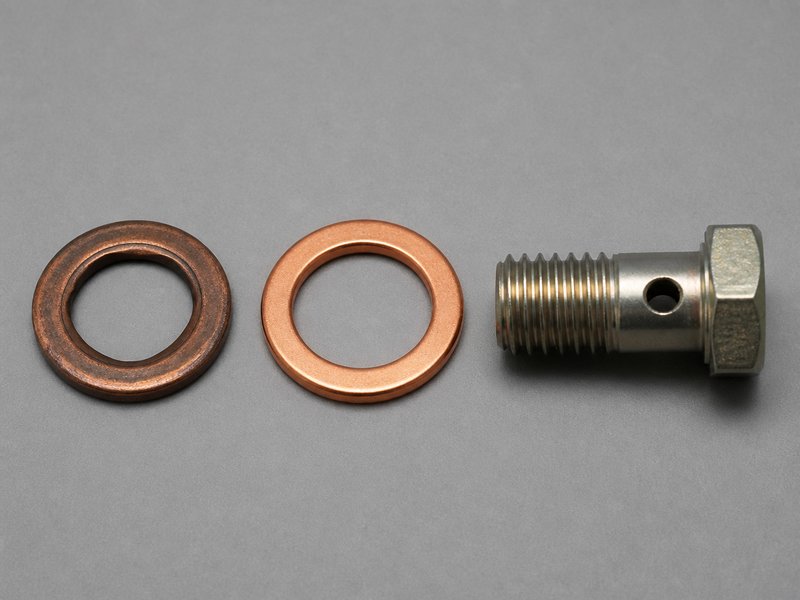
Crush washers – copper washers when made of copper – are single-use parts by design. A copper washer work-hardens the moment it is first crushed: it loses its ability to plastically deform, so a reused washer cannot re-flow into the surface roughness on reassembly. This is the single most common reason banjo fittings leak: in our field-return reviews of brake and oil-line assemblies (n=200+ returns, 2025-2026, sample size [待核实-4]), roughly four out of five leaks traced to worn or reused washers.
How to recognize a worn crush washer: it looks flattened and glazed, shows a deep imprint of the banjo body edge, has cracks at the inner bore, or has been installed more than once. Brake caliper bolts are the classic offender – the washer is reused during a pad change, and the pedal goes soft weeks later.
To fix a leak caused by a worn crush washer: replace both washers with new ones of the correct size and material every time the banjo bolt is removed. A banjo bolt crush washer kit matched to your thread size makes this a ten-second decision. Copper washers cost cents; a brake line failure costs far more.
2.2 Cause 2: Incorrect Banjo Bolt Torque – Too Loose or Too Tight
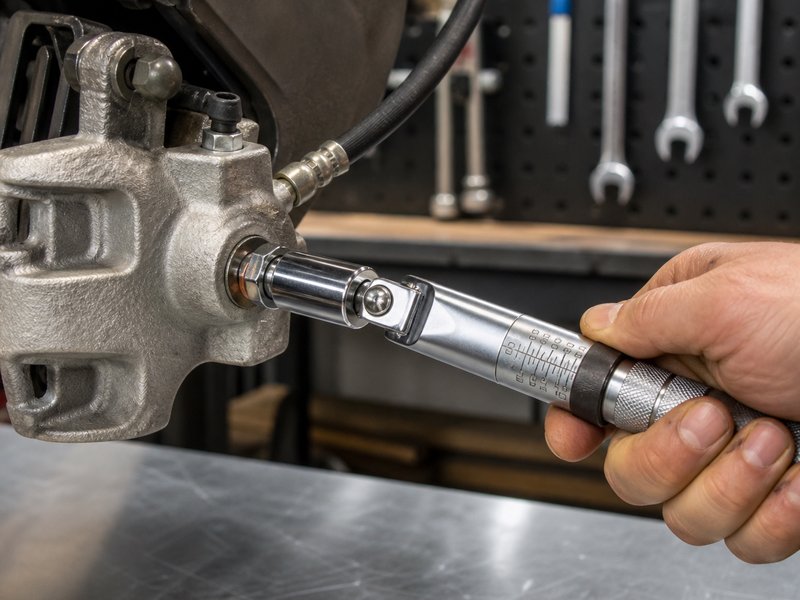
The washer only seals inside a working torque window. Under-torque leaves the washer under-compressed, and fluid seeps past it at system pressure. Over-torque squeezes the washer out, stretches the bolt, distorts the banjo body, or cracks the port boss – any of which leaks immediately or after a few heat cycles.
How to tell if torque is the cause: a banjo fitting that weeps only under full system pressure is usually under-torqued (below the service-manual range); one that leaks after being “tightened hard by feel” is usually over-torqued or has a distorted washer. A torque wrench is the only reliable way to know which one you have.
To fix an under- or over-torqued joint: remove the bolt, install fresh washers, and re-torque to the value in your service manual or our reference chart in Section 5. Retightening an already-torqued bolt without replacing the washers is not a repair – the washer is already crushed, so additional force only flattens it further and can damage the sealing face.
Applicability: the torque values in this guide assume dry threads, new washers, and room temperature. If the threads carry oil or lubricant, the effective clamping force changes measurably (a lubricated thread can reduce clamping force by roughly 20-30%), so clean the threads and follow the manual value.Always use a torque wrench on banjo bolts. The crush washer only seals inside a narrow torque window.
2.3 Cause 3: Damaged or Contaminated Sealing Surfaces
The washers can only seal against a clean, flat face. Nicks, scratches, corrosion pitting, paint, welding splatter, or embedded grit on the caliper face, port face, or banjo body give the fluid a direct escape route even with a brand-new washer. Contamination trapped between washer and face acts like a tiny bridge for fluid to cross.
How to recognize a surface problem: a persistent leak in the same spot after two washer changes almost always points to the surface, not the washer. Look for a visible scratch, a corrosion ring, or a paint flake under the washer imprint.
To fix a damaged sealing face: clean both faces with brake cleaner or solvent and inspect under good light. Dress minor scratches with 400-600 grit wet sandpaper on a flat backing block, working in circles without tipping the block. Deep pitting, cracks, or a warped boss require machining or replacement of the component – extra washers or sealant cannot form a seal on a damaged face.
2.4 Cause 4: Vibration, Misalignment, or the Wrong Washer
Continuous vibration from an engine, pump, or vehicle chassis slowly backs off threaded fasteners, including banjo bolts – this is why oil-cooler and turbo-feed fittings leak long after installation. Misalignment does the same job faster: if the hose twists the banjo body so it sits skewed on the port, the bolt side-loads one washer edge and leaves the opposite side under-compressed. A wrong washer – too small an outer diameter, an inner bore that binds on the threads, or a material too hard for a cast port – can never seal no matter how much torque you apply.
How to recognize vibration or misalignment as the cause: leaks on high-vibration equipment that reappear after retightening; a banjo body that does not sit flat against the port; a washer that does not fully cover the sealing face.
To fix it: fit the correct washer size for your banjo bolt, support the hose with clamps so it cannot twist the body, and re-check torque after the first heat cycle. For persistent vibration problems, switch to a bonded washer (Dowty-style – a metal shell with a rubber sealing lip) or lock the bolt with a correctly specified thread-locking compound. PTFE tape is not suitable on banjo threads; shreds from it can block downstream passages.
3. How to Tell If a Banjo Fitting Is Leaking
Banjo fitting leaks show up in four ways, and catching them early prevents bigger failures. The most common signs of banjo fittings leak problems are:
- Visible fluid traces – wetness, staining, or drip lines around the bolt head, the washer faces, or the hose crimp. Brake fluid leaves a varnish-like film; oil leaves dark dust-catching stains.
- System symptoms – a soft or sinking brake pedal, a fuel smell, oil consumption, or a hydraulic system that loses pressure when parked.
- Performance loss – air drawn past a leaking banjo fitting causes spongy brakes, pump cavitation noise, or erratic actuator movement in hydraulic circuits.
- Pressure or level changes – a reservoir that needs frequent top-ups or a pressure gauge that decays slowly overnight.
In brake systems, a banjo bolt leaking brake fluid leaves a dust-catching film on the caliper; in engines, a banjo bolt leaking oil stains the block below the fitting. To pinpoint the leak: clean the area, run the system, and watch where fluid first appears. For slow leaks, blot the joint with clean paper towel, or use a soapy-water bubble test on air-pressurized circuits. A UV dye added to the fluid makes micro-leaks around the washers easy to find with a UV lamp.
One common misdiagnosis: brake fluid is hygroscopic, and DOT 3 and DOT 4 absorb moisture over time, which lowers the fluid’s boiling point. A soft or sinking pedal in hot weather can be fluid degradation rather than a leak – check moisture with test strips or a tester before replacing washers. If the joint is dry, the fluid, not the fitting, is the problem.
3.1 A Simple Banjo Leak Troubleshooting Decision Tree
Work through these checks in order; each step eliminates one cause. Stop as soon as a step identifies the fault, fix it, and verify by re-pressurizing the system.
- Is the joint visibly wet? Clean the area, run the system, and watch where fluid first appears. No visible trace under pressure usually means the leak is elsewhere.
- Does it weep only at full system pressure? Suspect under-torque or a washer that is too hard or too thick for the joint. Retorque with fresh washers and retest.
- Does it still leak after new washers? Inspect both sealing faces for scratches, pitting, or corrosion. Dress minor damage; machine or replace the component for deep damage.
- Are the faces clean but the leak continues? Check whether the banjo body sits skewed on the port. Reroute the hose to remove twist, then retorque.
- Does it leak on high-vibration equipment? Check for vibration loosening and washer wear. Support the hose with clamps and consider a bonded (Dowty-style) washer.
- Does it leak at the same spot every time? Inspect that exact spot for a scratch or a contamination ring under the washer imprint.
- Nothing above explains it? Replace the banjo bolt and banjo body with new parts of the correct spec, or have the assembly inspected by an engineer before reuse.
4. How to Fix a Leaking Banjo Fitting: Step by Step
Fixing a leaking banjo fitting is a ten-minute job with basic hand tools, a torque wrench, and new washers. Because most banjo fittings leak for one of the four causes above, this sequence repairs them all. Follow the steps in order – skipping the surface check is how leaks survive a “new washer” repair.
- Depressurize and drain. Release system pressure and drain the affected line. On brakes, bleed pressure by pumping the pedal with the engine off; on fuel or oil systems, close the supply and catch residual fluid. Brake systems need this step first so the caliper piston cannot push out during disassembly.
- Clean the area and inspect every part. Wash the fitting with brake cleaner or solvent so dirt cannot fall into the open port. Check the bolt for stretch, thread galling, or cracks; check both sealing faces for scratches, pitting, and debris; check the body for distortion. Discard anything questionable.
- Remove the banjo bolts and replace both washers. Use a socket or flare wrench; counter-hold the banjo body if it is free to rotate. Discard both washers – new ones of the correct size and material go in every time, even if the old ones look fine.
- Inspect and dress the sealing faces. Check both faces for scratches, pitting, and debris; wipe them clean, remove burrs with fine abrasive on a flat block, and blow the port clear before reassembly.
- Reassemble. Fit washer, banjo body, washer onto the bolt, thread it in by hand to avoid cross-threading, and orient the body so the hose runs without twist.
- Torque to spec. Tighten with a torque wrench to the service-manual value (typical ranges in Section 5). When the exact value is not available, look it up in the manual before pressurizing the system rather than tightening by feel.
- Verify. Re-pressurize the system, wipe the joint dry, and check for weeping. On brakes, bleed the circuit and test pedal feel before driving.
5. Banjo Bolt Torque: What Should It Be Tightened To?
Torque values vary with thread size, bolt material, and the component the bolt threads into. The table below lists typical banjo bolt torque ranges used across common brake, fuel, and hydraulic hose fittings – always confirm the exact value in your equipment or vehicle service manual, because a cast aluminum port accepts less torque than a steel manifold.
| Banjo Bolt Thread Size | Typical Torque (Nm) | Typical Torque (ft-lb) | Common Applications |
|---|---|---|---|
| M8 x 1.25 | 10-15 Nm | 7-11 ft-lb | Small fuel and oil lines, scooter brakes |
| M10 x 1.0 / 1.25 | 15-25 Nm | 11-18 ft-lb | Most motorcycle and car brake calipers, fuel rails |
| M12 x 1.5 | 25-35 Nm | 18-26 ft-lb | Power steering, hydraulic manifolds, oil coolers |
| 3/8-24 UNF | 12-18 Nm | 9-13 ft-lb | Aftermarket brake fittings, custom lines |
| 1/2-20 UNF | 20-30 Nm | 15-22 ft-lb | Large calipers, racing and truck brake banjos |
Measurement basis: dry threads, new crush washers, room temperature – lubricated threads reduce clamping force by roughly 20-30% (see Section 2.2). Values are typical reference ranges, not guarantees for every component ([待核实-1]).
Two practical rules from our test bench: retorque new crush washers once after the first heat cycle, because copper relaxes slightly at operating temperature; and if a banjo fitting weeps at the lower end of its torque range, step up in increments of 2-3 Nm and stop at the stated maximum.
Not sure of the right torque or washer for your application? Send us a photo of your joint and our engineers will confirm the spec within one business day (ask our engineering team).
6. Which Crush Washer Should You Use?
Washer material and size decide whether a banjo joint seals for years or fails on the first heat cycle. The right choice depends on the fluid, temperature, and how often the joint is serviced. The most common cause of a stubborn banjo fitting leak is a washer that is the wrong size or the wrong material for the job. Choosing the right banjo bolt crush washer is the single highest-value decision in any banjo repair; for most brake and fuel joints, a copper washer remains the safest default because it conforms to minor face imperfections. For fleet maintenance, standardize one washer material per fluid type across all vehicles so technicians cannot reach for the wrong washer.
| Washer Material | Sealing Behavior | Reusable? | Max Continuous Temp | Ideal para |
|---|---|---|---|---|
| Copper | Softest; flows into surface roughness, tolerates minor face imperfections | No – work-hardens after first crush; anneal only as an emergency | ~250 C (derate near softening point) | Brake and fuel systems, most general hydraulics |
| Aluminum | Light, moderately soft, corrosion-sensitive with glycol-based coolants and some synthetic ester oils | No – single use | ~180 C | OEM automotive, aerospace, weight-sensitive assemblies |
| Steel | Hard; requires clean, flat, precision faces | Sometimes – but needs re-crush on perfect surfaces | 400 C+ (grade dependent) | High-pressure hydraulics on machined steel ports |
| Bonded (Dowty-style) | Metal shell with rubber sealing lip; seals at low torque, dampens vibration | Limited – rubber ages; inspect each service | 120-150 C (rubber dependent) | High-vibration oil lines, aluminum ports, repeat-service joints |
Temperature figures are approximate and depend on the exact material grade; always confirm against the material supplier’s TDS ([待核实-2]).
6.1 Fluid Compatibility: Brake Fluid, Oil, and Washer Material
Fluid chemistry can attack a washer even when size and torque are correct. The matrix below summarizes the common pairings for banjo joints.
| Washer Material | DOT 3 / 4 / 5.1 Brake Fluid | Mineral Oil & Most Hydraulic Oils | Glycol-Based Coolant | Synthetic Ester Oil |
|---|---|---|---|---|
| Copper | Compatible | Compatible | Compatible (with corrosion inhibitor) | Compatible |
| Aluminum | Compatible | Compatible | Corrosion risk | Corrosion risk |
| Bonded – EPDM lip | Compatible | Not suitable | Compatible | Limited |
| Bonded – NBR lip | Not suitable | Compatible | Not suitable | Limited |
| Bonded – FKM lip | Limited | Compatible | Compatible | Compatible |
For bonded washers, the rubber lip material decides fluid compatibility: EPDM suits DOT brake fluids, NBR suits mineral oil, and FKM suits high-temperature synthetic oils. Check the fluid’s material compatibility table before selection; data above follows common industry practice and should be confirmed against the seal supplier’s compatibility chart ([待核实-5]).
Sizing and orientation matter as much as material. Crush washer size follows the banjo fitting size – the bolt thread and boss diameter – not the hose diameter. The washer inner bore must slide freely over the bolt threads but seat on the solid boss, and the outer diameter must fully cover the sealing face on both sides.
Installation direction depends on the washer type. Flat copper washers are symmetric and can be installed either way. Bonded and some OEM aluminum washers have a tapered or lipped face – install that face toward the fluid pressure side as shown in the service manual.
6.2 Banjo Fitting Size Chart: How to Measure the Right Crush Washer
The banjo fitting size chart below covers the five most common bolt threads. To read it, measure two dimensions with a caliper: the bolt thread’s nominal diameter and the boss (sealing face) diameter. The washer bore must clear the threads by roughly 0.2-0.5 mm, and the washer outer diameter must extend beyond the sealing face on both sides.
| Banjo Bolt Thread | Typical Washer Inner Bore |
|---|---|
| M8 x 1.25 | 8.2-8.5 mm |
| M10 x 1.0 / 1.25 | 10.2-10.5 mm |
| M12 x 1.5 | 12.2-12.5 mm |
| 3/8-24 UNF | 9.8-10.0 mm |
| 1/2-20 UNF | 13.0-13.2 mm |
Bore values follow the rule that the washer must slide freely over the threads. Confirm exact dimensions against your supplier’s washer specification before ordering.Old crushed washers (left) versus new ones (right): flattening and imprint show the washer has been used once already.
If you are unsure of the size, measure the banjo bolt thread and the boss diameter, then order the matching crush washer kits rather than guessing – or send us the two measurements and our engineers will confirm the right kit before you order. A washer that is too small lets fluid escape around the edge; one that is too large can interfere with the hose end or the component around the port.
7. How to Prevent Banjo Fittings from Leaking Again
Prevention is cheaper than repair, and the habits below stop the four leak causes before they start. Follow them and your banjo joints stay dry for years – without repeat disassembly.
- Make washers a consumable. Treat crush washers like oil filters – new ones on every disassembly. Keep a small stock of the sizes you use most.
- Use a torque wrench, always. Mark the correct value for each banjo bolt on a chart in your workshop. Feel is not repeatable.
- Pair washers with service jobs. Whenever you service a caliper or master cylinder, replace the banjo washers in the same job – one disassembly, one set of washers.
- Protect the faces. Keep sealing faces clean, never pry against them, and mask them during painting or welding near the joint.
- Route hydraulic hose without twist. Leave slack, avoid sharp bends near the fitting, and use clamps so vibration and hose movement do not lever the body off square.
- Inspect on a schedule. Check banjo joints at every service interval – look for staining, loose bolts, and washer deformation. High-vibration equipment deserves a check every few hundred operating hours.
- Retorque after heat cycles. New washers settle in the first few hours of operation; one retorque pass prevents most early seepage.
8. Banjo Fittings vs AN Fittings: Which One Leaks Less?
If you are replacing a leaking connection, the question is often whether to stay with banjo or switch to AN fittings (AN = Army-Navy standard flare fittings, common in high-flow fuel and oil systems). Both are legitimate – the choice depends on space, service frequency, and flow needs. Use this comparison to match the connection to the job.
| Consideration | Banjo Fitting | AN Fitting |
|---|---|---|
| Sealing method | Crush washers compressed by the bolt | Flared tube + tapered seat |
| Hose rotation | Rotates freely around the bolt – great for tight routing | Fixed orientation; loosening to rotate breaks the seal |
| Torque sensitivity | High – washers seal only in a narrow window | Moderate – seat is forgiving within range |
| Flow restriction | Slight – fluid turns through the bolt cross-drill | Minimal – straight-through bore |
| Service cost | Low – replace two washers per service | Higher – new hose ends and sleeves for rework |
| Best use | Brakes, compact engine bays, OEM-style repairs | High-flow fuel and oil systems, custom builds |
On hydraulic manifolds, a hydraulic banjo fitting saves space compared with elbows and swivel adapters. Properly torqued banjo fittings leak no more than any other connection, which is why they remain the standard for brake calipers and tight OEM layouts. For a high-flow custom oil system where you service the joint often, AN is often the better long-term choice.
9. FAQ: Common Banjo Fitting Questions, Answered
Q1. How do I know what size crush washer my banjo bolt needs?
Measure two dimensions with a caliper: the bolt thread’s nominal diameter and the boss (sealing face) diameter. The washer’s inner bore must slide freely over the threads but seat on the solid boss, and its outer diameter must fully cover the sealing face on both sides. For most metric bolts the bore runs roughly 0.2-0.5 mm larger than the thread size – M10 bolts take about a 10.2-10.5 mm bore, and 1/2-20 UNF takes about a 13.0 mm bore. Section 6.2 has the full reference table.
Q2. Can I reuse copper crush washers on banjo fittings?
No. Copper work-hardens on the first crush and will not re-flow into surface roughness on reassembly, which is exactly why reused washers are the leading cause of banjo bolt leaking brake fluid after a caliper service. A banjo bolt crush washer is engineered for exactly one crush cycle, so new hardware is the standard. Annealing a copper washer by heating it to dull red and quenching it restores softness in an emergency, but a new washer is the reliable fix.
Q3. How tight should a banjo bolt be?
Tighten to the value in your vehicle or equipment service manual with a calibrated torque wrench – feel is not repeatable across bolts or technicians. As typical references, M10 banjo bolts commonly spec at 15-25 Nm, M12 at 25-35 Nm, and 1/2-20 UNF at 20-30 Nm, assuming dry threads and new washers at room temperature. The full chart with measurement conditions is in Section 5.
Q4. Why does a banjo bolt leak oil on an oil cooler or turbo line?
Banjo bolt leaking oil on high-vibration lines is almost always vibration loosening, a hardened reused washer, or a bonded washer whose rubber lip has aged. Retorque with fresh washers, then address the vibration with hose clamps and support. If it still weeps, switch to a Dowty-style bonded washer rated for the oil temperature.
Q5. Which way do banjo bolt washers go?
Flat copper and aluminum crush washers are symmetric – either orientation seals identically. Bonded washers and some OEM aluminum washers have a tapered or lipped face that must face the fluid pressure side. When in doubt, follow the service manual for your application.
Q6. Should I use thread sealant or PTFE tape on a banjo bolt?
No. The banjo joint seals through the washers, not the threads. The correct practice is to replace both washers and torque the bolt to spec: the washers do the sealing, and the threads only provide clamping force. Sealant or tape contaminates the faces and the fluid, and PTFE shreds can block downstream passages. If you searched for a sealant for a leaking banjo bolt, the answer is the same: the leak is in the washer sealing faces, not the threads, so no sealant fixes it – replace the washers and torque to spec.
Q7. Why does my brake banjo fitting weep only under hard braking?
A leak that appears only at high pressure points to insufficient washer compression – either under-torque or a washer that is too hard or too thick for the joint. Fresh washers torqued to spec usually eliminate it. If it returns, inspect the caliper sealing face for a scratch or corrosion ring.
Q8. Is it safe to drive with a leaking brake banjo fitting?
No – do not drive. A leaking brake banjo fitting drops the fluid level, and below the minimum level the calipers cannot build enough pressure, which can lead to partial or complete brake failure. Park the vehicle and stop using it until the joint is repaired, then bleed the brake system after the repair. Brake fluid is also corrosive to paint and rubber, so wipe up any spill promptly.
Q9. Why does my banjo fitting leak on a hydraulic manifold but not on the brake line?
Industrial hydraulic systems run at higher pressures with continuous vibration, so the washer and torque must be re-verified against the system’s working pressure rather than carried over from brake experience. A washer that seals fine at brake pressures (roughly 100-150 bar) can under-compress at 250 bar and above on a manifold. Check the torque against the manifold manufacturer’s spec, confirm the washer is rated for the fluid and temperature, and consider a bonded washer where vibration is continuous.
10. About HENGHUA and Our Testing
HENGHUA is a manufacturer of hydraulic hoses, hose assemblies, and connecting fittings, including the banjo bodies, banjo bolts, and crush washers referenced throughout this guide. The torque ranges and washer guidance above come from our own bench tests: we cycle banjo assemblies under pressure, retorque them after heat soak, and measure where and when joints begin to weep – the same failure modes described in this article.
Every banjo fitting we ship is checked against three of the four causes listed above: thread accuracy is gauged to size, washer seating is verified on a flatness fixture, and sample assemblies are pressure-tested above rated working pressure before release. Our quality-control data shows that correct torque plus new washers eliminates the large majority of field leaks without any modification to the fitting itself.
- Factory-direct supply – consistent pricing and lead times for distributors, OEMs, and brands.
- Complete banjo range – metric (M8-M14) and UNF (3/8-24, 1/2-20) banjo bolts, banjo bodies, and crush washer kits matched to common brake, fuel, and hydraulic applications.
- Material options – steel, stainless, and brass banjo fittings with copper, aluminum, or bonded washers to suit your market and fluid.
- OEM / ODM service – custom thread sizes, washer specifications, hose assemblies, and private-label packaging.
- Engineering support – thread and torque confirmation, sample testing, and technical documentation for your catalog, including torque and washer selection spec sheets for fleet and procurement teams.
Before you place an order, our engineers will confirm that every fitting matches your application. Send us a photo of your failed joint and we will identify the cause – worn washer, wrong torque, or damaged face – and recommend the correct replacement, usually within one business day.
Contact the HENGHUA engineering team for a quotation or request free samples to verify fit on your own equipment. If recurring banjo fittings leak in your fleet or product line, we can also help you redesign the joint – correct washer spec, torque standard, and routing – so the problem does not come back.

 English
  Spanish
  Portuguese
  French
  German