

A wire braided steam hose holds saturated steam because a steel wire braid, and not the rubber tube alone, carries the internal pressure and resists crushing. The braid geometry sets how much pressure the hose withstands and how well it survives handling on a hot, wet line. This guide explains the mechanism behind that reinforcement layer.
The article works down the reinforcement layer itself: how the layers share the load, which design lever to move when a line misbehaves, and where the wire stops helping. Every standard and steam value quoted here comes from a published anchor. For the material side of the same hose, see the EPDM steam hose guide.
About a 15-minute read at 250 words per minute; the mechanics of wire and textile reinforcement in saturated steam service.
What a Wire Braided Steam Hose Does Under Pressure
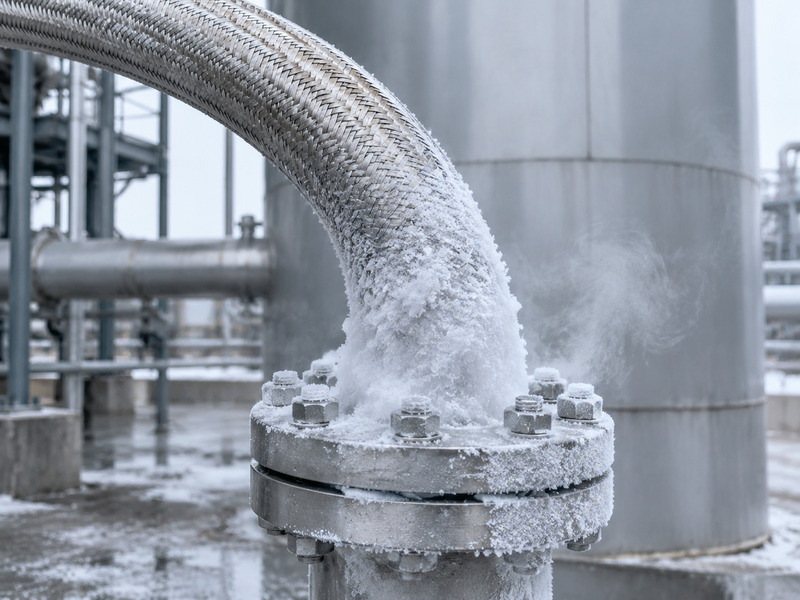
Saturated steam presses outward in every direction at once. The inner tube, normally EPDM, seals the fluid but cannot contain that pressure by itself. The reinforcement layer carries the load, and the cover protects the reinforcement from weather, abrasion, and contact damage.
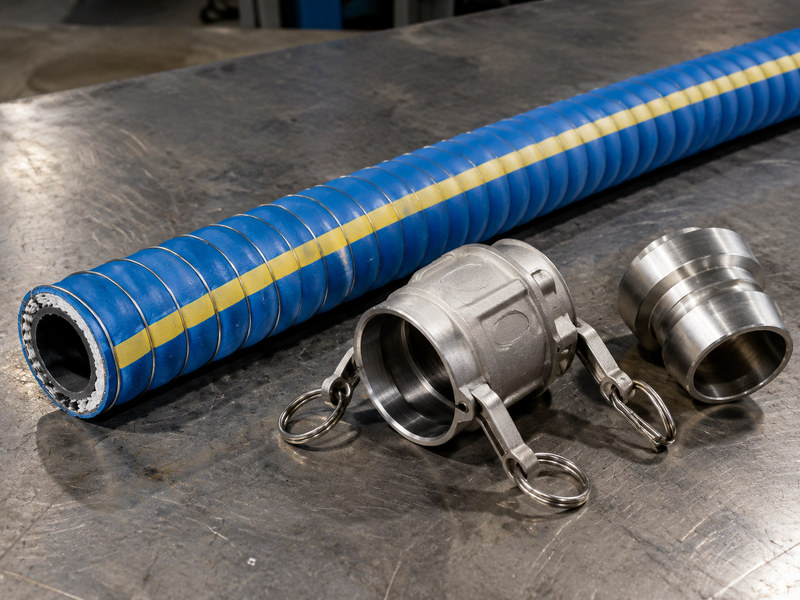
Think of the assembly as a pressure vessel that must also bend. The tube keeps hot steam away from the wire. The braid absorbs hoop stress and axial load. A perforated cover lets small amounts of gas escape instead of blistering the wall. Every layer is bonded so the assembly moves as one unit.
Table 1 lists the layers of a braided steam hose and the job each performs. The order matters, because heat reaches the reinforcement through the tube while moisture reaches the cover from outside.
Table 1. Layer stack in a braided steam hose and the function of each layer.
| Layer | Typical material | Primary function |
|---|---|---|
| Cámara de aire | EPDM rubber | Seals saturated steam and resists heat and water |
| Refuerzo | Steel wire | Carries hoop and axial load and adds a conductive path |
| Cover | EPDM, perforated | Shields the wire and vents trapped gas |
Hose wall thickness sets how much load the braid has to carry. A tube thick enough to seal a cold liquid may soften as steam heat soaks through it. The wire braid compensates by carrying load that the softened tube can no longer hold alone. That is why pressure, temperature, and wall build are always read together.
The steel wire braid is what separates a steam hose from a plain rubber line. Without it, the tube would swell and burst long before it reached working pressure. With it, the same tube can hold the pressure defined for steam service. The reinforcement, not the rubber, is the real pressure component.
How the Braid Angle and Layer Count Set Pressure Resistance
Braid angle is the angle at which each wire crosses the hose axis. A steeper angle, closer to the circumference, adds more radial or hoop strength. A shallower angle, closer to the axis, adds more axial strength and limits elongation under pressure. Manufacturers pick an angle that balances both for a given service.
Layer count is the second design variable. A single layer of wire carries less internal pressure than two layers, and two layers carry less than a multi-layer construction. Each added layer raises capacity without changing the bore, so pressure capability is often a question of how many layers the wall can hold.
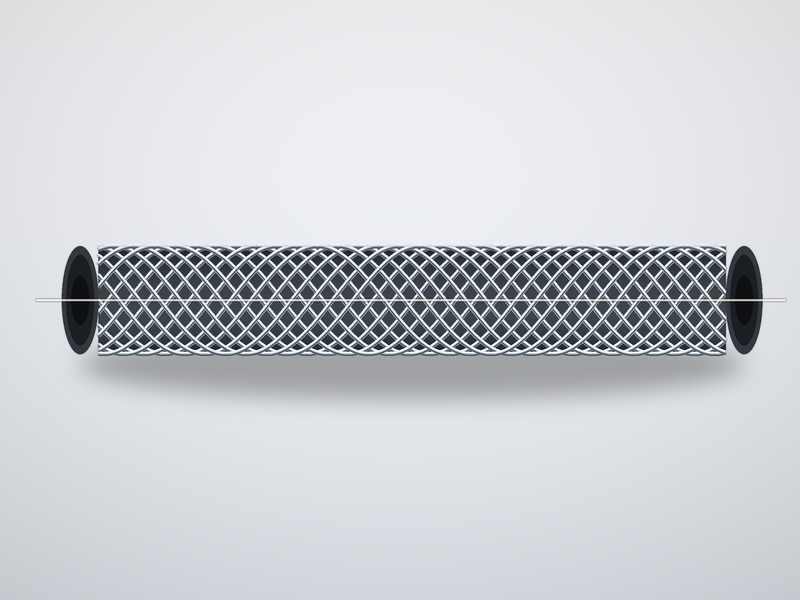
Figure 1. Braid angle measured against the hose axis sets the balance between radial and axial strength.
Table 2 maps each braid variable to the property it changes. The entries stay qualitative on purpose, because the right combination depends on the bore, the pressure, and the fitting system.
Table 2. How braid variables change the behavior of the reinforcement layer.
| Braid variable | Effect on pressure resistance | Effect on flexibility and crush resistance |
|---|---|---|
| Steeper braid angle | Raises radial or hoop strength | Less axial restraint, so the hose can lengthen more |
| Shallower braid angle | Favors axial strength over hoop strength | Opposes elongation and can stiffen the bend |
| More braid layers | Adds capacity layer by layer | Better crush resistance, heavier and stiffer |
| Higher braid density | More wire per unit length carries more load | More crush resistance, less flexible |
| Thicker wire or strand | Raises single-layer capacity | Reduces flexibility when overdone |
Braid construction varies with the service the hose is built for. Two hoses of the same bore can differ in braid angle, layer count, and density. Those choices explain why one holds more pressure or bends more easily than the other.
Bore size changes how much reinforcement a given rating needs. A large bore has more circumference, so each layer must carry more total load at the same pressure. A wide steam hose therefore often needs more reinforcement than a narrow one at the same rating. The pairing of bore and reinforcement is a design choice, not a fixed rule.
Why Steam Service Needs a Steel Wire Braid Instead of Textile
Textile reinforcement still has a place in steam service, but only at the low-pressure end. ISO 6134:2024 defines a low-pressure type with a textile reinforcement and a maximum working pressure of 0.6 MPa (6 bar) at 164 °C. The same standard defines a high-pressure type with a wire reinforcement, rated 1.8 MPa (18 bar) at 210 °C. Verification and burst testing follow ISO 1402.
Textile and wire differ in how they behave under heat and moisture. Natural and synthetic textile cords lose tensile strength as temperature rises, and water can swell or degrade them over time. Wire keeps its tensile strength at steam temperature, so it carries the higher hoop load without creeping. That difference is what pushes high-pressure steam service toward a metal braid.

Figure 2. A metal braid and a textile layer carry load differently once the hose reaches steam temperature.
Table 3 compares the two reinforcement families for steam duty. The comparison stays at the reinforcement level and does not cover the tube compound, which is handled elsewhere on this site. Assembly ratings, bore tables, and bend-radius figures belong to the specification article, and the choice between rubber and metal builds has a page of its own.
Table 3. Textile reinforcement compared with wire reinforcement for steam service.
| Propiedad | Textile reinforcement | Wire reinforcement |
|---|---|---|
| Strength at steam temperature | Falls as temperature rises | Holds across the steam range |
| Moisture response | Can swell or degrade when wet | Not affected by water |
| Creep under steady load | Higher risk over time | Low creep at working load |
| Static conductivity | Depends on the cord and the treatment | Provides a conductive path |
| Flexibilidad | Generally more flexible | Stiffer, especially with more layers |
| Typical pressure class | Low-pressure steam service | High-pressure steam service |
A pure textile build suits light steam duty, where the pressure stays low. Once the line reaches the higher pressure class, a metal braid becomes the standard answer.
Reinforcement choice also affects the way a hose fails. A textile layer tends to stretch and sag before it lets go, which gives a visible warning. A wire layer holds its shape until a strand breaks, so the damage can stay hidden under the cover. Inspection routines are built around that difference. In the steam hose assemblies our factory builds, the wire problems that reach a claim start at a bend or at the fitting bite, not in the middle of a straight run.
Wire Reinforced Hose: How the Braid Carries the Load
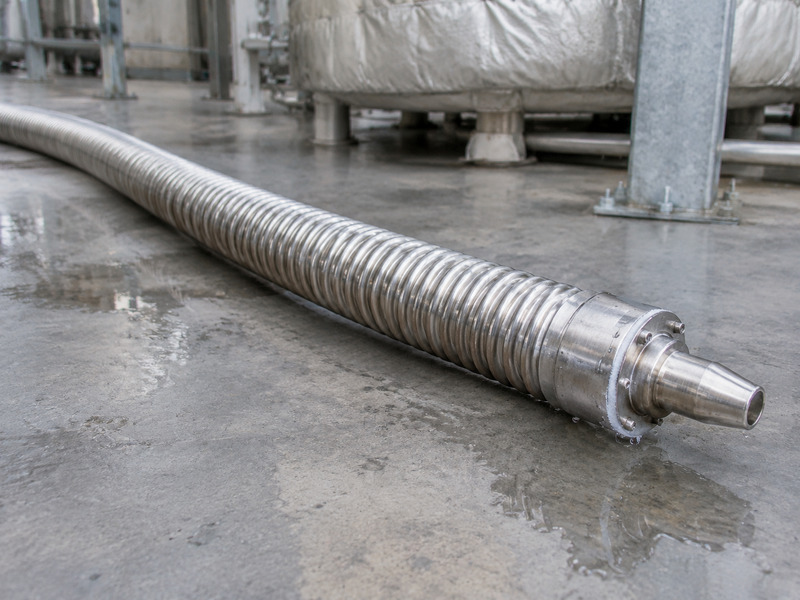
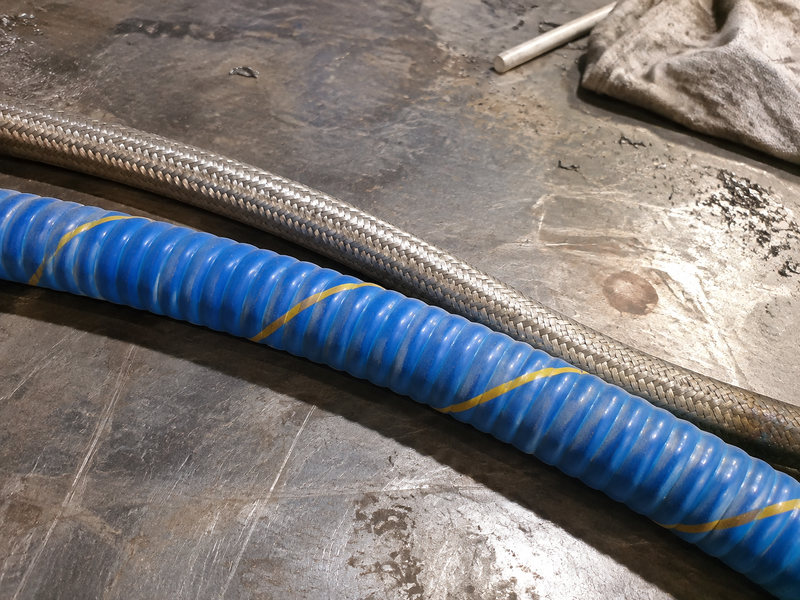
The term wire reinforced hose means the load-bearing layer is metal wire. In steam service that layer is usually a braid, in which two sets of wires interlace in opposite directions. A spiral build winds the wires one way, which changes how the hose flexes and stretches. For a steam line under steady pressure, the interlaced braid holds its shape and resists deformation.
Braid wire itself comes in two forms. A braid can be built from single wire or from strands, meaning several fine filaments twisted together. Strands bend more easily and tolerate repeated flexing, while heavier single wire adds stiffness. Braid density, the number of wire crossings per unit length, sets how much wire covers the tube.
Figure 3. A two-layer build compared with a multi-layer build; extra layers add capacity one at a time.
Table 4. Braid construction compared with spiral construction in a reinforced hose.
| Característica | Interlaced braid | Wound spiral |
|---|---|---|
| Wire path | Two sets cross in opposite directions | One set follows a single direction |
| Shape stability | Holds the bore against deformation | Frees the hose to flex and stretch |
| Elongation under pressure | Limited by the crossing wires | Higher, because the wire can straighten |
| Steam suitability | Common choice for steady pressure | Used where flexing dominates |
A denser braid carries more load and resists crushing better, but it also stiffens the hose. That trade-off is why a steam hose is ordered for its service, not simply for the thickest wall available. The general principles of braided construction are covered in the braided hose guide and in a companion piece on the benefits of braided hoses.
When the same wall uses wound wires instead of interlaced ones, the balance shifts toward flexibility and axial movement. That difference is explained for hydraulic builds in the two-wire braid versus four-wire spiral comparison.
Braided builds come in several pressure classes, and each class reflects a different balance of wire size, layer count, and density. A buyer who compares two hoses on wire count alone can miss that balance. The safer comparison is the rated pressure of the finished assembly at the intended steam temperature.
Braid Reinforcement and Static Conductivity in a Wire Braided Steam Hose
Steam moving through a braided steam hose generates static charge, and a dry rubber wall cannot dissipate it. The metal braid solves this by acting as a conductive path. When the wire is bonded to the tube and joined to metal end fittings, the charge has a route from the inner surface to the fitting and onward to ground.
ISO 8031 covers the electrical properties of rubber hoses and hose assemblies. A steam hose built with a metal braid is therefore both a pressure member and a grounding member. That dual role is one more reason the wire layer runs continuous from end to end, with no break at the fittings.
A braid reinforcement layer spreads load that would otherwise concentrate at a single point. Where a fitting bites into the wall, the braid carries the tension that the tube alone could not hold. The result is a connection that survives thermal cycling better than a tube-only joint.
The bond between the layers is part of the pressure design. When the tube, the wire, and the cover are bonded into one wall, the layers cannot slide against each other under pressure. ISO 8033 addresses adhesion between layers, which keeps the conductive path intact and stops the wire from shifting inside the hose.
Crush Resistance, Kinking, and the Limits of Braid Reinforcement
A braid does more than hold pressure. It also resists radial crushing, which matters when a hot hose is dragged over a curb or run over by a wheel. The wire cage helps keep the bore open, so the tube is not pinched shut. More layers and a denser weave raise that crush resistance.
Kinking is a different failure. A steam hose forced below its natural bend radius can fold, and a sharp fold concentrates stress on the wire. Repeated flexing at that spot eventually breaks wires. A hose that kinks easily under a modest load is usually a sign that the braid is too light for the service, or that the routing is too tight.
Bend behavior is measured, not guessed. ISO 10619-1 covers bending tests for rubber and plastic hoses, and ISO 4023 sets out test methods for steam hoses. Together they give a buyer a way to compare one braided steam hose with another on the same basis, rather than on appearance alone.
Routing protects the braid as much as the braid protects the hose. Long runs need support so the weight of the hose does not pull on the fittings. Bends should follow the natural curve the hose wants to take, not a tight path forced by the layout. The place where a braided hose fails points to the fix. A failure close to the fitting points to a heavier wire pack or a longer fitting bite. A kink that opens mid-span points to a build with more layers or a denser braid.
Range of use: a metal braid serves as a pressure and crush member in delivery service. For impact protection, add a flame guard or an external sleeve over the braid. For suction duty, where the pressure gradient runs inward, specify a hose built with a suction-rated reinforcement. A braided steam hose is built for pressure delivery.
A hose stored in a tight coil for a long period can take a set, and the wire may hold that curve. Easing a cold hose back into service, instead of jerking it straight, avoids stressing the braid before it warms. Good handling and good routing share one aim, which is to keep the wire working evenly.
Specifying a Wire Braided Steam Hose: Common Mistakes
Several mistakes recur when buyers specify a braided steam hose. The first is treating any wire-reinforced line as suitable for steam. A hydraulic hose with a metal braid is not a steam hose, because its tube compound and its rating are set for oil, not for steam. The label on the cover is the place to check first.
The second mistake is weakening the assembly at the ends. ISO 6134 uses metal hose fittings, and a steam hose must not be compressed with a band clamp or an ordinary clamp instead of a proper safety fitting. That substitution lowers the assembly rating. Bolt-type safety clamps are common in steam service because they grip without crushing the wall.
The third mistake is reading temperature and pressure apart. Saturated steam ties the two together, so a hose chosen only for its pressure number can still overheat. The pairing is set out in the steam hose working pressure notes (planned URL, publish before linking). The full specification approach is covered in the steel wire reinforced steam hose spec guide (planned URL, publish before linking).
A fourth mistake is ignoring the steam standard when comparing quotes. ISO 6134 is the reference for rubber hoses and assemblies in saturated steam service, and the two types it defines sit at very different pressure and temperature limits. A cheaper hose may simply belong to the lower type. Matching the type to the duty protects the line. Send us the line pressure, temperature, and bore and we will confirm which construction class fits the duty.
A final point is to match the hose to how it is used, not only to the steam main. A lance handled all day sees more flexing and abrasion than a fixed jumper. The more a hose moves, the more the cover and the wire ends at the fittings matter. Service conditions belong in the specification from the start.
Ordering a Wire Braided Steam Hose
To order correctly, confirm the saturated steam temperature at the line pressure before choosing a pressure class. The classes follow the steam standard rather than convenience. Table 5 gives the pressure and temperature pairs used across the common classes, and each value comes from the published steam table.
Table 5. Saturated steam pressure and temperature pairs across the common hose classes (IAPWS-IF97 values).
| Pressure (bar g) | Saturation temperature (°C) | Saturation temperature (°F) |
|---|---|---|
| 6 | 165.0 | 329.0 |
| 10 | 184.1 | 363.4 |
| 14 | 198.3 | 389.0 |
| 18 | 209.8 | 409.7 |
| 20 | 214.9 | 418.8 |
The pressure column answers only one part of the ordering question. Temperature, bore, fitting type, and the way the hose is handled all pull on the same choice. A braided build that is right for a fixed jumper may be wrong for a lance that flexes all day.
A wire braided steam hose should be selected as an assembly, not as a length of tube. The braid, the fittings, and the service conditions all set the final rating. When the tube, the braid, and the ends are matched, the hose runs cool, holds pressure, and drains its condensate at the end of the shift.
Solicita un presupuesto y muestras gratuitas
Wire Braided Steam Hose FAQs
What is a wire braided steam hose used for?
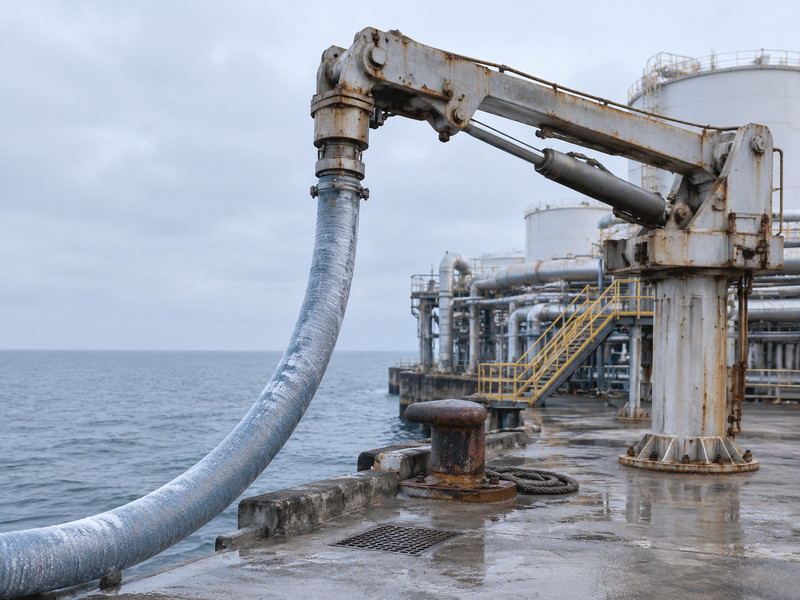
It carries saturated steam from a boiler, a manifold, or a steam main to a point of use. Typical jobs include steam lances, cleaning, heating, and process lines inside a plant. The metal braid lets the hose hold higher steam pressure than a textile-reinforced line, while staying flexible enough to route around equipment and valves.
Does a wire braided steam hose always need steel wire instead of textile?
No. Low-pressure steam service can use a textile-reinforced hose, which ISO 6134 lists with a maximum working pressure of 0.6 MPa (6 bar) at 164 °C. Metal wire becomes necessary when the line runs at the higher pressure class, where the reinforcement must keep its strength at steam temperature. The choice follows the duty.
How many braid layers does a steam hose need?
Layer count follows the pressure class and the bore. Each layer adds capacity, but it also adds weight and stiffness. The correct count is the one the manufacturer assigns to the rated pressure of the assembly, so a replacement should be ordered by the assembly rating rather than by a stored part number.
What does braid angle change in a wire braided steam hose?
Braid angle sets how the wire carries load. A steeper angle, nearer the circumference, raises radial or hoop strength and helps contain pressure. A shallower angle adds axial strength and limits how much the hose elongates under pressure. The angle balance is fixed at the factory, so it has to be settled at the specification stage rather than on site.
Is a wire reinforced hose the same as a braided hose?
Close, but not identical. Wire reinforced hose is the broad term for any hose whose reinforcement is wire. A braided hose is one specific build, where two sets of wires interlace in opposite directions. A spiral hose is a different build that winds the wires one way, which changes flexibility and elongation under pressure.
Why can’t a band clamp be used on a steam hose?
A band clamp or an ordinary clamp compresses the wall and weakens the connection. ISO 6134 uses metal hose fittings for steam service, and substituting a clamp lowers the assembly rating. Bolt-type safety clamps are the common answer because they grip the hose without crushing the reinforcement. The fitting must anchor the braid so the load passes through it.
How does the braid handle static electricity?
Steam flow generates static charge inside the hose. A metal braid bonded to the tube and joined to metal fittings acts as a conductive path. Charge moves from the inner tube to the fitting and then to ground. ISO 8031 covers the electrical properties of hoses and assemblies, so the same wire that carries pressure also carries charge.
Does more braid density always mean a better steam hose?
Not always. A denser braid carries more load and resists crushing better, but it also makes the hose stiffer and heavier. Very high density can reduce flexibility enough to harm routing and handling. Density should match the pressure class and the way the hose is used, not simply be pushed to a maximum.
What should I check before I order a metal braid for a high-pressure steam line?
Start from the saturated steam temperature at the line pressure, because the two move together. Then compare that temperature with the rating of the braided construction you plan to use. A hose rated only on pressure can still exceed its temperature limit. The pressure and the temperature must be read as one pair, not as separate numbers.
When should a wire braided steam hose be replaced?
Replace it when the cover shows deep cracks, when the wire is exposed or broken, or when the hose kinks at a bend that used to run straight. Leaks at the fitting and bulges under pressure are also end-of-life signs. Draining condensate after each use limits internal attack and helps the hose reach its expected service life.
About HENGHUA
HENGHUA makes hoses and fittings for distributors, retailers, and OEM brands worldwide. The steam hose line uses an EPDM inner tube with a textile or steel wire reinforcement layer, and the cover is pin-pricked for steam service. Two steam products are listed on the site: an EPDM steam hose rated to 170 °C and an EPDM high-temperature steam hose rated to 230 °C. End fittings can be supplied as clamp-type safety couplings, flanges, or threaded ends. The factory also offers assembled hoses, custom lengths, jacket printing, private label, and OEM or ODM work. Commercial terms are factory-direct pricing, short batch lead times, and warranty.
Standards referenced: ISO 6134:2024 (steam hose types and pressure limits), ISO 1402, ISO 8031, ISO 8033, ISO 4023, and ISO 10619-1 (assembly, electrical, adhesion, and bend testing). Steam values follow the IAPWS-IF97 saturated steam table.
 English
 Spanish
 Portuguese
 French
 German
 Arabic
 Russian
 Indonesian
 Japanese
 Korean