
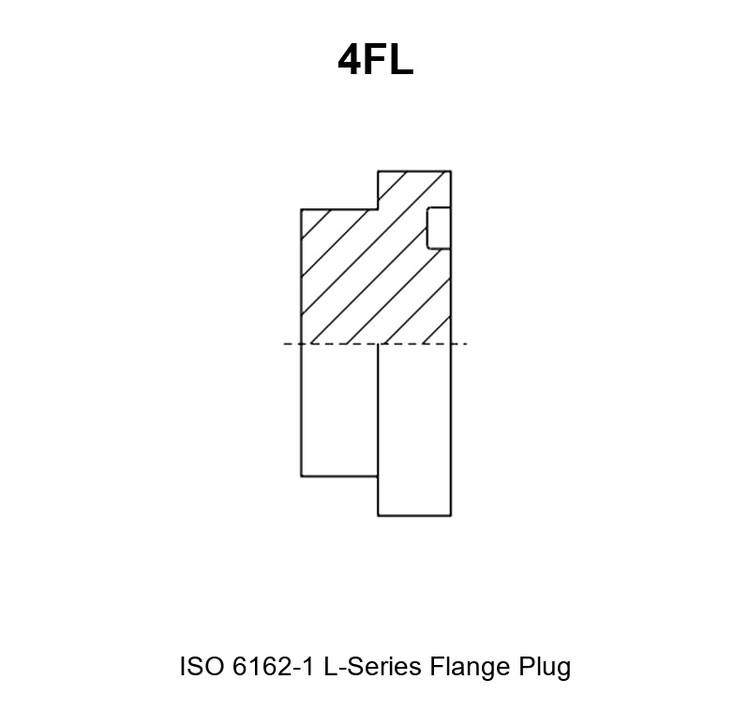
El adaptador 4FL es un tapón de brida de cuatro pernos de la serie L según la norma ISO 6162-1. Cierra un puerto de brida mecanizado según el patrón de cuatro tornillos de la serie L, código 61, de modo que se pueda tapar una bomba, un bloque de válvulas, un colector o una manguera sin afectar al resto de la conexión. Solo tiene una conexión: una superficie de brida que se asienta sobre el puerto.
La superficie de la brida debe coincidir exactamente con las dimensiones del orificio en cuanto al tamaño de la brida, la disposición de los pernos, el diámetro del espigón y la junta tórica, ya que la estanqueidad de la unión se consigue mediante una junta tórica de elastómero sujeta entre la superficie de la brida y la del orificio. Esa coincidencia exacta es la condición previa para eliminar las fugas en el orificio taponado.
Principio de estanqueidad de esta serie: el tapón se sella mediante una junta tórica en la superficie de la brida. No hay rosca en la zona de estanqueidad, por lo que no se compensa nada al apretar y no se utiliza sellador de roscas. Cuatro pernos sujetan la brida contra la cara del puerto y comprimen la junta tórica en su ranura. A diferencia de un adaptador roscado, en esta unión no hay sellador ni ángulo de apriete.
Ventajas principales
- Oculta un puerto de brida del código 61 con una sola pieza, en lugar de un par de bridas, una placa de obturación y una junta separada.
- Sello de junta tórica, por lo que al apretar los tornillos se comprime un sello de elastómero de forma controlada, en lugar de depender de la interferencia de la rosca.
- Ocho tamaños de bridas de la serie L en una sola serie, desde 1/2″ hasta 3″.
- Cabeza con brida hexagonal, lo que permite sujetar o extraer el tapón con una llave durante el mantenimiento.
- Acero al carbono con recubrimiento de zinc y cromo trivalente; disponible en acero inoxidable 304 o 316 para aplicaciones corrosivas y en alta mar.
- Cada lote se comprueba según el plano mediante calibres y controles dimensionales antes de su embalaje.
1. Para qué sirve un adaptador 4FL
El adaptador 4FL es un adaptador hidráulico para un puerto de brida de cuatro pernos de la serie L según la norma ISO 6162-1. Sustituye al extremo de manguera o tubo con brida que normalmente se acopla al puerto y cierra dicho puerto, convirtiéndolo en un extremo ciego.
El tapón tiene una cara con brida que presenta una ranura para la junta tórica debajo de la cabeza y un vástago cilíndrico liso. El vástago se introduce en el orificio, la cara de la brida se asienta sobre la cara del orificio y los cuatro pernos sujetan ambas caras entre sí. La junta tórica indicada para ese tamaño se encarga del sellado, por lo que la carga de los pernos tiene una única función: mantener unidas las caras.
Las razones más habituales para tapar un puerto son la puesta en servicio de un colector con estaciones sin utilizar, el aislamiento de un ramal durante el mantenimiento y la realización de pruebas de presión en un bloque con una salida cerrada.
Dado que la unión se realiza mediante una superficie de brida y no mediante una rosca, el límite de trabajo del tapón viene determinado por la serie de bridas, el tamaño de la brida, la calidad de los pernos utilizados y la clase de presión indicada para ese tamaño, y no por el par de apriete de la rosca.
Esta serie pertenece a la familia de bridas de cuatro pernos de la norma ISO 6162-1, la serie L, conocida como código 61. La serie S, para presiones más altas, código 62, es una norma independiente, la ISO 6162-2, con dimensiones de brida diferentes y su propia serie de tapones.
2. Especificaciones del 4FL
2.1 Conexión 1: cara de brida de cuatro pernos de la serie L según la norma ISO 6162-1
- Norma y familia de bridas: ISO 6162-1, serie L (código 61), brida de cuatro pernos.
- Gama de tamaños de brida disponible: de 1/2″ a 3″, en los incrementos que figuran en la tabla 2.5.
- Tipo/forma: conector macho con cabeza con brida, una ranura para junta tórica y un vástago cilíndrico liso que se introduce en el puerto.
- Método de estanqueidad: junta tórica de elastómero comprimida entre la superficie de la brida y la superficie del orificio; no hay rosca en la zona de estanqueidad.
- Norma de conexión: conexión con brida de cuatro tornillos de la serie L según la norma ISO 6162-1, con la disposición de cuatro tornillos y el orificio cónico correspondiente al tamaño de la brida.
2.2 Conexión 2: extremo cerrado (sin salida)
- Norma y familia de bridas: ninguna. El segundo extremo es un cabezal cerrado macizo.
- Gama de tamaños disponible: la cabeza cerrada está formada por la cabeza de brida, por lo que sigue los mismos tamaños de brida, de 1/2″ a 3″, que la conexión 1.
- Género/forma: cerrado, no es un puerto. No hay una segunda conexión, ni salida, ni orificio de paso.
- Método de sellado: no aplicable en este extremo; el cuerpo del tapón es macizo.
- Norma del puerto de acoplamiento: no aplicable. Este extremo cuenta con la ranura hexagonal que sirve para sujetar el conector.
Las conexiones 1 y 2 se consideran bloques simétricos únicamente en el sentido de que la conexión 1 es el lado de sellado y la conexión 2 es el lado cerrado. El adaptador 4FL tiene un solo extremo conectable, por lo que el comprador debe especificar el tamaño de la brida una sola vez, consultando la columna «TAMAÑO DE LA BRIDA» de la tabla 2.5.
2.3 Construcción y materiales
El cuerpo se mecaniza a partir de una barra en tornos CNC; el vástago, la superficie de la brida, la ranura para la junta tórica y la cabeza hexagonal se tornean en una sola operación, de modo que el vástago permanezca concéntrico con respecto a la superficie de la brida y a los orificios para los pernos.
- Material del cuerpo: acero al carbono de serie; acero inoxidable 304 o acero inoxidable 316 bajo pedido; latón para determinados tamaños.
- Recubrimiento y acabado: recubrimiento de cromo trivalente y zinc (Cr³⁺) para acero al carbono como estándar; recubrimiento de zinc-níquel disponible. El espesor del recubrimiento y la resistencia a la corrosión se confirman en cada pedido, en lugar de publicarse como un valor genérico.
- Opciones de material para la junta tórica: NBR, FKM (tipo Viton) y EPDM, seleccionadas en función del fluido y la temperatura de la conexión.
- Proceso de mecanizado: torneado de barra, conformación de la cara de la brida y de la ranura para la junta tórica, y comprobación de que se ajustan al plano.
- Característica destacada: una cabeza con reborde hexagonal que permite sujetar el tapón con una llave, además de la ranura para la junta tórica situada debajo del reborde y el vástago liso. Esta serie no cuenta con la característica de pasamuros.
2.4 Presión y temperatura
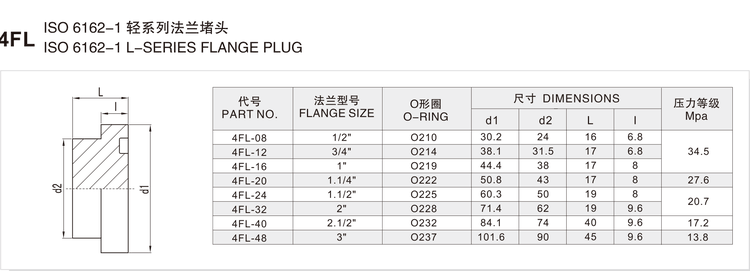
A diferencia de un adaptador roscado, el adaptador 4FL incluye en el catálogo la clase de presión impresa para cada tamaño de brida. Los valores que figuran en la tabla de referencia son 34,5 MPa para los modelos 4FL-08 a 4FL-16, 27,6 MPa para los modelos 4FL-20 y 4FL-24, 20,7 MPa para el 4FL-32, 17,2 MPa para el 4FL-40 y 13,8 MPa para el 4FL-48. Estas son las clases indicadas para los tamaños de brida de la serie L, y disminuyen a medida que aumenta el tamaño de la brida.
La clase de presión no es la única variable. La presión que puede soportar un orificio taponado también depende del grado y la longitud del perno, del estado de la superficie del orificio, del compuesto de la junta tórica, de la temperatura del fluido y del material del cuerpo. Para un servicio superior a la clase indicada, en el caso de cuerpos de acero inoxidable o de una combinación especial, el departamento de ingeniería de HENGHUA confirma la presión de trabajo para cada pedido, basándose en el tamaño de la brida, la calidad de los pernos, el método de sellado y el material seleccionado.
La temperatura es una cuestión relevante y se indica aquí como un dato relevante. En el caso de las juntas tóricas de NBR, el rango de trabajo es de aproximadamente -30 °C a +100 °C. En el caso de las juntas tóricas de FKM (tipo Viton), es de aproximadamente -20 °C a +200 °C. En el caso de las juntas tóricas de EPDM, es de aproximadamente -40 °C a +120 °C. Seleccione el compuesto en función del fluido y de la temperatura de servicio.
El acero al carbono con recubrimiento de zinc es adecuado para aplicaciones hidráulicas generales; especifique acero inoxidable 304 o 316 para entornos corrosivos o en alta mar.
2.5 Tabla de referencias y dimensiones
La tabla que figura a continuación muestra la gama completa de tamaños de la serie 4FL. Todas las dimensiones están expresadas en milímetros; la clase de presión, en megapascales.
| N.º DE PIEZA. | TAMAÑO DE LA BRIDA | JUNTA TÓRICA | d1 | d2 | L | l | Mpa |
|---|---|---|---|---|---|---|---|
| 4FL-08 | 1/2″ | O210 | 30.2 | 24 | 16 | 6.8 | 34.5 |
| 4FL-12 | 3/4″ | O214 | 38.1 | 31.5 | 17 | 6.8 | – |
| 4FL-16 | 1″ | O219 | 44.4 | 38 | 17 | 8 | – |
| 4FL-20 | 1,1/4″ | O222 | 50.8 | 43 | 17 | 8 | 27.6 |
| 4FL-24 | 1,1/2″ | O225 | 60.3 | 50 | 19 | 8 | – |
| 4FL-32 | 2″ | O228 | 71.4 | 62 | 19 | 9.6 | 20.7 |
| 4FL-40 | 2.1/2″ | O232 | 84.1 | 74 | 40 | 9.6 | 17.2 |
| 4FL-48 | 3″ | O237 | 101.6 | 90 | 45 | 9.6 | 13.8 |
What each column means
- N.º DE PIEZA. – the HENGHUA part number. The prefix
4FLmeans a four-bolt flange plug in the ISO 6162-1 L series, followed by the flange size code. - TAMAÑO DE LA BRIDA – the nominal flange size of the port the plug closes, from 1/2″ to 3″.
- JUNTA TÓRICA – the O-ring designation listed for that flange size. Order the O-ring with the plug, and state the compound required.
- d1 – the first diameter marked on the series drawing, in millimetres, printed from 30.2 mm at 4FL-08 to 101.6 mm at 4FL-48.
- d2 – the second diameter marked on the series drawing, in millimetres, printed from 24 mm at 4FL-08 to 90 mm at 4FL-48.
- L – the overall length of the plug from the flange face to the top of the head, in millimetres.
- l – the flange thickness of the head, in millimetres.
- Mpa – the pressure class printed for that flange size in megapascals. In the printed catalogue the column uses merged cells: one value covers a group of rows, and the continuation rows are left blank, here shown as a dash. Where a cell carries a dash, the value printed in the same merged group applies.
Note on the two diameters: the drawing shows a spigot diameter and a flange head diameter, and the printed d1 and d2 values must be read with the drawing. The d1 values follow the published L-series flange size steps from 1/2″ to 3″. Before ordering, confirm the spigot diameter and the flange face diameter against your port drawing; HENGHUA engineering verifies the pair for your flange size on request.
Flange size and size code chart
| Size code | Tamaño de la brida | O-ring listed |
|---|---|---|
| 08 | 1/2″ | O210 |
| 12 | 3/4″ | O214 |
| 16 | 1″ | O219 |
| 20 | 1,1/4″ | O222 |
| 24 | 1,1/2″ | O225 |
| 32 | 2″ | O228 |
| 40 | 2.1/2″ | O232 |
| 48 | 3″ | O237 |
The O-ring is a service item. Replace it whenever the plug is removed and refitted, and never fit a dry or stretched O-ring that has been stored loose.
3. How to Read a 4FL Part Number
A 4FL part number has two elements: the series prefix and the flange size code. This series does not use the sealing or geometry suffixes seen on other families, such as -SP, -WD, -PK, -04 or -9, because the plug has one flange connection and one closed end.
The prefix 4FL identifies the family: a plug with an ISO 6162-1 L-series four-bolt flange face. A different prefix in the same catalogue identifies a different geometry, such as the S-series flange plug, a threaded plug for an NPT or JIC connection, or an elbow or tee version of another family.
The size code is the flange size code. Worked example: 4FL-24.
4FL– flange plug, ISO 6162-1 L series, code 61.24– the 1.1/2″ flange size.- From the table: the O-ring is O225, d1 is 60.3 mm, d2 is 50 mm, L is 19 mm, l is 8 mm and the printed pressure class is 20.7 MPa.
A buyer ordering 4FL-24 therefore receives a plug for a 1.1/2″ code 61 flange port, and must supply four bolts of the correct grade and length for that port, plus the O225 O-ring in the required compound.
Check the abbreviation carefully: L series and S series both use a flange plug, but they are different standard series with different flange dimensions and different pressure classes, and the two do not interchange.
4. Instalación y montaje
A flange joint is assembled dry and clamped, not turned. HENGHUA does not print a single bolt torque figure for the series, because the correct torque depends on the bolt grade, the bolt size and the port material. Tighten to the bolt supplier’s recommendation for the grade and size used, or confirm the figure with HENGHUA engineering per order. Bring the four bolts up evenly by hand first, then tighten in stages, alternating across the flange, so the face stays square to the port.
O-ring handling: fit the correct O-ring for the flange size, in the compound selected for the fluid and temperature. Check the O-ring for cuts, flat spots and hardening before fitting, seat it in the groove without twisting it, and keep it clean and free of grit. Never reuse an O-ring that has seen service, and never fit two O-rings in one groove to make up a gap.
Face condition: both faces must be flat and clean. A burr, a paint run or a raised scratch prevents the O-ring from compressing evenly, and the joint will weep at first pressure no matter how hard the bolts are tightened.
No thread sealant: there is no thread in this joint. Do not apply thread tape, thread sealant or gasket compound to the flange face. Light oil on the spigot is enough to allow it to enter the port without scuffing.
Contamination control: cap the plug and the port whenever the joint is open, and keep the O-ring in its packaging until the moment of fitting. Debris that lands in the groove cuts the O-ring on first clamping.
Alignment and reuse: bring the plug squarely into the port before fitting any bolt, and check that the spigot enters without force. The body and the bolt holes can be reused if the flange face is undamaged and the head is not deformed; the O-ring is always a new part.
Errores habituales en el montaje y sus síntomas:
- Fitting an S-series plug into an L-series port, or the reverse. Symptom: the bolt holes or the spigot do not line up, and the plug sits proud of the port face.
- Missing or incorrect O-ring. Symptom: a steady weep around the flange face as soon as the port is pressurised.
- Tightening one bolt fully before the others. Symptom: the flange cocks, the O-ring is pinched on one side and the joint seeps from a single point.
- Reusing a hardened O-ring. Symptom: a leak that appears only when the circuit is cold, or that returns days after assembly.
- Paint, swarf or a raised scratch on the port face. Symptom: an intermittent weep that cannot be cured by further tightening.
Six-step assembly
- Confirm the part number and flange size against the port, and check that the port is an ISO 6162-1 L-series pattern.
- Clean the port face, the spigot and the O-ring groove, and inspect the face for burrs and damage.
- Fit a new O-ring of the correct size and compound, seated squarely in the groove.
- Bring the plug squarely into the port and check the spigot enters freely.
- Fit the four bolts by hand, then tighten them in stages, alternating across the flange.
- Pressurise the circuit, check the flange face for weeping, and re-check the bolt load after the first thermal cycle.
5. Aplicaciones y sectores industriales
Application tags for this series: hydraulic systems, water jetting, oil and gas, industrial equipment, construction machinery, agriculture, marine, material handling.
Commissioning and isolation of manifold ports. A manifold ordered with more stations than the first build needs is commissioned with the spare ports blanked. Hydraulic plug adapters close each unused station, keep the port protected from contamination and allow the station to be opened later without changing the manifold.
Repair and replacement work. When a flanged hose or tube end has to come off a machine for repair, the port can be closed with a 4FL adapter so the rest of the circuit stays in service. This keeps the oil in the system and keeps dirt out of the open port.
Pressure and leakage testing. Test benches use flange plugs to close the outlets of a block that is being pressurised. Because the joint seals on an O-ring at a clamped face rather than on a thread, the same plug can be removed and refitted repeatedly, with a new O-ring each time.
Transport and storage protection. Equipment shipped with open flange ports is protected with hydraulic plug adapters so that the face and the spigot bore are not damaged in transit.
6. Guía de recambios y referencias cruzadas
Cross-reference for this series is organised by standard and sealing method, never by brand. Two hydraulic adapters interchange only if the standard series, the flange size, the bolt pattern and the sealing method all match.
The 4FL series is an ISO 6162-1 L-series, code 61, flange plug with an O-ring face seal. It is not interchangeable with an ISO 6162-2 S-series, code 62, plug, even at the same nominal size, because the flange dimensions, the bolt pattern and the pressure class differ between the two standards. It is also not a threaded part: nothing in this series seals on a thread, so a threaded plug and a flange plug are never substitutes for one another.
To identify the correct replacement, measure three things.
- Flange size and bolt pattern. Measure the bolt hole centre spacing and the bolt hole diameter, and count the holes. Compare the pattern with the L-series dimensions for the flange size. If the spacing matches code 62 instead of code 61, the port is S series and this plug will not fit.
- Spigot and O-ring. Measure the spigot diameter and the O-ring groove, and identify the O-ring by its inside diameter and cross section. A plug with the correct bolt pattern but the wrong spigot or O-ring will bolt up and still leak.
- Sealing method. Confirm that the port seals on an O-ring at a clamped flange face, which is what makes this a flange adapter rather than a thread adapter. If the port in front of you is threaded, or relies on a metal cone, the part you need belongs to a different family.
Record the three measurements with the part number, and HENGHUA can match the replacement to the series and size code from the printed table in section 2.5.
7. Pedidos, embalaje y entrega
To order the 4FL adapter, give the following information:
- Series code:
4FL. - Full part number, for example 4FL-24, taken from table 2.5.
- Flange size and the standard series it must match, in this case ISO 6162-1 L series (code 61).
- O-ring requirement, including the compound: NBR, FKM or EPDM.
- Body material and plating: carbon steel with trivalent chromium zinc plating, zinc-nickel plating, or 304 or 316 stainless steel.
- Bolt grade and bolt length, if HENGHUA is also to supply the fasteners.
- Quantity, destination and packing format.
Packaging formats: bulk cartons for line-side consumption, small boxes for distributor shelves, and labelled bags for service kits. Labelling carries the part number, the flange size, the O-ring designation and the quantity. O-rings are packed separately from the plugs unless a kitted assembly is requested.
Sample orders: validation samples and first-article parts are available for OEM programmes, including drawing-based manufacture of specials where the printed table does not cover the required combination.
Lead time is confirmed per order, because it depends on the flange size, the material, the plating and the quantity. Send the requirement with the quantity and the required date, and HENGHUA confirms the schedule with the quotation. As a hydraulic adapter manufacturer and hydraulic adapter supplier, HENGHUA can quote the flange adapter, the O-ring and the fasteners as one kit.
8. Preguntas frecuentes
What is the difference between JIC 37° flare and ORFS, and which should I use?
A JIC 37° flare joint seals metal-to-metal on a 37° conical flare face under SAE J514. An ORFS joint seals a flat face against an elastomeric O-ring under SAE J1453. Neither is a flange joint. A four-bolt flange joint, which is what the 4FL series uses, seals with an O-ring in a flange groove under ISO 6162. Choose the family that matches the port already on the equipment.
Can NPT and BSPT be interchanged?
No. NPT is a 60° taper pipe thread under ANSI/ASME B1.20.1 and BSPT is a 55° taper pipe thread under ISO 7-1, so the thread form, angle and pitch differ and the two will not seal. This question does not apply to the 4FL series, because a flange plug has no thread at all. It matters when a threaded port has to be blanked, in which case order the correct threaded plug series instead.
How do I identify the correct 4FL size?
Measure the bolt hole centre spacing and the bolt hole diameter of the port, then match that pattern and the nominal flange size to the FLANGE SIZE column of table 2.5. Confirm at the same time that the pattern is code 61 and not code 62. When the flange size and the standard series both match a printed row, that row is the correct part number.
Which O-ring and material should I select?
Take the O-ring designation from the O-RING column of table 2.5 for the flange size, then choose the compound for the fluid and temperature: NBR for general mineral hydraulic oil in the range of approximately -30°C to +100°C, FKM (Viton-type) for higher temperatures up to approximately +200°C, and EPDM for water and water-based fluids in the range of approximately -40°C to +120°C. Fit a new O-ring each time the plug is refitted.
How is the working pressure of this plug determined?
The catalogue prints a pressure class for each flange size in this series, from 34.5 MPa at the small sizes down to 13.8 MPa at 3″, and that printed class is the starting point. The pressure the joint can hold in service also depends on the bolt grade and bolt length, the port face condition, the O-ring compound, the fluid temperature and the body material. For stainless steel bodies, special combinations or duty above the printed class, working pressure is confirmed per order by HENGHUA engineering, based on the flange size, bolt grade, sealing method and material selected.
What is the minimum order quantity and can I get samples?
Minimum order quantity depends on the flange size, the material and the plating, so it is confirmed with the quotation rather than published as one series figure. Samples and validation parts are available for OEM and distributor evaluation, including specials made to a drawing.
Does the 4FL adapter come with the O-ring and the bolts?
The 4FL adapter is quoted as a body, and the O-ring and the four bolts are separate items. Confirm the O-ring compound and, if required, the bolt grade and length when ordering, and state whether a kitted assembly is wanted. Stating all three when ordering a flange adapter keeps one size code matched to one port.
Can I use a code 62 plug in a code 61 port?
No. ISO 6162-1 L series (code 61) and ISO 6162-2 S series (code 62) are different flange standards with different flange dimensions, bolt patterns and pressure classes. Even where a size looks close, the faces and holes will not line up correctly, and forcing a fit loads the O-ring unevenly. Match the series first, then the flange size.
Send your requirement to HENGHUA
Send the part number, the flange size and standard series, the O-ring compound, the material and plating, and the quantity. HENGHUA confirms the match to the printed table, the seal options and the delivery schedule, and quotes the 4FL adapter that closes your port.
Related series in the same family: the 4FS adapter (flange) and the 4J adapter (plug). Browse the full Hydraulic Adapters range for the complete SAE J514 JIC, NPT, ORFS and ISO 6162 flange families.



 English
 Spanish
 Portuguese
 French
 German
 Arabic
 Russian
 Indonesian
 Japanese
 Korean