
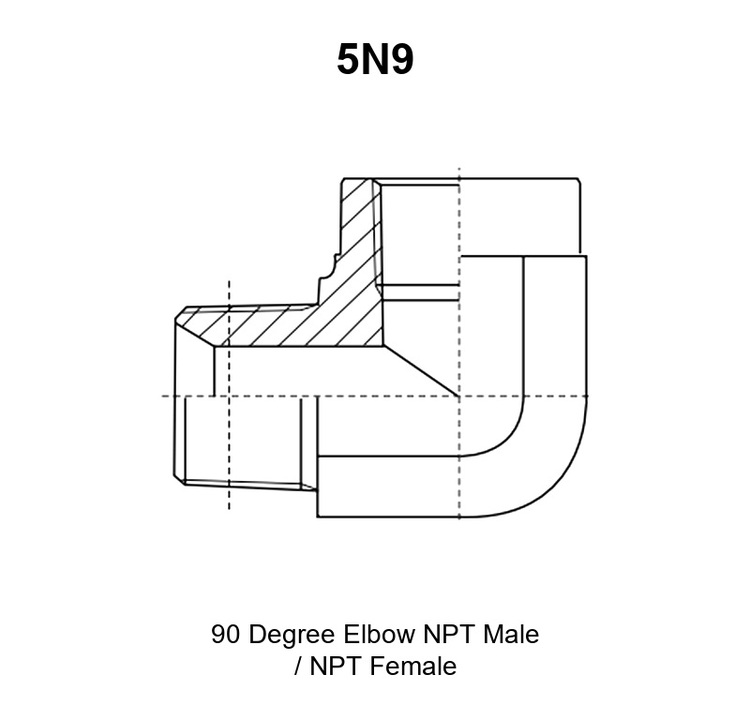
The 5N9 adapter is a hydraulic conversion adapter in the form of a one-piece 90° elbow, with an NPT male end on the horizontal leg and an NPT female tapped port on the vertical leg. It turns a taper pipe thread connection through a right angle, which keeps a hose or pipe run inside the machine envelope. Both ends are taper pipe threads, so both seal on the thread flanks and both require a suitable thread sealant.
Ventajas principales
- 90° elbow machined as one body, so a pipe thread run turns a corner without an extra fitting.
- NPT male end on one leg and NPT female tapped port on the other, on the same taper pipe thread standard.
- Thirteen catalogue rows from Z1/8″x27 up to Z2″x11.5, with combination rows for reducing elbows.
- Hex on the body so the elbow can be held while both ends are tightened and aligned.
- Carbon steel with trivalent chromium zinc plating, or 304 / 316 stainless steel for corrosive and marine duty.
- Machined from bar stock on CNC lathes with thread gauges applied batch by batch before packing.
1. What a 5N9 Adapter Does
A 5N9 adapter joins an NPT male taper pipe thread to an NPT female tapped port at 90°. As an elbow hydraulic adapter it is chosen for its envelope as much as for its thread sizes: one leg carries the external taper thread that screws into the port, the other leg carries the internal taper thread that accepts a mating nipple, and fluid turns through the elbow, so the part is used wherever a straight pipe thread connection would not fit the space available.
Both ends must match their mating parts exactly, because that is the precondition for eliminating leakage at the conversion point. A taper pipe joint does not seal on a seat, a flare or an O-ring: it seals on the interfering thread flanks. The 5N9 adapter therefore has to carry the correct NPT thread form, pitch and size on both legs, and both threads have to be engaged with the right sealant.
The sealing principle of this hydraulic conversion adapter is thread-flank sealing on both connections. Screwing the male taper thread into the female taper thread makes the flanks interfere progressively along the taper, and the joint becomes pressure-tight when a sealant suited to the fluid is present on the threads. The female end is a tapped port, an internally threaded hole in the elbow body, not a swivel nut.
Two practical points follow from that principle. The first is orientation: because a taper thread seats by engagement, the angle at which the male leg finally tightens also sets the direction the female leg points, so the outlet direction is planned as part of assembly. The second is standard discipline: NPT and BSPT must never be interchanged, because the two taper threads are built to different standards and will not seal in each other’s ports.
2. 5N9 Specifications
2.1 Connection 1 – NPT male taper pipe thread
- Thread standard and family: taper pipe thread per ANSI/ASME B1.20.1 (NPT), with the dryseal NPTF form covered by SAE J476. The catalogue writes the thread with the
Zprefix, soZ1/2"X14means a 1/2″ NPT thread with 14 threads per inch. - Thread size range: Z1/8″x27, Z1/4″x18, Z3/8″x18, Z1/2″x14, Z3/4″x14, Z1″x11.5, Z1.1/4″x11.5, Z1.1/2″x11.5 and Z2″x11.5, across the 13 catalogue rows, so the male leg of this NPT adapter covers the range on a single thread standard.
- Gender: male, external taper thread on the horizontal leg as drawn.
- Sealing method: thread-flank sealing with a sealant suited to the fluid. There is no O-ring, no cone seat and no flange face in this joint.
- Mating port standard: an NPT or NPTF female taper pipe port of the same nominal size. NPT and BSPT must never be interchanged: BSPT follows ISO 7-1, and its thread form and pitch differ from NPT.
2.2 Connection 2 – NPT female tapped port
- Thread standard and family: taper pipe thread per ANSI/ASME B1.20.1, with the dryseal NPTF form covered by SAE J476.
- Thread size range: the same NPT family, from Z1/8″x27 to Z2″x11.5, so the series covers same-size and reducing elbows.
- Gender: female. The vertical leg is a tapped port, an internally threaded taper hole machined into the elbow body.
- Sealing method: thread-flank sealing, identical in principle to the male leg. The mating male nipple is screwed into the tapped port and the joint is made tight with a fluid-compatible sealant.
- Mating port standard: an NPT or NPTF male taper pipe thread of the same nominal size.
Where both legs carry the same thread size, the row is a plain 90° elbow with a single size group in the part number. Where the legs differ, the part number carries two groups, the first for the male leg and the second for the female leg.
2.3 Construction and Materials
The elbow is machined from bar stock as one piece on CNC lathes, so the male thread, the tapped port, the two legs and the hex are produced in a single part with no brazed or welded corner in the pressure path. That matters on an elbow, because a joint or a weld at the corner would add a second sealing path in a part whose purpose is to change direction. Both threads are cut to the taper pipe thread form of their size and are gauged before packing.
Carbon steel is the standard body material, with trivalent chromium zinc plating (Cr3+) for general hydraulic service and zinc-nickel plating available where a harder deposit is preferred. For corrosive and offshore duty, 304 stainless steel and 316 stainless steel are the alternative body grades, and brass is available for selected sizes and compatible duties.
The series carries no elastomeric seal of its own, because both connections seal on the thread flanks. Hex width S1 is machined on the body to suit the size, and there is no lock nut, bulkhead feature or swivel, so this thread adapter is rigid and the outlet direction is set by the final engagement of the male thread.
2.4 Pressure and Temperature
The printed table for this series carries no pressure column, so no per-size working pressure is quoted here. Working pressure for these sizes is confirmed per order by HENGHUA engineering, based on the thread size, the sealing method and the material selected. Size, wall thickness of the body, thread form on both legs and body material all govern the result, and the taper pipe thread joint is usually the practical limit on the line.
Temperature range follows the body material and the sealant, because there is no soft seal in the body. As material facts: carbon steel with zinc plating suits general hydraulic service, 304 and 316 stainless steel are selected for corrosive environments, and brass is available for compatible duties. The thread sealant is selected for the fluid and the operating temperature, and where the wider circuit uses O-rings, that compound sets its own envelope: NBR approximately -30°C to +100°C, FKM approximately -20°C to +200°C, and EPDM approximately -40°C to +120°C.
2.5 Part Number and Dimension Table
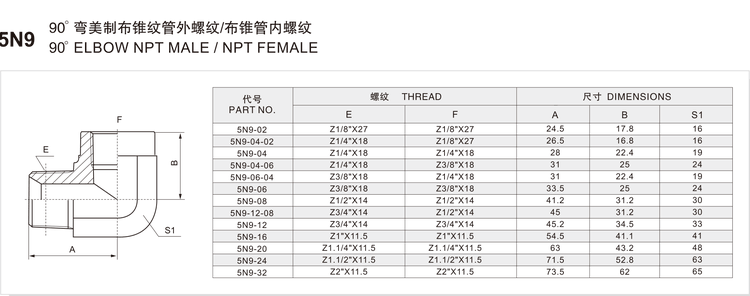
| N.º DE PIEZA. | E | F | A | B | S1 |
|---|---|---|---|---|---|
| 5N9-02 | Z1/8″X27 | Z1/8″X27 | 24.5 | 17.8 | 16 |
| 5N9-04-02 | Z1/4″X18 | Z1/8″X27 | 26.5 | 16.8 | 16 |
| 5N9-04 | Z1/4″X18 | Z1/4″X18 | 28 | 22.4 | 19 |
| 5N9-04-06 | Z1/4″X18 | Z3/8″X18 | 31 | 25 | 24 |
| 5N9-06-04 | Z3/8″X18 | Z1/4″X18 | 31 | 22.4 | 19 |
| 5N9-06 | Z3/8″X18 | Z3/8″X18 | 33.5 | 25 | 24 |
| 5N9-08 | Z1/2″X14 | Z1/2″X14 | 41.2 | 31.2 | 30 |
| 5N9-12-08 | Z3/4″X14 | Z1/2″X14 | 45 | 31.2 | 30 |
| 5N9-12 | Z3/4″X14 | Z3/4″X14 | 45.2 | 34.5 | 33 |
| 5N9-16 | Z1″X11.5 | Z1″X11.5 | 54.5 | 41.1 | 41 |
| 5N9-20 | Z1.1/4″X11.5 | Z1.1/4″X11.5 | 63 | 43.2 | 48 |
| 5N9-24 | Z1.1/2″X11.5 | Z1.1/2″X11.5 | 71.5 | 52.8 | 63 |
| 5N9-32 | Z2″X11.5 | Z2″X11.5 | 73.5 | 62 | 65 |
What each column means:
- PART NO. – the HENGHUA catalogue number.
5N9is the series code, followed by the size code of the male leg and, where the legs differ, the size code of the female leg. - E – the external (male) taper pipe thread on the horizontal leg, written with the
Zprefix, for example Z1/2″X14. - F – the internal (female) taper pipe thread of the tapped port on the vertical leg, also written with the
Zprefix. - A – the length from the male thread end to the centre line of the vertical leg, in mm, as drawn.
- B – the length from the female end face to the centre line of the horizontal leg, in mm, as drawn.
- S1 – the across-flats width of the hex on the body, in mm, for holding with a wrench.
Thread size and dash chart, read from the same table:
| Size code | NPT thread | Threads per inch | Rows using it |
|---|---|---|---|
| -02 | 1/8″ | 27 | 5N9-02, 5N9-04-02 |
| -04 | 1/4″ | 18 | 5N9-04-02, 5N9-04, 5N9-04-06, 5N9-06-04 |
| -06 | 3/8″ | 18 | 5N9-04-06, 5N9-06-04, 5N9-06 |
| -08 | 1/2″ | 14 | 5N9-08, 5N9-12-08 |
| -12 | 3/4″ | 14 | 5N9-12-08, 5N9-12 |
| -16 | 1″ | 11.5 | 5N9-16 |
| -20 | 1.1/4″ | 11.5 | 5N9-20 |
| -24 | 1.1/2″ | 11.5 | 5N9-24 |
| -32 | 2″ | 11.5 | 5N9-32 |
The size steps follow the taper pipe thread series, so order the 5N9 adapter by the NPT size of each leg rather than by an equivalent hose or tube dash number. Note also that A and B are measured to the centre lines of the two legs, so they describe the envelope of the elbow rather than a thread length.
3. How to Read a 5N9 Part Number
5N9 is the series code of this NPT adapter. In the HENGHUA American Adapters numbering the leading digit places the part in the male-to-female adapter family, the letter N identifies the NPT taper pipe thread interface and the trailing 9 marks the 90° elbow configuration, the same way a trailing 4 marks the 45° version in this range. The hyphen and the size groups then carry the size information.
The first size group is the male leg and the second group, where present, is the female leg. The codes follow the NPT sizes in the table: 02 for 1/8″, 04 for 1/4″, 06 for 3/8″, 08 for 1/2″, 12 for 3/4″, 16 for 1″, 20 for 1.1/4″, 24 for 1.1/2″ and 32 for 2″.
Worked example, 5N9-12-08: the male leg is 3/4″ NPT and the female leg is 1/2″ NPT. Reading the row returns male thread E of Z3/4″x14, female thread F of Z1/2″x14, dimension A of 45 mm, dimension B of 31.2 mm and hex S1 of 30 mm. The buyer therefore sees at a glance that this is a reducing 90° elbow with a larger male leg and a smaller female port, and that the body is 30 mm across flats.
4. Installation and Fitment
Both legs tighten on the same principle, and orientation is the extra step that an elbow adds. Apply a sealant suited to the fluid to the male thread, screw the male leg into its port by hand, then tighten it. As the taper thread engages, the angle at which it finally seats fixes the direction of the vertical leg, so plan the outlet direction before the final turns and avoid backing the elbow off after it has seated. On the female leg, apply sealant to the mating nipple and screw it into the tapped port.
No tightening angle is published in this catalogue for the series, so torque practice follows the mating components and the machine specification. Hold the elbow on hex S1 while tightening the male leg, and hold it again on the same hex while tightening the nipple into the tapped port, so neither joint is turned on the opposite leg.
Thread preparation is part of installation of this thread adapter because the joint seals on the flanks. Clean both threads and remove old sealant, apply fresh sealant to the male thread only, and leave the first thread or two clean so excess sealant is not pushed into the fluid path. Keep the tapped port capped until assembly and start every thread by hand before a wrench is applied.
Assembly steps:
- Confirm the two thread sizes from the part number and the table row, male leg first and female leg second.
- Inspect both threads, clean out old sealant and debris, and check the tapped port for damage.
- Apply a fluid-compatible sealant to the male thread that will enter the port.
- Hold the elbow on hex S1, start the male leg by hand and tighten it, setting the final outlet direction as it seats.
- Apply sealant to the mating nipple, start it by hand into the tapped port and tighten it while holding the elbow on S1.
- Pressurise the line and check both legs for weepage before the machine returns to service.
Common fitment errors and their symptoms:
- A BSPT male nipple threaded into the NPT female leg. The joint does not seat on the correct flank form and it leaks under pressure. NPT and BSPT must never be interchanged.
- Backing the elbow off to correct the outlet angle. A taper thread that has been loosened does not re-seal reliably and the joint weeps even after retightening.
- No sealant on either leg. Both joints weep along the thread flanks, because this series has no elastomer and no seat.
- Tightening on the body instead of the hex. The elbow is loaded across the corner and the opposite leg is loosened or over-tightened.
- Excessive sealant. Sealant enters the fluid path, or the thread cannot run in far enough and the elbow stands proud of the port.
- Planning the outlet direction too late. The elbow seats with the female port facing the wrong way and the hose run cannot be made without another fitting.
Reuse policy: the body of a 5N9 adapter may be cleaned and reused if both threads are undamaged and still engage cleanly. Old sealant is removed and new sealant applied at each re-assembly, and a thread that has been cross-threaded, galled or backed off under load is not reused.
5. Applications and Industries
Application tags for the 5N9 series: hydraulic systems, water jetting, oil and gas, industrial equipment, construction machinery, agriculture, marine and material handling.
As an elbow hydraulic adapter, the part is specified in concrete situations such as these:
- Right-angle routing inside a machine envelope. The 5N9 adapter turns the run at the port where a pipe thread port faces a wall, a frame member or another component, and removes the need to bend a hose or pipe in a tight space.
- Gauge and instrument take-off. A pressure gauge, transmitter or test point is often fitted close to a port where a straight connection would stand too far out or foul the guard.
- Repair work on mixed pipe thread circuits. A field repair that has to re-route a line around a new component is simpler with an elbow that changes direction and size in one part.
- Test benches, flushing rigs and manifold builds. The rigid elbow keeps pipework compact and predictable, and the tapped port on the vertical leg accepts an instrument or a nipple directly.
- Distributor stock and OEM assembly. The series is compact enough to hold across the full size range so a right-angle requirement can be met from stock during assembly.
6. Replacement and Cross-Reference Guide
Cross-reference for this NPT adapter is organised by standard, thread size, angle and sealing method, never by brand, because a hydraulic conversion adapter of this type has to match on every one of those points. Four questions decide the correct replacement: which taper pipe thread standard the part follows, which size each leg carries, whether the body is a 90° or 45° elbow, and how the joint is sealed.
Measure these three things before ordering a replacement 5N9 adapter:
- The thread standard. NPT follows ANSI/ASME B1.20.1 with a 60° thread angle, and the dryseal NPTF form follows SAE J476, while BSPT follows ISO 7-1 with a 55° thread form and a different pitch. Check the thread angle and the pitch, because the two families look similar and are not interchangeable.
- The geometry of the legs. Measure from the male thread end to the centre line (A in the table) and from the female end face to the opposite centre line (B), and confirm that the angle between the legs is 90°.
- The thread size at each leg. Measure the outside diameter over the male thread and count the threads per inch to match the E column, and identify the tapped port by its pitch and taper to match the F column.
A practical check is to screw the mating nipple into the tapped port by hand and count the turns, then to check the male leg dry against its port to confirm that it engages by hand before it is sealed and tightened.
7. Ordering, Packaging and Delivery
To order a 5N9 adapter, give the series code, the full part number, both thread sizes, the body material, the plating and the quantity, and state the fluid so the sealant recommendation can be confirmed. A complete line reads, for example: 5N9-12, both legs Z3/4″x14, carbon steel with trivalent chromium zinc plating, quantity 150 pieces.
If a leg combination outside the printed table is required for this elbow hydraulic adapter, send both thread sizes and the intended fluid, and HENGHUA will confirm whether it can be machined and whether the material and plating are available. Samples are available so the thread fit and the outlet geometry can be proven against the customer’s own ports before a production order is placed.
Packaging follows the usual formats for this range, with bulk cartons and part number labels for distributor stock and labelled bags or boxed kits where parts go direct to an assembly line. Each carton records the part number, the two thread sizes, the quantity and the batch reference, and lead time is confirmed per order, because it depends on the thread combination, the material, the plating and the quantity.
8. FAQ
What is the difference between JIC 37° flare and ORFS, and which should I use?
A JIC 37° flare per SAE J514 seals metal to metal on a conical flare face, with a nut drawing the flare into the cone. An ORFS joint per SAE J1453 seals on a flat face against an elastomeric O-ring in a groove. Choose the end that matches the port on the machine. This series uses neither: both of its legs are taper pipe threads and both seal on the thread flanks.
Can NPT and BSPT be interchanged?
No. NPT is defined by ANSI/ASME B1.20.1 with a 60° thread angle, and BSPT is defined by ISO 7-1 with a 55° thread form and a different pitch. The two must never be interchanged or substituted for one another. Where a machine carries BSPT ports, order a BSPT series rather than forcing this NPT adapter into the port.
How do I identify the correct 5N9 size?
Read both legs of the existing 5N9 adapter. Measure the male thread outside diameter and count the threads per inch to find the E value, then identify the tapped port by pitch and taper to find the F value. Where the legs differ, order the row with two size groups, for example 5N9-12-08 for a 3/4″ male leg and a 1/2″ female port.
What seal material should I select for my fluid and temperature?
This series has no elastomeric seal in its body, so the choice is the thread sealant on both legs. Select a sealant compatible with the fluid and the operating temperature, and confirm it against the actual fluid rather than the fluid family name. Where the surrounding circuit uses O-rings, the compound sets the envelope: NBR approximately -30°C to +100°C, FKM approximately -20°C to +200°C, and EPDM approximately -40°C to +120°C.
How is the working pressure of this adapter determined?
The printed table for this series has no pressure column, so no per-size figure is published. Working pressure for these sizes is confirmed per order by HENGHUA engineering, based on the thread size, the sealing method and the material selected. Because the part is an elbow, the body across the bend is assessed together with the two thread joints, and the taper pipe thread joint is usually the practical limit.
What is the minimum order quantity and can I get samples?
Minimum order quantity is confirmed per order, because it depends on the thread combination, the material and whether the row is a catalogue size or a special. Samples are available for validation so the thread fit, the outlet direction and the clearance in the machine envelope can all be checked before a production order. Send both thread sizes and the fluid, and HENGHUA will quote the sample line and the production line together.
Can the outlet direction be adjusted after the elbow is tightened?
Only within the engagement of the taper thread, and it is better to plan the direction before the final tightening. A taper pipe thread seats by flank interference, so the angle at which it seats fixes the direction of the female leg. If the elbow has to be backed off to correct the angle, the joint should be disassembled, cleaned, re-sealed and tightened again rather than loosened in place.
Why choose a 90° elbow instead of a straight adapter and a bend in the hose?
An elbow turns the run at the port and keeps the hose or pipe path short and predictable, which matters where the port faces a frame member, a guard or another component. It also avoids a tight bend radius in the hose, which is better for the hose and for flow. The trade-off is that outlet direction has to be planned during assembly and that this thread adapter makes two joints at one point in the system.
HENGHUA manufactures the 5N9 adapter in 13 catalogue rows from Z1/8″x27 up to Z2″x11.5, with both legs on the NPT taper pipe thread standard. Send the two thread sizes, the body material and the circuit fluid, and HENGHUA will confirm the part number, the finish and the delivery schedule for your inquiry.
Related series in the same family: the 5N adapter (straight) and the 1N9 adapter (90° elbow). Browse the full Hydraulic Adapters range for the complete SAE J514 JIC, NPT, ORFS and ISO 6162 flange families.


 English
  Spanish
  Portuguese
  French
  German
  Arabic
  Russian