

Steam curing concrete hardens precast units in a warm, saturated chamber instead of waiting on weather. Steam delivers heat and moisture together at 40–70 °C, so a mix reaches stripping strength in hours rather than days. This guide covers the four-stage regime, the 150 °F ceiling that guards against DEF, and the hose that feeds the chamber.
Pressures are gauge pressures at the hose outlet; saturated-steam temperatures are the saturation temperature at that pressure. About 16 min read.
Figure 1. Precast units curing inside a saturated steam chamber at atmospheric pressure.
Why Steam Curing Concrete Works
Concrete does not dry into strength; it reacts into strength. Cement grains hydrate and grow crystals that lock the aggregate together, and warmth speeds that chemistry along. Steam delivers heat and moisture at the same time, so the reaction accelerates without the surface drying out.
Moisture matters as much as warmth. A curing chamber is held near 100% relative humidity because the point of steam is to deliver heat without drying the concrete. Dry heat would pull water from the mix and stall the reaction at the surface.
That combination explains why steam curing is chosen over dry heating. Saturated steam condenses on cool concrete and releases latent heat straight into the surface. The unit warms through its own skin rather than through hot air alone.
The industrial version of this process uses a boiler and a distribution line, not a kettle. Saturated steam arrives at low pressure and spreads until the chamber air is uniformly warm and wet. The result is a controlled climate instead of a hot spot.
Every element in that line matters once the chamber fills. A steam hose that kinks or sheds heat can spoil an otherwise fine schedule. The EPDM saturated-steam hose page covers the material science behind the tube and cover.
Scope. This method applies to precast elements cured at atmospheric pressure inside a sealed curing chamber, whether a fixed room or a tarped frame, held near 100% relative humidity and stripped to a plant schedule. It suits plants where molds are expensive and turnover sets the pace. Cast-in-place work and ambient-air curing are separate methods with their own rules.
How Fast Does Accelerated Curing Concrete Gain Strength?
Accelerated curing concrete simply means concrete that reaches usable strength sooner. A mix that would sit for days in cool air can reach stripping strength in a single shift. That early gain is what frees molds for the next pour.
The speed comes from heat, and the useful band is narrow. Chamber temperatures are commonly held between 40 and 70 °C. Below that band the reaction barely quickens, and past 65 °C the risks begin to grow.
Timing matters as much as the target temperature. Strength climbs quickly at first and then levels off as the cement grains finish reacting. A plant buys the steep part of that curve and moves the unit along. What that curve hides is the later-age cost, because heat that buys an early gain can leave the same mix slightly weaker at 28 days and less resistant to water ingress.
The term accelerated curing concrete describes a strategy rather than an additive. The method is thermal, driven by saturated steam and a disciplined schedule. Mix design still sets the ceiling on what the concrete can reach.
Many plants compare a warm cure against a cold cure on the same mix. The gap is widest in the first day and narrows slowly afterward. That window is exactly the one a precast plant cares about most.
How Do the Concrete Curing Methods Compare?
Plants choose among several curing routes, and the right one depends on the product and the climate. Traditional concrete curing methods keep water available over a long, slow period of days. Steam curing concrete compresses that period into hours by adding heat directly.
Water curing keeps a unit wet under ponding, mist, or wet cover. It is simple and forgiving, but it needs days and steady labor. It also ties up molds for as long as the concrete keeps curing.
Membrane curing seals the surface with a curing compound. The film slows evaporation so the mix keeps its own water. It suits flatwork and sites where water is scarce.
Steam offers the fastest route to stripping strength, and it costs energy to run. The trade is deliberate: pay for heat, then recover the cost through faster turnover. A concrete hose still serves washdown and placement work around the same molds.
Table 1. Common concrete curing methods and where each one fits.
| Method | How it works | Where it fits |
|---|---|---|
| Water curing | Ponding, mist, or wet cover keeps the surface wet | Long-cycle castings and flatwork |
| Membrane curing | A compound film slows evaporation from the surface | Sites where water is scarce |
| Steam curing | Saturated steam adds heat and moisture together | High-output precast plants |
The right method is rarely a single answer for a whole plant. Many sites use water curing for long-cycle pieces and steam for the pieces that must move fast. The schedule and the product decide, not habit.
Building a Steam Curing Regime: Delay, Ramp, Hold, Cool
A reliable schedule has four stages, and each one protects the concrete in a different way. The stages run in a fixed order: initial delay, ramp, hold, and cool. Skipping a stage or rushing it is how good mixes get ruined.
The initial delay, often called preset, lets the fresh unit stiffen before heat arrives. Heat applied too early can trap water and stress the surface. Patience here buys stability later in the cycle.
During the ramp the chamber temperature climbs toward its target. During the hold, also called the soak, the concrete absorbs most of its heat energy. During cooling the unit is brought down gently toward plant air.
Any steam curing concrete regime follows that same four-stage logic. The setpoints differ from product to product, but the order never changes. A thin paver and a heavy panel both need heat delivered gently.

Figure 2. A steam curing temperature profile: delay, ramp, hold, and controlled cooling.
Table 2. The four stages of a typical steam curing regime.
| Stage | Purpose | Control point |
|---|---|---|
| Delay (preset) | Lets the mix stiffen before heat arrives | Wait until the surface holds its shape |
| Ramp | Raises the chamber temperature gradually | Keep the rise inside the safe window |
| Hold (soak) | Delivers most of the heat energy | Hold a steady target temperature |
| Cool | Brings the unit down without a shock | Cool at the approved rate toward plant air |
Controls make the difference between a schedule and a guess. Sensors, valves, and a timer hold the chamber to its plan. Without them the profile drifts and the cure becomes uneven.
The Cycle Record: What It Holds and Who Signs It
A regime only holds if someone signs it. Three roles keep the regime on track: production owns the cycle times, quality owns the temperature record, and maintenance owns the supply and the pipework that feeds the chamber. When one of the three is missing, the record becomes a description of what happened rather than a control on it.
The record itself is short. It needs the delay before heat, the rate of climb, the target temperature, the time held at that temperature, the cooling rate judged against the approved schedule, and the ambient reading at the end of the cycle. Anything left out turns a controlled cycle into a claim, and a claim is hard to defend when a customer asks how the strength was reached. Write the numbers down as the cycle runs, not from memory at the end of the shift.
Table 3. What a curing record holds, why each line matters and who signs it.
| Record line | Why it matters | Owner |
|---|---|---|
| Delay before heat | Sets how much strength the mix has gained before the temperature climbs | Production |
| Rate of climb | A fast rise is the main cause of thermal cracking in an element | Production |
| Target temperature and hold time | These two together decide the strength the element reaches | Quality |
| Cooling rate | A drop faster than the approved schedule stresses the section as it approaches plant air | Production |
| Supply condition | Wet steam and blocked drains explain most temperature excursions | Maintenance |
Four faults account for most excursions, and all four are visible in the record before they are visible in the product:
- A sensor in the wrong place. A probe near the inlet reads the supply rather than the load. Place it where the slowest part of the load sits in the chamber.
- A door opened mid-cycle. The temperature falls, the cycle restarts, and the section sees two short cycles instead of one long one.
- An unstable supply. Pressure swings at the header appear as temperature swings in the chamber, and the hose and its fitting see every one of them.
- A wet line. Condensate carried into the chamber cools whatever it lands on and delays the whole cycle behind it.
Cold weather adds two practical steps. Insulate the pipework and the hose on the way into the chamber, and warm the chamber before the first section goes in. Neither step changes the regime on paper, but both stop the first cycle of the day from running wet and cold.
Traceability is the reason the record exists at all. A customer who audits a precast supplier will ask for the temperature history behind a delivery, not for a description of the plant. A supplier who can produce a signed cycle record for the relevant pour answers the question in a minute. One who cannot has to rely on the strength test alone, which measures the outcome but not the process.
Training closes the loop. Everyone who starts a cycle should be able to say what the preset is, what the target temperature is, and what reading would make them stop and call a supervisor. That is a ten-minute conversation during induction, and it is the cheapest control in the whole system. It also removes the most common silent failure, which is an operator adjusting a setpoint to save time and saying nothing.
Keep two versions of the record if the plant serves both internal and external customers. The internal version can stay short and stay on the floor. The customer-facing version should carry the pour number, the sensor positions, the cycle values and a signature. Never rewrite one from the other after the fact; copy the floor sheet as it was completed, and file it with the delivery.
Review the regime once a season, and after any change to the mix, the molds or the chamber. An excursion is worth a note even when the element passes its test, because a pattern is easier to see in six months of notes than in one failed delivery. Small corrections made early cost far less than a rejected consignment.
The test of a regime is not the fastest cycle the plant ever ran. It is the worst one it can document, explain and stand behind. A signed record is what turns a good month of production into evidence.
The Limits: Temperature, DEF and What Not to Do
Heat is useful only inside a window, and the top of that window is firm. The National Precast Concrete Association’s QC Manual states ambient curing temperature should not exceed 150 °F (65 °C) unless measures to prevent delayed ettringite formation (DEF) are taken. A plant working the upper end of the 40–70 °C band is already above that line, so the DEF countermeasures belong to the regime rather than to the exception. Ignoring that line risks a slow, hidden problem.
Delayed ettringite formation is the reason for that ceiling. The mineral can re-form in concrete cured too hot and then expand later inside the hardened paste. Curing above the limit without countermeasures raises that risk.
Rise rate is the second limit, and it cuts both ways. A rise faster than about 40 °F/h (22 °C/h) can thermally shock and crack the concrete. A rise slower than about 20 °F/h (11 °C/h) wastes the benefit accelerated curing is bought for.
The two limits explain why steam curing needs controls rather than brute force. Heat that arrives too fast damages the unit, heat that runs too hot costs later-age strength, and heat that arrives too slowly wastes money. The safe path sits between those edges.
Some mistakes recur in new plants:
- Starting the ramp before the concrete has stiffened.
- Letting the chamber run hotter than the schedule allows.
- Cooling the unit faster than the schedule allows.
- Ignoring the rise rate because the target temperature looks modest.
Each mistake traces back to one idea. Temperature and time must move together, and neither can be rushed. The safe use of steam hoses guide covers the handling discipline that supports a stable cure.
Table 4. Steam curing limits and what each one protects.
| Limit | Value | Why it matters |
|---|---|---|
| Curing ceiling | 150 °F (65 °C) | Prevents delayed ettringite formation |
| Fastest safe rise | About 40 °F/h (22 °C/h) | Avoids thermal shock and cracking |
| Slowest useful rise | About 20 °F/h (11 °C/h) | Preserves the value of accelerating |
| Chamber humidity | Near 100% RH | Adds heat without drying the mix |
Steam Curing for Precast Concrete: What Changes in a Plant
Steam curing for precast concrete changes the rhythm of a plant rather than a single step. Pieces move through fixed stations, and the cure sits between casting and stripping. The whole layout is arranged around that warm pause.
Inside a plant, the chamber is a tool with a capacity, not a room with a mood. Every unit that enters adds mass and moisture to the load. In practice, steam curing concrete is scheduled around mold turnover rather than around the clock.
Molds drive the design as much as the product does. A plant with expensive steel forms wants those forms turning over quickly. Fast stripping is the economic reason steam curing for precast concrete exists.
Compared with other concrete curing methods, steam is the fastest and the most controllable. It is also the one that most changes how a plant schedules labor. The schedule, not the weather, sets the pace.
Cold weather sharpens the case for steam. When ambient air drops, a cold cure slows to a crawl and delays every downstream step. Steam replaces the missing heat and restores the schedule.
The same yard often handles both cement and steam. Bulk cement moves through its own line, so a cement hose may share the site with the curing equipment. Keeping the two systems separate avoids cross-contamination and confusion.
Steam Generator Concrete Curing Equipment and Hose
A steam generator concrete curing setup, meaning a packaged electric or fuel-fired boiler feeding the chamber, has to make steam and then move it without losing what it made. The generator raises water to saturated steam at low pressure. The distribution line carries that steam to the chamber at an even rate.
The word generator covers a range of hardware, from compact electric units to larger fuel-fired boilers. Sizing depends on chamber volume, load mass, and the target schedule. An undersized unit forces a longer ramp and a slower cure.
Steam generator concrete curing also depends on how the line is run. For the hose, one point matters. Condensate that collects in a cool run reaches the chamber as a slug of water and hammers the assembly once full steam follows.

Figure 3. A steam generator feeding an insulated hose line toward the curing chamber.
The precast concrete curing system article details the manifold and drop-hose layout that this equipment feeds. Here the focus stays on the supply side and the hose that carries the steam.
Table 5. What sets the size of a steam generator for curing.
| Factor | Effect on the generator |
|---|---|
| Chamber volume | A larger volume needs more steam to fill and hold |
| Load mass | Heavier units absorb more heat before warming |
| Ramp target | A faster rise demands more output per hour |
| Insulation quality | Poor insulation pushes the required output higher |
Which Hose to Use for Steam Curing Concrete
For steam curing concrete, the hose has to survive saturated steam at temperature and still stay flexible. Three questions settle most of the choice: what bore, what temperature class, and how the line is drained.
Bore, the internal diameter of the hose, follows flow and pressure drop. A hose size selection guide walks through the arithmetic, and the short version is simple. Too small a bore chokes the flow, while too large a bore wastes heat on a bulky line.
Temperature class follows the steam itself. ISO 6134 Type 1 is rated to a maximum working pressure of 6 bar, which corresponds to saturated steam at roughly 165 °C. ISO 6134 Type 2 is rated to 18 bar, corresponding to a saturated-steam temperature of 210 °C. The two type definitions are written for saturated steam and hot condensate, so superheated duty needs a separate specification.
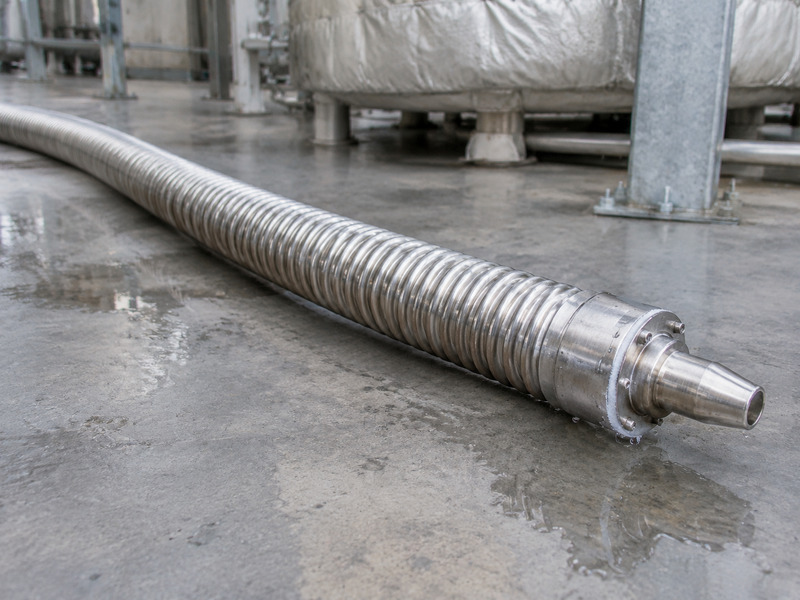
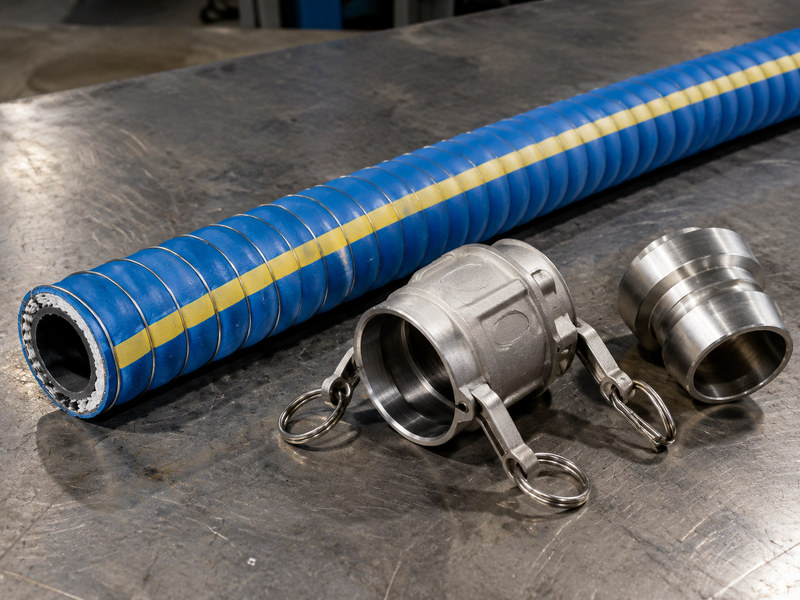
Both grades carry a perforated cover that lets leaked steam escape. Without those perforations, trapped steam can blister the cover from the inside. Insulation over the hose keeps the steam hot and shields nearby workers.
Drainage completes the picture and is easy to overlook. Condensate left in the line can hammer the hose the moment full steam arrives. Low-point drains and a slight fall keep the line clear. In our installation reviews, most premature failures on a curing line start at an undrained low point rather than at a hose that met its pressure class.
A decision-led choice comes down to a short list of cases:
- Low-pressure steam supply near 6 bar: choose an ISO 6134 Type 1 hose.
- Higher-pressure service near 18 bar: choose an ISO 6134 Type 2 hose.
- Long exterior runs: add insulation and fit low-point drains.
- Any new line: confirm the bore against the sizing guide before ordering.
If the temperature class and the bore are still unclear, the contact page is the fastest route to an answer. A short set of operating values is usually enough to pin the grade down.
Steam Curing Concrete FAQs
What is steam curing concrete?
Steam curing concrete is a method that hardens precast units by exposing them to warm, saturated steam instead of ordinary air. The steam is delivered at atmospheric pressure, so the process stays gentle rather than a pressure treatment. Chamber temperatures usually sit between 40 and 70 °C. The result is faster strength gain with the moisture still held inside the mix.
Why Would a Plant Use Steam Instead of Waiting for Air Curing?
Waiting for ambient conditions trades time for simplicity, and that trade fails when output matters. Steam supplies heat and moisture at once, so the hydration reaction runs faster. It also removes the weather from the schedule entirely. A plant can plan its stripping times instead of guessing at them.
What temperature should a curing chamber reach?
Most chambers run inside the 40 to 70 °C band, and the risk starts before the top of it. The National Precast Concrete Association’s QC Manual caps ambient curing at 150 °F (65 °C) unless the plant takes measures against delayed ettringite formation. Staying at or below 65 °C keeps the cure fast without extra measures.
Why is the chamber held near 100% relative humidity?
Saturation matters because moisture is a reactant, not a side effect. With the air held near 100% relative humidity, the concrete keeps the water it needs while it takes on heat. Drop the humidity and the surface gives up water faster than the interior can replace it, which stalls the reaction at the skin.
What are the four stages of a curing regime?
A typical regime runs initial delay, ramp, hold, and cool. The initial delay, or preset, lets the unit stiffen before heat arrives. The ramp raises the temperature gradually, and the hold delivers most of the energy. Cooling brings the unit down gently toward plant air.
How Fast Can Chamber Temperature Rise Before the Concrete Cracks?
Climb too fast and the section cracks; climb too slowly and the plant pays for speed it never collects. The window runs from about 20 °F/h (11 °C/h) to about 40 °F/h (22 °C/h). Outside that range the cure either damages the unit or gives back the time it was meant to save.
What is delayed ettringite formation?
Delayed ettringite formation is a reaction that can damage concrete cured too hot. The mineral can re-form inside the hardened paste and expand later, long after the unit looked sound. It is the main reason the curing ceiling exists. Keeping the chamber below 150 °F (65 °C), or applying countermeasures, limits the risk.
Which Hose Should a Plant Specify for Steam Service?
Start from the duty, then pick the grade. Low-pressure chamber curing normally lands on an ISO 6134 Type 1 hose, with the bore set by flow and the run insulated on long exterior legs. Fit low-point drains before the first cycle and check the cover perforations at every inspection.
How do ISO 6134 Type 1 and Type 2 differ?
Type 1 covers a maximum working pressure of 6 bar, which corresponds to saturated steam at about 165 °C. Type 2 covers 18 bar, corresponding to a saturated-steam temperature of 210 °C. The higher grade suits hotter or higher-pressure service. Both carry a perforated cover.
Does a small precast plant always need steam?
No, and the product decides. Long-cycle pieces and small shops can cure in ambient air or under water and simply accept the longer schedule. Steam earns its place where molds must turn over fast. If stripping time drives the business, steam usually pays for itself in turnover.
Final Verdict: Steam Curing Concrete and the Hose That Makes It Work
Steam earns its place in a precast plant because it replaces weather with a schedule. It delivers heat and moisture together, so the mix gains strength quickly without drying out. A four-stage regime of delay, ramp, hold, and cool keeps that speed under control.
The same method fails when heat is pushed past its limits. A ceiling around 150 °F (65 °C) guards against delayed ettringite formation. A rise rate between roughly 20 and 40 °F/h (11–22 °C/h) protects the concrete and still saves time.
The hose is the last and least glamorous decision, and it still matters. Match the bore, match the temperature class, insulate long runs, and drain the low points. A cure is only as stable as the line that feeds it.
HENGHUA supplies steam hoses for precast curing and other industrial steam duty. The range covers EPDM tubes with textile or steel-wire reinforcement, perforated oil-resistant covers, and ISO 6134 Type 1 and Type 2 envelopes. A 230 °C high-temperature grade is available for the hottest service.
Options include bolted safety clamps, crimped or swaged ferrules, flanged ends, and cam-and-groove couplings in carbon steel, 304 or 316 stainless, and brass. Every hose is hydrostatically tested to its rated working pressure before shipment and marked with size and working pressure. Factory-direct pricing, private labeling, and OEM or ODM support are available, along with a warranty on the range.
About the author. The HENGHUA technical team writes about industrial hose selection for steam, concrete, and cement service. The team helps precast plants match bore, temperature class, and drainage to their curing schedule. Questions about a specific line are welcome through the contact page.
 English
 Spanish
 Portuguese
 French
 German
 Arabic
 Russian
 Indonesian
 Japanese
 Korean