
The cryogenic hose temperature question starts with a simple fact: a composite hose temperature range in ordinary industrial service runs from about −30 °C to +150 °C depending on type. That band stops far above the cryogenic duties that LNG, liquid oxygen and liquid nitrogen represent. LNG is around −162 °C, LOX around −183 °C and LN2 around −196 °C at atmospheric pressure. A standard composite hose does not reach any of them.
This guide sets out the ladder from ambient to cryogenic, what changes at each step, and which construction takes over where the composite band ends.
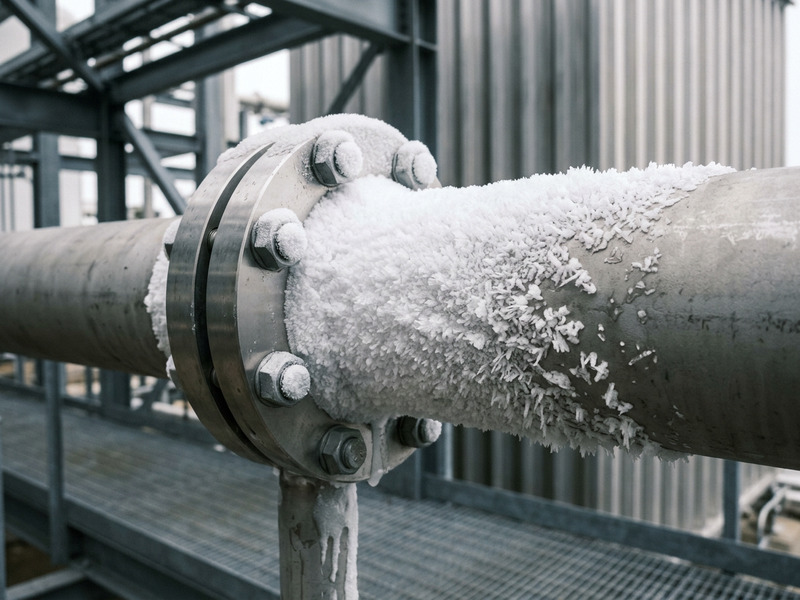
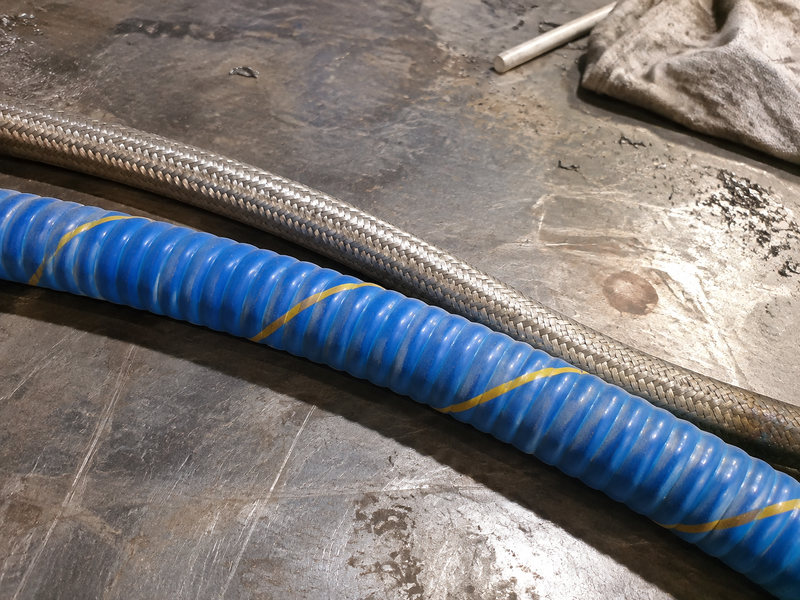
Figure 1. Frost on the outside is the visible evidence that the inside is far below ambient. The gap between −30 °C and −162 °C is not a margin; it is a different product.
What Is the Standard Temperature Range?
The type table gives the band, and the cryogenic hose temperature limit is narrower than buyers expect.
| Typ | Temperature band | Intended duty |
|---|---|---|
| Typ 1 | −20 to +60 °C | Vapour service |
| Typ 2 | −30 to +80 °C | Liquids, general |
| Typ 3 | −30 to +80 °C | Liquids, higher pressure |
| Typ 4 | −30 to +150 °C | Hot liquids |
| Exception | Below −30 °C on any type | Outside the band: confirm with data or change product |
Table 1. Composite hose temperature range by type. The lower bound is the same for Types 2 to 4, and it is roughly −30 °C.
Two readings matter when judging any cryogenic hose temperature claim. The upper bound is a liner and bond limit, not a metal limit. And the lower bound is not a margin to be stretched: below it, the thermoplastic film loses flexibility and the bond becomes the weak point.
A composite hose temperature range question therefore has a precise answer for ambient duty and a clear negative for cryogenic duty.
What Changes Between −30 °C and Cryogenic?
Everything that matters for a flexible wall.
The polymer transitions from flexible to glassy. A film that bends at −30 °C cracks at −100 °C, and the crack is a leak path rather than a cosmetic defect.
Thermal contraction becomes significant. A hose at LNG temperature is measurably shorter, and the fittings and supports see loads they were not designed for.
Water freezes on every surface and inside any unsealed insulation, which is why cryogenic lines are purged and dried before cooldown.
And the product boils. Any heat leak turns liquid into vapour, which is a pressure and composition problem as much as a thermal one.
Why Not Just Use a Thicker Wall?
Because the cryogenic hose temperature limit is set by the material, not the thickness.
Insulation slows heat ingress; it does not make a brittle polymer flexible. A thicker wall of the wrong material at −162 °C is a thicker brittle wall.
The same logic applies to the fittings. A standard camlock at cryogenic temperature is a sealing problem even before it is a strength problem, because the gasket has become glassy.
Which Construction Takes Over?
Two, and neither is an ambient composite hose. A ln2 temperature hose follows the same logic, one step colder.
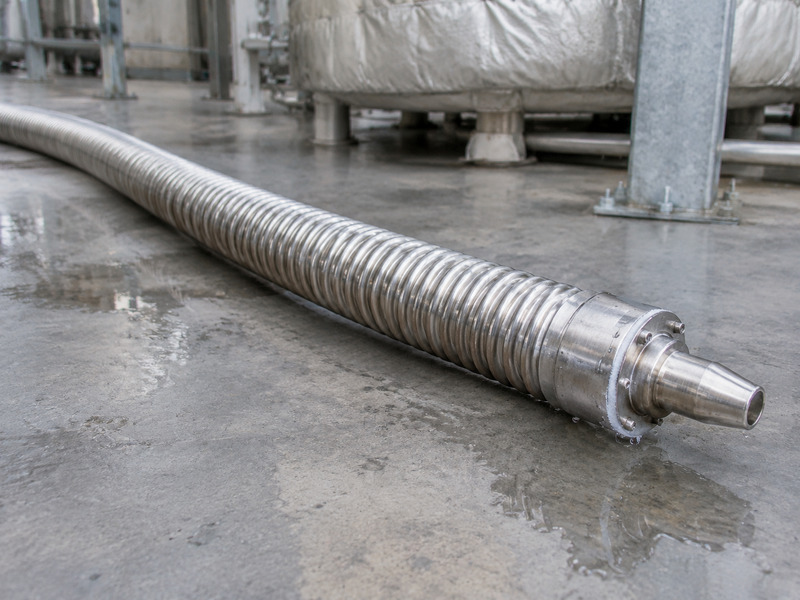
Corrugated stainless steel hose is the established construction. It has no polymer in the product path, it tolerates the temperature, and its flexibility comes from geometry rather than material.
Purpose-built cryogenic hoses use a flexible core with specialised insulation in a jacket, and some are described as composite because the wall is not a single metal tube. Those are engineered products with their own test basis.
An lng temperature duty therefore routes to one of those two, and the standard that governs it is the cryogenic or LNG system document rather than the composite hose standard.

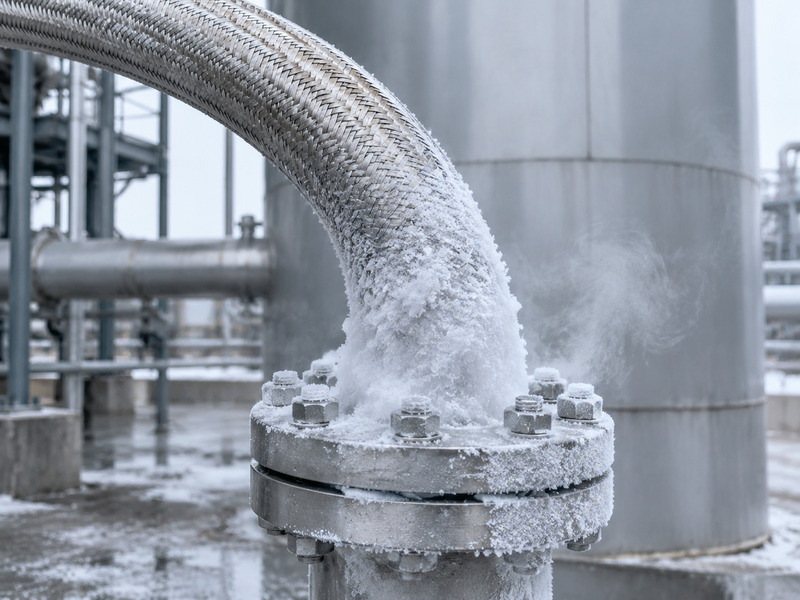
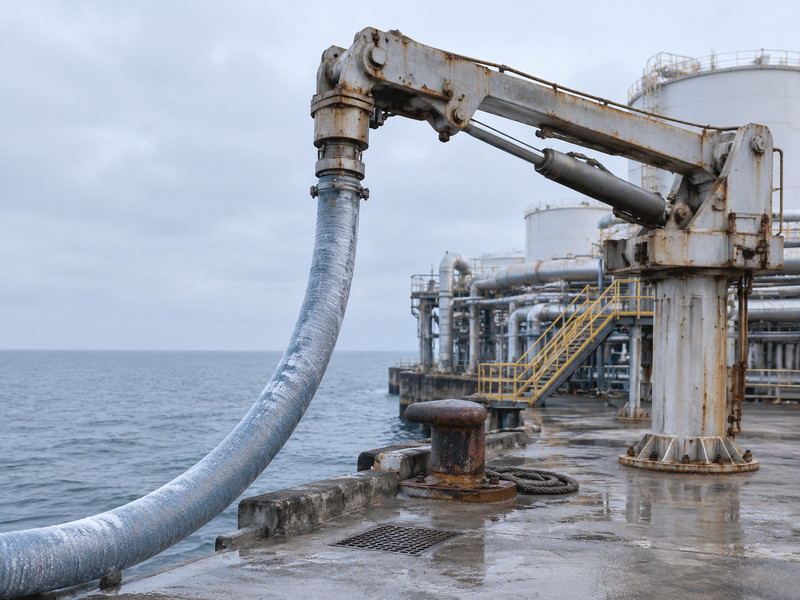
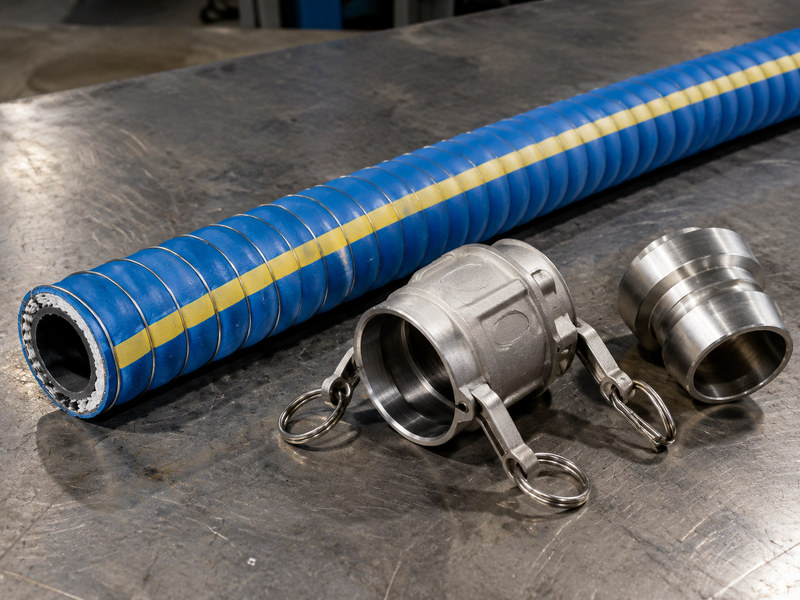
Figure 2. Ambient blue beside cryogenic frost. The band a standard composite hose covers ends around −30 °C, and everything below it is a different construction.
What Are the Reference Temperatures?
Four values worth knowing for the cryogenic hose temperature ladder, all approximate at atmospheric pressure. A ln2 temperature hose is specified at the coldest of them, which is also the reference used for most cryogenic testing.
LNG sits near −162 °C, and the exact figure moves with composition, which is why a duty should state a range rather than a point.
Liquid oxygen, the cryogenic form of oxygen at about −183 °C, brings an additional hazard: oxygen enrichment makes ordinary materials burn, so LOX duty has its own cleanliness and compatibility rules.
Liquid nitrogen is near −196 °C and is the usual test medium for cryogenic equipment because it is inert and cheap. A ln2 temperature hose must therefore be rated for the coldest duty in the family, not for the average.
And the standard composite band ends around −30 °C, which is the number to remember when someone proposes a composite hose for a cold duty.
| Duty | Temperature | Bauwesen | Governing document |
|---|---|---|---|
| General chemical | −30 to +80 °C | Composite, Types 2 and 3 | Composite hose standard |
| Hot chemical | Up to +150 °C | Composite, Type 4 | Composite hose standard |
| Refrigerated product | Around −40 °C | Special composite, confirm | Composite standard plus data |
| LNG | Around −162 °C | Corrugated stainless or cryogenic build | Cryogenic and LNG system standards |
| Liquid oxygen | Around −183 °C | Cryogenic build, cleaned for oxygen | Cryogenic standards plus oxygen rules |
| Liquid nitrogen | Around −196 °C | Corrugated stainless or cryogenic build | Cryogenic standards |
| Exception | Refrigerated duty between −30 and −40 °C | Composite, only with data at that temperature | Composite standard plus the supplier’s test data |
Table 2. Duty, temperature and construction. The shaded truth of this table is that the bottom three rows are not composite hose duties in the ordinary sense.
What Should a Specification Say?
Five lines.
The medium and its temperature range, including any excursion during cooldown or upset. The pressure at that temperature. The construction family and its governing standard. The insulation requirement, if the duty is cryogenic. And the documents required to prove all four, as the datasheet guide sets out.
A specification written with those lines can be answered by the right supplier and declined by the wrong one, which is the point. The Typenübersicht supplies the band values.
Where Do Buyers Go Wrong?
Four ways, and each appears in real enquiries.
Assuming the lower bound is conservative and can be stretched, which is the most expensive assumption in this category. It is a material limit.
Confusing insulation with temperature capability. A well-insulated ambient hose is still an ambient hose.
Specifying a cryogenic duty against a chemical standard, which produces offers that cannot meet it. And forgetting the fittings and gaskets, which fail at temperature before the wall does.
Why Does the Cryogenic Hose Temperature Question Matter Commercially?
Because the wrong answer is expensive in both directions. A buyer who over-specifies a cryogenic product for a −20 °C duty pays several times the necessary price and inherits insulation, weight and maintenance that the duty never needed.
A buyer who under-specifies gets a hose that fails early, and the failure is usually at a fitting where the polymer has gone glassy rather than in the middle of the wall.
The cryogenic hose temperature boundary is therefore a commercial line as well as a technical one. Knowing where it sits saves money in one direction and prevents a failure in the other.
How Do You Check a Claimed Range?
Three steps, and each is documentary.
Ask for the standard and the edition, not a temperature alone. A range without a standard is a marketing figure.
Ask for the test basis: what temperature the product was tested at, and for how long. A short exposure and a continuous duty are different claims, and only one of them describes a line that runs cold for a shift.
And ask what the range applies to: the liner, the bond, the assembly or the whole system. A liner range printed on a page is not an assembly range.
A vendor who answers all three is describing a product, and the certificate walkthrough shows what a scope should contain. One who answers with a number is describing a hope.
What Happens Just Below the Lower Bound?
The failure is not dramatic, which is what makes it dangerous.
A hose taken slightly below its band does not shatter. It becomes stiff, then it takes a set, then it cracks at a flex point. The crack appears after the line returns to ambient, which is why the cause is often misdiagnosed.
That pattern is why the lower bound should be treated as a hard limit rather than a guide. A hose that has been over-cold once is a hose with a reduced life, even if it looks sound.
What About Cold Rooms and Refrigerated Product?
Between −30 °C and −40 °C there is a band where a standard composite hose may still be viable if the liner and bond are rated for it. That band is where most confusion occurs.
A refrigerated warehouse at −25 °C is inside the standard band for a Type 2 or Type 3 hose. A blast freezer at −40 °C is outside it for most liners and inside it for none of the standard bonds.
The practical rule is to treat anything below −30 °C as a question for the supplier rather than an assumption. Ask for the data at that temperature, and if it does not exist, change the duty or the product.
How Does This Compare With the Upper Bound?
The upper bound behaves differently, and the difference is worth understanding.
At high temperature a composite hose is derated rather than excluded: the pressure falls as the temperature rises, following a curve. The hose remains within its specification, with less capability.
At low temperature there is no derating curve in the same sense. The material transitions, and the transition is a boundary rather than a slope.
That asymmetry is why the two ends of the range cannot be treated with the same rule of thumb, and why a derating curve is the wrong tool below −30 °C. Hot duty is a derating question; cold duty is a material question.
What Does This Mean for a Mixed Project?
A terminal that handles both ambient chemicals and a cryogenic product runs two product families, two document sets and two inspection routines.
The ambient lines follow the composite rules, as the specification table sets out. The cold lines follow the cryogenic standards, and the two should not be merged into one purchase order, because the answers to the same question differ.
Keeping them separate also keeps the pricing honest. A single tender that mixes both invites a bidder to price the easy lines and qualify the hard ones, and the comparison becomes meaningless. Write the temperature range into the enquiry before the bore: a supplier who sees −40 °C in the duty will either decline or ask for data, and either answer beats a wrong order.
Häufig gestellte Fragen
Can a composite hose handle −100 °C?
Not a standard one. The lower bound is around −30 °C, and below that the film and bond are outside their specification.
What is the LNG temperature?
About −162 °C at atmospheric pressure. It varies slightly with composition, so specify a range.
Is LN2 colder than LNG?
Yes. Liquid nitrogen is around −196 °C, which is colder than LNG at −162 °C.
What about LOX?
Around −183 °C, with an added hazard: oxygen enrichment makes many materials burn, so cleanliness rules are stricter.
Can insulation extend the range?
No. Insulation slows heat transfer; it does not change the temperature at which a material becomes brittle.
Which hose is used for cryogenic duty?
Corrugated stainless steel, or a purpose-built cryogenic hose with specialised insulation. Both have their own standards.
Does the pressure rating change at low temperature?
For a composite hose, the lower bound is a material limit rather than a derating curve. Below it the hose is outside its specification, not merely derated.
Über HENGHUA
The bands we build to are the ambient and moderate ones printed on each product page. Cryogenic duty is outside our range, and we do not supply it. If a duty sits below −30 °C, we will say so and point to the construction and standard that apply.
Send the medium and the temperature, and we will confirm whether the duty is inside our range or belongs to another product family.

 English
 Spanish
 Portuguese
 French
 German
 Arabic
 Russian
 Indonesian
 Japanese
 Korean