
A hose gasket is the cheapest component in an assembly, and the camlock connection is where it most often goes wrong. It is also the one part an operator can fit wrongly, lose, or replace with whatever is in the drawer. Selection therefore matters twice: the material has to suit the product, and the fit has to be obvious enough that a tired operator gets it right.
This guide sets out the materials, the seats they sit in, the failure modes that follow a wrong choice, and how to write a gasket line into a purchase order that suppliers can actually answer.
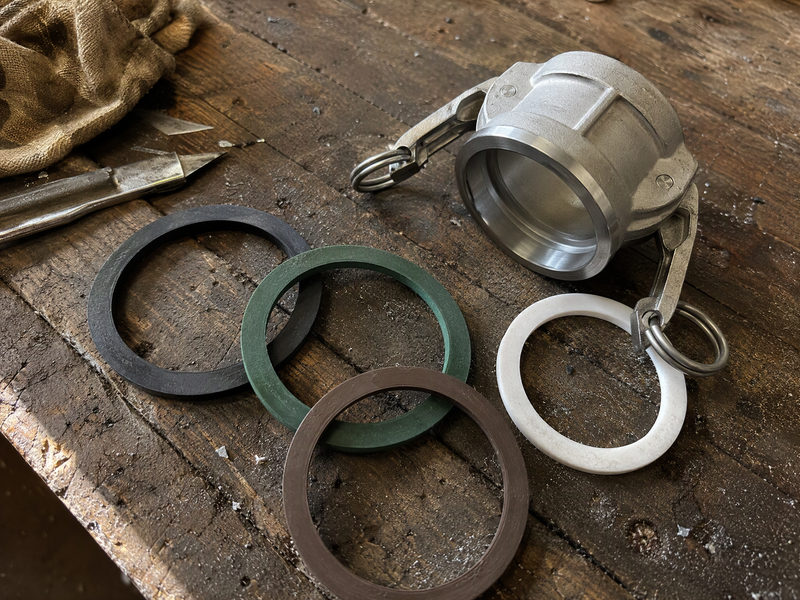
Figure 1. Four gaskets, one seat. The material decides the chemistry; the thickness and diameter decide whether it seats at all.
What Does a Hose Gasket Have to Do?
Three things, and only the first is about chemistry.
It has to resist the product, including cleaning chemicals, at the service temperature. It has to compress enough to seal the surface it sits against, then recover when the joint is opened. And it has to stay in its seat while the coupling is closed, because a gasket that falls out during connection is a leak waiting for a shift change.
Those requirements pull in different directions. A soft material compresses easily and takes a compression set. A hard material recovers well and needs more force to seal, which a camlock arm may not provide.
Which Materials Are Used?
Four elastomers and one plastic cover most industrial duty.
| Material | Good for | Poor for | Temperature character |
|---|---|---|---|
| Buna-N (NBR) | Hydrocarbons, oils, water | Ketones, strong acids, ozone | Moderate |
| EPDM | Water, steam, many acids, glycol | Mineral oils, aromatic hydrocarbons | Moderate, good in steam |
| Viton (FKM) | Aromatics, solvents, acids, heat | Ketones, some esters | High |
| PTFE | Almost all chemicals | Nothing chemically; poor compression | Very high |
| Silicone | High temperature, dry heat | Steam, many hydrocarbons | Very high, low strength |
Table 1. Gasket materials and where each one fails. The “poor for” column matters more than the “good for” column.
A camlock gasket in Buna-N is the default, because most industrial transfer involves hydrocarbons or water, and the fitting material decides how well the seat holds it. It is also the wrong default for a ketone, an aromatic solvent or a hot caustic line.
The ptfe gasket hose combination is the exception that covers everything chemically, as the flange guide sets out for bolted joints, at the cost of sealing behaviour. PTFE does not compress like rubber, so it needs a seat that applies force evenly and a joint that is not expected to be opened by hand every shift.
How Do You Match the Gasket to the Product?
Start with the chemistry and work backwards.
An epdm gasket chemical compatibility check is a good example of how narrow a material can be. EPDM is excellent in water, steam, glycol and many acids, and poor in mineral oils and aromatic hydrocarbons. A plant that uses EPDM everywhere for its steam lines will eventually fit one to a solvent line, and the gasket will swell within a week.
The practical method is to keep a table by product family rather than by chemical name. Three or four families cover most plants, and each has one gasket material assigned to it that is posted at the store.
Then add the temperature. A material that is fine at ambient can soften or harden at 80 °C, and the second effect is worse because a hardened gasket does not seal at all.
Why Does Compression Set Matter?
Compression set matters because a gasket that takes a set is a gasket that leaks on the next assembly.
Compression set is the permanent deformation left after a gasket has been squeezed. A material with poor recovery stays flattened, and when the joint is reopened and closed, the gasket no longer fills the gap.
Elastomers vary widely, and the variation is temperature dependent. A Buna-N gasket that recovers well at 20 °C may take a set at 70 °C, which is why a joint that seals in winter can weep in summer.
The practical consequences are two. Replace gaskets whenever a joint is opened, rather than reusing them. And choose a material whose set behaviour suits the temperature, not just the chemistry.

Figure 2. Two gaskets that came out of service. The one left in the seat has been squeezed out of its groove; the free one has grown and no longer fits the groove it came from.
Where Does the Seat Change the Answer?
The seat is the groove or face the gasket sits in, and it decides how much of the material’s capability is usable.
A camlock seat is shallow and relies on the cam arms to apply force. A soft gasket seals easily there; a hard one may not, because the arms cannot generate much compression.
A flange seat applies force through bolts and can use a harder gasket, including PTFE, provided the bolt load is even. Uneven bolt load is the usual reason a PTFE gasket weeps, and it is a torque problem rather than a material problem.
A plastic fitting seat deforms under load, which adds a variable. A gasket that seals on a metal seat may not seal on polypropylene, because the seat itself moves.
What Are the Failure Modes?
Four, and each has a signature.
Swelling shows as a gasket that has grown and will not sit in its groove. It follows a chemistry mismatch, and it is the most common failure on a line that changed product.
Compression set shows as a flattened gasket that no longer fills the gap. It follows temperature and repeated assembly.
Extrusion shows as a gasket edge pushed into the gap between the two faces. It follows over-pressure or a gap that is too wide, often on a worn seat.
Chemical attack shows as cracking, hardening or a sticky surface. It follows a slow reaction, and it is the failure that appears after months rather than days.
A fifth, less obvious, is the missing gasket. A joint assembled without one feels tight and leaks immediately, and it is the reason the spare should be stored at the point of use.
How Do You Write the Gasket Line?
Four fields: material, size, thickness and standard, recorded on the datasheet.
Material by abbreviation and family, not by colour. Size by the fitting standard, because a camlock gasket and a flange gasket are not interchangeable even at similar diameters. Thickness by the seat depth, because a thick gasket in a shallow seat will not let the coupling close.
Add a fifth field for the duty: the product family and the temperature. That line is what allows a supplier to challenge the material choice, which is the point of specifying it.
A purchase order that says “with gaskets” will be supplied with whatever is standard, and the standard is usually Buna-N.
How Should You Store and Replace Them?
Keep a small stock of the correct gasket at every point of use, in a sealed bag, labelled with the material and the date.
A gasket that has sat in a drawer for three years has aged, and an aged gasket is a variable that looks like a quality problem. Rotate the stock and discard anything that has hardened or cracked.
A hose gasket is a consumable, not a component. Replace on every break. A gasket that has been compressed once has already taken part of its set, and the second assembly starts from a worse position.
Train the replacement, not just the selection. An operator who knows that the green gasket belongs on the solvent line and the black one on the water line prevents more leaks than any specification.
Which Gasket Suits Which Duty?
| Duty | Gasket | Note |
|---|---|---|
| Diesel, kerosene, oil | Buna-N | Standard, cheap, adequate |
| Aromatic solvents | Viton or PTFE | Buna-N swells |
| Steam and hot water | EPDM | Good recovery in steam |
| Strong acids | PTFE | Confirm the seat can load it |
| Caustic CIP | EPDM or PTFE | Check temperature |
| Food product | EPDM or PTFE, approved grade | Declaration required |
| Ketones and esters | PTFE | Viton and Buna-N both fail |
Table 2. Gasket by duty. Where two materials are listed, the seat and the temperature decide.
How Do You Audit a Gasket Decision?
Three checks, and they take ten minutes.
Read the record: does the assembly file name a gasket material, or does it say “with gasket”? A file that names the material can be audited; one that does not cannot.
Look at the joint: is the gasket the colour and thickness of the one specified, and is it seated fully? A gasket sitting proud of the groove is a gasket that will not compress evenly.
Then ask the operator. If the answer to “which gasket goes on this line” is a shrug, the store is organised by availability rather than by duty, and the next leak is already scheduled.
An epdm gasket chemical claim deserves the same test on a line that has changed product. EPDM covers water, steam and many acids; on a mineral oil or an aromatic hydrocarbon it swells and loses strength, and the change is usually first noticed as a weeping joint rather than as a failed gasket.
Where the audit finds a mismatch, replace the stock rather than the note. A label on a drawer does not prevent an operator reaching into the wrong one at two in the morning.
What About Food and Potable Duty?
A gasket in a food or potable line is a product-contact part, so the material needs the same approval logic as the liner.
That means a food-contact grade and, for potable water, an approval for the market. A ptfe gasket hose is often the simpler document path, and an epdm gasket chemical grade is the usual alternative. A standard industrial Buna-N gasket is chemically adequate and not approved, which is a distinction an audit will make.
A ptfe gasket hose costs more and seals less forgivingly than an elastomer, because the seat has to apply load evenly across a material that does not flow. Where the declaration matters more than the seal, that trade is worth taking.
Where an elastomer is preferred for sealing behaviour, ask for the grade and the declaration, and record both against the assembly. The food grade guide covers the wider document chain.
Häufig gestellte Fragen
How often should a hose gasket be replaced?
Every time the joint is opened. A gasket that has been compressed has taken a set, and reuse is the most common cause of a weep.
Can I use a Buna-N gasket for solvents?
For aliphatic solvents, usually yes. For aromatic and chlorinated solvents, no: it swells and loses strength.
Does a hose gasket need to match the liner material?
No, and it should not be assumed to. A hose gasket is chosen for the product and the seat, not for the liner. A PTFE-lined hose with a Buna-N gasket is common and correct on hydrocarbon duty; on a solvent it is the weakest part of the assembly.
What size camlock gasket do I need?
The one matching the coupler size and standard, not the hose bore. A 2 inch camlock and a 2 inch flange gasket are different parts.
Why does my EPDM gasket fail on oil?
EPDM has poor resistance to mineral oils and aromatic hydrocarbons, and it is excellent in water and steam, which is where it belongs.
Does gasket thickness matter?
Yes. A thick gasket in a shallow seat prevents the coupling from closing, and a thin one may not fill the gap on a worn face.
Can I make a gasket from sheet material?
For an emergency, yes, if the material and thickness match. As a practice, no: a cut gasket has no controlled dimensions and no traceability.
Über HENGHUA
HENGHUA supplies composite hose assemblies with the hose gasket matched to the product and confirmed on the order, sized to the fitting standard rather than the hose bore. The material is stated on the assembly record so a replacement is not a guess.
Send the product, temperature and fitting type, and we will confirm the gasket material and the seat it needs.

 English
 Spanish
 Portuguese
 French
 German
 Arabic
 Russian
 Indonesian
 Japanese
 Korean