
Hose flow rate is set by bore and by the pressure drop you can afford, not by the pump alone. Doubling the diameter roughly quadruples the capacity at the same velocity, which is why bore dominates every sizing decision. The constraint is that weight, cost and bend radius also rise, and one of them usually ends the argument.
This guide works from volume to flow to bore, sets out the velocity limits that protect the liner and the product, and shows where a larger size stops paying for itself.
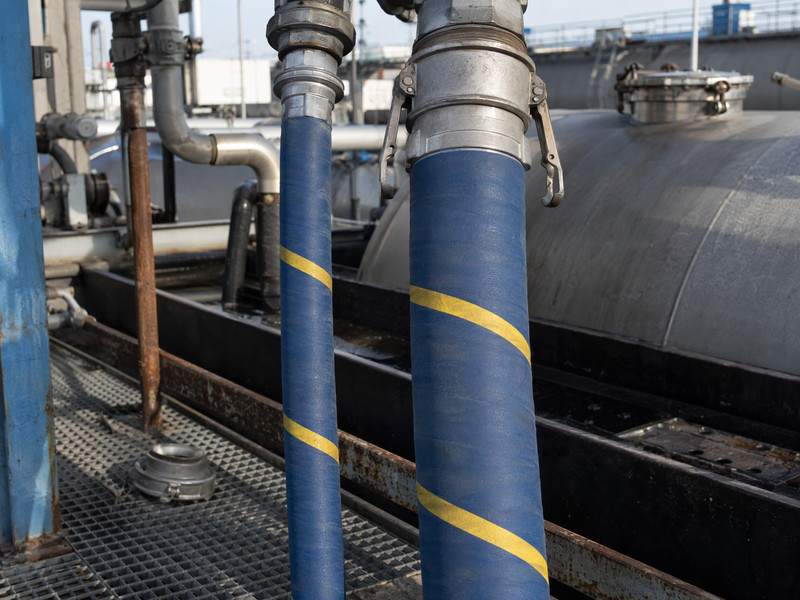
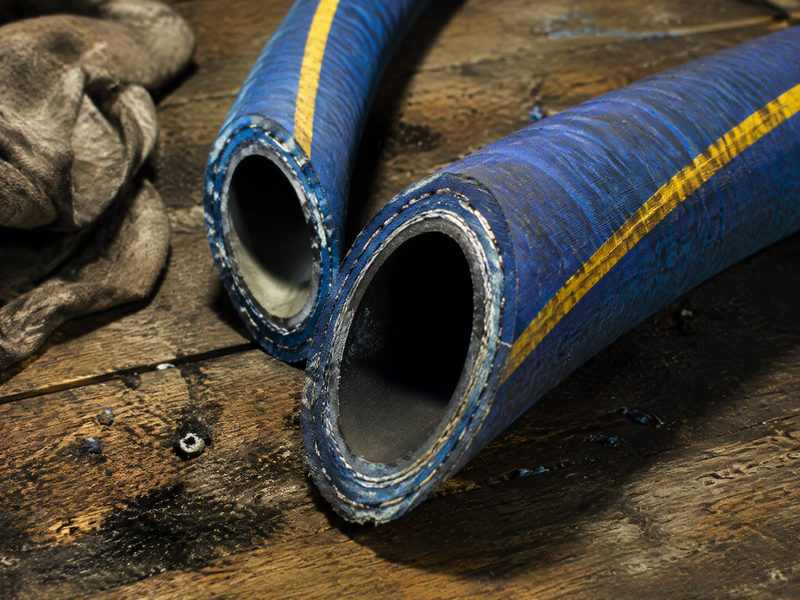
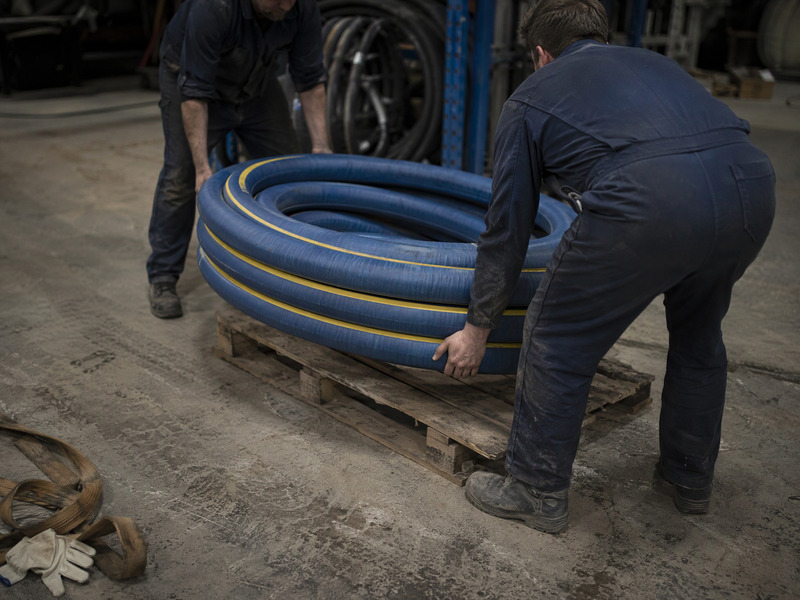
Figure 1. Two sizes, one duty. The larger line moves product faster and takes two people to connect, which is the trade the sizing decision has to settle.
What Determines Hose Flow Rate?
Hose flow rate depends on three things, and only the first is about the hose. The size chart shows where they intersect.
The bore sets the area available. The pressure available sets how hard the product is pushed. And the product’s viscosity sets how much resistance it meets on the way.
For a given pressure, a larger bore carries more flow because the resistance falls sharply with diameter. That is the dominant relationship, which is why sizing conversations start with bore rather than with pump pressure.
There are limits on each. Velocity cannot rise indefinitely without eroding the liner or degrading the product. Pressure is capped by the hose type and the fittings. And viscosity changes with temperature, so a line sized on a cold morning behaves differently by afternoon.
How Do You Convert Volume to Flow?
Divide the volume by the time available. That is the whole calculation, and it is where most projects start.
A transfer of thirty cubic meters in an hour is thirty cubic meters an hour. Express the same figure per minute if the pump curve is quoted that way, and keep the units consistent through the calculation, because mixing them is the most common arithmetic error in sizing.
The interesting question is not the average flow but the peak. A pump that delivers a steady rate needs a line sized for that rate. A pump that surges, or a line that fills a vessel against rising back pressure, needs a size that accommodates the worst moment.
Where the time available is fixed by a schedule, the flow follows. Where the flow is fixed by the pump, the time follows. Decide which one is fixed before choosing a bore.
What Velocity Should You Allow?
Velocity is the constraint that protects the hose and the product, and a velocity limit is better treated as a design input than as a final check.
| Medium | Sensible velocity band | Reason |
|---|---|---|
| Light hydrocarbons | Moderate to high | Low erosion, low shear sensitivity |
| Solvents | Moderate | Static generation rises with velocity |
| Viscous oils | Low | Drop dominates quickly |
| Food and beverage | Moderate | Product shear and foaming |
| Slurries | Low | Abrasion rises steeply |
| Chemicals with solids | Low to moderate | Settling and wear |
Table 1. Velocity bands by medium. Values are directional; confirm against the liner and the product data.
A velocity limit exists for a reason on each row, and the bend radius sets the route constraint that sits beside it. Hydrocarbons tolerate speed; slurries do not. Solvents generate static as they move, and a fast solvent line is a static source as well as a flow.
The practical rule is to size for the velocity band first and the pressure drop second. If the drop is too high inside the band, the bore is too small, and no amount of pump pressure fixes erosion.
Why Does Bore Matter More Than Pressure?
Bore matters more than pressure because resistance falls with the fourth power of diameter in laminar flow, and with roughly the fifth in turbulent flow.
That sensitivity is why a modest increase in bore often solves a problem that more pump pressure cannot. Doubling the pressure doubles the driving force; increasing the diameter changes the resistance term by a multiple.
The same relationship explains why undersizing is expensive to live with. A line that is one size small will always be the bottleneck, and every transfer pays for the error.
Buyers sometimes compensate with pressure. That works until the pump limit, and it accelerates wear on the liner and the fittings while it does.
How Do You Estimate Loading Time?
A loading time bore comparison is the quickest way to see the trade. Loading time is volume divided by flow, flow is what the bore delivers at your pressure and viscosity, and the bulk loading guide works the same logic through a terminal.
For a first estimate, use the bore band from the size chart and the pump curve at the expected discharge pressure. That gives a figure within engineering tolerance without a full calculation.
The estimate is good enough to compare two candidate bores, which is usually the decision at hand. It is not good enough to promise a schedule, because the pump may not deliver its rated flow at the actual head.
A loading time bore comparison is therefore a tool for choosing between options, not a commitment. State the assumption when you quote a time, and the assumption is usually the discharge pressure.

Figure 2. A pump outlet and one hose. The flange caps what can be connected, and the pump behind it caps what the line will pass.
Where Does Viscosity Change the Answer?
Viscosity is the variable that makes a line behave differently from the calculation, because it is temperature dependent.
A viscous product at ambient may need a bore two sizes larger than the same product warm. That is not a margin; it is a different duty.
Two practical consequences follow. Size on the coldest condition the line will see, and note it. And check whether the product is heated before transfer, because heating is often cheaper than a larger hose.
Where the product is shear-sensitive, viscosity also changes with velocity, which makes the calculation iterative. In that case a conservative bore is cheaper than an accurate model.
What About the Pump Curve?
The pump curve is the other half of the calculation, and it is the half buyers most often skip.
A centrifugal pump delivers less flow as head rises, and the head includes the hose. A positive displacement pump delivers roughly constant flow and generates whatever pressure the system demands, which makes the hose a pressure component rather than a flow component.
For a centrifugal pump, the hose drop moves the operating point along the curve, so the actual flow is lower than the free-delivery figure. For a positive displacement pump, the flow is set by the pump and the hose decides the pressure.
Sizing without the pump curve is therefore sizing blind, and a hose flow rate quoted without one is a guess with units. Ask for the curve, or for the expected discharge pressure and flow at the duty point.
How Do You Do Composite Hose Sizing in Five Steps?
A repeatable sequence beats a formula, and the specification table is where the result is recorded, because it keeps the assumptions visible.
- Fix the volume and the time available, and convert to flow.
- Choose the velocity band for the medium.
- Read the candidate bores that carry the flow inside that band.
- Check the pressure drop at each candidate against the pressure available.
- Confirm the fitting rating, the bend radius and the handling method for the chosen size.
The last step is the one that changes answers. A bore that is correct on flow may need a cradle, and a cradle may not fit the route.
Where the result is marginal, choose the larger size and reduce the pressure. A line with margin is easier to operate than one running at its limit.
What Changes Between Loading and Unloading?
Flow direction looks symmetric and behaves differently, because the driving equipment changes.
Loading usually pushes product from a pump into a vessel, so the pump curve sets the flow and the hose sees positive pressure. Unloading often pulls product out of a vessel with the same pump, so the hose may see a partial vacuum and the flow is limited by what the vessel will give up.
That difference matters for sizing. An unloading line needs a bore that suits the suction condition and a hose rated for vacuum, and a line sized only on the loading case can collapse on the way back.
Composite hose sizing therefore has to be done for both directions where the hose serves both. A line that loads at one rate and unloads at half that rate is a line with two duties, and the smaller one governs the hose.
Where Do Bends and Fittings Cost You?
Every bend and every fitting adds a local loss, and on a composite hose the bends are the ones people forget.
A hose route that curves around a column or drops into a pit may have four or five bends, each adding resistance comparable to several meters of straight hose. A calculation that uses straight length alone will understate the drop and overstate the flow.
Fittings add less, but they add. A reducer, a camlock and an elbow each contribute, and a line with several adapters is a line that behaves like a smaller hose than its bore suggests.
The practical approach is to count bends as equivalent length rather than to model them. Add a margin of a few meters per bend, and check that the margin does not change the chosen size.
How Do You Check a Proposal?
Four checks catch most bad proposals before the order.
Confirm the velocity at the stated flow, not at the maximum the hose could carry. A proposal quoted at a bore’s limit is a proposal that will not deliver the duty.
Confirm the drop at the actual length including bends. A drop quoted per meter and multiplied by straight length is optimistic on a routed line.
Confirm the fitting rating, because the assembly is limited by its weakest component.
And confirm the loading time bore relationship, which should match the duty the plant described rather than the catalogue band.
A proposal that survives all four is usually right. One that fails the first is usually a size too small.
What Should the Specification Say?
Write the volume, the time, the medium, the temperature and the pressure available, then let the supplier do the composite hose sizing and show the numbers.
Add the route: length, bends and lift. Add the connection size, because it may cap the answer. And add the handling method, because a bore that needs a crane is a bore that slows every shift.
A specification written this way invites a calculation. One that names a bore invites confirmation of a decision already made, which is not the same thing.
Where the plant has a previous line, include its size and its problems. A note that says the old line was slow in winter is worth more than a page of general description.
| Candidate | Flow at duty point | Loading time | Handling |
|---|---|---|---|
| 2 inch | Lower | Longer | One person |
| 3 inch | Higher | Shorter | One to two people |
| 4 inch | Higher again | Short | Two people |
| 6 inch | Highest | Shortest | Cradle or crane |
Table 2. How the format of a comparison looks. The values are filled from the calculation, not from the table.
How Do You Present the Result?
Present it as a table with three columns: size, flow at the duty point, and loading time.
One page, two or three candidate sizes, and the assumption stated. That format lets a project team decide without re-running the calculation, and it makes the trade visible: the larger size buys time and costs handling.
A table also makes the audit trail. Two years later, the choice can be checked against the duty rather than remembered.
Where Does Operation Change the Number?
Hose flow rate is a design figure, and operation changes it. A line that is throttled at the valve, run partly full or used for two products behaves differently from the calculation.
Partly full is the common case on gravity transfer. The hose flows less than its bore suggests, because the product only occupies part of the section, and the drop rises at the same time. A line sized on the assumption of a full bore will disappoint on a gravity duty.
Throttling moves the operating point along the pump curve and adds a loss that the calculation did not include. If the plant intends to throttle, say so, because the hose does not need to cover a flow the valve will remove.
Two products on one line is another case. A bore that suits a light solvent may be generous for a viscous product, and the velocity limit that applies is the stricter of the two.
What Does a Good Calculation Contain?
Six inputs and one output, written down.
Volume, time, medium, temperature, pressure available and route. The output is a bore with the velocity and drop at the duty point.
Where any input is missing, state the assumption. An assumption written down can be challenged; one held in someone’s memory cannot.
A hose flow rate calculation does not need to be long. A page is enough, and a page is what gets read when the line underperforms two years later.
Häufig gestellte Fragen
What hose size do I need for a given flow?
Use the velocity band and the pressure drop rather than a single figure. A 2 inch line suits moderate flows; 3 to 4 inch suits tanker work; 6 inch and above need mechanical handling.
Does higher pressure always increase flow?
Only until the pump curve or the hose rating stops it. Beyond that, the extra pressure is spent on wear rather than on flow.
How do I calculate loading time?
Divide the volume by the flow the bore delivers at your discharge pressure. State the pressure assumption, because the time changes with it.
Why is velocity limited?
Velocity is limited to protect the liner from erosion, the product from shear and the line from static generation. The limit depends on the medium.
Can I use a smaller hose and a bigger pump?
Within limits, and it is usually the expensive path. Wear rises, pressure drop rises and the pump works harder for the same result.
Does a composite hose sizing calculation differ from pipe?
It uses the same physics with a rougher wall and additional bend losses. The differences are small at low velocity and significant at high velocity.
What is the most common sizing error?
Choosing the bore from the connection size rather than from the flow and the drop, which repeats the previous line’s bottleneck.
Über HENGHUA
HENGHUA supplies composite hose from 1 inch to 8 inch and will check a proposed size against the flow, the drop and the fitting rating rather than confirming a bore from a drawing. We will say when the connection, not the hose, is the limit.
Send the volume, the time available and the pump data, and we will return the size and the assumptions behind it.

 English
 Spanish
 Portuguese
 French
 German
 Arabic
 Russian
 Indonesian
 Japanese
 Korean