
End fitting material decides three things: whether the joint survives the product, whether two people can lift the hose, and whether the fitting corrodes where nobody is looking. It also sets the assembly rating, because that rating is usually decided by the fitting rather than by the hose. 316 stainless is the industrial default, aluminium buys weight, and polypropylene buys chemical inertia at low pressure. The end fitting material decision is a duty question before it is a price question.
This guide compares the three on corrosion, weight, galvanic risk and cost, and sets out the duties where each one is the correct answer rather than the expensive one.
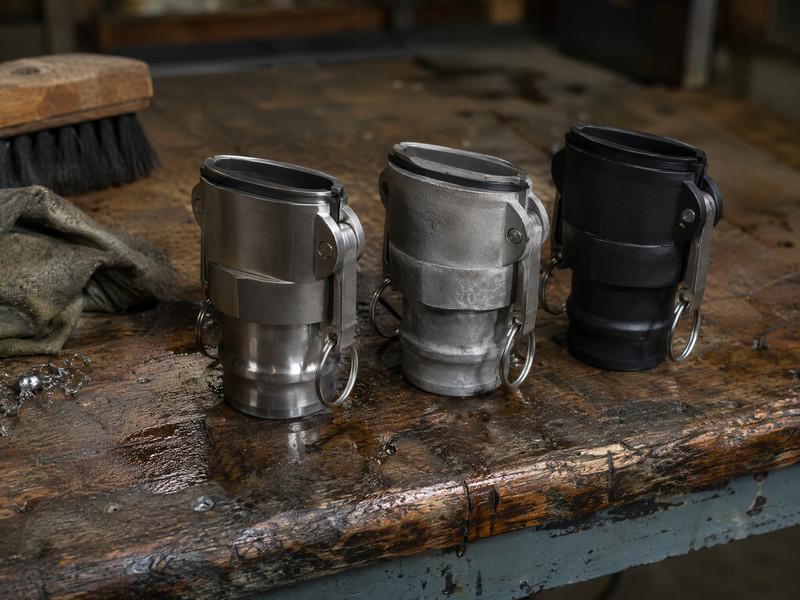
Figure 1. Three fittings, one bore. The visible difference is finish; the difference that matters is what each metal does in contact with the product and with the other metal.
What Does the Fitting Have to Do?
Four jobs, and the material affects all of them.
It has to seal, which means a face flat enough to compress a gasket and stiff enough not to deflect under load. It has to carry the helix, so the axial load has a path from wire to metal. It has to resist the product, including the cleaning chemicals. And it has to survive the environment outside the hose, which is often wet, salty or full of chloride.
The end fitting material decides how the fourth job goes, and a fitting that fails on it looks like a hose failure, because corrosion at the ferrule is where the leak appears. That is why the environment belongs in the specification, not just the medium.
What Does 316 Stainless Offer?
316 is the default for chemical and dock duty. A stainless steel camlock, the cam-and-groove quick coupling most terminals picture, is what they mean when they write the words, and the Typenübersicht sets the pressure band around it. The reason 316 leads is its molybdenum content, which improves resistance to chlorides compared with 304.
It is strong, it tolerates heat, it does not spark, and it can be welded and machined to tight faces. Those properties make it the safe answer where the duty is uncertain.
The costs are weight and price. A 6 inch stainless assembly is heavy enough to need a cradle, and the fitting cost is a meaningful share of the assembly.
Two practical notes. 316 and 316L are close cousins, and the low-carbon grade is preferred where welding is involved. And stainless is not immune to chlorides: stagnant seawater or concentrated brine can pit it, which is why marine duty sometimes moves to a higher alloy or to a different connection.
What Does Aluminium Offer?
Weight, mostly, and enough strength for low-pressure duty. Aluminium hose fittings are the reason a 4 inch dock hose can be handled by one person.
An aluminium fitting on a 4 inch hose can be lifted by one person where a stainless one needs two, and that changes handling habits more than any procedure. On dock and aviation work, where the hose is moved constantly, that is a real advantage.
The trade is corrosion. Aluminium is fine in dry hydrocarbon service and poor in wet or chloride-rich service, and it is at risk where it touches stainless in the presence of an electrolyte. That is galvanic corrosion, and it attacks the aluminium because it is the less noble metal.
Aluminium also has lower abrasion resistance at threads and sealing faces. A fitting that is connected and disconnected daily will wear at the thread before it corrodes, and a worn thread is a leak that no gasket fixes.
What Does Polypropylene Offer?
Chemical inertia and no metallic corrosion, at low pressure and moderate temperature.
Polypropylene fittings suit bleach, many acids and food-contact duties, and the material comparison explains why the same chemistry drives the liner choice where a metal fitting would corrode or contaminate. They are light, cheap and electrically non-conductive, which is useful in some laboratory and dosing applications and a disadvantage where static continuity is required.
The limits are pressure and temperature. A plastic fitting deforms under load and at temperature, so the assembly rating falls well below what the hose can carry. Threads are the weak point: a plastic thread cross-threads easily and strips.
Polypropylene also ages outdoors. UV exposure embrittles it, and a fitting that has sat on a rack in the sun for two summers can crack at the first tightening.

Figure 2. Two metals and a little water. The aluminium gives up material at the joint, and the leak appears at the thread rather than at the hose.
How Do the Three Compare?
| Property | 316 stainless | Aluminium | Polypropylene |
|---|---|---|---|
| Corrosion in wet chloride | Good | Poor | Good, but UV ageing |
| Weight | High | Low | Lowest |
| Strength and pressure capability | High | Moderate | Low |
| Abrasion at threads | Good | Moderate | Poor |
| Static continuity | Yes | Yes | No |
| Temperature ceiling | High | Moderate | Low |
| Relative cost | Highest | Moderate | Lowest |
Table 1. End fitting material compared on the properties that decide service. The temperature and continuity rows eliminate options fastest.
The table explains the market split. Stainless dominates chemical plants and docks, aluminium dominates aviation and mobile equipment, and polypropylene dominates small-bore dosing and food lines.
What About Galvanic Corrosion?
It is the failure mode that mixed stores create, which is why the datasheet should name one material per assembly rather than one material per component.
When two different metals are joined and an electrolyte is present, the less noble one corrodes faster than it would alone. Aluminium against stainless is the classic pair, and a wet hose store is enough electrolyte.
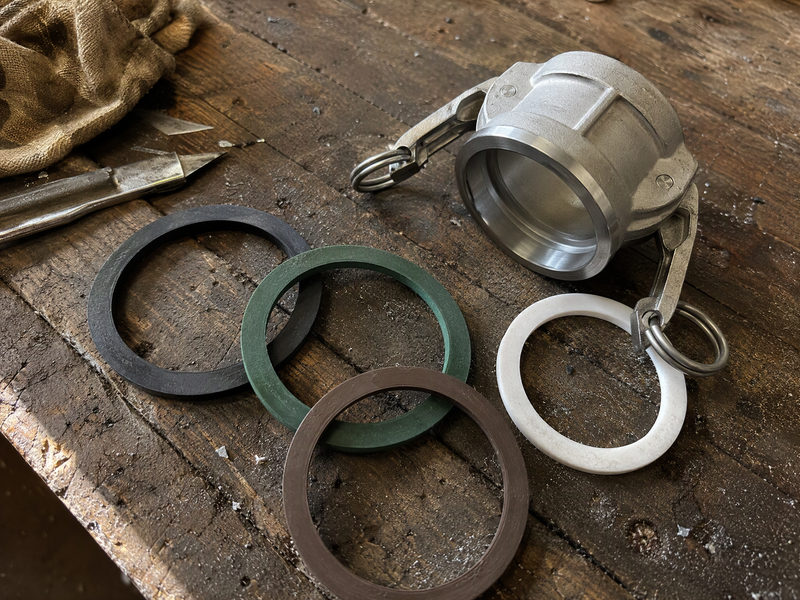
Three measures reduce the risk, and all three start with choosing the end fitting material once per assembly rather than per component. Keep one material per assembly, so the hose does not create its own cell. Where mixing is unavoidable, isolate the joint with a non-conductive gasket or a isolating washer. And keep the store dry, which is cheaper than either.
The same logic applies to galvanised fittings against stainless, and to a stainless ferrule on an aluminium body. If the fitting looks like two metals, it is a cell.
What About Threads and Sealing Faces?
The end fitting material affects how the connection wears, not just how it corrodes.
A stainless steel camlock will gall when tightened dry, especially in stainless-to-stainless joints. A compatible lubricant, applied sparingly, prevents the cold welding that seizes a coupling.
Aluminium hose fittings wear faster at the thread and are easier to cross-thread, particularly at small sizes where the wall is thin. A thread that has been cross-threaded once will never seal reliably again.
Polypropylene threads are the most forgiving of contamination and the least forgiving of force. Hand-tight plus a quarter turn is usually the limit, and a wrench is how a plastic fitting is destroyed.
Sealing faces matter as much as threads. A scratched face will leak whatever gasket is used, and a face that has been attacked by product will not hold compression.
Which Material Suits Which Duty?
| Duty | Recommended | Reason |
|---|---|---|
| Chemical transfer, general | 316 stainless | Corrosion and strength |
| Dock and tanker | 316 stainless or aluminium | Weight against environment |
| Aviation fuel, mobile | Aluminium | Weight, dry service |
| Bleach and hypochlorite dosing | Polypropylene | No metallic corrosion |
| Food and beverage, small bore | Polypropylene or 316 | Cleanability and approval |
| Wet marine atmosphere | 316 or higher alloy | Chloride resistance |
| Static-critical vapour line | Metal only | Continuity required |
| Duty not yet defined | Resolve the medium first | No material suits an unknown chemistry |
Table 2. Material by duty. Where two are listed, the deciding factor is weight or price rather than chemistry.
How Do You Read a Material Certificate?
Three fields matter: the grade, the heat number and the standard it was tested against.
A certificate that says “stainless steel” has told you nothing. One that says 316L with a heat number can be traced to a mill certificate and to the batch of fittings.
For aluminium, check the alloy rather than the word. For polypropylene, check the grade and whether it is food-contact approved if the duty requires it.
Ask for the certificate before the order, not after. A supplier who can produce one at quotation has a traceable supply chain; one who promises it later usually cannot.
How Do You Specify the Material?
Write the material, the grade and the environment, in that order.
“316L fittings, wet chloride environment” is a specification. “Stainless fittings” is a preference. The difference shows up in the second order, when the same wording produces a different grade.
Add the connection standard and the seal material, because a fitting is only as good as the joint it makes. And add the weight limit if the hose is handled, because that is the constraint that decides aluminium in practice.
Finally, name the certificate and the marking. An assembly that cannot be traced to a heat number is an assembly nobody can defend in an investigation.
How Does the Material Affect Weight in Practice?
A stainless steel camlock is the heaviest option at any bore, and the difference grows faster than the bore does because the fitting wall has to carry the same pressure over a larger diameter.
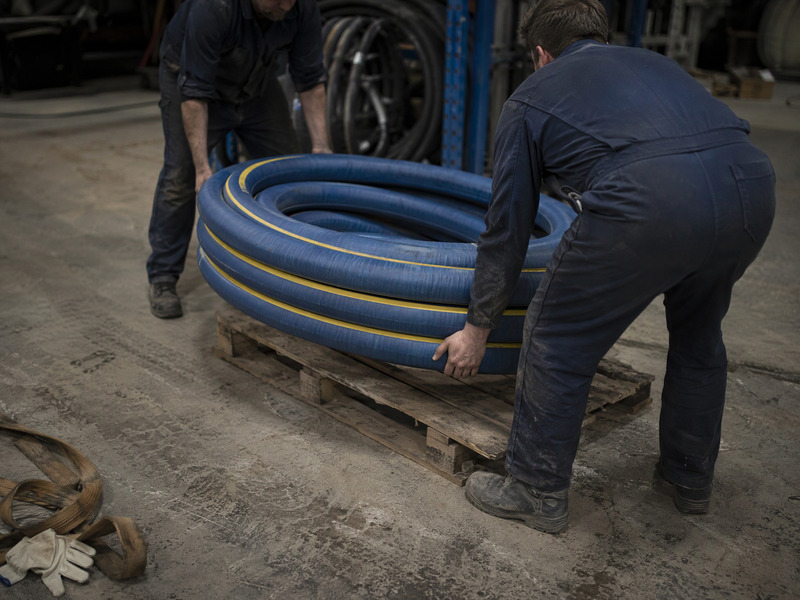
On a 2 inch assembly the choice barely changes how the hose is handled. On a 6 inch assembly it decides whether one person or two can connect it, and that decides whether the hose is lifted or dragged.
Aluminium hose fittings close most of that gap. The saving is not just comfort: a fitting that can be handled by one person is a fitting that gets checked, because the operator is already holding it.
Polypropylene fittings are lighter again, and their weight advantage matters on small-bore hose that is moved between points all day. At those sizes the fitting is a large share of the total mass, so the material choice is a handling choice.
The practical test is to weigh the finished assembly rather than the components. A hose that is comfortable on the bench can be unmanageable on a ladder, and the only way to know is to weigh it with the ends on.
What Should a Purchasing Specification Say?
Five lines, and each one prevents a substitution.
The material and grade, written as 316L rather than stainless. The connection standard and size, with the sealing face described. The seal material, matched to the product. The environment, including whether the fitting sees chloride or standing water. And the certificate requirement, with the marking scheme.
Add a sixth line where the hose is handled: a maximum assembly weight. That single number converts a preference for aluminium into a requirement that a supplier can meet or decline.
A purchasing specification that names all six can be compared across suppliers. One that says “stainless camlocks” will be answered with whatever grade is cheapest that month, and the difference will appear two years later as pitting at a thread.
For a specification table, the camlock type guide covers the connection side and the gasket selection covers the seal. The assembly guide covers how the fitting attaches to the wall, which decides how much of the load the material actually sees.
Häufig gestellte Fragen
Is 316 stainless always the best fitting material?
No. It is the safest default, not the cheapest or the lightest. Aluminium wins on handled lines and polypropylene wins on bleach and small-bore dosing.
Can aluminium and stainless fittings be used together?
They can, and they create a galvanic cell if an electrolyte is present. Isolate the joint or keep one material per assembly.
Does polypropylene affect the pressure rating?
Yes. The assembly rating is limited by the fitting, and a plastic fitting reduces it well below the hose rating.
Are polypropylene fittings suitable for potable water?
Yes, where the grade is approved for potable contact and the pressure is low. Polypropylene fittings are common on dosing and water lines, and the grade matters more than the material name.
Is aluminium suitable for seawater duty?
Not for sustained seawater duty. Aluminium corrodes quickly in chlorides, and marine duty usually calls for stainless or a higher alloy.
Do I need a material certificate?
Where the duty is regulated, traced or safety-critical, yes. The certificate should name the grade and the heat number.
What about coated fittings?
A coating buys corrosion resistance at the cost of a wear layer. Where the coating is damaged at a thread, corrosion starts underneath and is harder to see.
Über HENGHUA
HENGHUA supplies composite hose assemblies with end fittings matched to the duty rather than to the price list, with the material, grade and certificate confirmed on the order. We will say when a lighter fitting creates a corrosion problem and when a stainless one is simply extra weight.
Send the medium, the environment and how the hose is handled, and we will set out the fitting material, the seal and the certificate behind it.

 English
 Spanish
 Portuguese
 French
 German
 Arabic
 Russian
 Indonesian
 Japanese
 Korean