Choosing the correct hose thread size prevents leaks and equipment damage. Use this hose thread size chart to identify your connector as GHT, NPT, or BSP. This guide explains GHT vs NPT, how to measure hose thread size, and which thread fits pressure washers, garden hoses, and industrial systems.
What Are Standard Hose Thread Sizes?
A hose thread is the helical ridge on a male connector or the groove inside a female connector that creates a sealed, leak-proof joint.
Standard Garden Hose Thread (GHT)
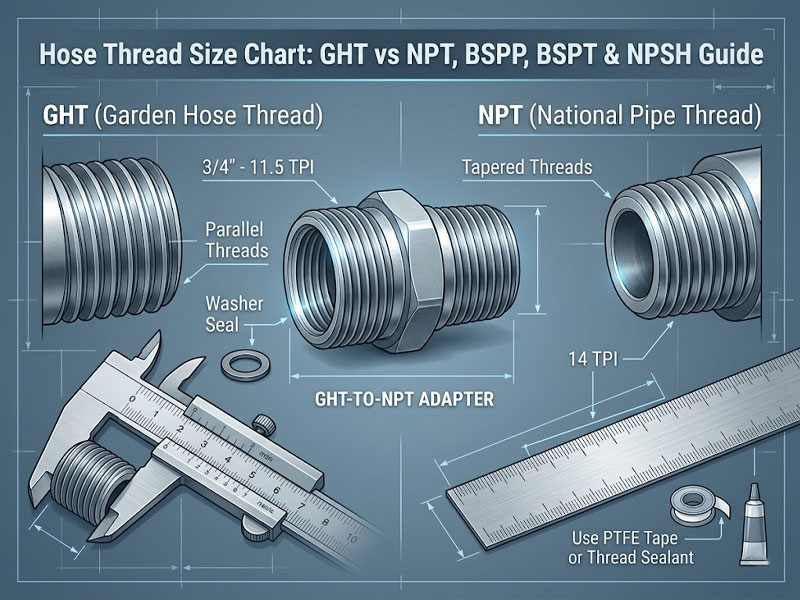
GHT (also called NH or NST; some reduced variants are labeled NHR) is the dominant standard for residential and commercial gardening in North America. Its key specifications are:
- Nominal Size: 3/4 inch (0.75″)
- Thread Pitch: 11.5 TPI (Threads Per Inch) – Note: This is NOT the same as standard pipe threads.
- Thread Type: Straight (parallel), non-tapered.
- Sealing Mechanism: Primarily relies on a compressible rubber or EPDM washer inside the female fitting.
National Pipe Thread (NPT)
NPT is used for higher-pressure applications like pressure washers, air compressors, and metal plumbing.
- Nominal Size: Varies (1/4″, 3/8″, 1/2″, 3/4″ are common)
- Thread Pitch: Varies by size (e.g., 1/2″ NPT = 14 TPI)
- Thread Type: Tapered (the diameter decreases along the length of the thread).
- Sealing Mechanism: The threads wedge together to create a seal, commonly using PTFE tape or thread sealant.
Hose Thread Size Chart: GHT, NPT, BSPP, BSPT, NPSH
This hose fitting size chart is most useful when it clearly shows the thread standard, thread form, and seal method.
| Thread Standard | Common Name | Nominal Size | TPI | Thread Form | Seal Method | Typical Applications |
|---|---|---|---|---|---|---|
| GHT (NH/NHR) | Garden Hose Thread | 3/4″ | 11.5 | Parallel | Compressible Washer | Residential faucets, garden hoses, sprinklers, Y-connectors |
| NPT | National Pipe Taper | 1/4″, 3/8″, 1/2″, 3/4″ | 18, 18, 14, 14 | Tapered | PTFE Tape or Sealant | Pressure washers, compressors, pipe systems, industrial fluid lines |
| NPSH | National Pipe Straight | 1/2″, 3/4″ | 14 | Parallel | Gasket or O-ring | Fuel pumps, tank fittings, low-pressure industrial |
| BSPP | British Standard Pipe Parallel | 1/2″, 3/4″ | 14 | Parallel | Bonded Washer / O-ring | Imported irrigation equipment, European fittings, instrumentation |
| BSPT | British Standard Pipe Tapered | 1/2″, 3/4″ | 14 | Tapered | PTFE Tape or Sealant | European high-pressure systems, steam lines |
How to use this chart:
- Homeowners & gardeners → Focus on GHT rows (washer-sealed, 3/4″-11.5 TPI).
- Pressure washer & air tool users → Focus on NPT rows (tapered, PTFE tape required).
- Owners of European equipment → Look for BSPP/BSPT rows — you will need an adapter.
- Industrial buyers → Reference NPT, NPSH, and BSPT for fluid transfer, fuel, and steam applications.
How to Measure Hose Thread Size Without a Gauge
You don’t always need special tools. In practical tests across many consumer fittings, these three checks correctly identify the thread type in most cases.
Limitation: These checks are useful for most consumer fittings, but critical industrial systems should still be verified with a proper thread gauge or spec sheet.
Step 1: The “Washer Check” (For Female Fittings)
Look inside the female end of your hose or device.
- If you see a rubber washer: You most likely have a GHT fitting. This washer is designed to compress against the flat, flared end of a male GHT connector.
- If you see bare metal threads with no washer: You likely have an NPT fitting.
Step 2: The Visual Taper Test
Hold the male threads sideways against a straight edge, like a ruler.
- Parallel (GHT): The thread diameter at the tip is the same as at the base.
- Tapered (NPT): The thread tip is visibly smaller than the base.
Step 3: Measure TPI (Threads Per Inch)
- Place a ruler along the threaded area.
- Count the thread crests within a 1-inch span.
- Compare: 11.5 TPI = GHT; 14 or 18 TPI = NPT.
Key takeaway: By combining the washer check, visual taper test, and TPI measurement, most users can identify their hose thread type at home without special tools.
GHT vs NPT: Differences, Compatibility, and Adapters
A common mistake is trying to connect a brass NPT fitting to a plastic GHT coupler. In many support cases, returns for leaking fittings are attributed to this thread mismatch. Because NPT threads are tapered, they will only engage 1–2 turns into a GHT fitting before jamming, leaving a large, unsealed gap. Conversely, a GHT fitting threaded onto an NPT pipe will feel loose and will not create a seal without a special adapter. Do not connect them directly; use a proper adapter (e.g., 3/4″ GHT female to 1/2″ NPT male).
Thread Types for Garden Hoses, Pressure Washers, and Industrial Equipment
Garden Hose and Irrigation Threads (GHT)
GHT is the standard for North American residential and commercial gardening. A frequent error is attempting to connect GHT to NPT without an adapter, which typically causes leaks. For irrigation systems, always verify that your timer, backflow preventer, and connectors specify GHT 3/4″-11.5.
Pressure Washer and Air Compressor Threads (NPT)
Most pressure washers and air tools use 1/4″ or 3/8″ NPT. Unlike GHT, NPT requires PTFE tape or pipe dope on the threads themselves to seal. When replacing a pressure washer hose, check both the pump outlet and the spray gun inlet — they may have different NPT sizes.
European BSP Threads for Imported Equipment
Equipment from Europe or Asia typically uses BSPP (parallel) or BSPT (tapered). These look similar to GHT but will cross-thread if forced. Always purchase a dedicated GHT-to-BSP or NPT-to-BSP adapter. (For engineering reference: BSPP is associated with ISO 228-1, and BSPT with ISO 7-1 for BSPT)
Common Hose Fitting Leaks and Fixes
Even with a reliable reference, issues can arise. Here are three frequent problems with proven fixes.
Problem 1: Leaking at the Faucet or Hose End
The Cause: A missing, old, or incorrectly sized washer. Over time, EPDM washers flatten and lose elasticity.
The Solution:
- Turn off the water and relieve pressure.
- Remove the female hose end from the faucet.
- Inspect the washer. If cracked, hard, or misshapen, replace it.
- Pro Tip: Use a “multi-fit” convex washer, designed to seal against both worn and new fittings. Replacing washers annually is a good maintenance practice.
Problem 2: Cannot Thread the Connector More Than 1 Turn
The Cause: A classic sign of a GHT-to-NPT mismatch.
The Solution: Do not force it. Forcing a mismatched thread can strip softer brass or plastic material, potentially ruining the fitting. Instead, use a brass adapter, typically costing.
Problem 3: Leak at a Quick-Connect Coupling
The Cause: A damaged internal O-ring (debris, temperature) or an incompletely engaged coupling.
The Solution:
- Disconnect and reconnect, ensuring a firm “click” or “pull.”
- Inspect the internal O-ring for nicks or flat spots. Replacement kits are widely available.
- Regular cleaning of the coupling’s internal screen can significantly reduce premature O-ring failures.
Which Thread Should I Use? A Quick Decision Guide
| If your fitting is for… | Then you generally need… |
|---|---|
| A garden hose faucet or sprinkler | GHT |
| A pressure washer or air compressor | NPT (tapered, with sealant) |
| Equipment imported from Europe | BSPP or BSPT (requires adapter) |
| A system with a washer and straight threads | GHT or BSPP |
| Tapered threads that seal on thread engagement | NPT or BSPT |
Safety and Pressure Rating Guidelines
- Never exceed the rated working pressure of your hose or fitting. Over-pressurization can cause sudden burst failure.
- For high-pressure applications (air, hydraulic, steam): Always consult the manufacturer’s datasheet and follow relevant standards (e.g., ANSI/ASME B1.20.1 for NPT).
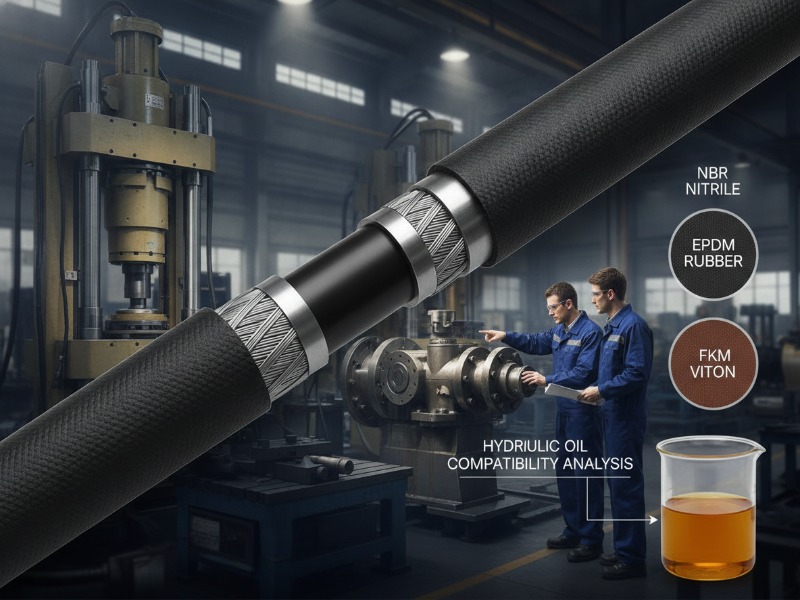
- For chemical or fuel transfer: Verify seal material compatibility (EPDM, Nitrile, Viton, PTFE) before installation.
- Always confirm thread type, pressure rating, and seal compatibility before use in hydraulic or other critical applications.
FAQs: Garden Hose Thread Size, NPT, and BSP
What is the standard garden hose thread size in North America?
The standard is 3/4″ GHT (Garden Hose Thread) with 11.5 threads per inch (TPI). It uses parallel threads and typically relies on a rubber washer for sealing.
How can I tell if my fitting is GHT or NPT?
Check for a rubber washer (GHT) vs. no washer (NPT), and look at the threads: parallel (GHT) vs. tapered (NPT). You can also measure TPI — 11.5 is GHT, 14 or 18 is NPT.
What size is a standard garden hose thread?
A standard garden hose thread is 3/4″ GHT with 11.5 TPI. It is a parallel thread that seals with a rubber washer.
Can you connect GHT to NPT directly?
No. GHT and NPT are not directly compatible. Use a brass GHT-to-NPT adapter.
How do I measure hose thread size without a thread gauge?
Use a ruler to count thread crests in 1 inch (TPI). Also, check for a rubber washer (GHT) and look for tapered threads (NPT).
What is the difference between BSPP and BSPT?
BSPP has straight threads and seals with a bonded washer or O-ring. BSPT has tapered threads and seals with PTFE tape. Neither is compatible with GHT or NPT without an adapter.
Why does my hose leak at the faucet even with a new washer?
The washer may be the wrong thickness, the faucet threads could be damaged, or the male GHT fitting may have a worn flare face. Try a multi-fit convex washer.
What is the difference between NH and NHR threads?
NH (National Hose) is standard GHT. NHR (National Hose Reduced) has a smaller outer diameter but the same 11.5 TPI. Both are generally compatible with standard GHT fittings.
Are pressure washer threads the same as garden hose threads?
No. Most pressure washers use 1/4″ or 3/8″ NPT. An adapter is needed to connect a standard garden hose.
What adapter do I need for GHT to NPT?
A brass adapter such as 3/4″ GHT female to 1/2″ NPT male, or the reverse, depending on your connection requirements.
Leaks and mismatched fittings are often preventable. Using a hose thread size chart to choose the right hose and fitting is highly effective. Remember: GHT has 11.5 TPI and a parallel thread that typically uses a washer; NPT has a tapered thread that seals with PTFE tape. Start by identifying your thread type and always verify pressure ratings.