

A steam hose assembly can be finished two ways, and the duty decides which. A crimped end is a permanent swaged attachment: the ferrule is pressed once onto the shank (the metal tail that sits inside the hose) and nothing then protrudes. A banded, or clamp-type, end uses a bolted or interlocking clamp that can be re-tightened.
That difference follows from a material behavior rather than from workmanship. This guide compares both routes, the rules they share, and how the assembly rating is actually set.
About a 15-minute read at 250 words per minute; the comparison tables are built to be scanned.

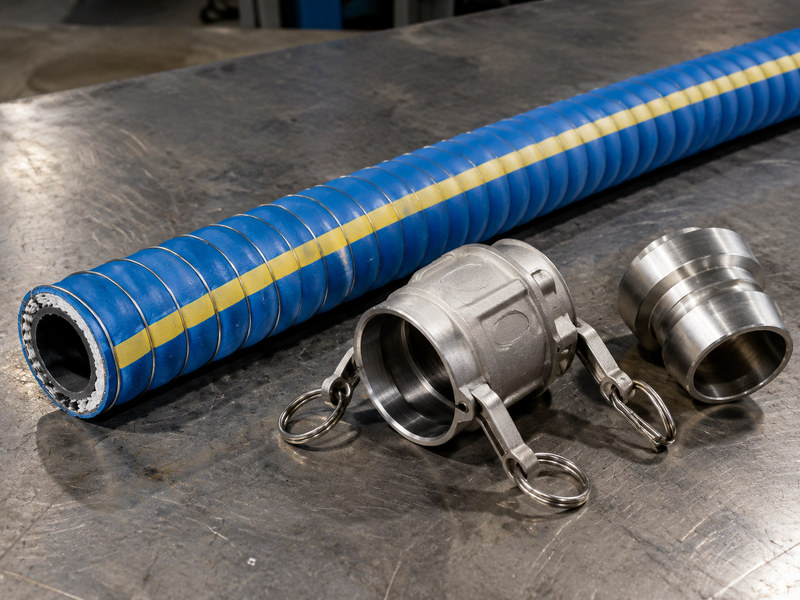
Figure 1. The same hose, two finishes. The crimped end is permanent and flush. The banded end can be opened, inspected and re-tightened in place.
What Makes a Steam Hose Assembly Different From a Hose?
A hose is a length of tube, reinforcement and cover with a published pressure and temperature rating established under a defined test. A steam hose assembly adds the ends, and the ends bring a second set of limits that the hose rating says nothing about.
NAHAD assembly practice handles this with one rule: rate the assembly by the lowest-rated component in it, whether that is the hose, the coupling, the clamp or the ferrule. Applied to steam, the rule means the assembly figure can be no higher than the hose figure. The two are equal only when the hose itself is the weakest part.
Table 1. What a steam hose assembly adds beyond the hose itself.
| Element | What it contributes | What it constrains |
|---|---|---|
| Hose | Pressure and temperature capability, bore and bend radius | Nothing about the ends |
| Coupling | The interface to the equipment or the next length | Adds its own pressure and temperature limit |
| Attachment | How the coupling is held on the shank | Decides whether the grip can be restored later |
| Assembly work | Whether the parts were joined to a defined procedure | Decides whether the rating can be claimed at all |
Why the Hose Rating Is Not the Assembly Rating
A supplier who quotes a 250 psi hose has rated a hose. The assembly on the end of it may be rated lower, because a coupling or a clamp selected for the bore can carry less than the hose does. Nothing about the hose changes that.
This matters when a specification is written from a catalog. Copying the hose figure onto the line item holds only where the hose is the weakest part. Otherwise it produces an assembly requirement no supplier can certify, and the gap shows up when someone asks what the assembly is rated for.
Why Two Routes Exist at All
Crimping and banding solve the same problem, and each solves a different part of it. Crimping gives a consistent, permanent, low-profile joint that is made once under controlled conditions. Banding gives a joint that can be re-opened and re-tightened after the hose has changed shape at temperature.
The choice therefore turns on whether the duty benefits from adjustment, and on whether the shop that builds the assembly is equipped and competent to do it properly.
Crimped End Connections on a Steam Hose
Swaging presses a ferrule onto the shank with a controlled reduction in diameter, so the grip comes from a formed metal-to-rubber interference rather than from threaded fasteners. A long ferrule paired with a matching coupling set is the arrangement used where the highest available shank retention is wanted.
The result is a joint with no fasteners to lose, nothing protruding past the hose outside diameter, and a profile that passes through guides and around bends without snagging. Made on the correct machine with the correct die, it is repeatable from assembly to assembly.
Table 2. The crimped route: what a crimped ferrule assembly delivers, and what it rules out.
| Propriedade | Crimped end |
|---|---|
| Attachment | Permanent swaged ferrule, formed under controlled reduction |
| Re-tightening | Not possible after the ferrule is pressed |
| Retention | Highest available when a long ferrule and coupling set are used |
| Profile | Flush, with no protruding fastener to snag |
| Repeatability | High, where the machine and die are matched to the hose |
| Adjustment in service | None, so the grip is fixed at the day it was made |
Why a Long Ferrule Beats a Shallow Sleeve
Not every crimped ferrule assembly is equal. A ferrule that grips a long length of shank distributes the load over more rubber and resists pull-off better than a shallow sleeve that grips only at the end. The long ferrule and coupling set is the arrangement specified where shank retention is the deciding factor.
The difference shows up under the loads a steam line actually produces: pressure thrust, thermal movement, and the weight of a hose full of condensate hanging from its ends. A short sleeve gives up first at the point where the shank stops gripping.
What a Crimped Ferrule Assembly Cannot Do
A crimped end cannot be re-tightened, so the assembly goes into service with the grip it was given. Where the duty is stable and the assembly is made properly, that is not a limitation. Where the rubber will take significant compression set and the joint relies on continued clamping load, it is the reason some plants choose a clamp.
The honest statement is that a crimped ferrule assembly is not adjustable. Whether that matters depends entirely on the duty, and the next section sets out the mechanism that decides it.

Figure 2. A crimped ferrule is formed once, under a controlled reduction. The grip it develops on the day it is made is the grip it carries for the rest of its service.
Banded End Connections on a Steam Hose
A banded end connection holds the shank with a bolted or interlocking clamp. The clamp body wraps the hose, the bolts compress it, and where the coupling carries an interlocking ridge, the clamp saddles engage that ridge to add mechanical grip on top of friction. That ridge belongs to the ground joint, or Boss coupling: a hammer-lug swivel female running onto a spud.
The defining property of a banded end is access. The clamp can be opened, inspected and re-tightened throughout the life of the assembly, which is what allows a joint to be restored once the rubber has taken its set.
Table 3. What a banded end connection brings to a steam hose, and what it asks in return.
| Propriedade | Banded end |
|---|---|
| Attachment | Bolted or interlocking clamp compressing the hose shank |
| Re-tightening | Possible, and part of the standard routine |
| Retention | Friction plus, where the clamp engages a coupling ridge, mechanical interlock |
| Profile | Proud of the hose, so routing needs a little more clearance |
| Repeatability | Depends on the fitter and on the torque figure being recorded |
| Adjustment in service | Full, including re-torque after the first heat cycles |
Why the Rubber Takes a Set at Steam Temperature
Rubber held in compression at steam temperature gradually stops pushing back. The material takes what is called compression set, and the clamping load falls with it. Nothing is broken, no work has been done badly, and the joint that was tight when it was made is simply less tight after the first few heat cycles.
That behavior is the reason ISO 6134:2024 requires an end fitting whose clamping force can be adjusted. A joint that can be re-tightened can be brought back to its figure. A joint that cannot has no way to recover the load.
The Bolt Kit Is Part of the Choice
Interlocking clamps are built around specific bolt threads and lengths, so a generic bolt of the same diameter will not seat correctly and the clamp will not develop its grip. The bolt kit travels with the clamp body, and losing it means waiting for the right part rather than pulling one from a general bin. The steam fittings and clamps buyer reference lists what to keep in stock.
That is a practical cost of the banded route rather than a fault. It is worth planning for on a plant that keeps spares, because the matched kit is the item most often missing when an assembly is rebuilt at the bench.
Why a W-Type Clamp Is Not a Substitute
A W-type or double-bolt clamp is a general industrial clamp built for standard bolts, and it suits general utility hose. A ground joint end needs the interlocking clamp and its matched non-standard bolts instead, and the steam hose fittings guide sets out the pairings. Fitting a W-type leaves the coupling ridge unengaged, so the end loses the added shank retention the coupling was selected for.
Mixing clamp families on a steam bench is one of the more common assembly errors, and it produces an assembly that looks complete and is not built as specified.
Comparing Steam Hose Assembly Routes Side by Side
Both routes are legitimate, and neither is a compromise. The table below sets out what each one asks of the buyer, so the choice can be made from the application rather than from habit.
Table 4. What each assembly route asks of the buyer, once the parts are paid for.
| Point | Crimped | Banded |
|---|---|---|
| Who holds the certification | The supplier, on its process record | The plant, on the figure it signs |
| Where the ceiling usually lands | The ferrule and coupling set, unless the hose itself is lower | The clamp, unless the hose or the coupling is lower |
| Dependence on spares | A ferrule and a re-swag | A matched bolt kit on site |
| Action after the first heat cycle | None permitted | Re-torque to the recorded figure |
| Field repairability | None; it returns to a workshop | The clamp opens and rebuilds in place |
| Who owns assembly quality | The workshop with the swaging machine | The fitter and the signed record |
Where Each Route Is the Better Answer
The crimped route suits a duty that is stable, a plant that builds assemblies in a controlled workshop, and installations where a flush profile matters. It also suits high-volume work, where repeatability between identical units is worth more than adjustability.
A banded end connection suits a duty that cycles hot and cold, a plant that needs to inspect and adjust joints in place, and situations where the assembly may have to be rebuilt on site. It also suits the small-bore utility work where a hose is handled constantly and the joint needs checking.
Why the Answer Is Often Both
Many plants use both, on the same site and sometimes on the same line. A crimped assembly goes on the stable process connection, and a banded assembly goes on the utility station where the hose is moved and the joint needs periodic attention.
That is not a compromise position. It is a correct reading of the two duties, and it is the arrangement most suppliers expect to see in a mixed order.
The Disagreement the Choice Sits Inside
Suppliers who favor swaging point to a joint made once under controlled conditions: permanent, flush, free of fasteners that can work loose, and repeatable across identical units. Suppliers who favor clamps point to the same compression set this guide describes, and argue that a joint whose clamping load can be restored is the safer answer on a line that cycles. Both sides accept the lowest-rated component rule.
The disagreement is adjustability. A permanently swaged end meets the lowest-rated component rule but not the adjustability requirement ISO 6134:2024 sets. A specification citing it is met on the clamp route. Swaged ends remain in use where the duty is stable and the plant’s procedure accepts a permanent joint.
The final call sits with whoever signs the plant’s assembly procedure.
How the Steam Hose Assembly Rating Is Actually Set
The rating question is answered by identifying which component sets the ceiling, and then confirming that the hose rating was not simply copied onto the assembly line item.
Steam adds one constraint on top of the pressure ceiling: the end connection must allow its clamping force to be adjusted as the rubber takes compression set. ISO 6134:2024 states that requirement for this product class. It is what decides the route on a joint that relies on continued clamping load.
Confirming Which Component Sets the Ceiling
Work through the parts in order. The hose carries a published working pressure at a paired temperature. The coupling carries its own limit based on body material, seat type and thread form, and the coupling types and sizes reference covers those options. The attachment carries a limit that depends on the clamp or the ferrule and on how well it was made.
The assembly figure is the lowest of the three physical parts. A supplier who can name the component that set the ceiling has rated the assembly. A supplier who repeats the hose figure has not.
The hose in a steam hose assembly publishes 17 bar (250 psi) at a paired steam temperature. The coupling and the clamp or ferrule can each sit below that pair, never above it. Within the swaged route the figure moves with the hardware: a long ferrule and coupling set reaches the hose value, while a shallow sleeve pulls it down. The joining procedure is a gate rather than a value.

Figure 3. The assembly figure and the component that set it belong on the tag. Without both, the next person to use the assembly has a number with no basis.
What the Rated Working Pressure Cannot Cover
A rated working pressure describes steady service at a paired temperature. It does not cover a pressure spike, a condensate slug, or the transient load a sudden valve movement produces, and it does not describe a duty in which the joint has been allowed to lose its clamping load.
Those events are covered by the design margin, not by the rating. The margin is there to absorb them, and it is not spare working capacity to be spent on a higher steady pressure.
Choosing a Steam Hose Assembly Route by Duty
Route selection is a short exercise once the duty is written down. The inputs that decide it are the thermal cycling pattern, the access available at the joint, the equipment at the workshop, and how the assembly will be maintained through its life.
Table 5. Matching the assembly route to the duty pattern.
| Duty pattern | Route that usually fits | Why |
|---|---|---|
| Steady process connection, little cycling | Crimped | The grip is not asked to change over the life of the joint |
| Duty that cycles hot and cold | Banded | The joint can be re-torqued after the rubber takes its set |
| Portable or handled hose | Banded | The joint can be inspected and adjusted without a workshop |
| High-volume identical units | Crimped | Repeatability between units is worth more than adjustability |
| No swaging equipment on site | Banded, built in-house; crimped ordered from the supplier | The banded route needs hand tools and a matched fastener set |
The Question to Ask Before Either Route
Ask who will inspect the joint in service, and how. A crimped end can be looked at but not adjusted. A banded end can be opened and set to a figure, which requires that figure to exist and to be recorded.
If the answer is that nobody will look at it, then the route matters less than the routine, and the assembly should be treated as a part with a planned replacement point rather than as one that is maintained.
What Neither Route Fixes
Neither route compensates for a hose run that bends tighter than its published radius, or for a coupling that carries a ridge no clamp is engaging. Neither one covers for a joint that was never tightened to a stated figure. Steam duty accepts the bolted or interlocking clamp end and the permanent swaged end; cam-and-groove and other quick-release ends sit outside that set on every bore. The steam hose inspection checklist sets out the checks that follow either route.
Those are selection or assembly errors rather than attachment problems, and no choice between crimping and banding will correct them.
Steam Hose Assembly FAQs
Is a crimped end or a banded end better for steam?
Neither is better in general. A crimped end is permanent and flush, and suits stable duty and consistent workshop assembly. A banded end can be re-tightened after the rubber takes compression set, and suits duty that cycles or that needs in-place inspection. The duty decides, not the method.
Why can a banded end be re-tightened when a crimped end cannot?
Because the clamp holds the shank with bolts. The bolts can be loosened and brought back to their figure at any time, which restores the clamping load the rubber has lost to compression set. A crimped ferrule is a formed attachment, so once it is pressed the grip is fixed.
Does a crimped end hold more pressure than a banded end connection?
Retention depends on the arrangement rather than on the route. A long ferrule and its matching coupling set give the highest available shank retention, which is why that set is specified where retention is decisive. A clamp that engages a coupling ridge adds mechanical interlock on top of friction. Retention and pressure ceiling are different questions: one says what will not pull off, the other how much pressure the assembly may carry.
What is the rated pressure of a finished steam hose assembly?
The assembly is rated by the lowest of three physical parts: the hose, the coupling, and the clamp or ferrule. NAHAD Industrial Hose Assembly Guidelines state this as the lowest-rated component rule, so the assembly figure cannot exceed the hose figure. A defined joining procedure is what makes any rating claimable, and it adds no fourth number to compare. The tag should carry the assembly figure and the part that set it.
Can I crimp a steam hose on site?
Not practically, because a crimped end needs a matched swaging machine and die, and the process has to be controlled to be repeatable. Where a plant has no swaging equipment, the assembly is made by the supplier. A banded end is the route that can be worked with hand tools and a matched bolt kit.
Why do interlocking clamps need their own bolts?
Because the bolts built for them are non-standard. The thread and the length belong to the clamp body, so a same-diameter bolt from a general bin neither seats nor lets the clamp develop its grip. A re-torque reading taken on a substitute bolt describes the fastener rather than the joint. The matched kit is ordered with the clamp.
Can a quick-release coupling be used on a steam assembly?
Steam does not permit them. The accepted ends are the bolted or interlocking clamp type and the permanent swaged type; cam-and-groove falls outside that set, as does every other quick-release pattern, on all bores and at any rating. The reason is adjustability: a steam joint has to accept being brought back to its clamping figure, and a quick-release mechanism cannot offer that.
Should the assembly tag record the route used?
Yes, and more than the route. It carries the assembly figure, the part that set it, the coupling, the clamp type or ferrule, the assembly date, and the torque figure where one applies. Without those entries, the next inspection cannot repeat what was done at the bench.
How do I decide the route for an existing line?
Start with the thermal pattern and the access. A line that cycles hot and cold, or whose joint has to be checked in place, points to a banded end. A steady process connection on a controlled workshop build points to a crimped end. Then confirm the coupling and the clamp are a matched pair before the assembly is built.
About HENGHUA and Steam Hose Assembly Supply
HENGHUA manufactures steam hose, industrial hose and hydraulic hose for plants, distributors and equipment builders worldwide. Assemblies can be supplied crimped or built with clamps and matching tails, so the route is decided by the duty rather than by what the shop happens to have.
On the fittings side we supply the ground joint coupling family, bolted safety clamps and the matched bolt kits that go with them, so a steam end arrives as a set rather than as parts to be reconciled. Every length is proof-tested hydrostatically before dispatch, and custom lengths, cover printing, private label and OEM work are available.
Two things we tell buyers plainly. An assembly is rated by its weakest part, so we quote the assembly figure rather than repeating the hose rating. And where a clamp is used, the torque figure goes onto the tag with the assembly, because a joint that is meant to be re-tightened needs a number to come back to.
Send the maximum pressure the system can deliver, the steam condition at the point of use, the bore and thread, and the duty pattern. We will then recommend a route and confirm the coupling, the clamp and the bolt kit as one package. Please get a quote and free samples, or review the steam hose category and the EPDM steam hose 170 °C product page.
O saturated steam hose guide covers the material and standard side, and is the right starting point before comparing end connections.
About the author: Written by the HENGHUA Engineering Team, hose application engineers and assembly specialists supporting hose selection, end connections and pressure testing for industrial, marine, food processing and mobile equipment customers. The assembly practice described here reflects our own bench and field service experience with both steam hose constructions.

 English
 Spanish
 Portuguese
 French
 German
 Arabic
 Russian
 Indonesian
 Japanese
 Korean