
A cryogenic hose works at temperatures where most polymers become brittle and most metals change behaviour. LNG sits near −162 °C at atmospheric pressure, and a hose for that duty is a different product family from the composite hose used on ambient chemical transfer. The ladder down to LOX and LN2, and where the composite band stops, is set out in the temperature review.
This guide explains what changes at those temperatures, which constructions are used, how boil-off drives the insulation decision, and where the standard composite hose stops.
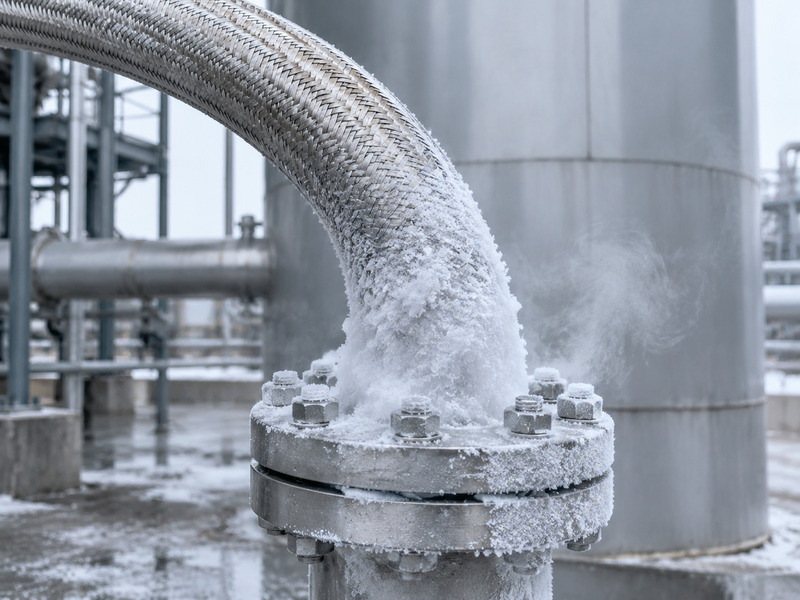
Figure 1. Frost at a flange is the visible evidence of heat leak. The hose is doing its job; the insulation is telling you how well.
Why Is Cryogenic Duty Different?
Four effects, and each changes the design rather than the specification.
Metals contract. A stainless hose at LNG temperature is shorter than the same hose at ambient, and the contraction has to be absorbed by the corrugations or the geometry rather than by the fittings.
Polymers embrittle. A thermoplastic film that flexes at −30 °C can crack at −160 °C, which is why the ordinary composite wall is not a candidate for cryogenic service.
Water freezes. Moisture in the air condenses and freezes on any surface below the dew point, so insulation, purging and drainage all matter.
And the product boils. Any heat that reaches the liquid turns it into gas, which changes the pressure in the system and the composition of what is being transferred.
What Constructions Are Used?
Two, in practice.
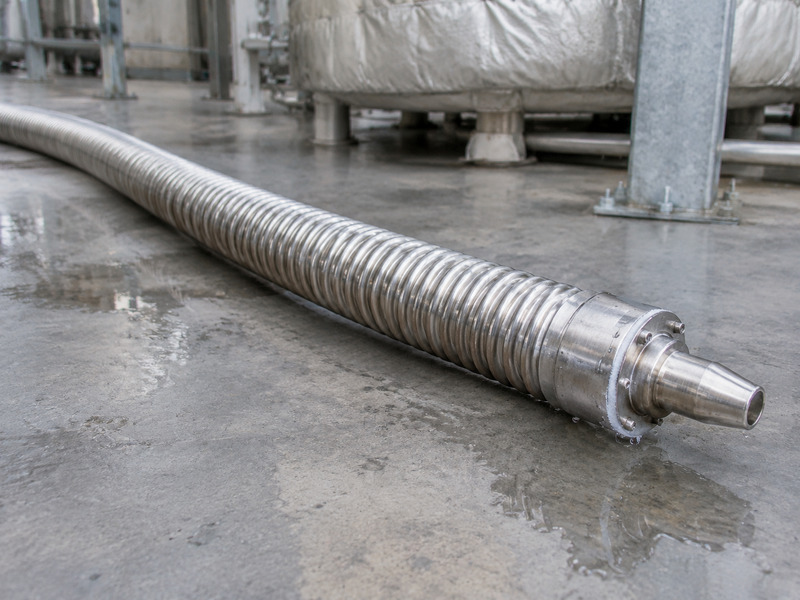
The first is corrugated stainless steel hose, with or without a braid, which relies on the corrugations for flexibility and the alloy for low-temperature toughness. It is the established construction for cryogenic transfer and it is covered by metal hose and cryogenic hose standards.
The second is a purpose-built cryogenic hose that combines a flexible core with high-performance insulation, often in a vacuum jacket. Some of these are described as composite because the wall is not a single metal tube.
The second category only qualifies when every layer is engineered for the temperature. A standard composite hose for chemical duty is not in either category. Its wall is a thermoplastic film stack designed for ambient to moderate temperature, and the European specification that governs it explicitly excludes LNG duty.
How Do the Constructions Compare?
| Attribute | Corrugated stainless | Purpose-built cryogenic hose | Ambient composite hose |
|---|---|---|---|
| Temperature capability | Cryogenic | Cryogenic | Ambient to moderate |
| Flexibilidade | Moderate, fatigue limited | Lower, insulation dependent | Elevado |
| Permeation | None through metal | Very low | Moderate |
| Peso | Elevado | High with jacket | Baixo |
| Insulation | External, added | Often integrated | Not applicable |
| Governing standard | Metal and cryogenic hose standards | Cryogenic and LNG system standards | Composite hose standard |
| Fatigue risk | Corrugation fatigue | Connection and jacket integrity | Film and bond |
| Not applicable | Ambient chemical transfer | Short transfers where loss is tolerated | Cryogenic duty, which the composite standard excludes |
Table 1. Constructions by attribute. The third column is included to show where the boundary sits, not as an option for cryogenic duty.
The table explains a purchasing reality. Cryogenic equipment is expensive, heavy and specialised. The cost is driven by insulation and by the testing regime rather than by the hose length.
What Does Boil-Off Mean for a Hose?
Boil-off gas, or BOG, is the vapour that forms when heat reaches stored cryogenic liquid. In a hose, that heat comes through the wall, through the insulation and through every fitting.
Three consequences follow. The product composition changes as the light ends boil first. The pressure in a closed system rises unless gas is vented or returned. And the hose’s insulation becomes a commercial variable, because boil-off is product lost.
The insulation decision is therefore not only about frost on the outside. It is about how much product the line gives up over a transfer, and that figure is what an LNG operator actually measures.
This is why vacuum-jacketed designs dominate where transfers are long or frequent, as the insulation comparison sets out, and why simpler insulation appears where transfers are short and the loss is tolerable.

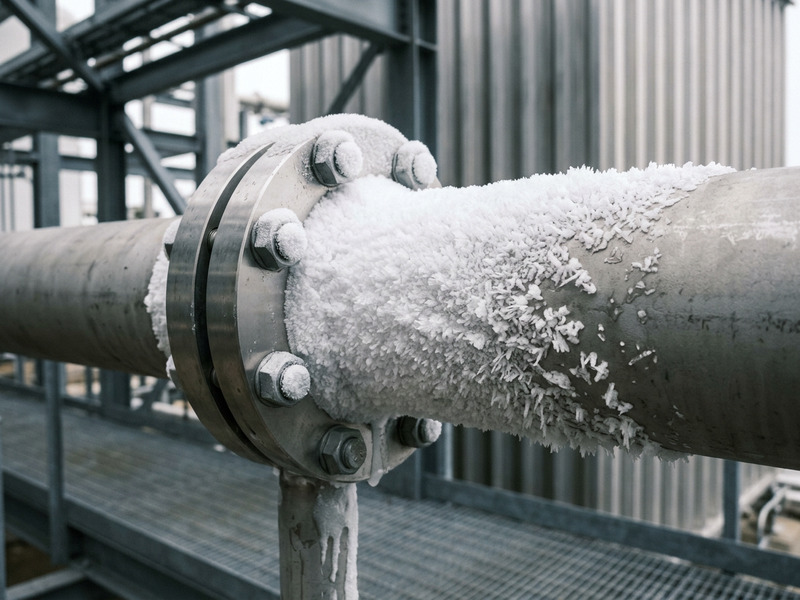
Figure 2. A bayonet end under frost. The coupling, the jacket and the hose are three separate parts, and the insulation is where the boil-off decision is made.
Which Standards Apply?
The composite hose standard that governs ambient chemical duty excludes LNG and LPG, as the standards map shows, which is the first thing to establish with any enquiry. Cryogenic flexible hose is covered by a dedicated standard for cryogenic service, and LNG transfer systems are covered by the LNG transfer system standard, which addresses the system rather than a hose in isolation.
Metal hose follows its own standard for corrugated assemblies. Those three documents answer different questions, and a project usually needs at least two of them.
| Document | Scope | What it decides |
|---|---|---|
| Composite hose standard | Ambient chemical and hydrocarbon hose | Types, pressure, temperature |
| Cryogenic hose standard | Flexible cryogenic hose | Performance and testing |
| LNG transfer system standard | LNG transfer systems | System design and approval |
| Metal hose standard | Corrugated metal assemblies | Design and testing |
| Exception | A hose inside a system already approved | The system document governs, and the hose standard supports it |
Table 2. The four documents a cryogenic enquiry meets. Only one of them describes an ambient composite hose.
Where Does a Cryogenic Composite Hose Fit?
Where the wall is engineered for the temperature, not where the word composite appears. The gap between the −30 °C floor of an ambient composite hose and LNG at −162 °C is 132 °C. No wall thickness and no insulation closes it; only a different wall does.
A cryogenic composite hose works by engineering every layer, not by choosing a familiar one: the core material, the barrier, the insulation and the jacket. That is a different product from an ambient composite hose with the same broad description.
For a buyer, the test is documentary. Ask which standard the product is tested to, what temperature the test uses, and what the approval covers. A product described as composite without a cryogenic test basis is a description, not a specification.
How Do You Specify Cryogenic Duty?
Six lines, and the first one is decisive. The type guide shows why the ambient bands cannot be stretched.
The medium and its temperature. The pressure and the flow. The insulation requirement, expressed as a boil-off or heat-leak limit rather than a material name. The end connections, which at cryogenic temperatures are usually bayonet, flanged or specially designed. The standard the project requires. And the system context, because an LNG hose is approved as part of a system.
Where the insulation requirement is not stated, the supplier will choose the cheapest option that survives, and the operator will pay for it in boil-off.
What Should You Ask a Supplier?
Four questions.
Which standard is the product tested to, and at what temperature. What is the heat-leak or boil-off figure, and under what conditions. What is the cooldown procedure and how long does it take. And what inspection is required between transfers.
A supplier who answers all four is selling an engineered product. One who answers with a temperature rating alone is selling a claim.
What Does Cooldown Do to a Hose?
A cryogenic line is not cold at the start, and the transition is where much of the mechanical duty happens.
Cooldown contracts the hose along its length and across its diameter, and the rate matters. A fast cooldown puts a thermal gradient through the wall, which stresses the bond between layers and the seal at each fitting.
That is why a cooldown procedure exists for cryogenic transfer and why it is specified rather than improvised. A gradual cooldown using vapour first, then liquid, is standard practice on large systems.
For a cryogenic composite hose, cooldown also tests the insulation. A jacket that loses vacuum will show frost at a predictable point, and the point moves as the vacuum degrades.
The practical check after a first cooldown is a walk-round with a torch and a thermal camera if one is available. Frost where frost should not be is the earliest evidence of a problem.
Where Does a Boil Off Gas Hose Sit?
A BOG line is a different line from the liquid transfer line, and it is often forgotten in the specification.
It carries vapour rather than liquid, at low pressure and still at cryogenic temperature. Its duty is dominated by insulation and by the risk of ice blockage rather than by pressure.
Two consequences follow. The bore is set by the vent rate rather than by a transfer rate. And the routing matters, because a low point in a vapour line collects liquid that has condensed, which can then freeze.
A cryogenic transfer hose and a boil off gas hose on the same system should be specified together, because the operating envelope of one affects the other.
How Do You Evaluate an Offer?
Five checks, and all of them are documentary.
The standard quoted, with the edition. The test temperature, which should be at or below the duty temperature. The approval scope, which should name the assembly rather than a material. The insulation performance, expressed in a figure with conditions. And the cooldown and inspection procedure, which is where most operating problems are actually solved.
An offer that answers three of the five is an offer that will need a second round. One that answers all five is a specification.
For an engineer comparing options, the useful discipline is to write the answers into a table before discussing price. A cryogenic transfer hose decision made on price alone usually revisits the insulation question within a year.
What About Ice and Moisture?
Water is the least discussed and most frequent problem on a cryogenic line.
Moisture condenses on any surface below the dew point, and a hose at LNG temperature is far below it. Ice forms on fittings, on flanges and inside unsealed insulation.
Ice on a fitting is not cosmetic. It can prevent a connection from seating, and it can crack a component when it expands. Ice inside insulation destroys performance permanently.
The practical measures are simple. Purge and dry before cooldown, seal the insulation, and keep the fittings accessible for inspection. A cryogenic composite hose with a sealed jacket and dry fittings behaves predictably; one with a breached jacket does not.
How Does a Cryogenic Project Differ From an Ambient One?
Five ways, and each changes the procurement rather than the product.
The first is the approval route. An ambient hose is bought to a product standard; a cryogenic line is usually approved as part of a system, which means the hose maker supplies data into someone else’s file.
The second is the testing. The assembly is tested cold, and the test facility is part of the cost. A supplier without cold test capability is a supplier who is passing the risk to you.
The third is the installation window. Cryogenic lines are usually installed during a shutdown, and the hose has to arrive with its documentation complete rather than with a promise to follow.
The fourth is the inspection regime. Ambient hoses are inspected visually and pressure tested; cryogenic hoses are inspected for insulation integrity, frost patterns and fitting condition, often with a thermal camera.
The fifth is the spare policy. The assembly is not a stock item in most plants, and the lead time is measured in months. A project that plans spares late plans a shutdown extension.
None of these is a reason to avoid a cryogenic line. All of them are reasons to start the specification earlier than an ambient purchase would need.
What Should a Project Team Ask First?
Three questions, in order.
Which standard governs the system, and who owns the approval. That establishes the document chain before any product is discussed.
What temperature and pressure the line sees at its coldest and its highest, including cooldown and any abnormal case. That sets the construction family.
And what the insulation requirement is, expressed as a boil-off or heat-leak limit. That sets the cost.
A team that answers those three before approaching suppliers will receive comparable offers, which is the only way to compare them on merit. A team that starts with a length and a bore will receive a range of products that are not comparable at all.
For the ambient lines around the cold side, the usual selection rules apply unchanged, and keeping the two families separate in the enquiry is what makes both answers usable.
Where Do Cryogenic Enquiries Go Wrong?
Four places.
Confusing a vapour return with a liquid transfer line, which produces a hose that is too large and over-insulated for the duty. Accepting a temperature rating without a test basis, which is the most common documentary failure in this category.
Ordering insulation by material name rather than by performance figure, which makes offers incomparable. And forgetting the fittings, which at cryogenic temperature are a significant part of both the cost and the risk.
Each is corrected by writing the requirement rather than the product name, which is the same discipline that works on ambient hydrogen and hydrocarbon duty.
What Does a Good Specification Look Like?
One page, and it reads like a duty rather than a catalogue entry.
Medium, minimum and maximum temperature, pressure and flow, insulation performance, connection type at each end, governing standard, system context, and the documents required at delivery. Eight lines, and every one of them can be answered by a competent supplier without a meeting.
A specification written this way also protects the buyer. When two offers differ, the difference can be traced to a line rather than argued as a preference, and the cheaper offer can be seen for what it is: a different product.
For the parts of the project that are not cold, the same discipline applies with the ambient rules, and the two documents should sit side by side in the project file so nobody quotes one against the other. Write the eight lines before the first call, and every offer that comes back can be compared line by line.
Frequently Asked Questions
Can a standard composite hose be used for LNG?
No. The ambient composite hose standard excludes LNG, and the wall materials are not specified for the temperature.
What temperature is LNG?
Around −162 °C at atmospheric pressure. Liquid nitrogen is colder at about −196 °C, and liquid oxygen is around −183 °C.
Is a cryogenic hose always metal?
Not always, and the metal corrugated construction is the established one. Purpose-built cryogenic hoses exist with non-metal cores and specialised insulation.
Why is vacuum insulation used?
Because it reduces heat leak, which reduces boil-off. The trade is weight, cost and a jacket that has to keep its vacuum.
What is a boil off gas hose?
It is the line that carries vapour boiled off from stored cryogenic liquid, rather than liquid itself. Its duty is low pressure and low temperature, and it is specified separately from a liquid transfer line.
How do I know if a product is suitable?
Ask for the standard, the test temperature and the approval scope. A description without those three is not evidence.
Can a cryogenic transfer hose be repaired?
Usually not in the field. Jacket and core integrity are factory concerns, and a field repair is a temporary measure at best.
About HENGHUA
Our composite hose covers ambient chemical, petroleum and food duty, up to the limits printed on each product page. We do not supply cryogenic or LNG hose, and we will say so rather than quote a standard composite build for a duty it was never designed for.
If your project is cryogenic, we can help with the ambient lines around it and will point you to the standard that governs the cold side.

 English
 Spanish
 Portuguese
 French
 German
 Arabic
 Russian
 Indonesian
 Japanese
 Korean