

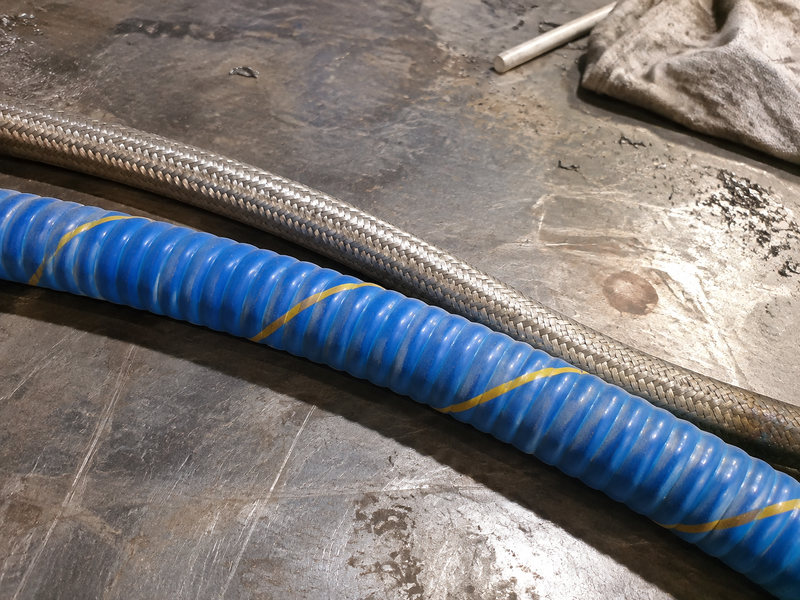
A rubber steam hose carries saturated steam through a flexible rubber body reinforced with textile or steel wire, while a stainless steel braided steam hose carries the same steam through a corrugated metal core wrapped in braided wire.
Rubber and metal hose constructions solve different problems, so the right choice depends on temperature, pressure, routing, movement and service life. There is no single winner across every duty. In this comparison, a stainless steel braided steam hose means a hose whose wetted core is corrugated metal and whose wire braid carries the pressure. It is not a rubber or PTFE tube that has a stainless braid over its cover.
Short answer: choose a rubber hose when the line keeps moving and the steam stays inside the ISO 6134:2024 limits. Choose a braided metal hose when the duty is hot, fixed and abrasive and the hot surface can be guarded.
This comparison covers pressure and temperature capability, flexibility, fatigue resistance, heat conduction and burn risk, service life, failure modes, and the installation and support each construction demands. Pressure and temperature pairs quoted here come from saturated steam data, and rated limits follow ISO 6134:2024.
About a 15-minute read at 250 words per minute; a practical comparison of rubber and metal steam hose constructions.
Rubber Steam Hose and Stainless Steel Braided Steam Hose: The Core Difference
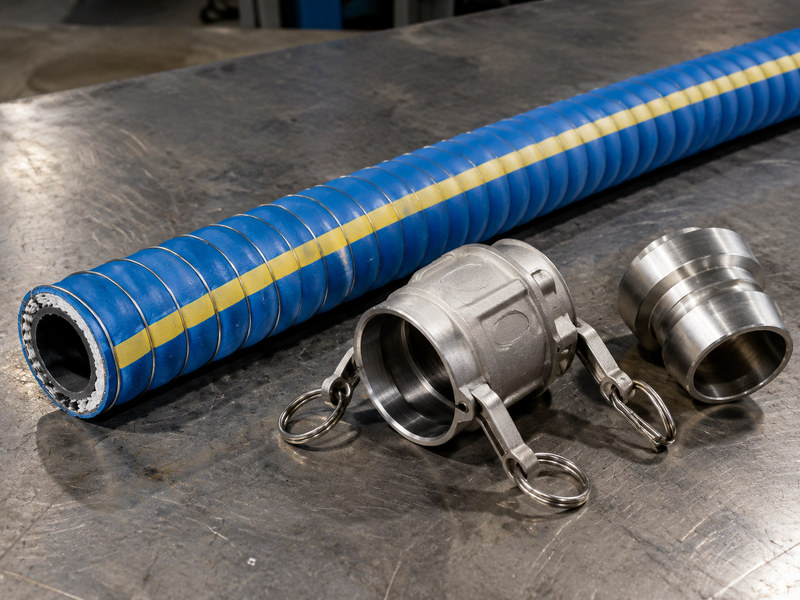
The two products share a job but not a mechanism. A rubber hose uses an EPDM (ethylene-propylene-diene monomer) tube for steam and heat resistance. Textile reinforcement covers lower pressures, steel wire covers higher pressures, and the cover is pin-pricked so trapped steam can escape. A metal hose takes the opposite route.
A stainless steel braided steam hose replaces the rubber body with a thin corrugated metal core and a braided wire sheath. The braid carries internal pressure, while the corrugation supplies the movement. That structural difference drives every later trade-off between the two families.
A rubber hose bends over a short radius, absorbs vibration and needs little support. A braided metal hose tolerates much higher temperatures but conducts heat to its surface, fatigues when it flexes and depends on correct support. The types of flexible hose materials page maps the wider material landscape.

Figure 1. Cutaway comparison of a reinforced rubber hose and a corrugated metal hose with wire braid.
Table 1. How a rubber hose and a braided metal hose differ in construction and behavior.
| Propriedade | Rubber hose | Braided metal hose |
|---|---|---|
| Core material | EPDM rubber tube | Corrugated metal core |
| Reforço | Textile or steel wire | Braided wire sheath |
| Movement | Bends over a short radius | Flexes through corrugation |
| Surface temperature | Cover stays warm | Surface conducts heat strongly |
| Typical fit | Mobile steam service | Fixed, hot or abrasive service |
Pressure and Temperature Limits of a Rubber Hose
ISO 6134:2024 is the reference for rubber hoses and hose assemblies for saturated steam. It defines two types. Type 1 is a low pressure hose, rated to 0.6 MPa or 6 bar at 164 °C, with textile reinforcement. Type 2 is a high pressure hose, rated to 1.8 MPa or 18 bar at 210 °C, with steel wire reinforcement. Hydraulic proof and burst testing follow ISO 1402.
The ISO 6134 ratings of 6 bar at 164 °C and 18 bar at 210 °C anchor almost every rubber hose decision. A line running at 6 bar g sits at about 165 °C of saturation temperature, so a Type 1 hose is already at its stated limit. A line at 18 bar g sits near 209.8 °C, which is Type 2 territory. The saturated steam chart (planned URL – publish before linking) gives the full curve.
The point that surprises buyers is that saturated steam ties temperature and pressure together. You cannot raise one without moving the other. That is why a rating is always printed as a pressure and a temperature pair, never as a pressure alone.
Table 2. Saturated steam pairs that bracket a rubber hose rating, which stops at the 18 bar g pair.
| Gauge pressure (bar g) | Absolute pressure (bar a) | Saturation temperature (°C) | Density (kg/m³) |
|---|---|---|---|
| 6 | 7.01 | 165.0 | 3.673 |
| 18 | 19.01 | 209.8 | 9.558 |
| 20 | 21.01 | 214.9 | 10.540 |
| 25 | 26.01 | 226.1 | 13.011 |
O EPDM steam hose guide explains why EPDM is the usual tube compound behind these ratings. For a wider view of the soft-material side, the PTFE vs rubber comparison (planned URL – publish before linking) sets the same question against a different family.
Flexibility, Bend Radius and Routing of a Flexible Metal Hose
A flexible metal hose has a corrugated stainless core inside a wire braid, and it does not stretch; it flexes. The corrugations act as a series of hinges, so the core shortens and lengthens along its axis as the line moves. A rubber hose behaves differently. It bends as a smooth curve and returns to shape, which makes it easier to route around tight corners and dense pipework.
Routing rules differ as a result. Rubber tolerates a short bend radius and can be coiled for storage or for a long run between two fixed points. A flexible metal hose needs a longer sweep and must avoid sharp, repeated flexing at one location, because every cycle works the corrugation metal.
Both families must respect the minimum bend radius the maker publishes. Exceeding it puts a permanent kink into the core or crushes the braid. A crushed braid loses pressure capacity even when the core itself is still sound, which is a quiet way to lose a line.
A practical rule helps at layout time. Fix both ends of a metal run, add a bend where the line needs to change direction, and never use the hose as a structural member. Rubber tolerates being pulled into place more easily, but it should still be supported so its own weight does not load the fittings. A braided metal hose must also bend in one plane only, because a twist shears the corrugation instead of flexing it. A rubber hose forgives a slight twist, but it still loses life when it is installed under torsion.
Movement also comes from pressure pulses, not only from vibration. A valve that opens and closes sends a surge down the line, and the surge flexes the hose along its length. Rubber rides that surge without much wear, while a metal hose converts it into corrugation stress. A support clamp near the valve trims the effect for either family and is easiest to add at the design stage.
Fatigue, Vibration and Service Life of a Steam Hose Assembly
A steam hose assembly lives or dies on how it handles movement. Compressors, pumps and thermal expansion all push vibration into the line, and that vibration is where service life is decided. Rubber damps vibration well, so a rubber assembly often survives a long, quiet life even on a moving machine.
Metal responds to vibration differently. A metal core can crack at a corrugation if it is forced to flex repeatedly without support, and the crack grows with every cycle. That is why a metal assembly is usually anchored and guided rather than left to swing freely.
Temperature shifts the balance further. Steam softens rubber over time, so a rubber assembly ages even when it is not moving. Metal does not age in the same way, but it loses strength when it is cycled hot and cold at a stressed point.
Ratings assume a reference temperature, and the allowed pressure is corrected from there. The pressure versus temperature derating guide describes how that correction is applied to rubber and to metal braid alike. A regular steam hose inspection catches a tired assembly before it bursts.
On the metal side, the correction follows a coefficient given per braid alloy, so two braids of different alloys do not share one curve at the same temperature. End fittings add their own limit on top. The full mechanism belongs to the derating article, and this comparison only notes that the metal path is alloy driven.
Heat Conduction and Burn Risk in a Stainless Steel Braided Steam Hose
The clearest safety difference between a braided metal hose and a rubber hose is surface temperature. A stainless steel braided steam hose uses metal from core to braid, and metal conducts heat straight to the outer braid. A surface carrying steam at 209.8 °C can be hot enough to burn on contact.
A rubber hose insulates its own wall. The EPDM tube delays heat and the cover stays much cooler, though it still gets warm on high duty. That is why metal lines near walkways are usually guarded or lagged, while many rubber lines are left bare.
Burn risk is not a reason to reject metal. It is a reason to plan the route, fit a guard where people pass, and label the line. The same care applies at the ends, where the fitting runs as hot as the core.
Insulation changes the trade-off, but it also hides the surface, so an insulated metal line needs inspection points. A bare rubber line stays visible, which helps a walk-round check but does not remove the duty risk on a high-temperature run.
How a Steam Hose Assembly Is Installed and Supported
A steam hose assembly is only as strong as its ends. Fittings must be rated for steam. A band clamp or an ordinary clamp is not a dedicated steam fitting. Using either clamp lowers the assembly rating and is a known failure source. Bolted safety clamps are common on steam duty.
Support also differs between the families. Rubber needs little support and can rest in a tray or on a hanger. Metal needs anchors and guides to control movement and to protect the braid from abrasion. Expansion loops and offsets absorb thermal growth so the core is not pulled tight.
Anchor spacing is the detail that decides how long a metal line lasts. Too few anchors and the core flexes at every pulse; too many and the thermal growth has nowhere to go. The right answer comes from the maker’s installation notes for the specific bore and braid, not from a rule of thumb carried over from a rubber line.
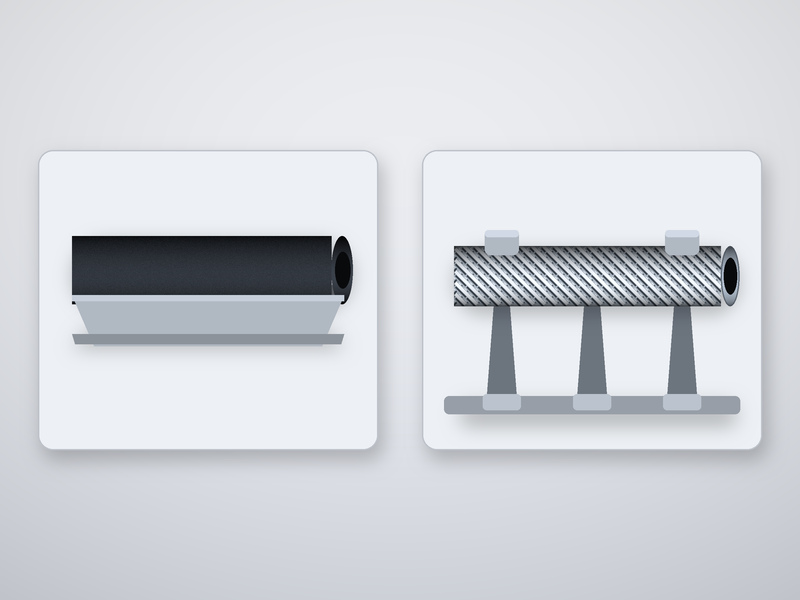
Figure 2. Installation and support comparison for a rubber hose and an anchored, guided metal hose.
Failure Modes: Rubber Steam Hose Versus Stainless Steel Braided Steam Hose
A rubber hose and a corrugated metal hose fail in different ways, and knowing the pattern helps you choose. A rubber hose usually fails from the inside out. Heat ages the tube, steam attacks it, and a crack eventually opens through the wall. The outer cover often shows a blister or a soft spot first.
A braided metal hose usually fails at a corrugation or at a fitting. Flex fatigue cracks the metal, or a weak joint lets go under pressure. The failure can be fast, and escaping steam near a corrugation is a serious hazard for anyone nearby.
The useful habit is to match the failure pattern to the duty. Where an early warning is valuable, rubber gives one. Where the duty is hot, static and abrasive, metal carries the load better even though it may fail faster when it does fail.

Figure 3. Failure mode comparison between a rubber hose and a braided metal hose.
Table 3. Failure modes and warning signs for a rubber hose and a braided metal hose.
| Failure mode | Rubber hose | Braided metal hose |
|---|---|---|
| Main mechanism | Tube aging and cracking | Corrugation fatigue |
| Where it starts | Inner tube wall | Corrugation or fitting |
| Warning sign | Blister or soft spot | Often none before leak |
| Speed of failure | Usually gradual | Often sudden |
| Inspection focus | Cover and tube | Braid, corrugation and welds |
Steam Temperature, Pressure and Condensate: The Duty Both Must Survive
Steam is never perfectly dry. Any real line carries some condensate, and condensate is the enemy of a rubber hose and of a corrugated metal hose. Slug flow, thermal shock and water hammer all start with pooled water, not with the hose material. Slope the run toward a trap and drain the low points so the assembly never holds a slug of water.
Condensate also changes the mechanical duty. Wet steam at a given pressure sits at the same saturation temperature as dry steam, so the pressure and temperature pair still governs the rating. What changes is the load, because a moving slug of water strikes the wall and the ends far harder than dry steam does.
Neither family is immune to that load. A rubber hose can be scuffed and eroded from the inside by a slug, and a metal hose can be fatigued faster when water pounds a corrugation. Draining, trapping and correct support reduce the load for both families.
Superheated steam is the boundary case, because it is not locked to the saturation curve, so the temperature derating route applies instead of a plain steam rating.
Draining also protects the rating itself. A slug of water does not raise the steam pressure, but it does raise the momentary force on the wall and on the end fittings. Over many cycles that force shortens service life even when the steady pressure and temperature stay inside the rating. Good trapping keeps the duty inside the envelope the maker published.
Handling, Storage and Weight Differences
Weight and handling separate a braided metal hose and a rubber hose on the shop floor. A braided metal hose is heavier than a rubber hose of the same bore, so it needs two hands, a cradle or a lifting point where a rubber line needs one. That weight also loads the end anchors, which is another reason the metal line needs more support.
Storage differs too. Rubber can be coiled and hung on a rack, and it recovers its shape when it is uncoiled. A metal hose should be stored straight or on a wide bend, because a tight coil can set a permanent curve into the corrugation. Keeping the original end caps on both families also stops grit from reaching the bore.
Training follows the hardware. Crews that handle rubber every day may treat a metal line the same way and bend it by hand, which is exactly what shortens its life. A short briefing on routing, support and the hot surface prevents avoidable damage, and it belongs with the fittings and the inspection routine rather than in a drawer.
Choosing the Right Hose: Rubber or Stainless Steel Braided Steam Hose
The decision comes down to matching the construction to the duty. Choose rubber when the line moves, when the run is long and curved, when a warning before failure matters, and when the steam pressure and temperature sit inside the ISO 6134 limits. Choose metal when the duty is hot, fixed and abrasive, and when the hot surface can be guarded.
Read the temperature, the pressure and the movement, then pick the family that matches all three rather than the one that wins on a single point.
Applicable range: a rubber hose covers saturated steam inside the ISO 6134 limits where the line moves. A braided metal hose covers hot, fixed and abrasive duty with a guarded surface. Where a line is hot and moving at once, fix the run so the hose stops flexing.
Table 4. Selection guide for a rubber hose versus a braided metal hose.
| Duty condition | Better suited family | Reason |
|---|---|---|
| Frequent movement | Borracha | Bends and damps vibration |
| Very high surface heat | Metal | Corrugated core and braid take heat |
| Tight, short bend radius | Borracha | Short radius without fatigue |
| Abrasive external contact | Metal | Braid resists abrasion |
| Need for a visible warning | Borracha | Outer cover shows the first sign |
| Hot duty that also moves | Neither family | Fix the line and absorb the movement |
| High ambient or radiant heat | Metal | No rubber cover to age from outside heat |
Neither family is universally better. Each one covers a boundary the other does not, and the safest steam line is the one that respects the pressure, temperature and movement it actually sees. In one plant a stainless steel braided steam hose and a rubber hose can share the load, each on the duty that suits it.
In installed cost, metal typically costs more because of the anchors, guides and guarding it needs; rubber costs less up front and is replaced sooner on hot, fixed duty.
For a quotation, send the working pressure with its paired saturation temperature; that pair narrows the family and the construction.
Stainless Steel Braided Steam Hose and Rubber Hose FAQs
Can a braided metal hose replace a rubber hose directly?
Not without checking the whole line. Metal and rubber differ in bend radius, support, surface temperature and end fitting, so a direct swap can overload the corrugation or leave a hot, unguarded surface. Confirm the pressure, the paired saturation temperature and the movement first. If any of those falls outside the metal hose rating, keep rubber or redesign the run.
Which family handles higher steam temperature?
Metal handles the higher temperature of the two. A braided metal hose relies on metal from core to braid and carries no rubber wall that can age under heat. Rubber is held by its published limits, and ISO 6134:2024 caps its two types at 164 °C and 210 °C. Above those points, a metal hose becomes the practical path.
Is a rubber hose always the safer choice?
No. Rubber is safer in one specific way and less safe in another. It insulates its wall, so the outer cover stays cooler and the burn risk is lower, and it tends to fail gradually, which gives a warning. Metal is safer on heat tolerance and abrasion. Match the family to the duty instead of assuming one is always safer.
Why does a braided metal hose get hot on the outside?
Because the braid is metal and metal conducts heat. In a braided metal hose the core and the braid are both metal, so heat moves from the steam straight to the outer layer. At 209.8 °C saturation temperature the braid can be hot enough to burn. Guard or lag any metal line where people pass.
How does fatigue affect each construction differently?
Rubber absorbs vibration and returns to shape, so it tolerates constant small movement. Metal flexes through its corrugation, and repeated flexing at one point can crack it. This is why a metal hose is usually anchored and guided rather than left to swing. Rubber usually needs less support for the same movement.
How are the ends fitted on each family?
A steam assembly must use fittings rated for steam, and the two families accept different ends. Rubber is often matched to bolted safety clamps or threaded ends. Metal may be welded or flanged. A band clamp or an ordinary clamp must never replace a dedicated fitting, because that lowers the assembly rating.
Which construction lasts longer in a plant?
It depends on the duty, not on the material alone. Rubber ages as steam softens it, even without movement, and a hot fixed line wears it faster. Metal resists heat but fatigues when it flexes without support. Where both are applied correctly, each can reach a long life. Misapplied, either can fail early.
Why can I not compare the two on pressure alone?
Saturated steam ties the two together, so a line rated for 18 bar g also carries steam near 209.8 °C, and one at 6 bar g sits near 165 °C. Read the pair, not the pressure alone. The saturated steam chart holds the full set of pressure and temperature pairs.
Does one family handle condensate better?
Not especially. Both families must be drained, because condensate collects in low spots and can slug the line. The material of the braid or the cover does not change that. Slope the run, drain it, and keep the assembly free of traps where water can pool and cause hammer.
What should a buyer confirm before ordering?
Confirm four things. First, the working pressure and its paired saturation temperature. Second, the movement the line will see. Third, the surface temperature risk where people pass. Fourth, the end fitting type. With those settled, the choice between a rubber hose and a corrugated metal hose follows from the duty.
Is a steel-braided water hose the same as a braided steam hose?
No. A braided water hose is usually a rubber or PTFE tube with a stainless steel braid over the cover, and it is sold for hot and cold water service. A braided metal steam hose has a corrugated metal core that carries the steam, and its wire braid carries the pressure. Check the wetted core before you treat the two as one part.
About HENGHUA
HENGHUA is a professional hose and fittings manufacturer supplying distributors, retailers and OEM brands worldwide. The steam hose line is built around an EPDM tube, with a textile or steel wire reinforcement, and a cover that is pin-pricked for steam service. The catalog steam hose products include an EPDM steam hose rated to 170 °C and a high temperature EPDM steam hose rated to 230 °C. Ends can be supplied as clamp-style safety couplings, flanges or threads, and the range includes factory assemblies, custom lengths, branded wrap print, private label and OEM/ODM. Commercial terms are factory-direct pricing, short lead times on volume, and a warranty.
 English
 Spanish
 Portuguese
 French
 German
 Arabic
 Russian
 Indonesian
 Japanese
 Korean