
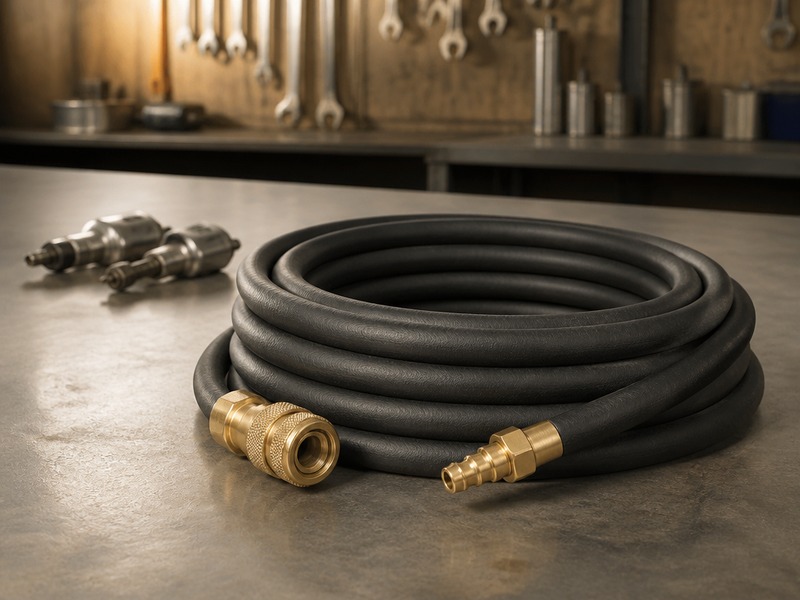
For most workshops the right compressed air hose is a 3/8 in. bore rated 300 PSI, with a material chosen for the temperature the hose will actually see. Rubber covers the widest temperature band, PVC is the lightest and the most temperature-limited, and polyurethane and hybrid sit between them. From there the four decisions are material, inside diameter, pressure rating, and length with fittings, and two comparison tables carry the numbers that decide the purchase.
What Does a Compressed Air Hose Have to Do — and Which Type Do You Need?
A pneumatic hose does three jobs at once: hold pressure without leaking, deliver enough flow for the tool’s rated inlet pressure, and survive the surface it is dragged across. Those three jobs rule out one universal hose, because rubber, PVC, polyurethane, and hybrid constructions each carry their own temperature window, pressure rating, and failure mode. Material and bore do the heavy lifting; pressure rating and fittings confirm the choice rather than define it. For the anatomy and the reinforcement layers behind that choice, see our what is an air hose guide.
The 4 Steps to Choosing a Compressed Air Hose
The four steps form a decision method, not a catalog. Each step removes options until one hose remains. Read them in order, because a step late in the list is wasted effort if an earlier one is wrong. Material and bore carry the most weight; the remaining two steps confirm the choice.
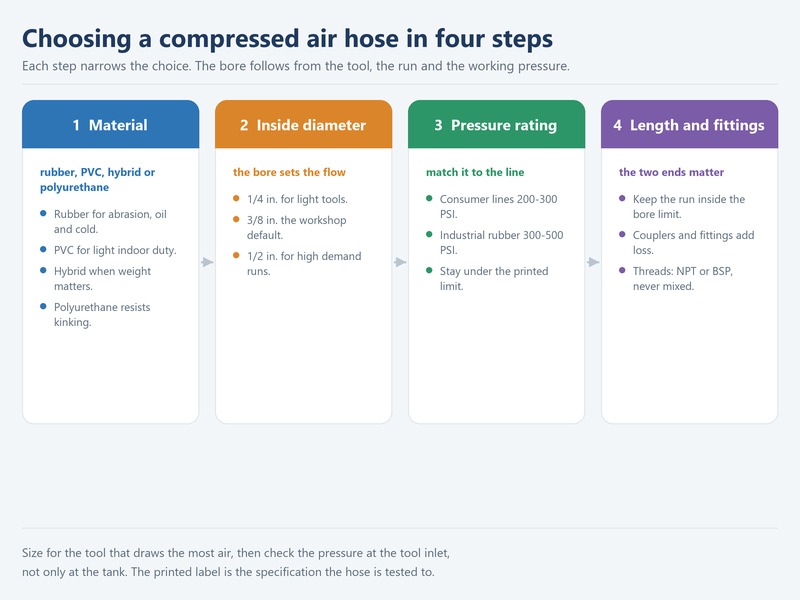
Figure 2. The four-step selection flowchart: material, inside diameter, pressure rating, length and fittings.
Step 1: Match the Hose Material to Your Environment
Start with where the hose lives, not with price. Rubber handles the widest temperature band and the roughest surfaces. PVC and polyurethane are lighter and cheaper but lose flexibility near freezing. Hybrid blends sit in the middle and are the sensible default for a heated garage.
Temperature decides more purchases than pressure does. Rubber hose is rated from −40 °C to +70 °C (−40 °F to +158 °F) under ISO 2398:2024. Thermoplastic hose under ISO 5774:2023 covers −10 °C to +60 °C (14 °F to 140 °F), and some polyurethane makers extend that to −20 °C. A PVC hose rated to −10 °C is often flexible only to about 0 °C (32 °F) in practice. If the hose will sit in an unheated shop through winter, that gap is the whole decision, and it decides which air hose material you should buy.
Abrasion and oil matter just as much. A hose dragged over concrete or stored against a drain pan needs a rubber cover; a light hose that hangs on a wall and feeds a blow gun does not. Your air hose material choice should follow the environment and only then the budget. Our rubber vs PVC air hose comparison goes deeper, but the short version is that the cover and the temperature rating decide most of the outcome. Our air hose selection guide walks through the whole process.
Step 2: Size the Inside Diameter to Your Tool
The inside diameter, not the outer jacket, determines how much air reaches the tool. Undersizing is the most common and most expensive mistake in a workshop, because the tool still runs, just below its rated torque or speed.
Follow the tool’s demand. A spray gun on light work or a small impact wrench is comfortable on 1/4 in. bore over a short run. A 1/2 in. impact wrench, a sander, or a production spray gun needs 3/8 in. or larger. When the length grows, the required bore grows with it, because friction loss climbs along the run. Measure the pressure at the tool end first, then set the bore that holds that figure over the whole run.
Use pressure drop as your check. A 3/8 in. hose loses roughly 2–5 PSI per 25 ft, and a 1/4 in. hose at 50 ft flowing 8 SCFM measures about 6 PSI of loss. Those numbers sound small until they stack up against a tool rated to run at 90 PSI inlet. The air hose size chart guide lists the full range of compressed air hose sizes, and Step 4 below handles length and fittings.
Step 3: Confirm the Pressure Rating Against Your Compressor
Most compressors put out 90–150 PSI, and most pneumatic tools are rated around 90 PSI at the inlet. A hose rated 200–300 PSI therefore already clears the pressure a home or light shop setup runs, with margin, while industrial rubber hose runs 300–500 PSI for heavier duty. Burst pressure is typically three to four times the rated pressure, which is the safety reserve behind the number printed on the cover.
Do not chase the highest number you can find. Match the rating to the compressor, then keep a margin. OSHA 29 CFR 1926.302(b)(5) is explicit that a hose must never be used above the manufacturer’s safe operating pressure, and the pressure rating on the label is that limit. Our working and burst pressure compared explainer shows how to read both figures without confusing them.
Step 4: Pick the Length, Fittings, and Couplers
Length is a flow decision, so keep runs as short as the job allows. The recommended maximum is 25 ft for 1/4 in., 50 ft for 3/8 in., and 100 ft for 1/2 in. bore. Beyond that, friction loss eats the advantage of the larger hose.
Then finish the line with fittings and couplers that match your shop standard. Most couplings are threaded in 1/4 in. NPT, and the coupler has to match the plug style already in use: Industrial, Automotive, ARO, V-style, or European, because the styles do not interchange. Choose the bore, the compressed air hose fittings, a quick connect coupler, and a reel as one set so nothing in the line restricts flow.
Crimped or properly clamped compressed air hose fittings also need a pressure test, and if you run a wall-mounted line, a compressed air hose reel keeps the bore and fittings consistent. Our air hose fittings guide covers the sizing in detail.
Compressed Air Hose Sizes: Flow, Tools, and Maximum Run
Hose size is a flow decision, and the numbers are straightforward once you set them side by side. At 90 PSI, a 1/4 in. bore moves about 5–10 SCFM, a 3/8 in. bore moves 10–20 SCFM, and a 1/2 in. bore moves 20–35 SCFM. Those are typical catalog values, so confirm your tool’s real demand in its manual before you commit. This page gives only the numbers the four-step decision needs; the full size chart lives on the air hose size chart guide. When you order by size, ask for the label text and the batch pressure-test record together, so the band you choose is the band you receive.
Table 1 pairs the compressed air hose sizes with the tools they suit and the maximum run each supports. Read it as a starting point: if your tool sits at the top of a band, or your run is at the maximum length, step up one size and let the friction loss fall.
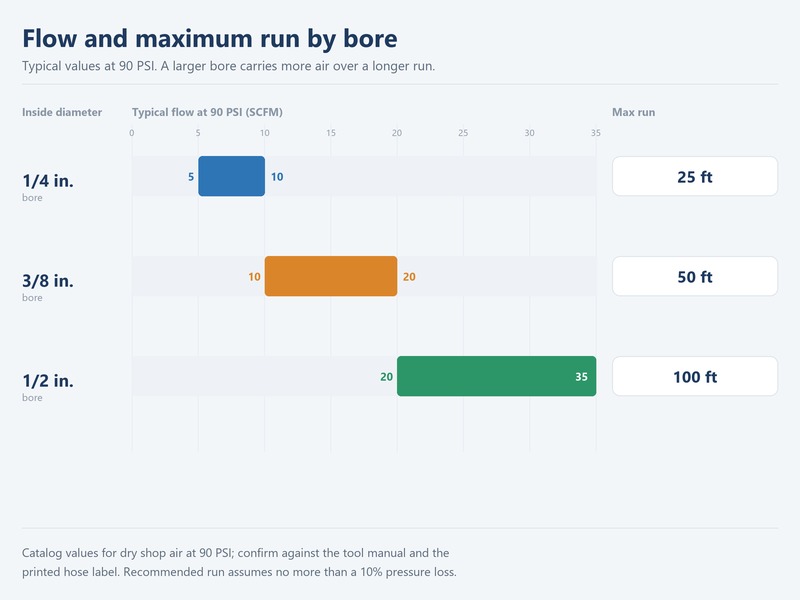
Figure 3. Flow, tools, and maximum run for 1/4 in., 3/8 in., and 1/2 in. bore.
Table 1. Hose sizes at 90 PSI (typical catalog values): flow, suitable tools, and recommended maximum run.
| Inside diameter | Typical flow at 90 PSI | Tools it suits | Recommended maximum run |
|---|---|---|---|
| 1/4 in. | 5–10 SCFM | Airbrushes, blow guns, staplers, light spray work | 25 ft |
| 3/8 in. | 10–20 SCFM | Impact wrenches, ratchets, sanders, most spray guns | 50 ft |
| 1/2 in. | 20–35 SCFM | 3/4 in. and 1 in. impact wrenches, blasting, high-consumption tools | 100 ft |
A 3/8 in. hose rated 300 PSI is the sensible home-shop default: it covers a spray gun, a production sander, and most impact tools, and it keeps pressure drop low over a 50 ft run. The three compressed air hose sizes above cover almost every workshop tool, so step up to 1/2 in. only for a 1/2 in. impact wrench that genuinely pulls more air, and step down to 1/4 in. only for light tools on short runs. If the hose lives on a wall, a compressed air hose reel keeps it coiled and out of the way.
Compressed Air Hose Materials Compared: Rubber, PVC, Polyurethane, Hybrid
The compressed-air hose material decides the temperature range, the weight, and how long the hose lasts, and the four common options each earn their place. Rubber is the durable, cold-tolerant choice. PVC is the light, inexpensive choice that stiffens in the cold. Polyurethane is light and resists kinking. Hybrid blends trade a little of each strength for a middle price.
Table 2 compares the four common compressed air hose materials on temperature range, working pressure, weight, service life, and price. Match the row to your environment and the decision usually makes itself. For a full two-way breakdown, see our rubber vs PVC air hose comparison.
Table 2. Air hose materials compared by temperature range, rated pressure, weight, service life, and typical 2026 US retail price (planning values).
| Material | Temperature range | Pressão de funcionamento típica | Weight (50 ft, 3/8 in.) | Service life | Typical price (2026 US retail) |
|---|---|---|---|---|---|
| Rubber | −40 °C to +70 °C (−40 °F to +158 °F) | 300–500 PSI | Heaviest | Longest on abrasive duty | $0.60–0.80/ft |
| PVC | −10 °C to +60 °C (14 °F to 140 °F); flexible to about 0 °C (32 °F) in practice | 200–300 PSI | Lightest | Shortest in cold or sun | $0.40–0.60/ft |
| Polyurethane | −10 °C to +60 °C (14 °F to 140 °F); some makers to −20 °C | 200–300 PSI | Luz | Good; resists kinking | $0.50–0.70/ft |
| Hybrid | −10 °C to +60 °C (14 °F to 140 °F) | 200–300 PSI | Luz | Moderate | $0.50–0.70/ft |
Weight matters more than people expect. A 50 ft, 3/8 in. rubber hose is noticeably heavier than the same length in PVC or hybrid, and that weight is felt at the end of an eight-hour day and on every overhead job. If the hose is carried rather than dragged, the lighter air hose material earns its place; if it is dragged over concrete, rubber does.
Five Air Hose Mistakes That Cost You Air
Most weak-tool complaints trace back to one of five decisions made before the hose was ever connected.
- Undersizing the bore — a 1/4 in. hose on a 1/2 in. impact wrench starves the tool and drops torque even when the compressor is fine.
- Running the hose too long — every extra 25 ft adds pressure drop, so a 100 ft run on a 3/8 in. hose quietly bleeds air all day.
- Mixing coupler styles — Industrial, Automotive, ARO, V-style, and European plugs look similar but do not seal against each other, so a forced fit leaks.
- Ignoring temperature — a PVC hose used below freezing stiffens, kinks, and can crack at the fitting.
- Buying on price alone — the cheapest hose usually fails at the cover or the crimp, where repair cost plus downtime outruns the saving.
One more habit costs air without showing up on any gauge: leaving a leaking quick connect coupler in the line. A worn coupler leaks continuously whenever the system is pressurized, so replace it rather than topping up the compressor. The same logic applies to a spray gun that runs uneven because its inlet fitting is restricted.
Retire and replace any compressed air hose that shows a bulge, a cut into the reinforcement, a cracked cover at the fitting, or a leak that returns after a new clamp. Replacement is the only safe action for a hose rated 200–500 PSI. Taping, splicing, and field re-clamping sit outside the safe operating envelope, because a field repair cannot restore the batch pressure rating.
Storage decides how long a line stays serviceable. Coil a hose loosely rather than pulling it tight over a hook, because a sharp bend traps stress in the same spot every time it is stored. Keep the coil out of direct sun and away from hot metal, and hang it so the ends stay clear of the floor, where grit and water collect. Before every shift, run a hand along the cover and check both ends. A soft spot, a blister, or a fitting that has started to weep means the line is finished, not repairable. A dry, loosely coiled line also unrolls without fighting you on a cold morning.
Reading the Label: What Every Air Hose Must Show
The label is the specification, and a hose that hides it is a risk. Before you buy, confirm the label states the inside diameter, the rated pressure, the temperature range, the standard it meets, and the date or batch code.
- Inside diameter — the number that sets flow, in inches or millimeters.
- Pressão de serviço — the safe operating limit, for example 300 PSI.
- Burst pressure — typically three to four times the rated pressure.
- Temperature range — the full band, such as −40 °C to +70 °C for rubber.
- Padrão — ISO 2398:2024 for rubber, ISO 5774:2023 for thermoplastic.
- Batch or date code — traceability if a batch ever needs review.
A hose sold without these markings gives you no way to confirm it meets the pressure and temperature you are about to run it at, and the compressed air hose fittings are often the first part to be underspecified. When you buy in quantity, ask for the label text and the batch test record together, so the specification on the label is the specification you receive.
Treat the batch code as a service record and run it as three steps. First, write the install date on the tag the day the hose goes into service. Second, rotate stock first-in, first-out, so the oldest line is used first. Third, log the failure reason when a line is retired, because that note tells you more about the next purchase than any catalog listing. A hose that has sat in a hot store for years can harden before it is ever used, even though the label reads the same.
Which Compressed Air Hose Fits Your Setup? Two Worked Cases
Case 1: One 2 hp Compressor in a Home Garage, a 50 ft Run to an Impact Wrench
For that setup, choose a compressed air hose with a 3/8 in. bore rated 300 PSI in rubber or hybrid. The 3/8 in. bore carries 10–20 SCFM, enough for a 1/2 in. drive tool, and it holds the loss to about 2–5 PSI per 25 ft. A 50 ft run still lands close to the 90 PSI the tool wants at its inlet. A 1/4 in. bore would be too small for that length, and a 1/2 in. bore is more hose than the compressor can feed.
Case 2: Three Bays on One Compressor — One Hose Each, or One Long Line?
Run one hose per bay. A single long line that reaches three bays costs pressure at every extra foot, and the last bay sees the weakest pressure. Keep each bay’s hose as short as the work allows, size the bore to the hungriest tool in that bay, and cap the run at the 25/50/100 ft maximum for 1/4, 3/8, and 1/2 in. bore. If one bay pulls far more air, give it a larger bore rather than a longer hose.
Frequently Asked Questions
What size hose do I need for a home shop?
A 3/8 in. hose rated 300 PSI is the practical default for a home shop. It carries enough air for impact wrenches, ratchets, sanders, and most spray guns, and it keeps friction loss low over runs up to about 50 ft. Step down to 1/4 in. only for light tools on short runs.
Are all quick connect couplers compatible?
No. Industrial, Automotive, ARO, V-style, and European couplings look similar but are not interchangeable, and a coupler will not seal against a plug of a different style. Match the quick connect coupler to the plugs already in your shop, keep the compressed air hose fittings on the same style, and replace a worn coupler rather than forcing a mismatched pair together.
How long can I run an air hose?
The usual maximum is 25 ft for 1/4 in., 50 ft for 3/8 in., and 100 ft for 1/2 in. bore. Beyond those lengths, friction loss rises faster than the extra reach is worth. If you need more distance, use a larger bore rather than a longer hose.
Does hose length change the pressure at the tool?
Yes. Pressure drop climbs with length, so a longer run delivers less pressure at the tool even when the compressor gauge has not moved. A 3/8 in. hose loses about 2–5 PSI per 25 ft, and a 1/4 in. hose at 50 ft carrying 8 SCFM measures about 6 PSI of loss.
Can I repair a damaged hose?
Only replace it. A hose with a bulge, a cut into the reinforcement, or a cracked cover at the fitting should be taken out of service, not taped or re-clamped. A repaired hose can fail under pressure without warning, so the safe approach is to replace the whole assembly with a tested one.
What working pressure should I look for?
Match the hose to your compressor and keep a margin. Home compressors put out 90–150 PSI and most tools run at about 90 PSI inlet, so a hose rated 200–300 PSI is comfortable for a home shop, while industrial rubber hose at 300–500 PSI covers heavier duty. Never exceed the manufacturer’s safe operating pressure.
Do I need a compressed air hose reel?
Not always, but a compressed air hose reel keeps a compressed air hose tidy and stops it being stored coiled under tension. Wall-mounted reels suit fixed bays and retractable reels suit mobile work. A reel does not change flow, but it adds a swivel and a coupler, so keep the bore matched.
Is a bulk order cheaper?
Usually, yes. A bulk order of hose, fittings, and couplers in a single specification spreads setup and freight costs and keeps the bore and coupling style consistent across a shop. Give the supplier your temperature range, tools, and run length, and ask for the label text and the batch test record with the quote.
Get the Right Compressed Air Hose for Your Setup
HENGHUA manufactures reinforced compressed air hoses and complete hose assemblies for workshops, distributors, and OEM brands. Every hose we build uses a high-tensile textile reinforcement layer with an abrasion- and oil-resistant cover, is rated 200–500 PSI, and leaves the factory with crimped brass fittings and a pressure test on every batch.
We supply 1/4, 3/8, and 1/2 inch bore in rubber, PVC, polyurethane, and hybrid constructions, with custom lengths, fittings, colours, reels, and OEM/ODM branding. Because we control compounding, extrusion, braiding, and crimping in one plant, lead times stay short on a bulk order and the specification on the label is the specification you get. If you are sourcing compressed air hoses for retail, distribution, or industrial use, send us your specification and we will quote against it, or visit our air hoses range and contact our engineering team for a quote and free samples.
Final Verdict: Four Decisions, One Hose
Material, bore, pressure rating, and fittings are the four decisions, and they are best made in that order. For most home and light-shop setups the answer is a 3/8 in. hose rated 300 PSI in a material that matches the local temperature, finished with fittings that match the rest of the shop. If you cannot decide between a bulk order of rubber, hybrid, or PVC, tell us the tool, the run length, the coldest temperature, and the annual volume, and we will quote the specification that fits.
Written by the HENGHUA engineering team, with input from workshop and maintenance teams across North America and Europe. HENGHUA manufactures reinforced air hoses and hose assemblies in rubber, PVC, polyurethane, and hybrid constructions, from 1/4 inch to 1/2 inch, rated 200–500 PSI, with custom lengths, fittings, colours, and OEM branding.






 English
  Spanish
  Portuguese
  French
  German
  Arabic
  Russian
  Indonesian
  Japanese
  Korean