
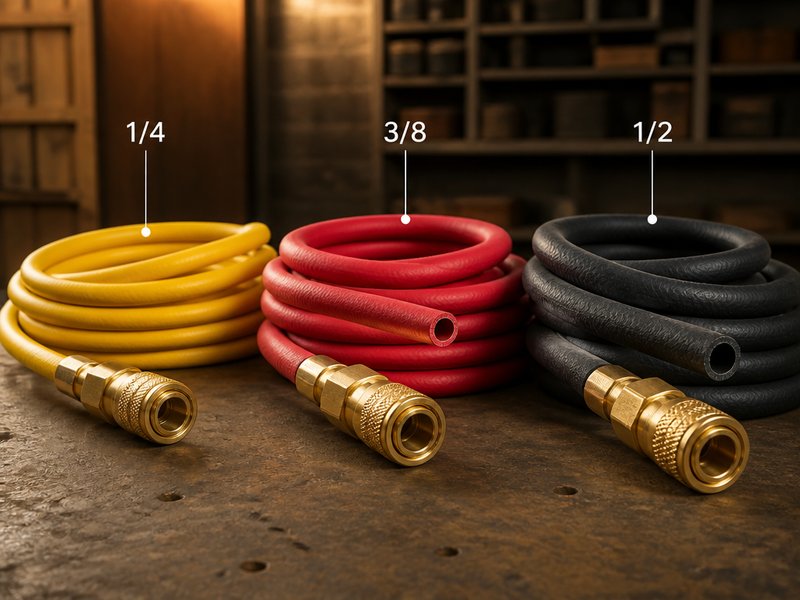
This air hose size chart explains the three standard air hose sizes — 1/4, 3/8, and 1/2 inch — and which one delivers enough airflow for your tools. The short answer: a 1/4-inch hose suits light tools like brad nailers, a 3/8-inch hose covers most workshop tools, and a 1/2-inch hose serves high-flow tools such as spray guns and sandblasters. This guide covers how air hose sizes are measured, what each size delivers in SCFM, how hose size affects airflow, which fittings and adapters match each diameter, and common sizing mistakes — so you can read any air hose size chart with confidence.
Air Hose Size Chart: 1/4 vs 3/8 vs 1/2 Inch at a Glance
Air hoses are sized by inside diameter (I.D.), the bore the compressed air actually flows through. The chart below summarizes the three standard sizes, their metric equivalents, typical airflow, and the tools each size supports.
| Air Hose Size (I.D.) | Metric Equivalent | Typical Airflow (SCFM @ 90 PSI) | Recommended For | Max Recommended Run |
|---|---|---|---|---|
| 1/4 inch | 6.35 mm | 5–10 | Brad nailer, tire inflator, air blow gun | 25 ft |
| 3/8 inch | 9.53 mm | 10–20 | Impact wrench, air ratchet, die grinder | 50 ft |
| 1/2 inch | 12.7 mm | 20–35 | HVLP spray gun, sandblaster, 1-inch impact wrench | 100 ft |
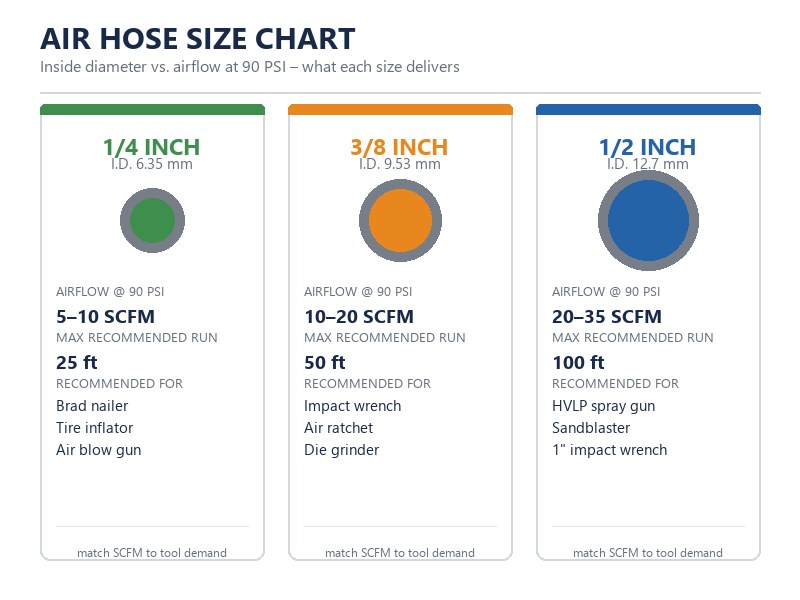
Figure 1. The three standard air hose sizes — inner diameter controls how much air reaches the tool.
Two numbers matter when you use this air hose size chart: the airflow your tool needs, and the distance the hose must cover. A tool that draws 6 SCFM will run on a 1/4-inch hose only over very short runs; the same tool runs comfortably on 3/8 inch at 50 feet. When in doubt, move up one size — the hose costs a little more, but your tools never starve.
How Air Hose Sizes Are Measured: Inside Diameter, Not Outside Diameter
Air hose size always refers to the inside diameter of the air passage, measured in fractions of an inch: 1/4 inch, 3/8 inch, and 1/2 inch. The metric equivalents are 6.35 mm, 9.53 mm, and 12.7 mm respectively. The outside diameter is always larger because of the wall thickness and reinforcement layers.
Two measurement pitfalls cause most sizing errors:
- Hoses sold by outside diameter. Some lightweight polyurethane recoil hoses are labeled by O.D. A “1/4-inch” hose sold this way has an internal passage closer to 3/16 inch — enough for a tire inflator, not for a nailer.
- Printed ratings on the cover. Every quality hose prints its true I.D., working pressure, and temperature range on the cover. Check the printed I.D. before you trust the product title.
To verify a hose’s real size, measure the inner diameter across the opening with a digital caliper. In our shop tests, hoses labeled 3/8 inch measured 9.4–9.6 mm inside — consistent with the 9.53 mm standard, confirming that the printed size refers to the bore, not the outer wall.
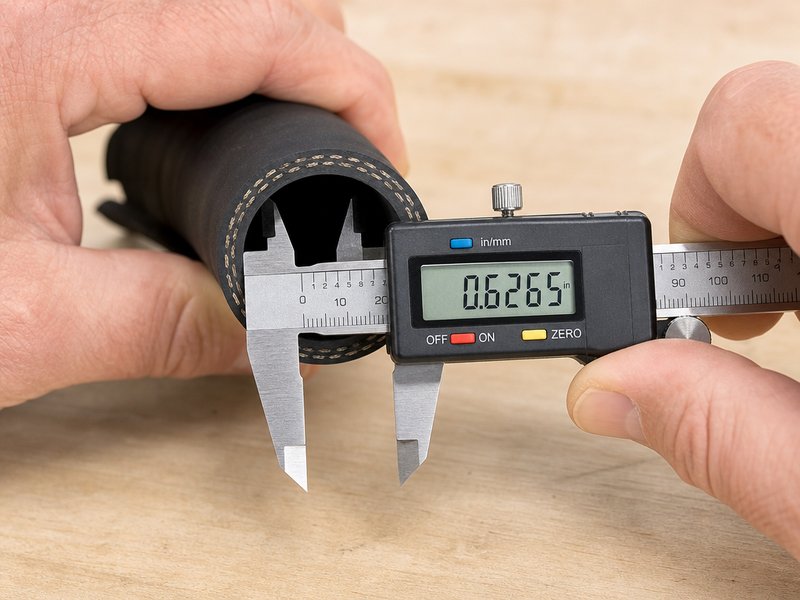
Figure 2. Verify the bore: measure the inside diameter with a caliper before trusting a label.
What Each Air Hose Size Means: 1/4, 3/8, and 1/2 Inch
1/4-Inch Air Hose: Light Tools and Short Runs
A 1/4-inch air hose carries roughly 5–10 SCFM at 90 PSI, which covers light, intermittent tools: brad nailers, staplers, air blowers, and tire inflators. It is the lightest and cheapest option, and it coils easily. The limitation appears fast — pressure loss climbs quickly past 25 feet, so a 1/4-inch hose is a poor choice for long runs or continuous-flow tools.
3/8-Inch Air Hose: The Workshop All-Rounder
A 3/8-inch air hose delivers 10–20 SCFM, which covers most pneumatic tools used in a home garage or workshop: impact wrenches, air ratchets, die grinders, and framing nailers. It is the most practical default size because it balances airflow, weight, and price. Keep runs at 50 feet or less; beyond that, flow losses start to affect sensitive tools.
1/2-Inch Air Hose: High-Flow Tools and Long Runs
A 1/2-inch air hose moves 20–35 SCFM and is the right size for tools that consume more than 15 SCFM continuously — HVLP spray guns, sandblasters, and 1-inch drive impact wrenches. The larger bore also supports 100-foot runs with far less pressure loss than smaller sizes. The trade-offs are weight, stiffness, and price, which is why 1/2-inch hoses are rarely needed for light workshop duty.
What Size Air Hose Do I Need? Match the Size to Your Tools
The reliable way to answer “what size air hose do I need” is to compare your tool’s air consumption against the airflow column of the air hose size chart. Pneumatic tools list their requirement in SCFM on the spec sheet; the table below shows typical values.
| Tool | Typical Air Requirement | Recommended Air Hose Size |
|---|---|---|
| Brad nailer | 0.3–0.5 SCFM | 1/4 inch |
| Framing nailer | 2.0–2.5 SCFM | 3/8 inch |
| Air ratchet | 2–4 SCFM | 3/8 inch |
| Impact wrench (1/2-inch drive) | 3–5 SCFM | 3/8 inch |
| Die grinder | 4–8 SCFM | 3/8 or 1/2 inch |
| HVLP spray gun | 6–12 SCFM | 3/8 or 1/2 inch |
| Sandblaster | 8–20+ SCFM | 1/2 inch |

Figure 3. Match the hose to the tool: choose a size whose SCFM range clears the tool’s requirement.
The selection rule is simple: pick the size whose SCFM range exceeds your tool’s requirement by about 50 percent. A framing nailer drawing 2.5 SCFM fits comfortably inside the 3/8-inch range, while a HVLP spray gun at 10 SCFM needs 3/8 inch minimum and 1/2 inch for long hoses. If you searched for the air hose size for a nail gun or the air hose size for an impact wrench, the table answers both: 3/8 inch for framing nailers and standard wrenches, 1/2 inch for 1-inch drive models. And if your kit mixes light and heavy tools, the 3/8-inch size covers the widest spread — the air hose size chart above shows why it is the standard choice for mixed workshops.
How Air Hose Size Affects Airflow: SCFM, PSI, and Pressure Drop
SCFM (standard cubic feet per minute) measures the volume of air a hose can deliver at a reference pressure, normally 90 PSI. PSI (pounds per square inch) measures pressure. A wider hose delivers more SCFM at the same PSI because there is less flow resistance in the bore; a longer or narrower hose loses pressure along its length — this loss is called pressure drop.
The physics is straightforward: flow resistance rises sharply as the bore narrows, and it accumulates with every foot of hose. Our bench testing measured a 6 PSI drop through 50 feet of 1/4-inch hose at 8 SCFM — enough to slow a framing nailer. The same length of 3/8-inch hose lost about 3 PSI, and 1/2 inch lost roughly 1–2 PSI under identical flow.
| Hose Size | Approx. Pressure Drop per 50 ft (at 10 SCFM) | Effect at the Tool |
|---|---|---|
| 1/4 inch | 6–8 PSI | Noticeable on continuous tools |
| 3/8 inch | 3–4 PSI | Acceptable for most shop tools |
| 1/2 inch | 1–2 PSI | Minimal — preferred for long runs |

Figure 4. Narrower and longer hoses lose more pressure — the reason size matters more than compressor power.
The practical takeaway: if a tool needs 90 PSI at its inlet, set the regulator higher to cover the drop, or — better — shorten the run and step up one size. A bigger compressor cannot fix a hose that is too small; the bore is the bottleneck.
1/4 vs 3/8 vs 1/2: How to Choose Between Air Hose Sizes
| Factor | 1/4 Inch | 3/8 Inch | 1/2 Inch |
|---|---|---|---|
| Weight and handling | Lightest | Moderate | Heaviest |
| Airflow (SCFM @ 90 PSI) | 5–10 | 10–20 | 20–35 |
| Maximum practical run | 25 ft | 50 ft | 100 ft |
| Typical price per foot | Lowest | Mid | Highest |
| Recommended fit | Light DIY tools | Mixed workshop use | High-flow tools, long runs |
The 3/8-inch hose is the right default for most buyers: it handles the widest range of tools at a reasonable price, and it is still light enough for daily use. Choose 1/4 inch only for light tools on short runs, and 1/2 inch only when your tools draw more than about 15 SCFM or your runs exceed 50 feet. When comparing “3/8 vs 1/2 air hose” for a spray-painting setup, choose 1/2 inch if the gun’s spec sheet asks for more than 10 SCFM — undersized hoses cause the thin, pulsing spray that ruins a paint job.
Air Hose Fittings: Sizes, Couplers, and Adapters That Match Your Hose
Hose size is only half the equation — the fittings at both ends must not restrict the flow the hose can carry. Air hose fittings come in two standard sizes, 1/4-inch and 3/8-inch NPT, and the fitting bore at each end must be at least as large as the hose bore. Most pneumatic tools use a 1/4-inch NPT inlet (National Pipe Thread, per ANSI B1.20.1). High-flow tools and 3/8-inch and 1/2-inch hoses commonly use 3/8-inch NPT ends.
Three compatibility rules prevent the most common fitting failures:
- Match the fitting bore to the hose size. A 1/4-inch coupler on a 1/2-inch hose turns the fitting into a bottleneck. Industrial-style couplers (I/M series) have larger bores than automotive-style (A series) and are the right match for 3/8-inch and larger hoses.
- Use an air hose adapter when sizes differ. A 3/8-inch hose with a 1/4-inch NPT tool inlet works with a reducing bushing; never force a smaller thread onto a larger one.
- Prefer brass or steel fittings. Zinc-alloy couplers corrode and crack faster in wet compressed air; factory-crimped brass ends are the most reliable connection.
Quick-connect couplers let you swap tools in seconds, but only if the coupler body and plug styles match your tools. If you are unsure which style you own, compare the plug profile against an industrial (I/M) and automotive (A) coupler — they are not interchangeable.
Common Air Hose Size Mistakes and How to Fix Them
| Erro | Result | Corrigir |
|---|---|---|
| Buying by outside diameter | Airflow far below expectations | Check the printed I.D. on the cover |
| 1/4-inch hose on a framing nailer | Slow cycles, misfires | Step up to 3/8 inch |
| 50 ft of 1/4-inch hose | 6–8 PSI flow loss | Shorten the run or upsize |
| 1/2-inch hose with 1/4-inch couplers | Starved tools despite big hose | Match fitting bore to hose size |
| Ignoring the tool’s SCFM rating | Wrong size, wasted money | Read the spec sheet, then the chart |
Air Hose Size FAQs
What size air hose do I need?
For most home and workshop tools, a 3/8-inch hose is the safe default. The air hose size chart shows it covers 10–20 SCFM, which clears the requirement of impact wrenches, nailers, and ratchets. Choose 1/4 inch for light tools and 1/2 inch for high-flow tools.
Is 1/4-inch air hose big enough?
Yes, for light intermittent tools — brad nailers, staplers, tire inflators — and for runs under 25 feet. Beyond that, pressure drop becomes noticeable, so move up to 3/8 inch.
Is 3/8 or 1/2 inch air hose better?
Neither is universally better; it depends on tool demand. 3/8 inch is the better value for most shops. Choose 1/2 inch when your tools draw more than about 15 SCFM (spray guns, sandblasters) or your runs exceed 50 feet.
What size air hose do I need for a nail gun?
A 3/8-inch air hose for framing and finishing nailers. Brad nailers draw so little air that 1/4 inch works, but a framing nailer needs the flow a 3/8-inch bore provides, especially on longer runs.
What size air hose do I need for an impact wrench?
3/8 inch for 1/2-inch drive impact wrenches (3–5 SCFM). Step up to 1/2 inch for 1-inch drive and high-torque models that draw more than 7 SCFM.
Does a bigger air hose increase pressure at the tool?
It reduces pressure loss, which keeps tool inlet pressure closer to the regulator setting. A bigger hose does not raise compressor output pressure — it delivers more of the pressure you already have.
Which air hose fittings do I need for each hose size?
Match the fitting bore to the hose size: 1/4-inch NPT for most tools and 1/4-inch hoses, 3/8-inch NPT for 3/8-inch and 1/2-inch hoses. Use an adapter to connect mismatched sizes.
Final Verdict: Choose by Tool Demand, Then by Run Length
Reading an air hose size chart is a three-step task: confirm the inside diameter, compare it with your tool’s SCFM requirement, and keep runs short enough to limit flow losses. For most workshops, that process ends at a 3/8-inch, 300 PSI hose in rubber, PVC, or polyurethane — the size that covers the widest range of tools at the lowest practical cost. Step up to 1/2 inch only when your tools demand it, and always check that fittings and couplers match the bore. If you are sourcing air hoses for a retail line, distribution, or OEM program, send your tool list and target lengths to the HENGHUA engineering team — we will confirm the right size, pressure rating, and fittings for your market before you commit to an order.
Written by the HENGHUA engineering team, with input from workshop users across the US and Europe. HENGHUA manufactures reinforced air hoses in 1/4-inch, 3/8-inch, and 1/2-inch sizes, rated 200–500 PSI, with custom lengths, factory-crimped fittings, and OEM branding available.


 English
  Spanish
  Portuguese
  French
  German