

Hose derating is how a published pressure rating is adjusted when service temperature rises above a reference temperature. The rating shown on a catalog page is a room-temperature number, and a pressure derating chart tells you what that number becomes as temperature climbs.
This guide covers the derating mechanism for steam and high-temperature hot water service only. It explains the reference temperature, where the correction factor comes from, how end fittings limit the assembled hose, and why saturated steam is read from the saturation curve instead of a flat temperature slope. For general, cross-category derating outside steam service, read our guide to how hose ratings shift with temperature instead.
About a 14-minute read at 250 words per minute; the derating mechanism, reference temperature, end fittings and the steam special case.
What Hose Derating Means at Elevated Temperature
A hose does not lose strength the moment it gets hot, but its rated capacity is no longer the number printed for room temperature. Manufacturers publish a base pressure rating, meaning the allowable pressure at a stated reference temperature, then expect the user to lower it above that point. That deliberate reduction is hose derating, and it is a design step rather than a defect. The material behavior behind those limits is covered in our EPDM steam hose guide.
The mechanism matters because steam and hot water stress a hose in different ways. Saturated steam locks temperature and pressure together, so a plant cannot pick either one freely. Hot water lets the plant set pressure and temperature independently, so the two cases call for different readings of a pressure derating chart.
A derating review therefore begins with two questions. What reference temperature does the data sheet use, and what is the temperature at the hose wall rather than at the boiler outlet? Both answers usually sit on the same catalog page, and both must be read together.
The governing limit has to be named before any arithmetic starts. If the fitting or the assembly already caps the pressure below the hose body, then the body chart is not the binding number. Naming that limit first keeps the rest of the review honest.
Table 1. The four inputs behind any hose derating review.
| Input | What the catalog states | What the user must supply |
|---|---|---|
| Reference temperature | One reference temperature for the whole table | The measured temperature at the hose wall |
| Base rating | Allowable pressure at that reference temperature | The design pressure at service conditions |
| Correction factor | A factor published by construction | The factor for the exact hose build |
| End fitting | Coupling type and connection method | Whether the assembly limit still holds |
Why Hose Derating Starts From a Reference Temperature
Every published working pressure is tied to a reference temperature, because the same hose does not hold one limit across the whole range. Industry convention places that reference temperature near 70 °F (21 °C), and a smaller group of manufacturers states it at 100 °F. The number is a baseline, not a service limit. Below it, the base rating normally stands unchanged.
Above the reference temperature, the allowable pressure steps down along a published correction factor (also written as a derating factor). That factor is not one universal slope; it follows the tube compound and the reinforcement. A rubber hose and a stainless steel braided hose therefore do not share a single temperature derating curve. Even within rubber, a textile-reinforced build and a wire-reinforced build can part company at high heat.
Two catalogs can list the same base rating and still diverge once the line runs hot. Comparing base numbers alone hides the part that decides the outcome. A buyer who matches base ratings and stops there has compared the wrong column.
The reference temperature also sets the shape of the whole table. If one maker states the base at 70 °F, every row above it is a reduction from that point. If another states the base at 100 °F, the same physical hose shows lower numbers at the top of the table, even when the two hoses are identical.

Figure 1. The step down in allowable pressure begins at the published reference temperature.
Where a Pressure Derating Chart Comes From
A derating chart is a lookup table, not a physical constant. Manufacturers build it from material testing and published construction data, then state the allowable pressure at each temperature step. Every row pairs a temperature with a pressure, and neither column means anything on its own. That pairing is what separates a chart from a single derating figure.
The factor differs by material family. Rubber constructions follow the tube and the reinforcement layer, while metal hose follows the braid alloy. At the same temperature, two alloys can sit far apart, which is why a metal braid chart cannot be reused for a rubber hose. The closer an alloy sits to its own high-temperature limit, the steeper the published factor becomes.
Multi-layer products sit between those families. A composite hose built for chemical and heat service is a useful example, because its chart has to answer for more than one layer at once. The same is true of any hose that combines a liner, a barrier layer and a cover with different thermal behavior.
A chart is also only as good as its test basis. The values behind it come from material testing and from the construction that was tested, not from a generic rule of thumb. When a supplier cannot say which construction a chart describes, the chart should not be used for selection. A chart also states a steady condition, so anything that moves the hose wall temperature over time, such as a cycling line or an unlagged run, sits outside the chart and needs its own review.
Table 2. How the correction factor is assigned across construction families.
| Construção | Factor follows | Why it differs |
|---|---|---|
| Rubber, textile reinforced | Tube compound and textile layer | Textile loses strength gradually with heat |
| Rubber, wire reinforced | Tube compound and steel wire | Wire carries pressure while the tube ages |
| Metal braided | Braid alloy | Alloy strength falls quickly near high heat |
| Composite | Every layer in the stack | The weakest layer sets the limit |
How Temperature Derating Works for Steam and Hot Water
Temperature derating follows two different paths, depending on the fluid. For hot water and superheated steam, the plant sets both pressure and temperature, so it reads the allowable pressure straight from the correction factor at the service temperature. The chart is used as written, one row per operating point.
Saturated steam is the case that breaks the pattern. Its temperature and pressure are not independent, because the saturation curve fixes one from the other. That single fact changes the whole reading and is the reason this guide treats steam separately from generic cross-category derating. Move the pressure and the temperature follows, so the two are read as one pair.
For superheated steam, the temperature sits above the saturation value, so the problem returns to two variables and a factor lookup applies again. The plant may set a temperature well above the saturation point for the same pressure, and the chart follows that higher temperature.
The reading also has to respect the construction ceiling. A line rated for a steam hose working pressure up to 20 bar sits above the 18 bar Type 2 ceiling, and Table 4 puts that pressure at 214.9 °C. The next reference step, 25 bar g, reaches 226.1 °C. Both sit past the temperature span the two ISO types cover, so a rating at that level needs a construction and service review rather than a bigger chart number.

Figure 2. Two reading paths: a saturation curve for steam and a correction factor for hot water.
Table 3. How the reading path changes with the fluid.
| Fluid | Are pressure and temperature free? | How you read the limit |
|---|---|---|
| Hot water | Yes, both are chosen by the plant | Apply the correction factor at the set temperature |
| Saturated steam | No, the saturation curve locks them | Convert pressure to temperature, then compare |
| Superheated steam | Yes, the plant sets it above saturation | Confirm the margin above saturation, then read the factor at the superheat temperature |
Reading Hose Derating From the Saturation Curve
For saturated steam, hose derating becomes a two-step read. Read the pressure first, convert that pressure to its saturation temperature, then compare that temperature with the hose limit. The fluid itself links the two properties, so the reading is a direct comparison.
Public saturated steam tables make the conversion deterministic. At 6 bar g the saturation temperature is 165.0 °C, and at 18 bar g it is 209.8 °C. Those pairs line up with the two ISO 6134 steam hose types, whose published figures are 164 °C for Type 1 and 210 °C for Type 2. Read the standard’s figure and the table’s figure as the same two operating points. A higher pressure always means a higher saturation temperature, never the reverse.
Because steam pressure and temperature move together, a steam line is checked against the hose temperature limit rather than a pressure margin alone. Pair this reading with the steam hose temperature rating versus pressure rating discussion when the two numbers are quoted side by side.
The same two-step read applies to any saturated line, from a small header to a large distribution main. What changes is the pressure, and with it the saturation temperature. The method does not change, only the pair of numbers that comes out of the table. The full pair listing sits in our saturated steam chart, which gives the saturation temperature for each pressure step.
Table 4. Saturated steam pressure and temperature pairs used in this guide.
| Pressure (bar g) | Absolute pressure (bar a) | Saturation temperature (°C) |
|---|---|---|
| 6 | 7.01 | 165.0 |
| 18 | 19.01 | 209.8 |
| 20 | 21.01 | 214.9 |
| 25 | 26.01 | 226.1 |
How End Fittings Change the Allowable Assembly Pressure
A catalog working pressure describes the hose body, not the finished assembly. The fitting type, its material, and the way it attaches all add their own limit, and the lowest limit governs the assembly. A strong hose with a weak joint is still a weak assembly.
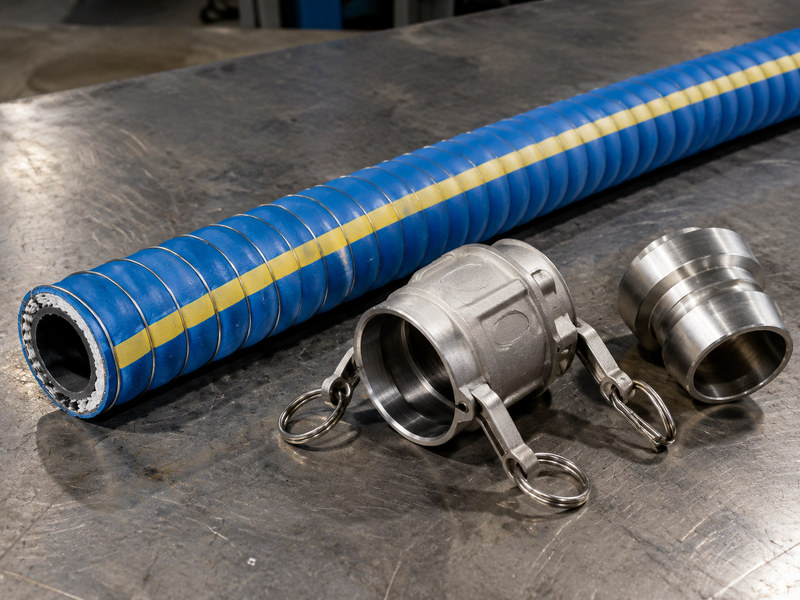
Dedicated steam couplings hold the rated assembly pressure, while a clamp band or an ordinary clamp lowers it. On steam service, bolted safety clamps are common because they hold the coupling mechanically. The working pressure versus burst pressure distinction matters here, since a burst figure says nothing about the joint.
The same logic applies across hose families. A hydraulic hose temperature rating is also a body property that the coupling can undercut, so the pattern is not unique to steam. Whenever a number is quoted for a bare hose, ask which assembly it was tested with.
Weld-in ends and crimped ends each set their own assembly limit. A welded end transfers load through metal, while a crimped end relies on the mechanical grip of the ferrule. Each path has its own temperature behavior, and the catalog value for the hose body covers neither.

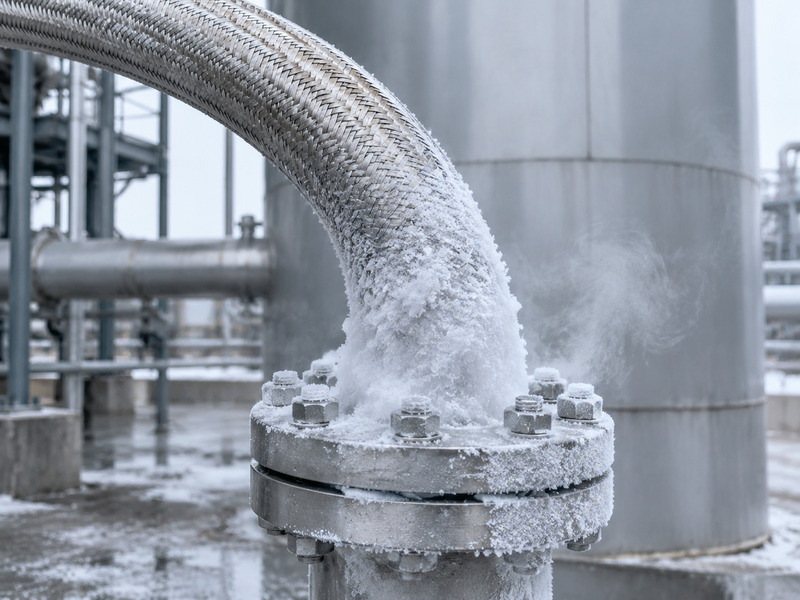
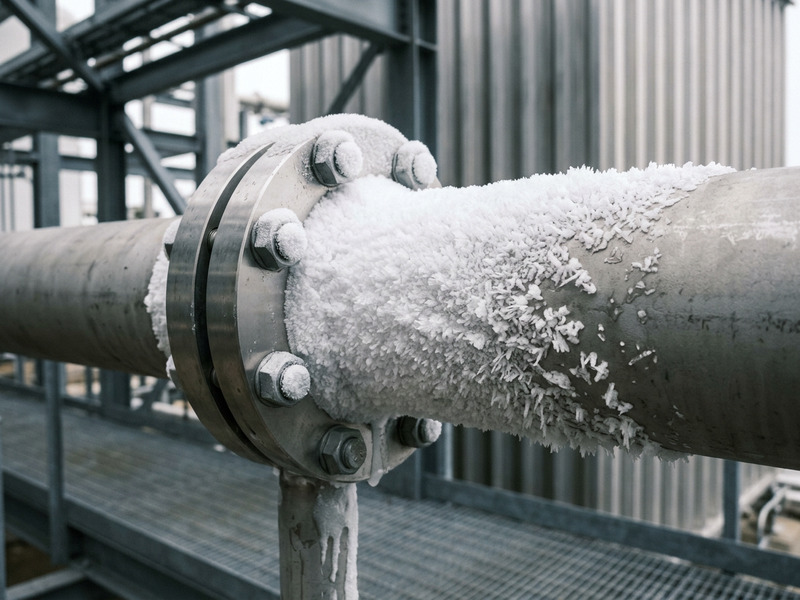
Figure 3. The end connection can set the binding limit for the assembly.
What Public Catalogs and Standards Commonly Do
Public catalogs and standards follow a small set of shared practices. They state a reference temperature, publish a factor by construction, cap the base rating, and warn that the assembly can be lower than the hose. None of those steps hands the buyer one number that works everywhere.
ISO 6134 frames steam hose from the outside. Type 1 permits a maximum pressure of 0.6 MPa (6 bar) at 164 °C, and Type 2 permits 1.8 MPa (18 bar) at 210 °C. Burst and verification testing follows ISO 1402. The reinforcement also follows the type, textile for low pressure and steel wire for high pressure.
What the standards do not do is hand over one derating percentage valid for every hose. That value stays with the manufacturer and the construction, so a pressure derating chart is always tied to a specific product line. A chart copied from one catalog and applied to another is a common source of error.
The practical habit is to read standards for the frame and catalogs for the numbers. The standard tells you the ceiling for a type; the catalog tells you the allowable pressure at temperature for one build. Keeping the two roles separate avoids reading a catalog value as a universal limit.
Table 5. The steam hose frame set by ISO 6134:2024.
| Type | Maximum pressure | Corresponding temperature | Reforço |
|---|---|---|---|
| Type 1 | 0.6 MPa (6 bar) | 164 °C | Textile |
| Type 2 | 1.8 MPa (18 bar) | 210 °C | Steel wire |
Common Mistakes When Applying Hose Derating
The most common mistake is quoting a catalog number that was never intended for the service temperature. The tell is a data sheet with a single pressure column and no reference temperature printed beside it. A hot line quoted that way is being judged against a limit the manufacturer never offered for it.
Another mistake is applying a generic factor to a steam line. A factor built for hot water answers a question that saturated steam does not ask, because the saturation pressure already fixes the temperature. The check for a saturated line is a single table lookup.
One more mistake is stopping at the hose body. The fitting, the assembly and the installation each carry their own limit, and the lowest one decides. Leaving the fitting out of the review is the same as reviewing only half of the assembly.
The last mistake is expecting one percentage to cover every hose. Public catalogs give factors by construction, precisely because one value would be wrong across most of the range. Use the chart for the exact build in hand.
Elevated Temperature Derating FAQs
Does a higher temperature always lower the allowable pressure?
Yes, above the reference temperature it does. Every published hose rating is set at a reference temperature, and the allowable pressure steps down once service temperature climbs above that point. The size of the step depends on the tube compound, the reinforcement and the fitting, so two hoses with the same base rating can diverge. Below the reference temperature, the base rating normally stands.
What reference temperature do hose catalogs use?
Most hose catalogs set their base rating near 70 °F, and a smaller set of manufacturers uses 100 °F instead. The number itself matters less than matching it: two charts built on different references cannot be compared row by row. Convert both to one reference before you compare, and quote that reference whenever a rating is passed to another engineer.
How does hose derating work for saturated steam?
For saturated steam the pressure already carries the temperature, so there is no separate slope to apply. Take the gauge reading, look up the saturation temperature that belongs to it, and check that value against the hose limit. That is why a steam line is judged on temperature as much as on pressure.
Is the derating chart the same for every hose type?
No. A chart is published for one specific construction. Rubber hoses follow the tube and reinforcement, while metal braided hoses follow the braid alloy, and the two families do not share one curve. Composite products sit between them, because each layer can limit the result. Treating any chart as universal is a common selection error.
How do end fittings affect the assembly pressure?
A catalog pressure covers the hose body only. Once a fitting is attached, the assembly has its own limit, set by the fitting type, the material and the connection method. Dedicated steam couplings carry the rated assembly pressure. An ordinary clamp or a clamp band does not. Which limit binds depends on the fitting type, so the same hose can show two different assembly ratings on two different end connections.
Why does superheated steam behave differently from hot water?
Superheated steam carries a temperature above the saturation value for its pressure, so its two variables are independent again, exactly as they are for hot water. Both are read from a correction factor at the service temperature. Saturated steam is the special case, where the curve removes that freedom and forces the two-step read.
Can I add a safety margin instead of using the chart?
A margin does not replace a chart, because the chart already reflects how the construction weakens with heat. Adding an arbitrary margin above a still-derated pressure can hide the fact that the hose, not the margin, sets the limit. Use the published factor first, then decide whether the design condition still clears the lowest limit in the assembly.
What does ISO 6134 say about steam hose limits?
ISO 6134:2024 covers rubber hoses and hose assemblies for saturated steam, and it grades them by how much pressure the reinforcement can carry. A Type 1 hose is the textile build, capped at 0.6 MPa (6 bar) and 164 °C. A Type 2 hose is the steel wire build, capped at 1.8 MPa (18 bar) and 210 °C. Verification testing is set by ISO 1402.
Does hose derating change how I maintain a steam hose?
It concerns the pressure you may apply, not routine care. A steam hose still needs condensate drained after each use, and any hose used near its temperature limit should be inspected more often for cover cracking and fitting movement. Pressure and temperature limits describe the service condition, while inspection keeps the assembly inside that condition over time.
Where should I start when a steam line runs hot?
Begin with the fitting, since the end connection usually sets the lower limit. Confirm the published limit for the exact construction next, then check the hose against the design condition. A steam line that looks acceptable on the body rating can still fail on the assembly rating, and that is the check people skip.
Does flow rate change the allowable pressure?
Flow rate does not change the allowable pressure directly, but it changes the temperature the hose actually sees. A slow line loses more heat and runs cooler, while a fast, well-insulated line keeps the hose closer to the steam temperature. Always judge the hose against its wall temperature, not the headline steam value on the drawing.
Can one hose serve both steam and hot water?
A single hose can sometimes serve both, but only if it meets the tougher of the two limits. Steam service adds the saturation-curve reading, while hot water adds an independent temperature factor. A hose chosen for steam usually covers hot water at the same or lower temperature, provided the fittings and the assembly are rated for both.
Applying Hose Derating to Your Line
Start with the reference temperature on the data sheet, apply the correction factor for the exact construction, then check the fitting and the assembly limit. For saturated steam, convert pressure to temperature before anything else. Hose derating is complete only when the lowest of those limits still clears the design condition.
About HENGHUA
HENGHUA is a professional hose and coupling manufacturer supplying distributors, retailers and OEM brands worldwide. Its steam hose line centers on an EPDM tube with textile or steel wire reinforcement and a pin-pricked cover for steam service. On-site steam hose products include the EPDM steam hose (170 °C) and the EPDM high-temperature steam hose (230 °C).
End terminations can be clamp-type safety couplings, flanges and threaded connections. The factory also offers assembled hose, custom lengths, sheath printing, private label and OEM/ODM work. Commercial terms are factory-direct pricing, short batch lead times and a warranty.
 English
 Spanish
 Portuguese
 French
 German
 Arabic
 Russian
 Indonesian
 Japanese
 Korean