
EN 13765 type 1 is the vapour-service hose in the standard’s four-type classification. It carries 4 bar maximum working pressure, a 0.5 bar vacuum rating and a −20 °C to +60 °C window. Types 2, 3 and 4 cover liquids at 10 bar and 14 bar, with Type 4 reaching +150 °C. Three inputs decide the choice: the medium, the pressure at the hose, and the service temperature.
This guide sets out the classification table and shows which type fits vapour recovery, chemical discharge, tanker work and hot service. It explains what a type designation does not tell you, and it covers the “Class A / Class B” labels that appear on older documents. It also covers how the type changes the wire and end fittings, and the questions to put to a supplier before you accept a datasheet.

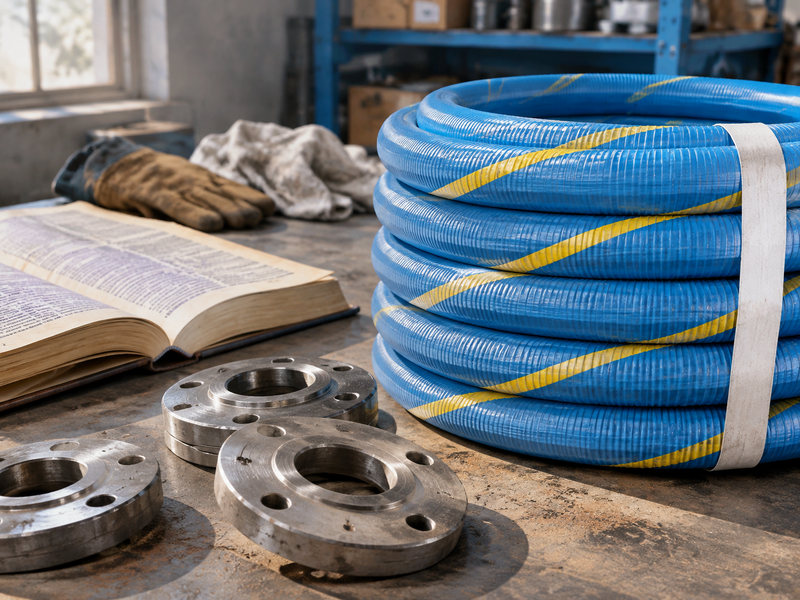
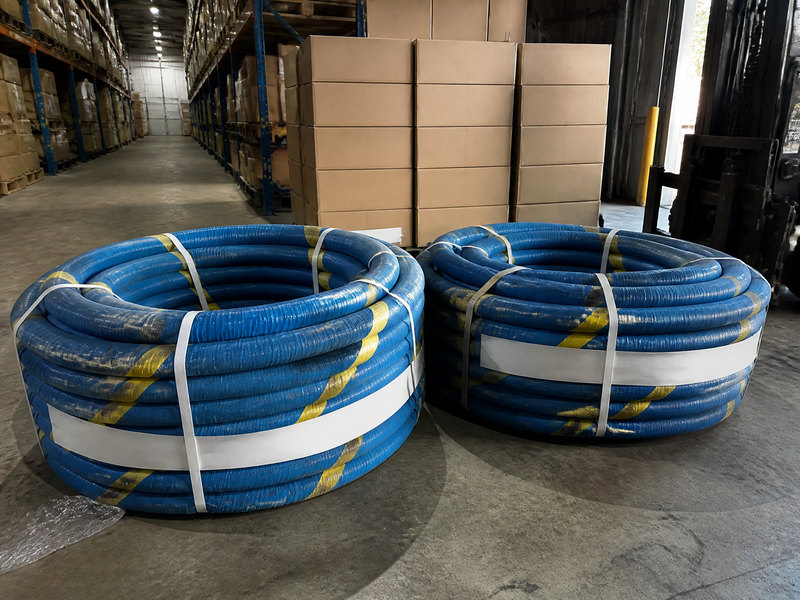
Figure 1. Two bores on one rack: the size difference is what changes handling weight, bend radius and the number of fitters needed.

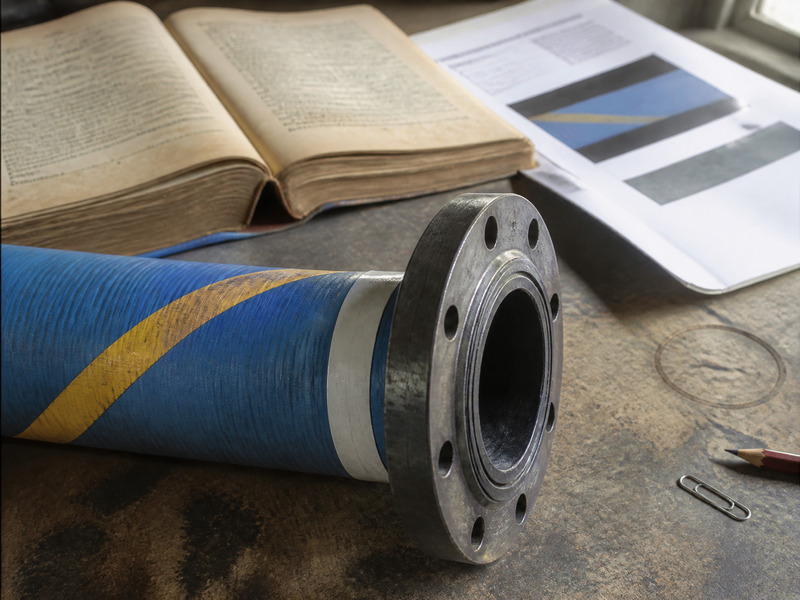
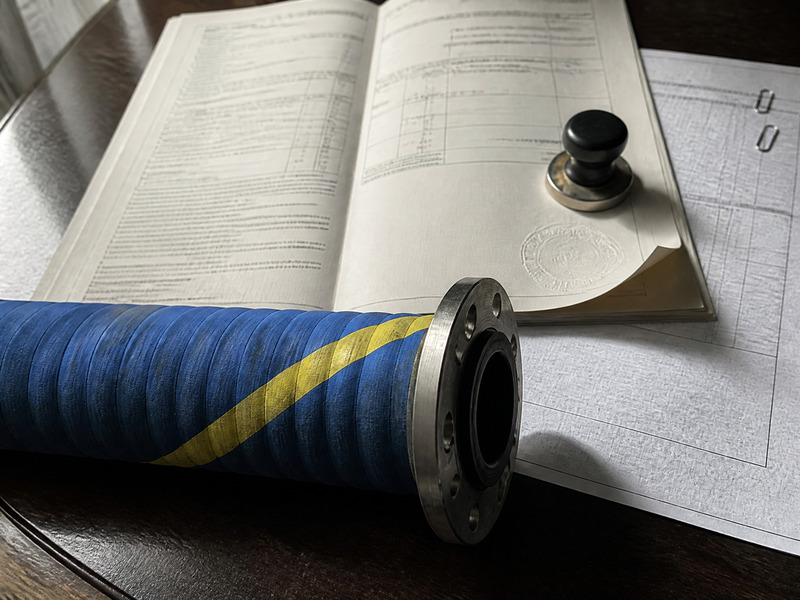
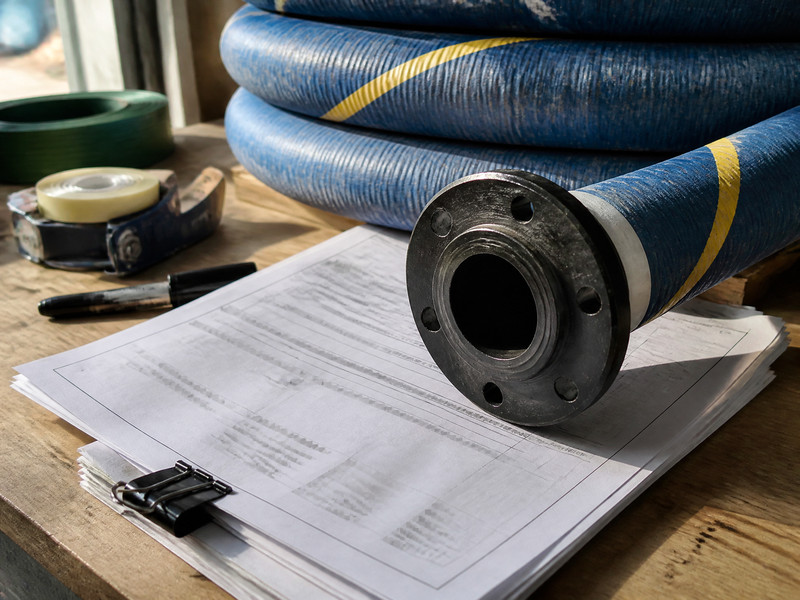
Figure 2. Both assemblies carry the same bore, and only the end connection differs. A type is chosen from pressure, temperature and product before the connection is discussed, and Table 1 in this section gives the four pressure classes with their proof and burst limits.
What Does EN 13765 Actually Classify?
EN 13765:2018 is the European specification for thermoplastic multi-layer, non-vulcanised hose and hose assemblies used to transfer hydrocarbons, solvents and chemicals. It covers bore from 25 mm to 300 mm and working pressures from 4 bar to 14 bar. Across the four types the working range spans −30 °C to +150 °C. Within that envelope, Type 1 is limited to −20 °C to +60 °C, so a site that sees −25 °C in winter cannot use Type 1 for vapour service. Clause 4 classifies hose by working pressure and temperature range in a four-column table.
Service comes first. An EN 13765 Type 1 hose is a vapour hose by definition, while Types 2, 3 and 4 are intended for liquids. Everything else in the table follows from that split, because vapour lines run at low pressure and modest temperature while liquid transfer carries both the pressure and the thermal load.
The scope also excludes duties that buyers often assume are covered. EN 13765 does not apply to aircraft ground fuelling, retail fuel dispensing, oil burners, LPG or LNG transfer, fire fighting, offshore LNG, or refrigeration circuits. Those duties have their own documents.

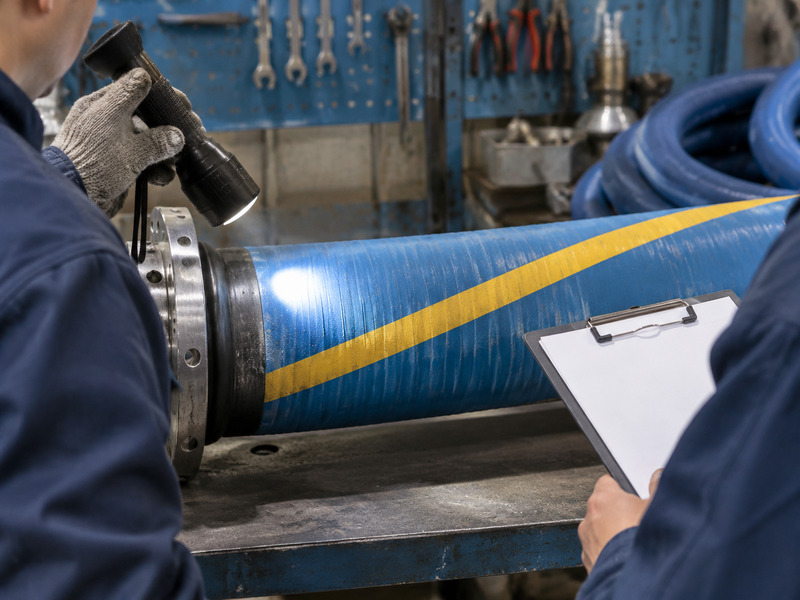
Figure 3. The sawn face shows the order plainly: helix inside the bore, then film, then fabric plies, then cover, then the outer helix. Type 3 differs from Type 1 in that stack rather than in the wire, and the pressure for each type is in Table 1.
The Four Types Side by Side
| Propriedade | Type 1 | Type 2 | Type 3 | Type 4 |
|---|---|---|---|---|
| Maximum working pressure | 4 bar | 10 bar | 14 bar | 14 bar |
| Proof pressure | 6 bar | 15 bar | 21 bar | 21 bar |
| Minimum burst pressure | 16 bar | 40 bar | 56 bar | 56 bar |
| Capacidade de vácuo | 0.5 bar | 0.9 bar | 0.9 bar | 0.9 bar |
| Working temperature range | −20 °C to +60 °C | −30 °C to +80 °C | −30 °C to +80 °C | −30 °C to +150 °C |
Table 1. Pressure and temperature values by type, from the classification clause of EN 13765. Read them as minimum requirements for the type, not as a performance ceiling. Rows are per type; the −30 °C to +150 °C span is the envelope across the four types, not a rating for a single hose.
Two readings of this table matter in practice. The pressure columns move together: proof sits near 1.5 times the working pressure and minimum burst at four times, so a higher rating needs higher proof and burst figures behind it. Types 3 and 4 share every value except temperature, which is why temperature separates them and pressure does not.
A composite hose working pressure printed on a datasheet is not automatically a type. Where a build is published above the type minimum, ask for the proof and burst results that support the number, and ask which type the assembly is declared against. The composite hose working pressure figure also has to be read with the vacuum rating, since a hose that holds pressure may still flatten on suction.
Is EN 13765 Type 1 Ever the Right Choice?
Yes, for vapour. Type 1 is the low-pressure member of the family, with a 4 bar working pressure, a 6 bar proof test, 16 bar minimum burst and a 0.5 bar vacuum rating. It suits vapour recovery and vapour return lines, where the line carries solvent or hydrocarbon vapour and the pressure comes from a small blower or from displacement during loading.
Temperature is the constraint to watch. At −20 °C to +60 °C, Type 1 covers ambient vapour recovery in most climates, but it does not cover a hot vapour stream or a line that is steam-purged between campaigns. If the hose also sees liquid slugs during pigging, the duty has left vapour service and the type should move with it.
A vapour line also carries static risk, because vapour and any condensate are often low-conductivity fluids. Continuity between end fittings and plant earth is a separate specification item, and it should be written into the order rather than assumed from the type.
Which Type Covers Liquid Chemical Transfer?
Types 2, 3 and 4 cover liquids, and pressure separates Type 2 from Type 3. Type 2 runs to 10 bar working pressure with a 15 bar proof and 40 bar minimum burst, inside the same −30 °C to +80 °C window as Type 3. Type 3 raises working pressure to 14 bar, proof to 21 bar and minimum burst to 56 bar, and keeps the temperature range.
In plant terms, Type 2 suits drum and IBC decanting, short pump discharges, and tank-to-tank transfer where the pump curve tops out well below 10 bar. Type 3 suits rail car and ISO tank discharge, road tanker unloading and dock lines, where relief valve settings and static head push the required pressure upward. The 0.9 bar vacuum rating on both covers normal suction lift, but it is not a full-vacuum rating.
A type 3 composite hose is also the build most often specified with a stainless bore and a heavier cover. For berth work the 14 bar build is usually the entry point, with Type 4 added when the product runs hot. The same hose that carries 14 bar at a berth is expected to survive abrasion on concrete and repeated coupling, and those additions raise cost and weight without changing the type.
What Does Type 4 Add?
Type 4 adds temperature. Pressure values match Type 3 exactly. The working range extends to +150 °C against +80 °C, which is why Type 4 is specified for hot oil, hot solvent and hot chemical discharge.
The −30 °C to +150 °C range is bought with materials: a different film and a different wire grade, not a thicker wall. Hot service pushes the lining toward fluoropolymers and constrains the cover compound, so a type 4 assembly usually costs more per metre than a Type 3 build at the same bore. The EN 13765 temperature range is a material capability statement, not a chemical compatibility statement.
Our high-temperature build is published at 177 °C on its product page, above the Type 4 ceiling. It is a distinct construction for that duty, and anyone comparing it with a Type 4 line should compare test values rather than the headline number.
How Does Temperature Change the Pressure You Can Use?
Pressure falls as temperature rises, and a single working pressure figure does not carry that derating. A hose holding 14 bar at 20 °C may be rated lower at 80 °C, because the thermoplastic film softens and the fabric carries a larger share of the load. Specify the pressure at the service temperature, not at ambient.
This is where the EN 13765 temperature range becomes a commercial question as well as a technical one. Two suppliers can both quote Type 3 and still offer different usable pressures at 70 °C, because the curve depends on their film and fabric combination. Ask for the derated figure in writing, for your medium and your temperature.
For chemical duty the derating interacts with resistance. Our guide to chemical resistance and temperature derating explains how to read a resistance table at temperature rather than at 20 °C.
Where Do “Class A” and “Class B” Fit?
Buyers often meet “Class A” and “Class B” on composite hose datasheets, on older certificates and in tenders, and reasonably assume they sit inside EN 13765. They do not sit in the 2018 classification. Clause 4 classifies hose by type only, and its table has four type columns and no class rows.
The labels are not meaningless, but they belong to other documents. Older British dock, road and tanker specifications, and some company standards, used class language for hose assemblies before the European type scheme took over. Our comparison of BS 5842 and EN 13765 covers that handover in detail.
The practical rule is simple. A buyer comparing a Class A certificate with an EN 13765 Type 1 declaration is comparing two different things. Ask which document and edition define the class, and what test values sit behind it. If the answer is a type table, work from the type. If the answer is silence, treat the class as marketing until the document appears.
How Does the Type Change the Hardware?
The type sets pressure and temperature; the construction clause sets the hardware that must survive them. EN 13765 requires a multi-ply wall of thermoplastic films and fabrics that together seal the bore, a cover of fabric with an abrasion-resistant coating, and an external wire helix. The internal wire is stainless steel, galvanised or polymer-sheathed carbon steel, or aluminium, chosen for chemical resistance.
The internal helix holds the bore open under suction, so its material is a chemical decision as much as a mechanical one. An EN 13765 Type 1 hose carries the same wall stack as the higher types, which is why a vapour line still needs the wire specified by medium. An acid that is harmless to the film can still attack a carbon steel wire, and a sheathed wire is only as good as the sheath. Our article on the composite hose inner wire covers collapse and corrosion, and the inspection points that catch both.
Bore drives bend radius, and the standard tabulates it per type. At 25 mm bore the minimum bend radius is 125 mm for Types 1 and 2 and 200 mm for Types 3 and 4. At 80 mm bore the figures are 300 mm and 350 mm. A tighter installed bend kinks the bore and starts the failure path, whatever the pressure rating says.
End connections sit outside the type table. Flange drilling follows EN 1092-1 or ASME B16.5, and the fixed versus floating decision belongs to the assembly. Our guide to fixed and floating flanged ends explains which end should rotate on a dock line and why. The layer stack that produces these properties is covered separately for readers who want the construction detail.
How Do You Write the Type Into a Specification?
A specification that names only the type leaves the supplier free on everything that decides service life. The table below shows the wording that removes that freedom.
| Duty | Write in the specification | Do not rely on |
|---|---|---|
| Vapour recovery | EN 13765 Type 1, bore, length, end connections, continuity requirement | “Composite hose, vapour service” |
| Plant chemical discharge | EN 13765 Type 2, bore, medium and concentration, derated pressure at service temperature | The type number alone |
| Rail car or ISO tank unloading | EN 13765 Type 3, bore, MAWP, relief valve setting, stainless bore if required | A distributor’s pressure headline |
| Hot oil or hot solvent | EN 13765 Type 4, highest service temperature, derated pressure at that temperature | The ambient pressure rating |
| Dock or jetty line | Type 3 or 4 with flange standard, length, lifting and inspection regime | Class A or B wording with no document |
Table 2. Specification wording by duty. The right-hand column lists phrases that leave a buyer unprotected.
A fourth point belongs in every enquiry. Ask for the assembly marking to carry the type, the bore, the working pressure and the date of manufacture. A hose that loses its identity at a terminal cannot be checked against its certificate later.
Three additions make the wording usable in procurement. State the relief valve setting and the static head, so the supplier can check the working pressure against the system rather than a catalogue. State the medium with concentration and temperature, because film choice follows the medium. State the test regime you expect before shipment, whether proof only or proof with a continuity record.
A vapour line specified as EN 13765 Type 1 without a continuity clause is the most common gap we see in tender documents. The clause is one line, and it is cheaper than a site investigation after a static incident.
Proof testing does not replace inspection. A hose can pass its proof pressure and still be unfit for service. That happens when the cover is cut through to the reinforcement, or when the helix has started to corrode under a damaged sheath. Pair every test with a visual check of the full external surface.
Frequently Asked Questions
Is EN 13765 Type 1 suitable for liquid chemicals?
No. EN 13765 Type 1 is intended for vapour applications with a 4 bar maximum working pressure. Liquid transfer starts at Type 2, which raises working pressure to 10 bar and minimum burst to 40 bar.
What is the difference between Type 3 and Type 4 composite hose?
Only the temperature range. Both are rated at 14 bar working pressure with a 21 bar proof and 56 bar minimum burst, but Type 3 works to +80 °C and Type 4 to +150 °C. That EN 13765 temperature range difference, not pressure, decides between them.
Does a higher working pressure mean a better hose?
Not by itself. A composite hose working pressure is only meaningful with its proof and burst figures, so ask for all three values and the test record behind them. A headline pressure with no proof figure is an incomplete claim.
Is a 20 bar composite hose still an EN 13765 hose?
The type table stops at 14 bar, so a 20 bar build is published above the type minimum. Ask which type it is declared against, and for the proof and burst results that support the rating.
Is a type 3 composite hose the right choice for dock work?
For most berth lines, yes. A type 3 composite hose at 14 bar covers tanker unloading and dock transfer, and Type 4 is added only when the product temperature exceeds 80 °C.
Can one hose cover both suction and discharge?
Yes, if it is built with an internal helix and rated for vacuum. Types 2 to 4 carry a 0.9 bar vacuum rating, which covers normal suction lift but not full vacuum service.
How often should a composite hose be pressure tested?
The interval comes from the site inspection regime or the terminal regulation, not from EN 13765. Many operators test annually and inspect before each transfer, using the proof figure in the type table as the reference value.
Does EN 13765 cover LPG or LNG composite hose?
No. The standard excludes LPG and LNG, which have separate documents. An LPG or LNG build has to be specified against its own standard, not against a type from this table.
About HENGHUA
HENGHUA manufactures composite hose and hose assemblies for distributors, terminals and OEM brands. Linings include PTFE, XLPE, polypropylene and UHMWPE over a woven fabric carcass, with stainless or coated carbon steel helixes and factory-crimped or flanged ends. Assemblies are built to the bore, pressure class and temperature range you specify, with the test record for each assembly supplied with the order, plus custom lengths, fixed or floating flanges and marking to your specification. The full range is listed in our composite hose size and lining options. If you are writing a tender, send the medium, temperature and relief valve setting through our contact page. We will quote against the type rather than a headline number.
 English
 Spanish
 Portuguese
 French
 German
 Arabic
 Russian
 Indonesian
 Japanese
 Korean