
PVC vs TPR vs PU hose comes down to five variables: water temperature, working pressure, abrasion, media chemistry, and whether the hose touches drinking water. Most water, air and general-purpose lines then have a short answer. Choose PVC hose for cold, low-pressure, low-abrasion duty where cost leads. Choose TPR hose (thermoplastic rubber) when the line is handled daily, stored outdoors, or carries warm water or light oil.
Choose ether-based polyurethane (PU) hose when abrasion, kink resistance or working pressure decides whether the line survives. This guide explains what each material actually is, how the three compare on properties you can specify and test, which standards govern them, and a five-step sequence you can run before placing an order.
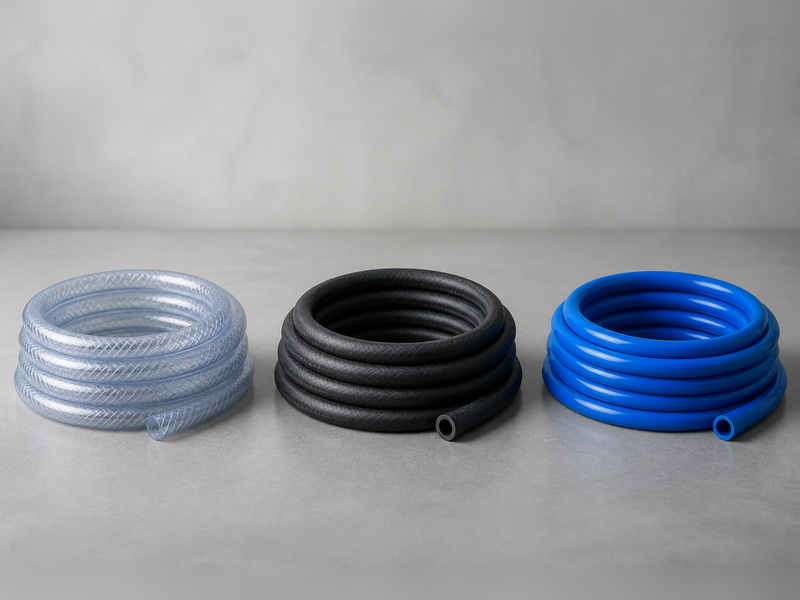
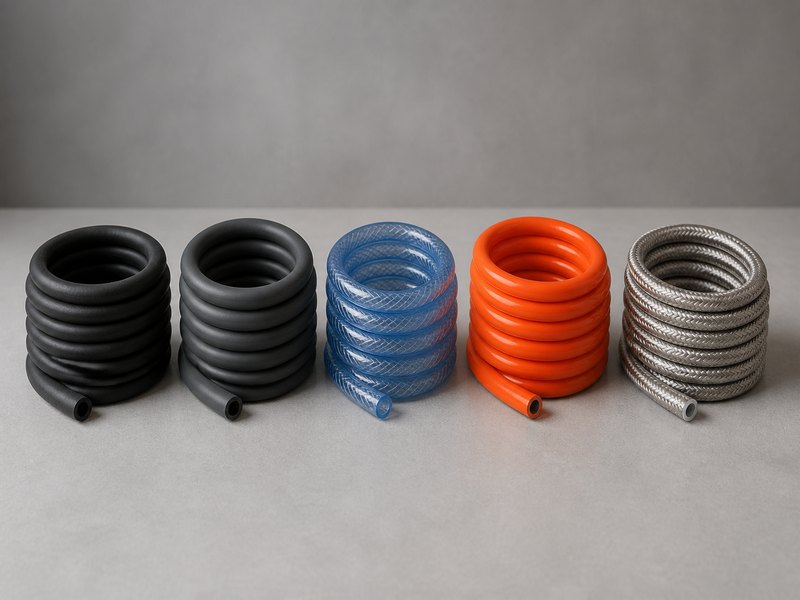
Three coils, three cost tiers: clear plasticised PVC, a black TPR rubber blend, and a blue ether-based polyurethane hose.
PVC vs TPR vs PU Hose: The Direct Answer
None of the three materials is universally better. Each one wins inside a different operating window, and the window is set by the hardest condition the line will meet rather than the average condition. A hose does not fail on a typical Tuesday; it fails during the hottest afternoon, the coldest morning, or the week the pump surges. That is the whole decision rule for PVC vs TPR vs PU hose: match the material to the worst case, and the choice becomes obvious.
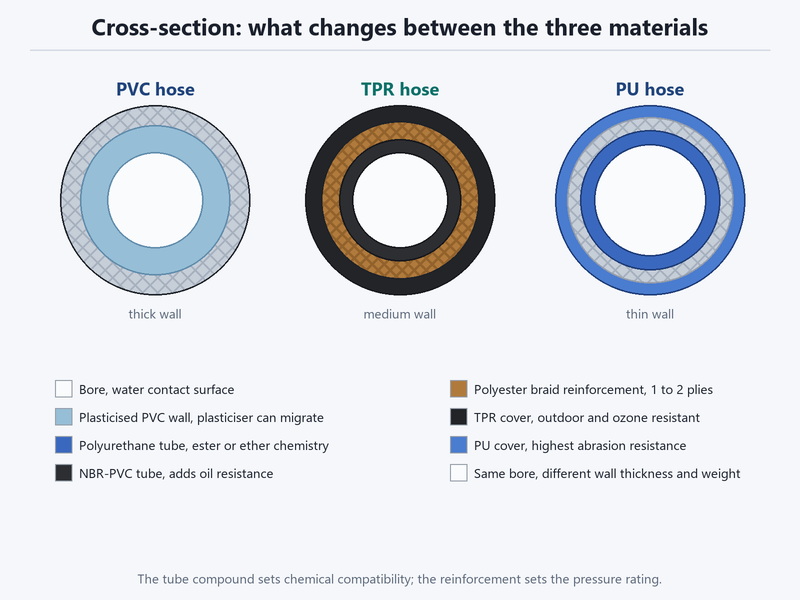
All three are thermoplastics, but the tube compound and the reinforcement type set the fluid, pressure and suction capability.
Table 1. PVC vs TPR vs PU hose at a glance: chemical basis, typical service band and best-fit duty.
| Material | Chemical basis | Typical service temperature | Typical hardness | Relative abrasion resistance | Relative cost | Best-fit duty |
|---|---|---|---|---|---|---|
| PVC hose | Plasticised polyvinyl chloride | -10 to +60 °C | 65 to 80 Shore A | Low to moderate | Lowest | Cold water, low-pressure spray, light irrigation, ventilation |
| TPR hose | Thermoplastic rubber: vinyl-nitrile blend or olefinic TPE | -30 to +80 °C | 55 to 80 Shore A | Moderate to high | Middle | Handled water and air lines, outdoor washdown, light oil transfer |
| PU hose | Polyurethane, ester-based or ether-based | -40 to +80 °C, grade dependent | 85 Shore A to 60 Shore D | Elevado | Highest | Abrasive slurry, tight coiling, higher pressure, cold climate |
A single rule resolves most of the material differences in Table 1. Identify the one condition that would destroy the cheapest material, then buy the material that survives that condition and no more than that condition.
Scope: this guide applies to textile-reinforced water, air and general-purpose hose. Steam hose, fire hose and chemical-transfer hose built to other standards sit outside it.
What Each of These Three Hose Materials Actually Is
The three names get used interchangeably in catalogues, which is why buyers end up comparing prices for products that are not equivalent. PVC, TPR and PU are all thermoplastics, meaning they soften when heated and can be extruded, but they are built on entirely different polymer systems. A broader flexible hose materials guide covers the whole family; the sections below stay with the three materials that compete for the same water and general-purpose duty.
PVC Hose: Plasticised PVC and the Plasticiser Question
Rigid PVC is a hard, brittle polymer and cannot be used as a hose on its own. A hose-grade compound adds a plasticiser, commonly in the range of 25 to 40 parts per hundred, and it is that additive which makes the material soft, draggable and translucent. The consequence matters more than the definition, because a plasticiser is not chemically locked into the polymer chain. It can migrate out under heat, ultraviolet exposure and sustained flexing.
What migration looks like in service is predictable. The hose loses flexibility first, then hardens and yellows, then cracks at the bend points and near the couplings. The surface also becomes a release path for the additive itself, which is why a clear PVC hose that felt supple in its first summer can behave like a stiff tube after two or three seasons outdoors.
Plasticiser selection is now a specification item rather than a detail. Bis(2-ethylhexyl) phthalate (DEHP) and three related ortho-phthalates have been restricted in the European Union since July 2020 at 0.1 per cent or more by mass in plasticised articles, and formulators have moved to terephthalates, cyclohexanoates and other non-phthalate options. A hose sold for garden or potable use in those markets should state which plasticiser family it uses.
Where plasticised PVC is the right answer:
- Cold water delivery, flood irrigation, sump and drain-down lines.
- Low-pressure spray, washdown and dust suppression where the hose stays on a reel.
- Ventilation and light dust extraction, where abrasion and temperature loads are low.
- Any duty where a clear bore for product visibility or the lowest cost per metre dominates.
TPR Hose: Two Different Blends Sold Under One Name
TPR stands for thermoplastic rubber, and in hose catalogues a thermoplastic rubber hose means either of two different constructions. That ambiguity is also why a tpr vs pvc comparison is unreliable when the two suppliers mean different things by TPR. The first is a vinyl-nitrile blend, in which plasticised PVC is combined with nitrile rubber to add oil resistance and elasticity. HENGHUA’s TPR rubber PVC mixed multipurpose hose is built this way, with an NBR-PVC tube and cover plus polyester braid reinforcement. The second is an olefinic thermoplastic elastomer, typically a styrene or EPDM-polypropylene based compound that contains no plasticiser at all.
The distinction matters when a buyer specifies “TPR” and receives whichever construction the supplier stocks. A vinyl-nitrile TPR hose behaves like a tougher PVC: excellent outdoor life and oil resistance come from the nitrile phase, but a fraction of the plasticiser is still present. An olefinic TPR hose has no plasticiser to lose, so its flexibility is inherent and it does not stiffen with age in the way PVC does.
TPR hose is the better match when:
- The hose is dragged, coiled and handled every working day.
- The line sits outdoors, on a reel or a rack, exposed to sun and ozone.
- Service temperature drifts below freezing or above the PVC ceiling.
- The water carries light oil, diesel traces, fertiliser or mild detergent.
- The surface under the hose must not be marked by a dark rubber cover.
PU Hose: Ester-Based or Ether-Based Decides Water Service
Polyurethane hose has the highest abrasion resistance of the three materials and keeps useful flexibility at temperatures where PVC has already stiffened. It is also the most expensive by the metre, and it carries one failure mode that is entirely avoidable if the correct grade is specified. Polyurethane is supplied in two chemistries, and they behave completely differently in water.
Ester-based polyurethane has the higher tensile strength and slightly better resistance to oils and fuels. It also has poor hydrolysis resistance, meaning warm water and humid air attack the polymer backbone and progressively break it down. Ether-based polyurethane trades a small amount of oil resistance for far superior hydrolytic stability and better low-temperature flexibility, and it also resists microbial attack inside the tube.
Ether-based polyurethane hose is the correct choice when:
- The water runs warm, hot, or sits in the line between cycles.
- Ambient humidity is high, or the hose is stored damp.
- Abrasive solids pass through the line and wear is the lifetime limiter.
- The hose must coil tightly without flattening and recover its shape.
- Working pressure is higher than a textile-reinforced PVC or TPR hose can hold.
Hose Material Comparison: How PVC, TPR and PU Differ on Measurable Properties
A hose material comparison is only useful if the properties are ones you can put in a purchase specification and later verify. Temperature, hardness, abrasion loss and chemical resistance all have defined test methods, and all three materials have published values for them. The table below collects the differences that change the outcome on a real line; the notes that follow explain how each one fails in practice.
Table 2. Property comparison of PVC, TPR and PU hose materials for water and general-purpose service.
| Propriedade | PVC hose | TPR hose | PU hose |
|---|---|---|---|
| Practical temperature band | -10 to +60 °C | -30 to +80 °C | -40 to +80 °C, grade dependent |
| Flexibility at -20 °C | Stiffens and can crack | Retains flexibility | Retains flexibility |
| Abrasion loss by rotating-drum method | Highest loss | Intermediate loss | Lowest loss |
| Oil and fuel resistance | Poor; plasticiser can be extracted | Good in vinyl-nitrile grades | Good to excellent, best in ester grades |
| Behaviour in warm water | Softens and loses strength | Stable | Stable in ether grades, degrades in ester grades |
| Ultraviolet and ozone exposure | Needs stabilisers; hardens over time | Good | Good |
| Kink recovery after coiling | Slow; takes a permanent set | Good | Best of the three |
| Potable-water construction | Available with phthalate-free compounds | Available | Available, ether grades preferred |
| Relative cost per metre | Lowest | Middle | Highest |
Temperature: The PVC Hose Temperature Rating Is the Tightest of the Three
Of the three materials, the PVC hose temperature rating is the narrowest, and it is the one buyers exceed most often without noticing. A plasticised compound softens as it warms, so both stiffness and tensile strength fall together. Published working pressure is normally quoted at a reference temperature near 23 °C, and it must be derated above that point.
The pressure a plasticised PVC hose loses as it warms is larger than most specifications suggest. A commonly published derating example shows a PVC hose rated close to 200 psi at 70 °F (21 °C) falling to roughly half that value at 120 °F (49 °C). A line that runs at 30 psi in winter can be operating at over half its remaining capacity on a hot afternoon.
TPR raises the ceiling because the rubber phase keeps its elasticity where plasticised PVC has gone soft. Values in the range of -30 to +80 °C are typical for a textile-reinforced construction, and a thermoplastic rubber hose holds that band without relying on an additive that can migrate out. The polyurethane hose temperature rating is not a single figure, because the two chemistries do not share an upper limit.
Pressure: Working Pressure, Burst-to-Working Ratio and Temperature Derating
Working pressure on a water hose is set mainly by the reinforcement, not by the tube compound. All three materials are normally supplied with one or two plies of high-tensile polyester or similar textile braid, which is why a 300 psi rating appears across PVC, TPR and PU constructions of similar bore and ply count. The material choice changes how long that rating holds, not the number on the label.
Three specification items decide whether a pressure rating is real:
- The burst-to-working ratio: 4:1 for textile-reinforced water hose, and 3:1 for low-pressure thermoplastic multipurpose constructions.
- The temperature at which the rating applies, since every material loses strength as it heats up.
- The proof test pressure and duration, typically applied at 1.5 to 2 times working pressure under a hydrostatic test method.
Ask for the burst-to-working ratio, the reference temperature and the proof test pressure in writing. A catalogue that lists only “300 psi” is telling you the best case, not the operating case.
Abrasion: When an Abrasion Resistant Hose Pays for Itself
Abrasion resistance is where polyurethane separates from the other two, and it is measured rather than asserted. The rotating-drum abrasion test, published as ISO 4649 and formerly known as DIN 53516, records the volume of material lost from a sample under a defined abrasive path. Polyurethane compounds lose substantially less volume than rubber or soft PVC under that method, which is why an abrasion resistant hose for slurry, sand or concrete contact is usually specified in PU.
The commercial argument follows the wear rate rather than the price. A PVC hose dragged daily across a concrete apron will wear through the cover and expose the reinforcement within a season or two of heavy use. An ether-based polyurethane hose under the same handling typically reaches the same point several times later. Between tpr vs pvc covers of the same wall thickness, the TPR loss is the lower of the two, though neither comes close to a polyurethane cover. If the hose is dragged rather than carried, the higher purchase price is usually recovered before the second replacement.
Chemical Resistance: It Depends on What the Water Carries
Water is rarely only water. Municipal supply carries chlorine and chloramine, irrigation lines carry fertiliser and iron, construction dewatering carries lime and grit, and washdown lines carry detergent. Each of those changes how long a tube compound lasts, and the three materials respond differently.
PVC has good resistance to acids, alkalis and salts, but it is the weakest of the three against oils, fuels and solvents, which can extract plasticiser from the tube. A vinyl-nitrile TPR hose adds oil and fuel resistance through the nitrile phase, which is why it is the usual choice where a line might see diesel or lubricant. Polyurethane has good all-round chemical resistance, with ether grades preferred for anything water-based or humid and ester grades preferred where oils and fuels dominate.
TPR vs PVC: How Do They Differ in Your Hands?
TPR vs PVC is the comparison a buyer can settle without a laboratory, because the difference shows up in handling within a minute of uncoiling the hose. A plasticised PVC hose bends easily but recovers slowly. Press a tight kink into it, hold it for a few seconds and release, and a visible flat spot remains. A TPR hose of the same bore springs back, and the kink disappears.
The gap in kink recovery between the three materials compounds over a service life. Every flat spot left in a PVC hose becomes a low-flow point and a stress concentration, and it is usually the place where the cover cracks first. A TPR hose keeps its bore open through repeated coiling, so the flow stays consistent and the weak points do not accumulate in the same way.
Outdoor behaviour separates them further. Plasticised PVC needs ultraviolet and ozone stabilisers to survive sun exposure, and even with them it stiffens and yellows as plasticiser migrates. TPR compounds are used specifically for outdoor duty because the elastomer phase is not consumed by weathering, and a non-marking cover grade leaves no dark scuff on decks, floors or finished surfaces.
TPR covers handled, outdoor and warm duty, while PVC stays the right choice for stationary cold-water duty. A clear PVC hose shows the fluid and any blockage inside it, it costs less per metre, and it handles cold, low-pressure, stationary duty perfectly well. Where the hose is going to sit on a reel and move twice a year, PVC remains the sensible purchase.
PVC vs Polyurethane Hose: The Difference You See on the Wear Log
PVC vs polyurethane hose looks like a simple price comparison at the quotation stage and stops looking simple once the hose has been in service for a year. Polyurethane costs more per metre, but a PU hose of the same inner diameter carries a thinner wall for the same working pressure and coils into a smaller package. That reduction in wall thickness and weight changes how the line behaves on a reel, in a confined space and on a machine that has to move it.
The service difference is concentrated in three places. Polyurethane holds pressure with a thinner wall, survives dragging where PVC would abrade, and stays flexible at -40 °C where PVC has already stiffened, which is why the polyurethane hose temperature rating stays useful in a cold-climate storeyard. Against that, PVC is transparent, cheaper, and easier to bond and fabricate in the field, which matters for temporary or one-season installations.
The one trap in the PVC vs polyurethane hose decision is warm water. Because ester-based polyurethane hydrolyses, a buyer who orders “polyurethane” for a warm-water line can end up with a hose that degrades from the inside, turning cloudy and weak before any external wear appears. Specify ether-based polyurethane for water service and the problem does not arise.
Is the Hose Safe for Drinking Water?
Potable duty is a certification question rather than a material question, and all three materials can pass it. It also cuts across every duty in the types of water hoses rundown, which is why the certificate has to travel with the compound rather than the category. A hose is potable when the specific compound it is made from has been evaluated for contact with drinking water, not when the material family is named PVC, TPR or polyurethane. That is why two hoses sold as “food grade PVC” can differ completely in whether either one is acceptable on a drinking-water line.
Four certification routes cover most requirements. NSF/ANSI 61 evaluates drinking-water system components for health effects. NSF/ANSI 51 covers food equipment materials. FDA 21 CFR 177.2600 covers rubber articles intended for repeated use. EU Regulation 10/2011 governs plastic food-contact materials, and the 3-A sanitary standards cover multiple-use plastic materials in dairy and beverage service.
PVC carries the largest formulation risk of the three materials. A plasticised PVC compound contains plasticiser, heat stabiliser and lubricant, and any of them can migrate into standing water if the grade was not selected for contact service. Test programmes on consumer garden hoses have reported detectable lead and phthalate leaching, which is a formulation outcome rather than a property of PVC itself. Certified phthalate-free compounds with non-lead stabilisers are widely available and should be specified by name.
Documents to request before a hose touches drinking water:
- A current certificate listing the exact compound, not just the material family.
- The maximum contact area and temperature the certificate covers.
- Confirmation that production uses no regrind or recycled compound.
- A statement of the plasticiser family used in the compound.
- The intended service life and any flushing recommendation.
One practical point sits outside the certificate. Water left standing in any hose, in any material, warms in the sun and supports microbial growth, so a hose used for drinking water should be flushed before use and drained after it.
Which Standard Should the Hose Be Built To?
A standard converts a material claim into a testable requirement, and it is the cheapest piece of quality assurance a buyer can put in a purchase order. For water hose, four standards do most of the work, and they split by material and by whether the line is under suction:
- ISO 6224, adopted in Europe as EN ISO 6224, covers textile-reinforced thermoplastics hoses for general-purpose water applications. This is the natural standard for a PVC, TPR or PU delivery hose.
- ISO 3994, adopted as EN ISO 3994, covers helical-thermoplastic-reinforced thermoplastics hoses for suction and discharge of aqueous materials, in three types.
- ISO 1403, adopted as EN ISO 1403, covers textile-reinforced rubber hoses for the same general-purpose water duty.
- ISO 5774, adopted as EN ISO 5774, covers textile-reinforced plastics hoses for compressed-air applications, which is the relevant standard when the same hose is used on a pneumatic line.
The test methods behind those specifications are what actually get measured. ISO 1402 sets the hydrostatic proof and burst procedure. ISO 4649 sets the rotating-drum abrasion method. ISO 1817 and ASTM D471 set liquid-immersion testing for oil and chemical resistance. ISO 7326 sets ozone resistance under static conditions.
Garden hose is a duty, not a standard. That is why two 15 mm hoses can behave so differently. Naming a duty-specific standard in the purchase order is what removes the ambiguity.
How to Choose: A Five-Step Decision Sequence
Choosing between PVC vs TPR vs PU hose is easier when each step can eliminate a material outright. The sequence below is ordered deliberately, because running it in this order prevents the most common error, which is choosing on price before the operating envelope is known. Work through it with the numbers from the actual installation, not from the catalogue:
- Record the highest water temperature, including stagnation in a sun-exposed hose. Anything above about 60 °C removes PVC.
- Record the maximum pressure including surge, then derate it for that temperature. A 300 psi cold rating is not 300 psi hot.
- Decide whether the hose is dragged over abrasive ground. If it is, polyurethane is the only material that changes the replacement interval.
- Decide whether the hose touches drinking water. If it does, require a certificate naming the exact compound.
- Decide the handling and storage pattern, because daily coiling and permanent outdoor exposure both point toward TPR.
Running the five questions usually collapses into one line. Cold, static, low pressure, no abrasion, no potable contact means PVC. Handled daily, outdoors, warm, or lightly oily means TPR. Abrasive contact, tight coiling, higher pressure or sub-zero storage means ether-based PU. Where two conditions conflict, the harsher one decides.
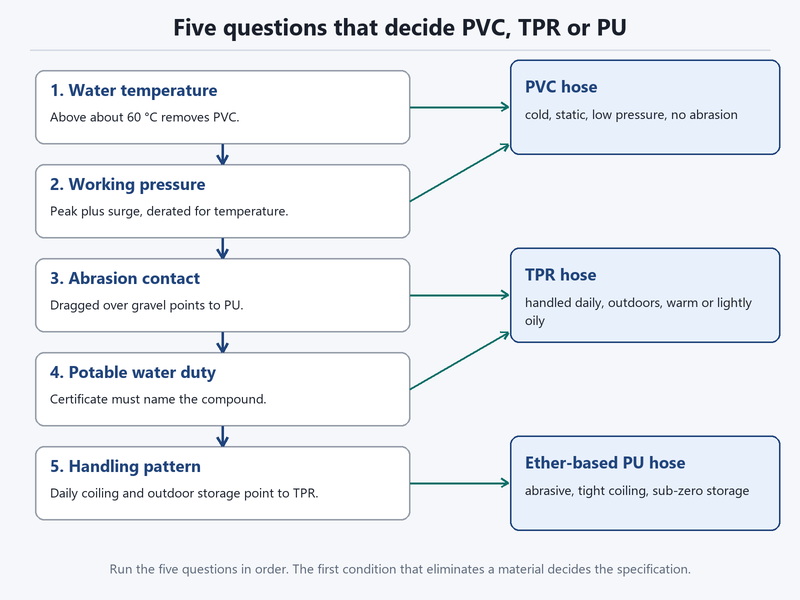
Run the five questions in order: the first condition that eliminates a material decides the specification.
Worked Example: Choosing for a Construction Dewatering Line
Take a dewatering line pumping from a sump on a construction site. The peak water temperature is 15 °C in winter and 30 °C after a day in the sun. The pump discharges at 90 psi with a 20 psi surge at start-up, so the peak is 110 psi. The hose is dragged 40 m across a gravel pad twice a day, the water is not for drinking, and the crew coils the hose onto a truck bed every evening.
Step one tests PVC on temperature: the 30 °C peak sits inside the PVC band, so PVC survives. Step two sets a 110 psi requirement with margin, which any textile-reinforced hose of the right ply count meets. Step three removes both PVC and standard TPR, because dragging over gravel is exactly the duty where abrasion decides the replacement interval. Step four removes the potable requirement entirely. Step five sets the handling expectation, which the abrasion answer has already overridden.
The outcome is an ether-based polyurethane cover on a textile-reinforced construction, sized for the 110 psi peak with the surge included. Had the same hose stayed bolted to the pump and never moved, the arithmetic would have reversed and a plasticised PVC hose would have been the correct purchase.
The value of the dewatering example is the order of the steps, not the numbers. Price appears in none of the five, and yet price is the first question most buyers ask. Run the sequence first, then compare the price of the one or two materials that survive it.
Application Matrix: Which Material Wins for Each Duty?
Duty-based selection is faster than property-based selection once the five steps have been run, because most industrial and agricultural duties repeat across sites. The matrix below maps common water and general-purpose duties to the material that survives them at the lowest total cost.
Table 3. Application matrix: recommended hose material by water and general-purpose duty.
| Duty | Recommended material | Reason |
|---|---|---|
| Cold water delivery on a reel, low pressure | PVC | Lowest cost, clear bore, adequate for static duty |
| Flood irrigation and drain-down | PVC or TPR | PVC where cost leads, TPR where the hose is dragged |
| Washdown and dust suppression, daily handling | TPR | Kink recovery, non-marking cover, outdoor life |
| Water carrying light oil, diesel or detergent | TPR or PU | Nitrile phase in TPR; ester grades in PU |
| Construction dewatering with grit or sand | Ether-based PU | Abrasion resistance and kink recovery under dragging |
| Warm or hot water transfer | Ether-based PU | Hydrolytic stability and retained pressure rating |
| Compressed air with occasional water carry-over | TPR or PU | Oil resistance and outdoor durability |
| Potable water transfer or temporary supply | Any, compound certified | Certification follows the compound, not the material name |
Two product families cover most of the middle rows of a PVC vs TPR vs PU hose decision. A TPR rubber PVC mixed multipurpose hose handles daily washdown, light oil and compressed air in one construction, while the broader water hose range covers discharge and suction duties from 150 psi upward. For compressed-air duty specifically, the rubber vs PVC air hose comparison picks up where this guide stops, because the fitting and coupling decision follows the material decision.
How to Compare Cost per Year, Not Cost per Metre
Comparing hose materials on purchase price per metre produces the wrong answer whenever the materials wear at different rates. The number that matters is the annual cost of keeping the line running, which combines purchase price, replacement frequency, and the labour and downtime each replacement consumes.
The arithmetic is simple enough to run before ordering. In this illustrative example, if a polyurethane hose costs about 1.8 times the PVC hose it replaces, and in that dragging duty it lasts about three times as long, the annual material cost index is 1.8 divided by 3, or 0.6. That is roughly 40 per cent lower per year, before counting two avoided changeovers. Reverse the duty, and a stationary cold-water reel where nothing wears, and the same arithmetic flips in favour of PVC.
Three cost items are usually left out of a cost-per-year comparison and should not be. The first is labour and downtime per replacement, which scales with how often the hose is changed. The second is coil size and weight, because a thinner-walled PU hose takes less storage space and less handling effort per metre. The third is the cost of a failure, since a burst hose on a dewatering line stops the job, while the same failure on a washdown line is an inconvenience.
A pressure-rated water discharge hose at the low end of that range costs little more than a general-purpose hose and removes the guesswork about pressure capacity, which is often the cheapest way to close a marginal specification.
Suction Duty Changes the Answer
A suction line is a different problem from a delivery line, and it is the one duty where the material question matters less than the construction question. On suction, atmospheric pressure pushes the water into the tube while the pump pulls from the other end. Nothing except the hose wall resists the resulting collapse, so an unreinforced tube flattens and the flow stops.
The fix is not a better polymer; it is a helix. A helical thermoplastic reinforcement, usually a rigid PVC or similar spiral bonded into the wall, gives the tube a shape it cannot lose under vacuum. ISO 3994 covers exactly this construction, and it distinguishes three types within the standard so a buyer can specify the duty rather than the appearance.
The distinction between the two duties is set out in more detail in this suction hose vs delivery hose guide. All three materials can be built into a suction hose, and the combination is often deliberate. In a tpr vs pvc suction hose of the same bore, the TPR cover also tolerates riverbank dragging that abrades a plasticised PVC cover faster.
The combination of cover and helix is where the cost decision sits. A PVC helix with a PVC cover gives the lowest cost per metre for a stationary pump intake. A TPR cover over the same helix survives dragging on a riverbank or a gravel pad. An ether-based polyurethane cover adds abrasion resistance and low-temperature flexibility for winter dewatering. On the intake side of a pump, specify a helix-reinforced suction hose rather than a plain delivery hose.
How Do Storage and Handling Decide Hose Shelf Life?
Thermoplastic hose does not cure or perish like rubber, but it still ages, and most premature failures trace back to storage rather than to service. The three ageing routes are plasticiser migration in PVC, oxidative and ultraviolet degradation at the surface, and permanent deformation from long-term bending or stacking.
Two simple rules prevent most of it. Coil the hose at or above its minimum bend radius, which for a flexible textile-reinforced multipurpose hose is roughly three times the outside diameter and rises to ten to fifteen times the outside diameter on a wire-reinforced line. And store the coil hanging or on a shelf rather than under weight, because a hose that spends a winter compressed into a tight oval will keep that oval.
Keep hose out of direct sun, away from electric motors and welding equipment, which generate ozone, and out of contact with solvents and oil. Drain any water out before storage, since water left in a tube that freezes can split the wall from the inside.
Common Selection Mistakes and the Sign Each One Leaves
Most PVC vs TPR vs PU hose decisions go wrong in a small number of predictable ways, and the failures are visible before they are expensive, provided someone is looking at the right place. The list below pairs each common mistake with the physical sign it produces, so a maintenance round can catch the problem while the hose is still in service.
Check these seven points before you order; each one leaves a physical sign when it is missed:
- Cost the wearing duty before ordering, not only the price per metre; a second replacement in the same season is the sign of a duty that was never costed.
- Match the hose to the duty; a delivery hose run on the suction side flattens into an oval that recovers slowly or not at all.
- Derate the pressure rating for the working temperature; a blister or a fitting blow-off well below the burst rating is the sign that the derating was skipped.
- Name the polyurethane chemistry when the water runs warm; a cloudy, chalky tube failing from the inside is the sign of an ester grade in water service.
- Read the certificate to the exact compound and contact temperature; a food-grade label covers a different scope from potable service.
- Bend the hose at or above its minimum radius at the reel flange; a cracked cover at the same point on every replacement is the sign of a radius that was too tight.
- Store coils hanging or on a shelf; a permanent set and a low-flow flattened section are the signs of a coil left under load.
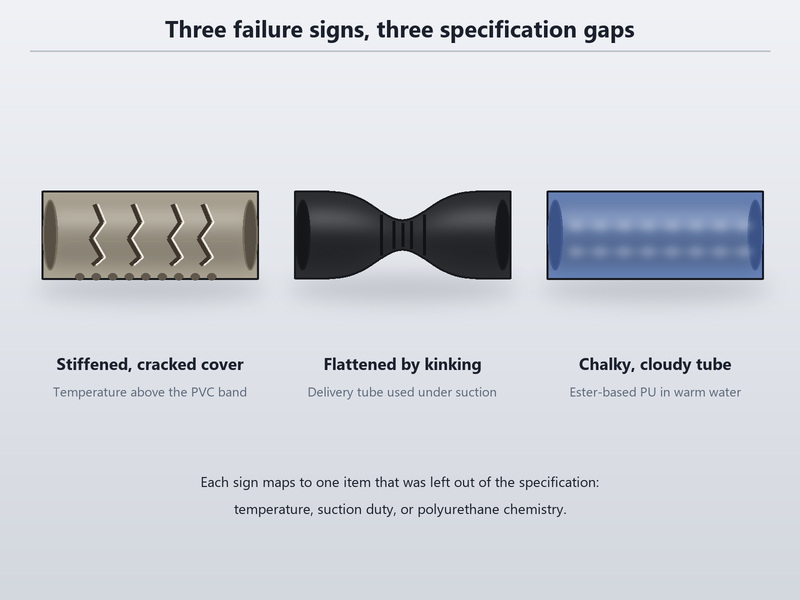
Each failure pattern points to one specification item that was left out: temperature, suction duty, or polyurethane chemistry.
How to Verify a Hose Before You Place a Bulk Order
A specification is only as good as the evidence behind it, and six documents close almost all of the risk on a hose order. Ask for them before the purchase order is raised, not after the first field failure.
What to request from any supplier:
- The compound data sheet, naming the tube compound, the plasticiser family if the material is PVC, and the polyurethane chemistry if the material is PU.
- The pressure and temperature rating table, showing working pressure at the reference temperature and the derating above it.
- The burst-to-working ratio and the proof test pressure, with the test method named.
- The abrasion test result by ISO 4649, if abrasion is the reason you selected the material.
- The certificate for potable or food-contact service, listing the exact compound and the contact conditions — the document a dairy or beverage plant checks first.
- A sample length, so the hose can be kinked, coiled and dragged before thousands of metres are committed; a fleet that rotates hose across sites should test it on the worst site first.
A sample can then be verified against the supplier’s claims in about an hour, without a laboratory. Coil it to the minimum bend radius you need and leave it for ten minutes; a PVC hose will hold the shape while a TPR or ether-based polyurethane hose recovers. Bend it tightly and look for surface whitening, which indicates stress rather than elasticity. Weigh and measure a cut length to check wall thickness against the data sheet. Leave a sample in water at the top of its rated temperature for a week and look for a chalky or cloudy tube, which is the first sign of hydrolysis in an ester-based polyurethane.
The batch-consistency check is the one buyers skip most often, and it costs nothing. Ask what happens if the compound changes between the sample and the production batch. A supplier with in-house compounding can name the batch and produce the test record; a trader usually cannot, and that answer tells you more about the material you are buying than any catalogue page.
Frequently Asked Questions
What is the difference between PVC, TPR and PU hose?
PVC is a plasticised compound, TPR is a thermoplastic rubber blend and PU is a polyurethane, so the three differ in temperature range, abrasion resistance and the way they age.
Which hose material is best for a garden or washdown hose that is handled every day and stored outdoors?
For daily handling and outdoor storage, a TPR hose gives the best balance of kink recovery, sun resistance and price, while PVC remains adequate for a hose that stays on a reel.
Why does a plasticised PVC hose go hard and crack?
Plasticised PVC depends on plasticiser for its softness, and that additive migrates out under heat, ultraviolet exposure and repeated flexing, leaving the compound stiff and brittle at the bend points.
Is a polyurethane hose better than a PVC hose for a warm-water line that sits idle between cycles?
A polyurethane hose resists abrasion and holds pressure with a thinner wall, but ester-based grades hydrolyse in warm water, so water service should always specify the ether-based chemistry.
How do I choose between PVC vs TPR vs PU hose for a dewatering line that runs through winter?
Run the five-step sequence in order: peak water temperature, peak pressure, whether the hose is dragged, whether the water is for drinking, and how often the hose is handled.
What is the real PVC hose temperature rating for a hose that sits in the sun all summer?
General-purpose plasticised PVC hose is typically rated from about -10 to +60 °C, and its working pressure has to be derated as the temperature approaches that ceiling.
Does the polyurethane hose temperature rating differ between ester and ether grades?
TPR and ether-based PU both reach roughly -40 °C at the low end, but the practical upper limit and the tolerance of warm water depend on the chemistry, with ether grades far better suited to water.
Can a thermoplastic rubber hose be used for air as well as water?
Yes. A textile-reinforced thermoplastic rubber hose is regularly used for compressed air, provided the working pressure and the operating temperature both stay inside the published rating.
What does a hose material comparison not tell me?
A comparison of hose materials cannot tell you how a particular compound was formulated, so a comparison shortlists the material while the certificate and the specification sheet confirm the actual product you receive.
Is an abrasion resistant hose always polyurethane?
Polyurethane grades produce the lowest abrasion loss, though heavy-wall rubber and TPR covers are also specified where a hose is dragged rather than worn by slurry.
Which standard should a PVC or TPR water hose meet for a municipal potable-water contract?
For a delivery hose the usual reference is ISO 6224, adopted in Europe as EN ISO 6224, while suction duty moves to ISO 3994 and compressed air duty moves to ISO 5774.
How should a hose be stored between seasons on a site where winter temperatures drop below freezing?
Drain it, coil it at or above its minimum bend radius, keep it out of direct sun and away from motors and welding equipment, and hang it rather than stacking weight on the coil.
How to Source PVC, TPR and PU Hose from HENGHUA
HENGHUA manufactures textile-reinforced thermoplastic and rubber hose for water, air, chemical and general-purpose service, and the property values used throughout this guide come from the same compounds we produce and test. Because extrusion, braiding, covering and hydrostatic testing are handled in house, the rating published on a specification sheet is the rating the finished hose is tested against.
The material coverage matches the decision the guide describes. A TPR rubber PVC mixed multipurpose hose covers handled washdown, light oil and compressed-air duty at a working pressure of 20 bar, the 300 psi nominal class, from -30 to +80 °C, with a non-marking cover and polyester braid reinforcement. The wider water hose range covers discharge and suction constructions from 3/16 inch to 8 inch bore, with potable-water compounds certified to NSF/ANSI 61 and FDA 21 CFR 177.2600 where drinking-water contact is required.
What we offer on the engineering side:
- Compound selection support, including plasticiser family and ether versus ester confirmation for the fluid in question.
- Reinforcement matching, so the ply count and helix type follow the pressure and suction duty you specify.
- Sample lengths and test reports before a bulk order, including hydrostatic proof testing.
- Custom bore, length, colour and cover finish, with private-label marking for distributors.
- Batch traceability, so a field return can be traced back to its production run.
Because compounding and testing sit under one roof, a buyer weighing up a PVC vs TPR vs PU hose option can see the tested numbers behind each one rather than a catalogue claim. Before you place an order, send us the fluid, the peak working pressure including surge, the worst-case water temperature, the bore size, and whether the line is under suction. Our engineers will confirm the material and the reinforcement against those conditions, and we will tell you plainly when a cheaper material is sufficient.
Contact our engineering team for a matched recommendation, a quotation, or a sample length to test on your own equipment.
Sources and Standards
This guide is written from published standards, material supplier data and our own production records. No external links or numbered citations are used; the standards below are named so a buyer can verify each claim independently:
- ISO 6224 and EN ISO 6224, textiles-reinforced thermoplastics hoses for general-purpose water applications.
- ISO 3994 and EN ISO 3994, helical-thermoplastic-reinforced thermoplastics hoses for suction and discharge of aqueous materials.
- ISO 1403 and EN ISO 1403, textile-reinforced rubber hoses for general-purpose water applications.
- ISO 5774 and EN ISO 5774, plastics hoses, textile-reinforced types for compressed-air applications.
- ISO 1402, hydrostatic testing of rubber and plastics hoses and hose assemblies.
- ISO 4649, formerly DIN 53516, determination of abrasion resistance using a rotating cylindrical drum.
- ISO 1817 and ASTM D471, rubber and plastics, resistance to liquids including oil immersion.
- ISO 7326, assessment of ozone resistance of rubber and plastics hoses under static conditions.
- NSF/ANSI 61, drinking water system components, health effects; NSF/ANSI 51, food equipment materials.
- FDA 21 CFR 177.2600, rubber articles intended for repeated use; EU Regulation 10/2011, plastic food-contact materials.
- EU REACH Annex XVII, restrictions on certain phthalates in plasticised articles.
 English
  Spanish
  Portuguese
  French
  German
  Arabic
  Russian
  Indonesian