
Composite hose vs rubber hose comes down to construction. A composite hose is a stack of thermoplastic films, fabric and wire that is not vulcanised, so it is lighter and more flexible at the same bore. A rubber hose is a vulcanised tube with textile or wire reinforcement, which gives it toughness and a lower entry price. The right choice depends on the medium, the handling and the number of years you intend to keep the line.
This comparison works through weight, flexibility, chemical range, temperature, pressure and cost, and it names the duties where rubber remains the better answer. It also explains why a lighter hose changes the labour around the transfer, not just the handling of the hose itself, and how to compare the two on a service-life basis rather than an invoice basis.
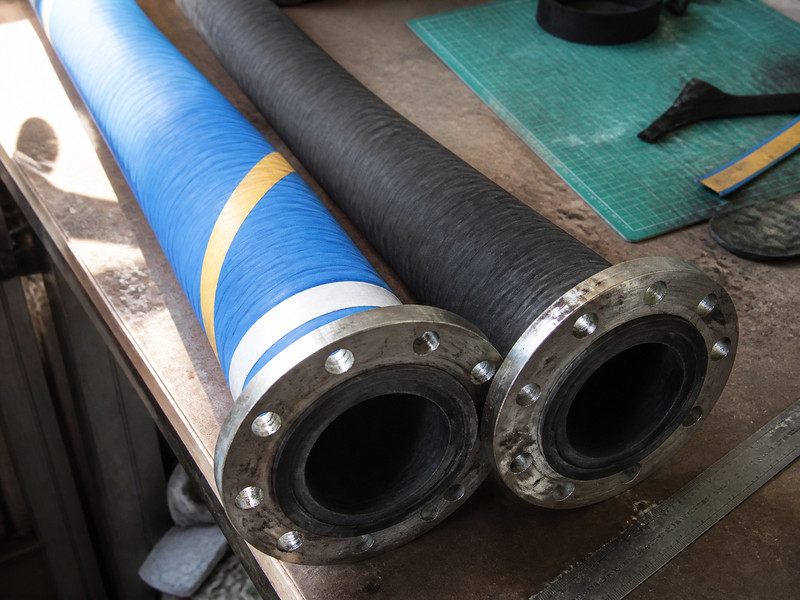
Figure 1. A composite hose and a rubber hose of the same nominal bore, laid side by side before either is rigged.

Figure 2. Two cut ends on the same mat: the left shows wire and separate plies, the right a single rubber wall with one fabric line. That difference sets weight, flexibility and repair practice, and the property table in this section compares the two.
What Is the Core Difference?
A composite hose is built from separate layers that are bonded but not vulcanised. Thermoplastic films seal the bore, woven fabric carries the load, and steel wire helixes hold the shape inside and out. Each layer can be changed without redesigning the others, which is why one construction family covers a wide chemical range.
A rubber hose is a tube of compounded rubber, cured in an autoclave or press, usually with textile or wire reinforcement and a rubber cover. The tube and cover are formulated for the duty, and the whole wall behaves as one material rather than a stack of independent layers.
That difference explains most of the comparison that follows. Separate layers allow thin walls and low weight. A cured tube allows toughness and, in reinforced builds, high pressure. Neither is better in the abstract.
Side by Side
| Property | Composite hose | Rubber hose | How to verify |
|---|---|---|---|
| 建設 | Thermoplastic films, fabric and wire, not vulcanised | Vulcanised rubber tube with textile or wire reinforcement | Ask for the layer stack in writing, not a trade name |
| Weight at equal bore | 下へ | Higher | Weigh 3 m of each on the same scale and record kg/m at the ordered bore |
| 柔軟性 | High, with a small bend radius | Lower, especially in large bore | Measure the minimum bend radius to the inner curve at working pressure, in mm |
| Chemical range | Wide, set by the lining choice | Set by the compound, narrower per build | Compare the liner or compound against the product list at service temperature |
| 温度 | Type dependent, up to +150 °C in the standard | Compound dependent; take the continuous limit from the compound datasheet | Compare the type or compound limit with the highest and lowest product temperature |
| Pressure | 4 to 14 bar in the standard types, higher in special builds | Higher in reinforced builds | Compare at the service temperature, not at ambient |
| 摩耗 | Good, cover dependent | Good to excellent | Check the cover compound and its thickness against the duty |
| First cost | Higher | 下へ | Compare quotes at the same bore, length, ends and test regime |
| Repair | Limited; replacement is normal | Limited; replacement is normal | Ask what the supplier will repair and what it will only replace |
Table 1. Composite hose vs rubber hose on the properties buyers compare. Values describe typical practice, not every product on the market.
The table hides one important asymmetry. Rubber hose performance depends heavily on the compound, so two products with the same description can behave differently. Composite hose performance depends on the film and the layer count, which are easier to state in a specification and easier to verify in a test record.
How Much Does Composite Hose Weight Save?
At the same bore, a composite hose is typically lighter because the wall is thin and the materials are low density. The saving grows with bore, which is why the difference is barely noticed at 25 mm and obvious at 100 mm and above.
Weight is not only a handling question. A lighter hose needs less support along a jetty, fewer people to move it, and less effort to lift it onto a rack. On a dock line that is coupled and uncoupled several times a day, that changes the working day rather than the specification sheet.
Our own experience with terminal crews is that the weight difference is the first thing they mention, before pressure or chemical range. It is also the reason a heavier hose gets dragged rather than carried, which shortens its life regardless of construction.
Is Composite Hose More Flexible in Practice?
Yes at equal bore, and the difference widens as bore increases. The thin thermoplastic wall bends more easily than a cured rubber wall of the same pressure capability, and the helical wire supports the bore so it does not kink at a tight radius.
Flexibility has a limit that buyers should know. A tight bend still damages the wall, and the minimum bend radius in the standard is a requirement rather than a suggestion. A composite hose bent below its radius will kink, and a kinked hose is a retired hose.
The practical advantage appears in routing. A flexible line can follow a curved path without an elbow, which removes a joint and a leak path. On a tanker connection that is rigged and struck repeatedly, fewer joints is a real gain.

Figure 3. Two hoses of the same nominal bore bent on the same deck: the corrugated one turns inside a shorter arc while the smooth rubber one sweeps wider. The rated radii behind that difference are in Table 2, and the type table gives the minimum per bore.
Which One Handles More Chemicals?
Composite hose, in most comparisons, because the lining can be chosen for the medium. Polypropylene covers acids and alkalis, XLPE adds oxidising chemicals, UHMWPE broadens the range with abrasion resistance, and PTFE covers the aggressive solvents and concentrated acids that defeat the polyolefins.
Rubber compounds cover a narrower band each. EPDM handles acids, alkalis, ketones, alcohols and steam but not petroleum oils or aromatics. Nitrile handles oils and fuels but not ketones, esters or strong acids. Fluorocarbon rubber widens temperature and hydrocarbon resistance but struggles with hot alkalis, ketones and amines.
The practical consequence is inventory. A chemical plant using composite hose may hold three linings; the same plant using rubber may hold six compounds to cover the same product list. Our chemical resistance and derating guide explains how to read a resistance table before either choice is made.
Where Does Rubber Hose Win?
Rubber wins on abrasion, on high pressure and on first cost. A slurry line, a sand discharge or a concrete pump line is brutal on any hose, and a heavy rubber wall with a thick cover survives longer than a thin thermoplastic stack.
Rubber also wins where the pressure is high and the bore is modest. Reinforced rubber hose covers pressure bands that composite hose does not reach in standard types, which is why hydraulic and high-pressure transfer duties stay with rubber or with metal. The pressure and temperature ceilings of the metal option are set out in our composite hose vs metal hose comparison.
Finally, rubber wins on price for a simple duty. A plant moving water or air at ambient temperature does not need a thermoplastic multilayer wall, and paying for one is a specification error in the other direction.
How Do the Costs Compare Over Service Life?
The composite hose cost per metre is usually higher at the factory gate, and the gap widens with specialty linings. Against that, the composite hose often lasts longer in chemical service, needs fewer people to handle it, and can be replaced by one person rather than two.
The honest way to compare is per year of service on the same duty. Take the purchase price, divide by the seasons the hose survived, and add the labour hours per change and the downtime per change. On aggressive chemical duty, the composite hose frequently wins that calculation. On water, air and slurry duty the composite hose frequently loses that calculation.
Buyers should also count the cost of getting the specification wrong. A rubber hose that swells and fails in three months costs more than its price in downtime and disposal, and a composite hose that is over-specified for water costs more than it needs to.
Which Duty Suits Which Hose?
| Duty | Better choice | なぜ |
|---|---|---|
| Chemical transfer, mixed product list | Composite | Lining selection covers a wide chemical range |
| Dock and jetty transfer | Composite | Lower weight, easier handling, large bore available |
| Tanker and rail car unloading | Composite | Flexibility at large bore, stainless bore options |
| Slurry and abrasive solids | Rubber | Thick wall and cover resist abrasion |
| High pressure, small bore | Rubber | Reinforced builds cover higher pressure bands |
| Steam service | Rubber, EPDM | Saturated steam suits EPDM compounds |
| Water and air at ambient | Rubber or general-purpose | Composite adds cost without benefit |
Table 2. Duty-based selection between the two constructions. The composite hose vs rubber hose decision is usually settled by the medium and the handling, not by the price.
A buyer who works through this table will find that most chemical, petroleum and marine transfer duties point one way, and most abrasive and high-pressure duties point the other. The remaining cases are settled by handling frequency and by the labour available at the site.
What Belongs in the Comparison Sheet?
Start with composite hose weight, measured as kilograms per metre at the length you actually handle. A figure per metre is meaningless if the line is rigged as three coupled lengths, because the couplings add weight at every joint and the crew lifts the assembly, not the hose.
Then record composite hose flexibility as a minimum bend radius at the working pressure, not as an adjective. A radius in millimetres can be checked against the route; a claim that a hose is flexible cannot. The same discipline applies to the rubber option, so the two columns are comparable.
Finally, write the duty. A rubber hose vs composite hose decision made without the medium, the temperature and the coupling frequency is a preference, not an engineering choice. Put those three fields at the top of the sheet and the rest follows.
| Comparison field | Unit | Why it decides the choice |
|---|---|---|
| Weight per metre | kg/m | Handling, support and crew size |
| Minimum bend radius | mm | Route, elbows and installation space |
| Chemical range | Product list | Lining or compound selection |
| Pressure at temperature | bar at °C | Wall build and reinforcement |
| Coupling frequency | per shift | Labour and wear at the ends |
| Replacement interval | seasons | Service-life cost comparison |
Table 3. Comparison fields for a composite hose vs rubber hose decision. Fill the units column before the values, or the sheet will mix inches, millimetres and bar without anyone noticing.
When Does Labour Decide the Choice?
Composite hose weight changes the crew size a job needs. A line one person can carry to the berth is rigged faster than one that needs two, and the difference repeats every shift. Over a season that is a rostering question, which is why terminal managers raise it before engineers do.
The composite hose vs rubber hose argument also runs through inspection. A lighter hose is easier to lift onto a bench, so the external surface gets checked properly instead of being walked past. Inspection quality is a safety variable, and it is influenced by weight more than most specifications admit.
Composite hose flexibility changes where the hose can be installed. A route with a tight bend may need an elbow with a stiff hose and none with a flexible one, and every elbow is a joint that can leak. Fewer joints is a maintenance saving that never appears in the purchase price.
What Changes When a Site Runs Both?
Most plants do. The composite hose vs rubber hose split often follows the product list: thermoplastic linings for the aggressive chemicals, rubber compounds for slurries, steam and utility lines. The risk is not the split itself but the paperwork, because two standards and two inspection regimes have to coexist.
Record composite hose flexibility limits in the same drawing that shows the rubber hose routes, so the maintenance team does not apply one rule to both. A bend radius that is comfortable for rubber may be outside the composite limit, and a fitter working from memory will not know which is which.
Keep the rubber hose vs composite hose distinction visible on the rack as well. A tag that names the construction, the bore and the pressure prevents the substitution that happens when a hose fails at two in the morning and the nearest spare is the wrong material.
よくある質問
Is composite hose lighter than rubber hose?
Yes at equal bore, and the difference grows with size. The thermoplastic wall is thinner and the materials are lower density, which matters most on large bore dock and tanker lines.
Can composite hose replace rubber hose everywhere?
No. Abrasive slurries, high-pressure small-bore duties and saturated steam are better served by rubber compounds, and a general-purpose water line rarely justifies the composite construction.
Which one is more chemical resistant?
Composite hose, because the lining can be matched to the medium. A single rubber compound covers a narrower chemical band, so a plant needs more variants to cover the same product list.
Is rubber hose cheaper?
Usually at first cost, and often by a wide margin on standard sizes. The comparison changes when the duty is aggressive and the composite hose survives several seasons longer.
Does a lighter hose really change operating cost?
It changes labour. A hose one person can carry is handled differently from one that needs two, and on a line coupled several times a day that difference is visible in the rota.
Can both types be used on the same manifold?
Yes, provided each is specified for its duty and the connections match. Mixing constructions is common; mixing specifications without checking is where problems start.
Which is better for a dock line?
Composite, in most cases, because of weight, flexibility and the availability of large bore with a stainless bore option. Our dock hose selection guide covers the sizing and inspection side.
Is composite hose vs rubber hose a fair comparison at equal pressure?
Yes, provided both are compared at the same pressure rating and the same bore. A rubber hose and a composite hose at equal nominal size rarely share an internal diameter, so the flow and the mass per metre differ before the pressure is considered. The fair sheet records working pressure at temperature, bore, minimum bend radius and mass per metre, and it separates hose from assembly, because two flanges weigh more than the hose they join. A rubber hose vs composite hose comparison that skips those fields compares two catalogues, not two lines.
HENGHUAについて
HENGHUA assembles composite hose with polypropylene, UHMWPE, XLPE and PTFE linings, so a chemical duty can be matched to a lining rather than to a compromise compound. We also supply the fittings and the test records that make an assembly usable at a terminal.
The range is listed in our composite hose size options, and the construction detail behind the weight and flexibility numbers sits in the multi-layer build guide. If you are weighing composite hose vs rubber hose for a specific line, send the medium, temperature, pressure and handling frequency through our contact page and we will answer for that duty rather than in general.
 English
 Spanish
 Portuguese
 French
 German
 Arabic
 Russian
 Indonesian
 Japanese
 Korean