
Composite hose fail safe behaviour comes from its wall. A breach in the inner film lets product seep through the fabric plies and out through the cover as a visible leak. The load-bearing layers and the wire helix still hold the line together. The hose loses containment slowly instead of releasing the whole line at once. That sequence is what the industry calls leak before burst.
This article explains the four stages of the mechanism, the burst margins the standard requires, and the failure modes where the sequence does not help. It then sets out what a leak looks like on a jetty or a loading rack, and which inspection catches it first. It closes with the wording that puts a composite hose fail safe requirement into a specification without overstating it. It also names the four situations where the mechanism gives no warning at all. No standard certifies a hose as fail safe; what can be specified is a construction, a minimum burst and a proof test.

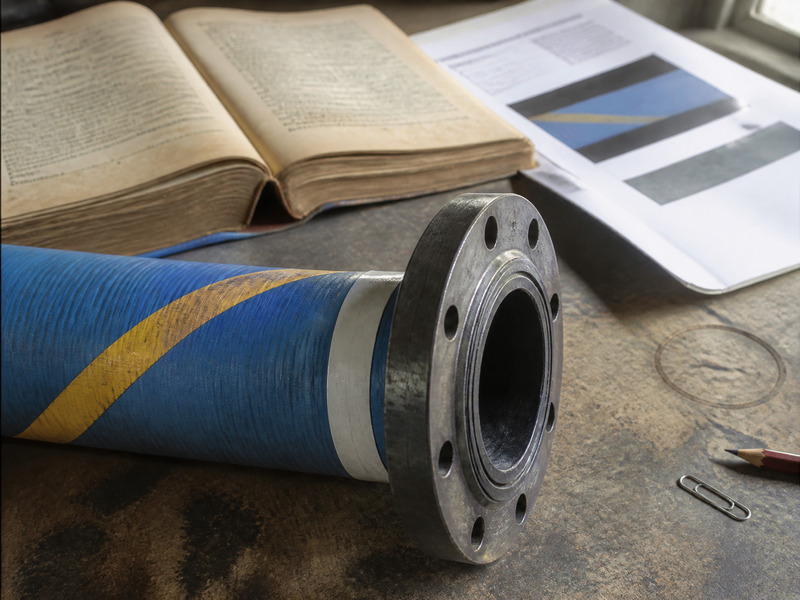
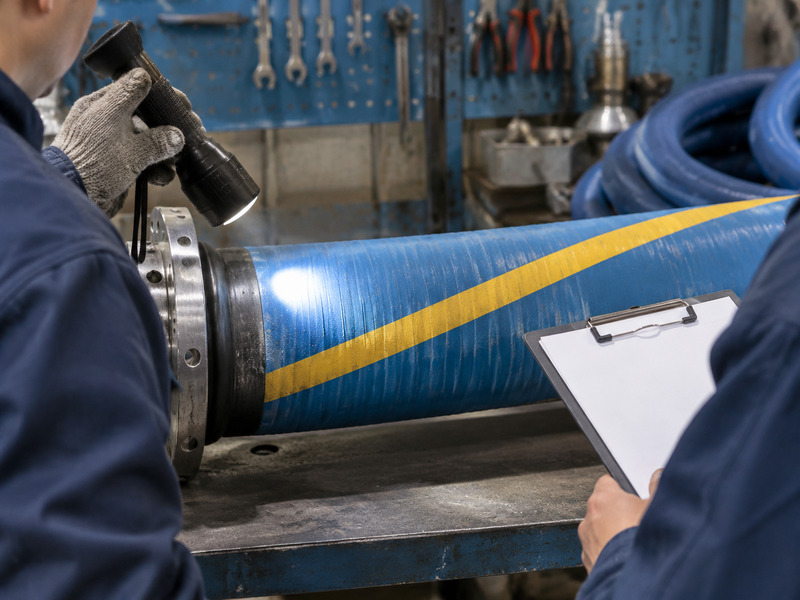
Figure 1. A weep at a fabric seam on a hose cover, with a torch held close to the surface during a walk-round check.
What Does “Composite Hose Fail Safe” Actually Mean?
Leak-before-burst means the first consequence of damage is a leak rather than a rupture. The pressure boundary is a stack of thermoplastic films, and the tensile load is carried by woven fabric and two steel helixes. A breach in one film does not remove the fabric, so the assembly keeps its shape and most of its strength while product finds a path to the outside.
The phrase describes a behaviour, not a certificate. No standard stamps a hose as fail safe, and no supplier can promise that every failure will be gradual. What the construction does is make a gradual failure the likely outcome for the damage modes that occur in normal service.
The distinction matters at a terminal, where the response to a leak is a pump stop and a bucket, and the response to a burst is an emergency. A hose that gives five minutes of warning is a different risk object from one that gives none.
How Does the Leak-Before-Burst Sequence Run?
The sequence has four stages, and each one is visible if someone is looking for it.
- The inner film is breached. Chemical attack, permeation, a sharp fold or a hard particle in the product opens a pinhole in the product-contact layer.
- Product wicks into the fabric plies. The breach is small, so the flow is small, and the fabric carries it along the helix path rather than through the wall.
- The cover blisters or discolours. Product collects under the coated fabric cover and lifts it, which shows as a soft spot or a bubble.
- A weep appears at the outside. Product reaches the surface at a seam, a pinhole or a fitting, and the leak becomes visible and smellable.

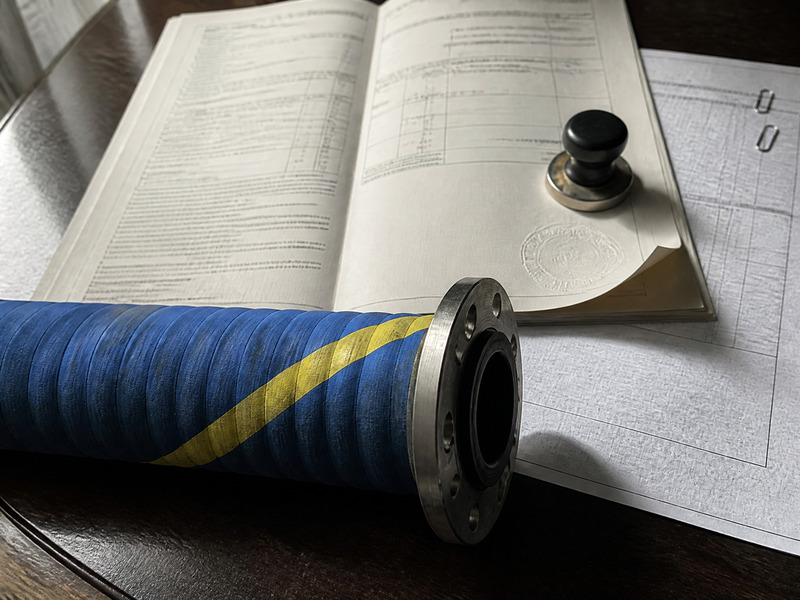
Figure 2. The cover is slit and folded back, and the plies underneath are already dark and wet: the product is inside the wall before anything shows on the outside. The four stages are described above, and the burst margins are in Table 1.
The time between stage one and stage four depends on the product, the pressure and the size of the breach. A thin solvent can cross the plies in minutes and a viscous oil can take days, which is why the same defect produces very different reports from two sites.
Why Does the Multi-Layer Wall Change the Outcome?
A single-wall product has one pressure boundary. When that wall is breached at pressure, the stored energy in the line has somewhere to go, and the opening grows because the wall is what resists the growth. A multi-layer wall behaves differently because the layers do different jobs.
The films seal, the fabric carries hoop stress, and the helixes hold the bore and resist crush. Damage to a film reduces the seal, not the strength, so the hose can still hold pressure while it leaks. That separation of duties is the whole reason composite hose fail safe behaviour is possible. A single-wall product cannot leak slowly at pressure, because the same layer that seals also carries the load.
The wire helix also limits the size of an opening. A split in a film runs until it meets a wire, and the helix pitch is a few millimetres, so the tear is arrested rather than propagating along the bore. In a burst, the fabric fails as a sheet, and the result is a large opening.
What Composite Hose Burst Pressure Does the Standard Require?
EN 13765 sets a minimum burst for each type, and the figure is a multiple of the working pressure rather than a small margin above it.
| 種類 | Maximum working pressure | Proof pressure | Minimum burst pressure | Burst to working ratio |
|---|---|---|---|---|
| Type 1 | 4 bar | 6 bar | 16 bar | 4 to 1 |
| Type 2 | 10 bar | 15 bar | 40 bar | 4 to 1 |
| Type 3 | 14 bar | 21 bar | 56 bar | 4 to 1 |
| Type 4 | 14 bar | 21 bar | 56 bar | 4 to 1 |
Table 1. composite hose burst pressure and proof pressure by type, from the EN 13765 pressure and temperature table. Every type carries a minimum burst of four times its working pressure.
The ratio is a design minimum, not a service allowance. It exists so that a hose at its rated pressure still has reserve when a pressure surge arrives. It also keeps a proof test at 1.5 times the working pressure away from the hose limit. Proof testing is carried out to EN ISO 1402 with the pressure raised no faster than 1.7 bar per minute, and the hose must show no leakage or damage at the proof figure.
Ask for the composite hose burst pressure as a tested minimum rather than a calculated figure. Check that the test was carried out on an assembly with the fittings that will actually be supplied. A buyer who sees a burst figure quoted without the type and the temperature is looking at a number with no context. The same construction has four different ratings depending on which type it is built to.
What Are the Common Composite Hose Failure Modes?
Most failures fall into seven groups, and only some of them follow the leak-before-burst path.
| 故障モード | Usual cause | Warning before loss of containment | What limits the damage |
|---|---|---|---|
| Film breach | Chemical attack, permeation, hard particle | Blister, damp patch, smell | Fabric plies hold pressure while the film leaks |
| Cover damage | Drag, abrasion, cut to the fabric | Visible cut or frayed cover | Fabric remains intact until the cut deepens |
| Helix corrosion | Coating breach at a cut end or fitting | Soft spot, reduced vacuum resistance | Film still seals until it is perforated |
| Fitting failure | Incomplete insertion, wrong ferrule, thermal cycling | Product at the ferrule, reduced pull-off strength | A crimped joint usually weeps before it separates |
| Fatigue at a tight bend | Bend below the rated radius, repeated flexing | Kink that does not recover, cracked film at the fold | Helix arrests the tear |
| Overpressure | Surge above the burst figure, blocked line | なし | Nothing, the wall fails as a sheet |
| Fire exposure | External fire, hot work nearby | Smell, smoke, discoloured cover | Nothing, the films melt |
Table 2. composite hose failure modes and how each one behaves. Only the first five normally produce a warning, and the last two are the cases where fail safe does not apply.
Read this list of composite hose failure modes as a guide to what to look for rather than a list of what the hose can survive. Overpressure and fire are outside the mechanism, and a hose cut through the helix with a forklift tine is outside it too.
What Does a Leak Look Like on Site?
A developing leak rarely announces itself as a jet. The first sign is usually a change in appearance at one point on the cover. Look for a darker patch on a light cover, a bubble under the coating, or a wrinkle that was not there at the last check.
The second sign is smell. Most hydrocarbon and solvent products are detectable at concentrations far below the visible leak rate, which is why a walk-round with the nose is still part of the procedure at many terminals.
The third sign is at the ends. Product collects in the interstice between the hose and the ferrule. A damp ring around a fitting or a stained ferrule is a signal that the seal has been breached somewhere along the length.
A white cloth wiped along the underside is the cheapest detector there is. Product that appears on the cloth at a low point, where gravity has collected it, tells you the breach is upstream of that point.
None of these signs is dramatic, and that is the point. A composite hose fail safe record is built from small observations made on a routine shift, not from one clever test.
Which Inspections Catch the Leak First?
A short daily check finds most developing leaks, and it does not need a test bench.
- Walk the full length with a torch, looking for blisters, soft spots and colour change.
- Wipe the underside with a white cloth at the low point and at each fitting.
- Squeeze the cover along the length, feeling for a soft patch where product has collected.
- Check the ferrule area for staining, product rings and movement of the hose in the fitting.
- Confirm the hose is inside its bend radius at both ends, because a kink is where a film cracks.
- Record the findings against the hose tag, so the next check has a baseline.
A pressure test proves the assembly holds at the proof figure, and a vacuum test proves the helix still supports the bore. Neither replaces the walk-round, because both are carried out at a pressure that a small breach may not reveal. A test certificate is evidence of a moment; the walk-round is evidence of a trend. Our inspection programme outline sets the checks against a service calendar.

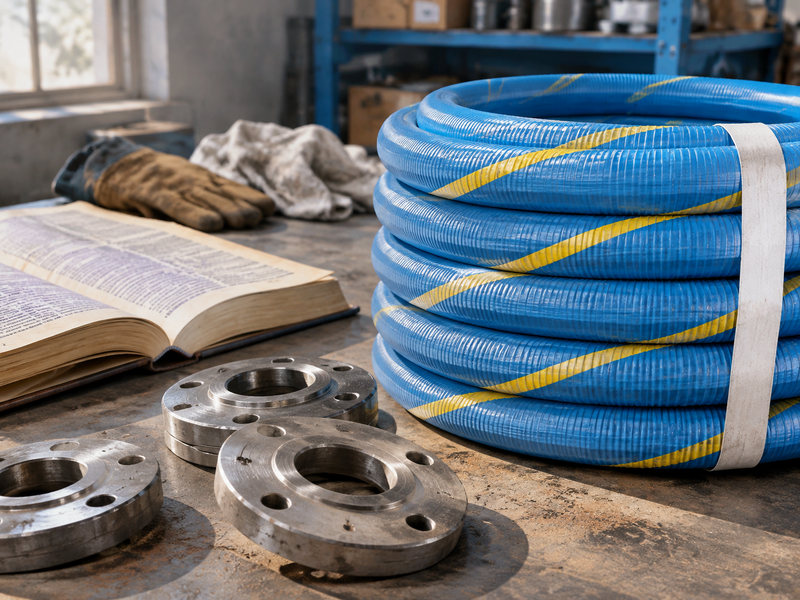
Figure 3. The left hose is torn open along its length; the right one sits in a tray with a slow weep at the cover. The same duty can end either way, and which one you get depends on the damage rather than on the age of the hose.
When Does Composite Hose Fail Safe Not Apply?
Four situations remove the warning, and each one has a rule attached to it.
- Mechanical damage that cuts through the helix. A hose severed by a forklift or crushed against a kerb can open without any weep, because the reinforcement is gone at that point.
- Overpressure above the burst figure. Once the fabric fails, the opening grows and the line empties. This is why the relief valve setting and the static head matter more than the hose rating alone.
- Fire or hot work. Thermoplastic films melt, and a hose that was leak-before-burst in service becomes a flow path in seconds.
- A lining that is chemically wrong for the product. A film that dissolves or swells rapidly does not leak slowly; it fails across an area, and the fabric follows.
There is a fifth case that is not a failure of the hose at all. A hose reused on a product it was not specified for may pass every visual check and still fail in a week. The film is attacked from the inside, with no external sign until it perforates.
Honest specification work says this out loud. Leak-before-burst is a property of the construction under normal damage, and it is not a substitute for relief protection, correct lining selection or inspection. A buyer who needs a guarantee should ask for a burst figure and a test record, because those are the parts a supplier can actually sign.
How Do You Specify It Without Overstating It?
Write the requirement as a construction and a test, not as a promise. A supplier can commit to a layer stack and a burst figure; nobody can commit to a failure mode in every circumstance.
| Field | What to write | What it prevents |
|---|---|---|
| Lining material and grade | Named polymer, matched to the product list | A film that fails chemically in weeks |
| Wire material and coating | Stainless grade, or coated carbon steel | Helix corrosion behind the film |
| Minimum burst | At least four times the relief valve setting plus static head | A hose with no reserve against a surge |
| Proof test | 1.5 times working pressure, held and recorded | A fitting that was never proved |
| Bend radius | The standard figure for the bore and type | A kink that cracks the film at the fold |
| Cover construction | Coated fabric with a stated adhesion figure | A cover that lifts and hides a leak path |
| Marking and records | Type, bore, pressure, date, test date | A hose that cannot be traced to its test |
Table 3. Specification fields that support a composite hose fail safe claim. Each one is inspectable, which is what separates a requirement from an adjective.
Two of these fields do most of the work. The burst factor sets the reserve, and the lining selection decides whether the film survives long enough for the reserve to matter. A hose with a four-to-one burst margin and the wrong lining fails in the first month, and a hose with the right lining and no margin fails on the first surge.
Our failure analysis note for petrochemical plants covers the post-incident side of the same subject, including how to tell a chemical breach from a mechanical one by the shape of the opening.
よくある質問
Does composite hose always leak before it bursts?
No. It does so for the damage modes that develop over time, such as a film breach, cover damage or a corroding helix. Impact damage, overpressure and fire can still produce a sudden failure.
What is the burst pressure of a composite hose?
The standard minimum is 16 bar for Type 1, 40 bar for Type 2 and 56 bar for Types 3 and 4. Each figure is four times the working pressure of that type, and the type must be quoted with the number.
How long does a leak take to develop?
How long a leak takes to appear depends on the product and the size of the breach. A solvent that swells the film can reach the cover within a shift, while a slow chemical attack may take weeks. A light solvent can cross the plies in minutes, while a viscous oil can take days. That is why the daily walk-round matters more than the annual test.
Can a leak seal itself?
Sometimes, temporarily. A swollen film or a plug of solidified product can close a small breach, and the hose then looks sound at the next check. A hose that has leaked once should be retired, not returned to service.
Is leak before burst the same as fail safe?
In practice it is the mechanism behind the claim. Fail safe describes the outcome, and leak before burst describes the sequence that produces it. Neither is a certification.
Does a higher burst pressure make the hose safer?
Only up to a point. A high burst figure with the wrong lining, a damaged cover or a kinked installation gives less protection than a modest figure on a sound assembly.
Is composite hose fail safe a standard requirement?
No. The clause that can be written into an order is a minimum burst, a proof test and a lining that suits the product. None of the three is a fail safe certificate.
How do I check for a leak without a test bench?
Wipe the underside with a white cloth, walk the length with a torch, and squeeze the cover for soft spots. These three checks find most developing leaks, and our type guide explains which pressure each type is proved at.
HENGHUAについて
HENGHUA produces composite hose in UHMWPE, XLPE, polypropylene and PTFE linings, a woven fabric reinforcement, and a stainless steel or coated carbon steel helix. Ends are crimped or flanged, with fixed or floating flanges, and each assembly is proved before it leaves the shop.
The construction is the reason composite hose fail safe behaviour exists, and the composite hose category lists the types and linings against the duties they cover. The helix side of the same story, including how a corroding wire removes the vacuum margin, is set out in our inner wire guide. If you need a burst figure and a lining recommendation for a specific product, send the medium, the temperature and the relief valve setting and we will answer for that duty.
 English
 Spanish
 Portuguese
 French
 German
 Arabic
 Russian
 Indonesian
 Japanese
 Korean